
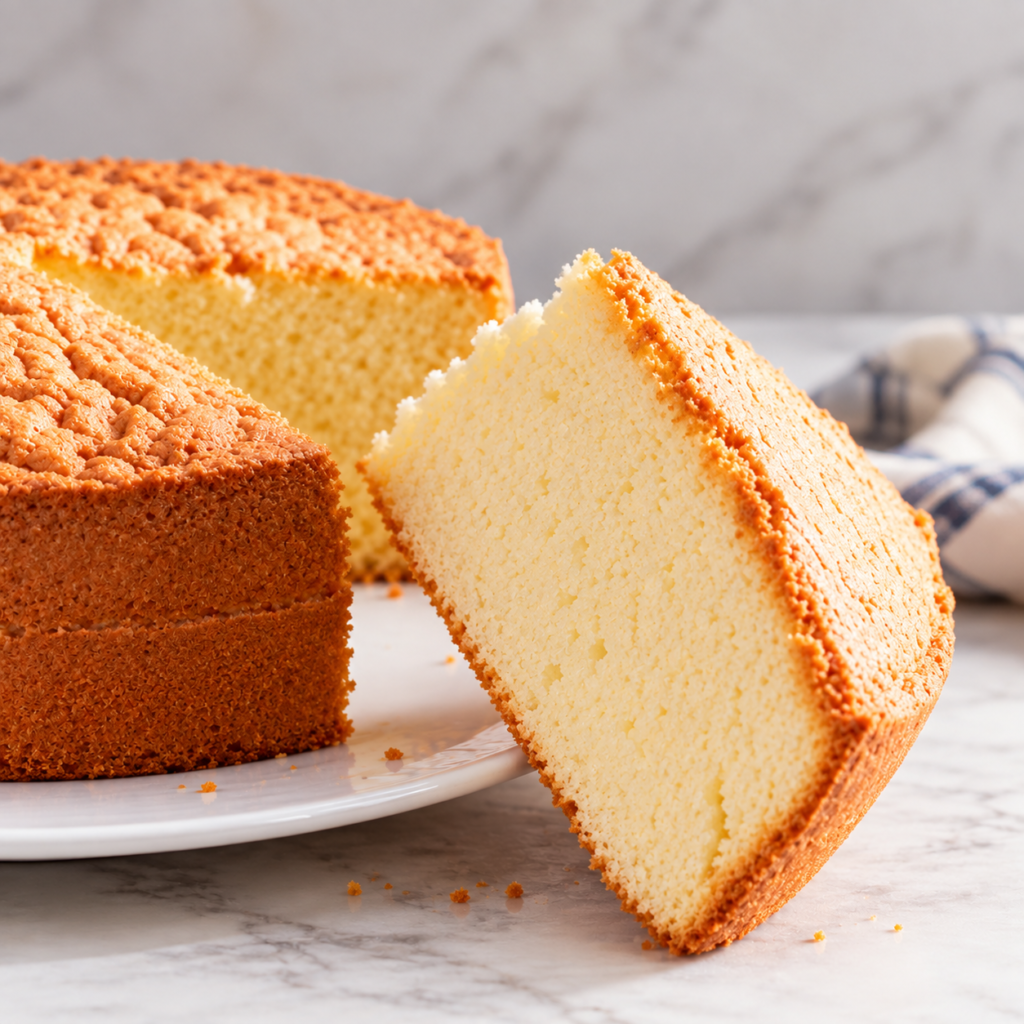
Eggless Baking Guide: Common Problems, Causes & Easy Fixes
Why did my eggless cake sink? Why is it dense? Why does it crumble? And how can I make an eggless cake soft and moist?
If you have ever asked yourself one of these questions, you are in the right place.
Welcome to my eggless baking guide, where I share practical solutions to common eggless baking problems. From dense cakes and dry sponges to cakes that sink or crumble, you’ll learn what causes these issues and how to fix them for better baking results at home.
Eggless baking can be wonderfully rewarding, but it can also be a little unpredictable, especially when you are just starting out. A cake may rise beautifully in the oven and then sink. A perfectly browned cake may still be gummy in the centre. Or you may follow a recipe carefully and end up with a cake that is dry, dense or crumbly.
The good news is that these problems are usually not random. There is a reason your bake behaved the way it did.
With more than 25 years of baking experience, I’ve learned that good baking is not about never making mistakes. It is about understanding what went wrong, knowing what to check, and making the right adjustments the next time you bake.
This guide will help you troubleshoot common eggless baking problems and find the right solution, so you can bake with greater confidence.
Use this eggless baking guide to identify the problem that best matches your cake and find the appropriate fix.
- Eggless cake sinks in the middle → Check leavening, liquid, baking time and oven temperature.
- Eggless cake is dense or heavy → Check flour measurement, mixing and leavening.
- Eggless cake is dry → Check flour quantity, fat, liquid and baking time.
- Eggless cake crumbles → Check structure, moisture and whether the cake was sliced too soon.
- Eggless cake doesn’t rise → Check your leavening agents, oven temperature and batter.
- Eggless cake is gummy in the center → Check liquid, pan size and baking time.
- Eggless cake is sticky on top → Check moisture, sugar and whether it is fully baked.
- Eggless cake cracks on top → Check oven temperature, pan size and batter consistency.
- Eggless cake becomes hard after cooling → Check flour quantity, fat, mixing and baking time.
- Gluten-free egg-less cake falls apart → Look at flour balance, binding and moisture.
If you cannot find your exact problem, work through the troubleshooting checklist near the end of this guide.
Why Is Eggless Baking Different?
Before troubleshooting an egg-less recipe, it helps to understand what eggs actually do in baking.
Eggs can contribute:
- Structure
- Moisture
- Binding
- Emulsification
- Richness
- Stability
- Aeration
- Colour
When you remove eggs, those functions have to be provided by other ingredients or by the way the recipe is formulated.
That is why replacing an egg is not always as simple as adding a particular ingredient in its place.
For example, yogurt, flax seed, fruit purées, aquafaba, starches and commercial egg replacers can each perform different functions.
The important question is not simply:
What can I use instead of an egg?
It is:
What was the egg doing in this particular recipe?
Once you start thinking this way, egg-less baking becomes much easier to understand.
Why Does My Eggless Cake Sink in the Middle?
This is one of the most common egg-less cake problems.
You take the cake out of the oven looking beautifully risen, and then, as it cools, the center drops.
Common causes
Too much leavening
Adding extra baking powder or baking soda does not necessarily make a cake lighter. Too much leavening can cause the cake to rise rapidly before its structure has developed enough to support it.
Too much liquid
An overly wet batter may not develop enough structure to hold the rise.
Under-baking
The outside may look finished while the center is still not fully set.
Opening the oven too early
A sudden temperature change can cause a delicate cake structure to collapse.
Incorrect flour-to-liquid balance
This is particularly important when working with alternative or gluten-free flours.
How to fix a sinking egg-less cake
Start with the basics:
- Measure ingredients accurately.
- Use fresh baking powder and baking soda.
- Follow the recommended pan size.
- Preheat the oven properly.
- Avoid opening the oven too early.
- Make sure the center is fully baked before removing the cake.
If your egg-less cake is repeatedly sinking in the middle, read my detailed guide on Why Does My Egg-less Cake Sink? Causes & Easy Fixes. It goes deeper into the reasons cakes collapse after rising and how to troubleshoot each one.
And most importantly, don’t automatically add more baking powder the next time.
Find the actual cause first.
Why Is My Eggless Cake Dense and Heavy?
A dense egg-less cake is not simply the result of leaving out eggs.
Several things can make a cake heavy.
Check these first:
- Too much flour
- Too little liquid
- Overmixing
- Inactive baking powder or baking soda
- Incorrect flour combination
- Batter sitting too long before baking
- Oven temperature that is too low
The most common mistake: too much flour
When measuring flour by volume, it is very easy to add more than the recipe requires.
For consistent baking, I prefer using a kitchen scale whenever possible.
A small difference in flour quantity can make a noticeable difference to the final crumb.
For a deeper look at why cakes become heavy, dense or tight, read Why Your Cake Is Dense: 7 Mistakes & How to Fix Them.
How to fix a dense egg-less cake
Start by checking the flour measurement.
Then check your leavening agents and mixing technique.
The batter should be mixed enough to combine the ingredients, but not worked unnecessarily.
If you are baking with gluten-free flours, also look at the flour blend. Different flours contribute different amounts of starch, protein, fat and moisture.
Why Is My Eggless Cake Dry?
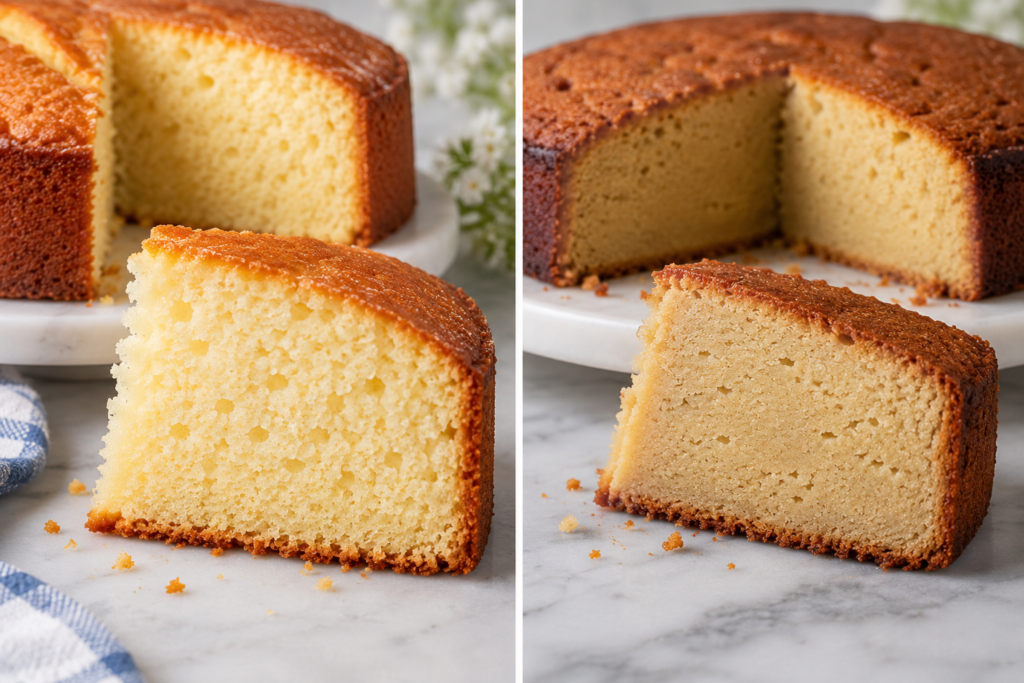
A dry egg-less cake can be caused by several factors.
Common reasons
- Too much flour
- Too little liquid
- Too little fat
- Over baking
- Oven temperature too high
- Baking for too long
Ingredients such as oil, butter, yogurt, milk, buttermilk or suitable fruit purées can contribute moisture and tenderness, depending on the recipe.
But adding more liquid is not always the solution.
Too much liquid can leave you with a cake that is gummy, sticky or underbaked in the center.
The goal is balance.
If your egg-less cake is consistently dry
Check:
- How much flour you are actually using.
- Whether your oven runs hotter than its displayed temperature.
- Whether you are baking longer than the recipe requires.
- Whether the recipe contains enough fat and moisture.
Change one variable at a time so you can understand what made the difference.
Why Does My Eggless Cake Crumble When I Slice It?
A crumbly cake may simply need more time to cool.
Eggless cakes can be more delicate when warm, so resist the temptation to slice immediately.
If the cake still crumbles after cooling completely, look at its structure.
Possible causes
- Too much flour
- Too little moisture
- Insufficient binding
- Over baking
- Incorrect flour combination
- A recipe that needs additional structural support
This becomes even more important when baking egg-less and gluten-free.
Without gluten and eggs, the recipe may need other ingredients to provide binding and structure.
Depending on the recipe, these can include:
- Psyllium husk
- Flax seed
- Xanthan gum
- Starches
- Yogurt
- Nut flours
- Other suitable binders
The right ingredient depends on the recipe and flour combination.
Why Does My Cake Fall Apart When I Cut a Slice?
If your cake breaks or crumbles as soon as you cut a slice, first check whether it has cooled completely. A warm eggless cake may not yet have developed a stable crumb.
If it still falls apart when cool, look for these clues:
- Dry, sandy crumbs: Check whether you have used too much flour or overbaked the cake.
- A soft cake that breaks under the knife: Check the recipe’s binding ingredients and structural balance.
- A cake that crumbles mainly at the edges: Check for excessive browning or drying around the sides.
- A gluten-free cake that breaks into pieces: Review the flour blend and binding system.
Use a suitable sharp knife and cut the cake only after it has cooled completely. If the problem persists, investigate the recipe rather than relying on a different cutting technique alone.
If your cake is gluten-free as well as eggless, read my Gluten-Free Baking Guide to understand how flour balance, moisture and binding affect the cake’s structure.
Why Does My Eggless Cake Not Rise?
A flat cake can be frustrating, especially when you have followed the recipe carefully.
Before changing the recipe, check these basics.
1. Are your leavening agents fresh?
Old baking powder or baking soda may not provide sufficient lift.
2. Did you measure them correctly?
Too little may produce a flat cake.
Too much can cause rapid expansion followed by collapse.
3. Was the oven properly preheated?
The cake needs the right baking environment from the beginning.
4. Did the batter sit for too long?
Some chemical leavening reactions begin as soon as wet and dry ingredients are combined.
5. Was the batter mixed appropriately?
Overmixing can affect texture, while insufficient mixing can leave pockets of dry ingredients and uneven distribution.
Why Is My Eggless Cake Gummy or Wet in the Centre?
There is an important difference between a moist cake and a gummy cake.
A good egg-less cake should be tender and moist.
It should not feel wet, sticky or pasty in the middle.
Common causes of a gummy center
- Too much liquid
- Too much fruit purée
- Too much yogurt
- Excess sugar
- Under-baking
- Incorrect pan size
- Oven temperature that is too high
A cake that is baked at too high a temperature may brown quickly on the outside while the center remains underbaked.
What to do
Check the recipe’s pan size and baking temperature first.
If the center remains wet repeatedly, don’t simply add more flour. Look at the overall liquid-to-flour balance.
Why Is My Eggless Cake Sticky in the Centre?
A sticky center may indicate that the cake has not baked completely.
It can also happen when the batter contains a high proportion of moisture or sugar.
Check:
- Baking time
- Oven temperature
- Pan size
- Quantity of liquid
- Quantity of sugar
- Fruit purée or yogurt used in the recipe
A beautifully browned top is not proof that the center is fully baked.
Why Did My Eggless Cake Crack on Top?
A crack is not automatically a baking failure.
Sometimes it simply means the outside of the cake set before the center finished expanding.
This can happen when:
- The oven temperature is too high.
- The pan is too small.
- The batter is particularly thick.
- The cake is positioned too close to the top heating element.
If the cake has a good crumb and is properly baked, a small crack may simply be part of its appearance.
Why Does My Eggless Cake Taste Like Baking Soda?
Baking soda is a strong leavening agent and needs to be used carefully.
A strong alkaline taste may result when too much baking soda is used or when there isn’t enough acidity in the recipe to balance it.
Depending on the recipe, acidic ingredients such as yogurt, buttermilk, lemon juice or vinegar may react with baking soda.
Adding more baking soda is not a shortcut to a lighter cake.
Balance matters.
Why Does My Eggless Cake Taste Too Much Like Yogurt?
Yogurt is a useful ingredient in many egg-less cakes because it can contribute moisture, tenderness and acidity.
But too much yogurt can affect both flavour and texture.
If the yogurt flavour is overpowering:
- Check the quantity used.
- Consider the type and thickness of yogurt.
- Check the overall balance of the recipe.
- Make sure you are not adding yogurt as an extra ingredient to compensate for another problem.
Different yogurts contain different amounts of water and have different levels of acidity, so they are not always interchangeable.
Why Does My Eggless Cake Become Hard After Cooling?
If your cake feels soft when warm but becomes hard once it cools, look at:
- Flour quantity
- Fat quantity
- Baking time
- Oven temperature
- Mixing
- Flour type
Over baking is a common reason for a cake becoming dry and firm after cooling.
This can be particularly noticeable in gluten-free egg-less baking, where flour combinations have a significant effect on the final crumb.
For a practical example of achieving a soft, moist gluten-free cake, see my Gluten-Free Orange Pound Cake.
Why Is My Eggless Cake Too Moist?
Moist is good.
Wet is different.
If your cake feels excessively wet or sticky, there may be too much moisture in the formulation or it may simply need more baking time.
Possible reasons
- Too much liquid
- Too much yogurt
- Too much fruit purée
- Too much sugar
- Under-baking
- Incorrect flour ratio
Don’t automatically solve a wet cake by adding more flour.
That may give you a dense cake instead.
Look at the complete formula.
How Do I Replace Eggs in Baking?
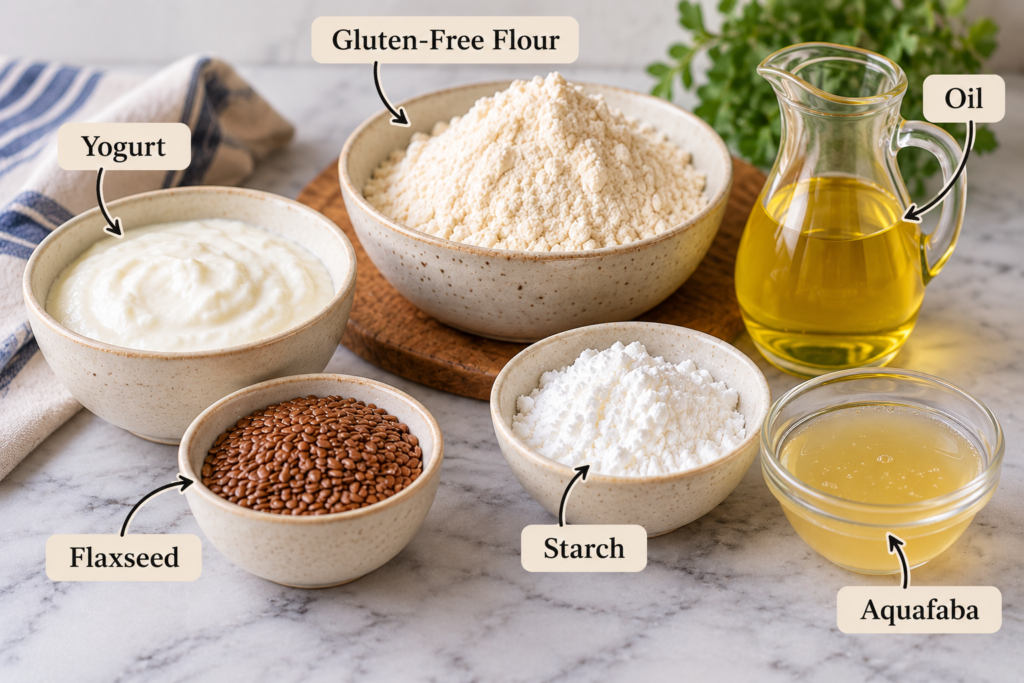
There is no universal one-to-one egg substitute that works equally well in every recipe.
The right replacement depends on what the egg contributes.
For moisture and tenderness
Ingredients such as yogurt or suitable fruit purées may help.
For binding
Flax seed or other suitable binders can be useful.
For structure
Starches and other structural ingredients may play a role.
For aeration
Some recipes can benefit from ingredients such as aquafaba, particularly when the recipe relies on whipped or foamed ingredients.
The important thing is to understand the function of the egg, rather than simply replacing it by volume.
For example, my Almond Coconut Cookies show how egg-less and gluten-free ingredients can be combined to create a soft, chewy cookie rather than a dry, crumbly one.
Eggless Baking with Gluten-Free Flours
This is where things become particularly interesting.
When you bake without eggs and without gluten, you are removing two major sources of structure.
That means you need to think carefully about:
- Flour combinations
- Binding
- Moisture
- Starch
- Crumb structure
- Fat
- Leavening
A gluten-free flour cannot always replace wheat flour cup-for-cup.
Rice flour, almond flour, millet flour, coconut flour, tapioca flour and potato starch all behave differently.
For a deeper explanation of gluten-free flour blends, binders and moisture, see my Gluten-Free Baking Guide for Beginners.
You can also browse my Gluten-Free Recipes for tested recipes using different gluten-free ingredients.
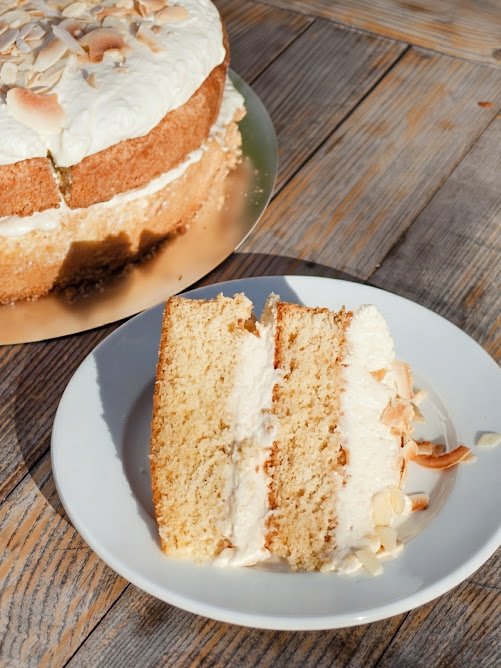
Eggless Baking with Millet Flour
Millet is one of my favourite ingredients to work with, but it needs to be handled thoughtfully.
Millet flour can have a distinctive flavour and can behave differently from refined wheat flour.
Depending on the recipe, combining millet with other gluten-free flours or starches can help create a better balance of flavour, moisture and texture.
If you are new to millet baking, don’t judge the recipe only by the raw batter.
The final texture depends on how the ingredients interact during baking and cooling.
10 Eggless Baking Mistakes to Avoid
1. Measuring flour inaccurately
Too much flour can quickly make an egg-less cake dense.
2. Adding extra baking powder
More leavening does not automatically mean a lighter cake.
3. Overmixing the batter
Mix until the ingredients are properly combined and stop there.
4. Ignoring pan size
The depth of your batter affects how quickly the center bakes.
5. Skipping preheating
The cake needs the correct oven temperature from the start.
6. Opening the oven too early
A sudden temperature change can affect a delicate cake structure.
7. Judging doneness only by colour
A golden top can hide an underbaked center.
8. Cutting the cake while it is hot
Allow it to cool before slicing for a cleaner crumb.
9. Changing several ingredients at once
If you change flour, liquid, sugar and leavening together, you won’t know what actually fixed the problem.
10. Treating every egg-less recipe the same way
An egg-less sponge, brownie, cookie and bread each behave differently.
Eggless Baking Guide: My Troubleshooting Checklist
When an egg-less bake doesn’t turn out as expected, pause before changing the recipe.
Ask yourself:
Did I weigh the flour accurately?
Were my baking powder and baking soda fresh?
Did I use the correct quantity of leavening?
Was the oven properly preheated?
Did I use the recommended pan size?
Was the batter too thick or too thin?
Did I overmix the batter?
Did I allow the batter to sit before baking?
Was the cake fully baked in the center?
Did I change any ingredient or quantity?
Did I allow the cake to cool completely before slicing?
If oven temperature is a recurring problem for you, my guide on How to Use Your Oven for Baking is the most relevant next read. It covers preheating, temperature and common oven-related baking mistakes.
If you are using an OTG or planning to buy one, my guide to the best OTG ovens for baking in India explains what to look for in temperature control, heating elements, rack positions, usable space and convection.
This simple checklist can often tell you much more than making another batch without understanding what went wrong.
Eggless Baking Guide: How to Troubleshoot Without Guessing
When a recipe fails, resist the temptation to change everything at once.
Instead:
Step 1: Identify the exact problem
Was it dense?
Dry?
Gummy?
Crumbly?
Flat?
Sunken?
Step 2: Look at the texture
The crumb often tells you more than the appearance.
Step 3: Check your measurements
Start with flour, liquid, fat and leavening.
Step 4: Check the oven
Temperature and baking time matter enormously.
Step 5: Change one thing
Make one thoughtful adjustment and bake again.
This is how you learn what your ingredients are actually doing.
Build Your Eggless Baking Knowledge One Problem at a Time
You don’t need to memorise hundreds of rules to become good at egg-less baking.
You need to understand a few basic relationships.
Flour provides structure.
Liquid hydrates the flour and affects texture.
Fat contributes tenderness and richness.
Sugar affects sweetness, moisture and browning.
Leavening creates lift.
Binders help hold the bake together.
Heat transforms the batter into the final structure.
Once you understand these relationships, troubleshooting becomes much more logical.
More Eggless Baking Resources
Eggless Cake Troubleshooting
- Why Is My Eggless Cake Dry?
- Why Your Cake Is Dense?
- Why Does Your Eggless Cake Sink?
- Why Is My Eggless Cake Gummy in the Middle?
- Why Is My Eggless Cake Not Rising?
- Best Egg Substitutes for Eggless Cakes
- How to Use Your Oven for Baking?
- How to Make Eggless Cake Soft and Moist?
- Why Is My Eggless Cake Sticky on Top?
- Yogurt vs Flax vs Banana in Eggless Baking
- How to Bake a Light, Airy Eggless Sponge Cake
- Why Does My Eggless Cake Crumble?
- Why Does My Eggless Cake Become Hard After Cooling?
- Why Does My Eggless Cake Crack on Top?
- Why Does My Eggless Cake Taste of Flour or Curd?
- Why Is Flax Egg Making My Cake Grainy?
- What Can I Use Instead of Yogurt in an Eggless Cake?
- How to Store Cake Properly
- How to Cool a Cake Properly
Gluten-Free Baking
- Gluten-Free Baking Guide for Beginners
- Gluten-Free Recipes
- Gluten-Free Orange Pound Cake
- Almond Coconut Cookies
Frequently Asked Questions About Eggless Bake
Can egg-less cakes be as soft as cakes made with eggs?
Yes. A properly formulated egg-less cake can be soft, moist and tender. The final texture depends on the recipe, ingredient balance, mixing method and baking conditions.
What is the best egg substitute for cakes?
There is no single best substitute for every cake. The right choice depends on the function the egg performs in that particular recipe.
Why does my egg-less cake sink after baking?
Common causes include excess leavening, too much liquid, underbaking, an unsuitable pan size or opening the oven too early.
How can I make an egg-less cake moist?
A moist cake comes from the right balance of liquid and fat. Ingredients such as yogurt, milk, oil or suitable fruit purées can contribute moisture depending on the recipe.
Why is my egg-less cake dense?
Too much flour, insufficient liquid, overmixing, inactive leavening agents or an unsuitable flour combination can all contribute to a dense cake.
Why does my egg-less cake crumble?
The cake may have insufficient structure, too much flour, too little moisture or may have been overbaked. Slicing while warm can also make it appear more crumbly.
Can I make a cake that is both gluten-free and eggless?
Yes. But gluten-free egg-less baking requires more attention to flour combinations, binding, moisture and structure because both gluten and eggs are absent.
Why does my egg-less cake crack on top?
A high oven temperature, thick batter or a pan that is too small can cause the outside to set before the center finishes expanding.
Final Thoughts
Eggless baking becomes much less intimidating when you stop looking at a failed bake as a failure.
A sunken cake is telling you something.
A dense crumb is telling you something.
A gummy center is telling you something.
A cake that falls apart when sliced is telling you something.
Your bake is giving you clues.
Look at the ingredients. Look at the ratios. Look at the mixing. Look at the oven. Then make one thoughtful change at a time.
That is how you move from simply following an egg-less recipe to actually understanding egg-less baking.
I have been baking for more than 25 years, and this is one of the most useful lessons I have learned along the way:
Good baking is not about never making mistakes. It is about learning to read them.
I hope this guide helps you do exactly that.
Sharmila Sengupta | Baking Expert & Educator | 25+ Years of Baking Experience