
Why Does My Eggless Cake Sink? Causes, Troubleshooting & Easy Fixes
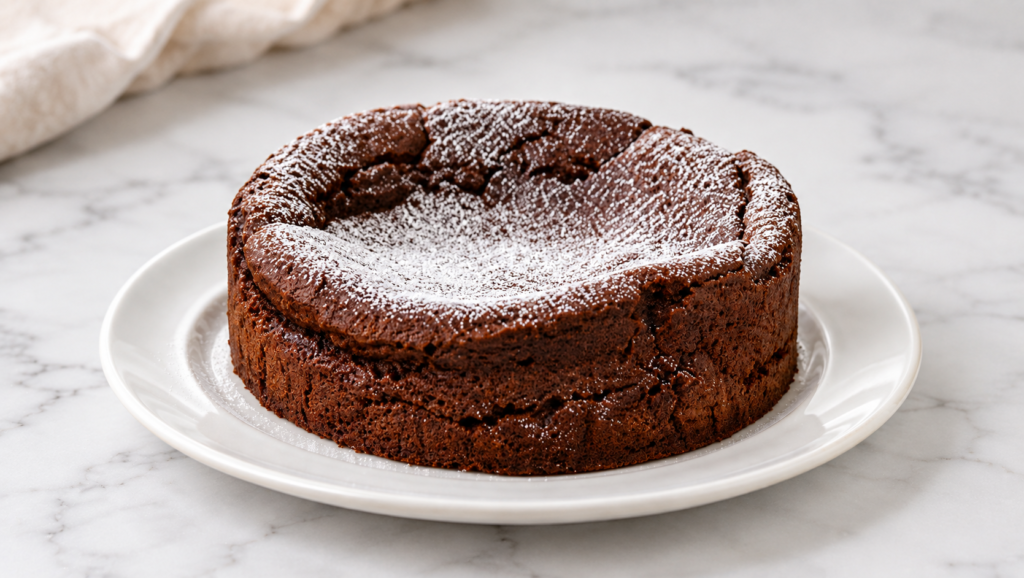
Why does my egg less cake sink? It rises beautifully in the oven—and then sinks in the middle.
Or perhaps it looks perfect when you take it out, only to collapse as it cools.
A sinking eggless cake usually means that the cake has risen before its structure was strong enough to support it. The cause could be too much leavening, excess moisture, an unsuitable egg substitute, under baking, an incorrect oven temperature, or a structural imbalance in the batter.
The good news is that a sunken cake usually leaves clues.
The shape of the collapse, the texture of the center, when the cake sank, and what you changed in the recipe can tell you where to look.
After years of baking and teaching eggless baking, this is how I approach the problem: I don’t change everything at once. I first read the cake.
If you’re working through common egg less baking problems, this article is part of my Eggless Baking Guide: Common Problems, Causes & Easy Fixes, where I explain what can go wrong, why it happens, and how to troubleshoot it step by step.
Quick Problem Finder
Before changing your recipe, find the description that most closely matches your cake.
My cake rose well and then sank after coming out of the oven
Check for:
- under baking
- excess moisture
- an egg substitute that added too much liquid
- a cake structure that had not fully set
If the center is wet or gummy, see Why Is My Egg-less Cake Gummy in the Middle?
My cake sank while it was still baking
Check for:
- too much baking powder or baking soda
- opening the oven too early
- incorrect oven temperature
- a batter that is too heavy
- insufficient structure
My cake has a deep crater in the center
Check:
- leavening
- moisture
- oven temperature
- baking time
- pan size
My cake is both sunken and dense
Look at the flour-to-liquid balance, leavening, mixing, egg substitute and baking conditions.
For a deeper look at what can make a cake heavy, compact or unusually tight, read Why Is My Cake Dense?.
My gluten-free egg less cake has sunk
Don’t automatically apply the same fixes used for a wheat-based cake.
A gluten-free eggless cake has no gluten network, so flour and starch balance, binders, hydration, leavening and overall structure all need to be considered together.
Why Does an Egg-less Cake Sink?
An egg less cake sinks when the structure formed during baking cannot support the expansion created by air and leavening.
Think of a cake as a balance between expansion and setting.
Leavening agents such as baking powder and baking soda help the batter expand. Air incorporated during mixing also contributes to the rise.
But the cake needs to develop enough structure around that expansion before the baking process is complete.
If the cake rises faster than its structure can support, the center may collapse.
This is why adding more baking powder is not automatically the solution to an egg less cake that doesn’t rise well.
The structure of an egg less cake depends on the complete recipe: flour, starches where used, liquid, fat, sugar, egg substitute, leavening and baking conditions all work together.
And if the cake is gluten-free as well as egg less, the structural equation changes again.
1. Too Much Baking Powder or Baking Soda
One of the first things I check when an egg less cake rises dramatically and then sinks is the amount of leavening.
It is easy to think that because eggs are absent, an egg less cake needs extra baking powder.
It doesn’t necessarily.
Too much leavening can produce more gas than the developing cake structure can hold. The cake rises quickly, but the structure cannot keep supporting that expansion.
The result can be a cake that looks impressive in the oven but collapses a few minutes later.
Signs of excessive leavening
You may notice:
- a very rapid rise
- a large dome
- a coarse or uneven crumb
- a collapse in the center
- cracks around the top
- an unpleasant alkaline or bitter taste
What to do
Use the amount of baking powder or baking soda specified in a properly tested recipe.
Don’t increase the quantity simply because the batter looks heavy.
Also remember that baking powder and baking soda perform different jobs. Whether baking soda works effectively depends on the acidic ingredients present in the recipe.
If your cake is not only sinking but also feels heavy, compact or unusually tight, the problem may extend beyond the collapse itself. In that case, it is worth looking at the wider causes of dense cake texture, including flour measurement, moisture balance, leavening and mixing.
2. Your Leavening Agent May Be Weak
The opposite problem is also possible.
Old or poorly stored baking powder can lose effectiveness, particularly when exposed repeatedly to moisture.
A weak leavening agent may leave you with a cake that barely rises.
This sometimes leads to another mistake: adding extra baking powder to compensate.
That can create an imbalance rather than fixing the original problem.
My practical advice
Store baking powder and baking soda properly and check their freshness.
Measure accurately rather than estimating.
When troubleshooting a recipe, don’t change the leavening, flour and liquid all at once. You won’t know which change made the difference.
3. There Is Too Much Moisture in the Batter
Excess moisture is another common reason an egg less cake sinks.
An egg less cake may contain milk, yogurt, buttermilk, oil, fruit puree, water or other liquid ingredients.
The problem isn’t necessarily a single ingredient.
It is the overall moisture balance of the batter.
If there is more moisture than the structural ingredients can support, the cake may rise initially but remain too soft in the center.
As it cools, the weak structure can contract and collapse.
Signs of excess moisture
A sunken cake may have:
- a wet center
- a gummy crumb
- a sticky texture
- a heavy middle
- a soft or under-set structure
Before reducing liquid or adding more flour, ask what changed.
Was the yogurt thinner than usual?
Did you use a different brand of plant milk?
Was the fruit puree particularly watery?
Did you add an egg substitute that contributed additional moisture?
Did you measure your flour by cups rather than weight?
These small differences can change cake texture significantly.
4. Your Egg Substitute May Be Changing the Recipe
This is one of the most important things to understand about egg less baking.
An egg isn’t simply a source of moisture.
Depending on the recipe, it contributes structure, binding, emulsification, fat, moisture and aeration.
When we remove the egg, other ingredients have to take over those functions.
That is why yogurt, flax seed, chia, mashed banana, applesauce and commercial egg replacers do not behave identically.
They can contribute different amounts of:
- moisture
- binding
- fat
- acidity
- weight
- structure
So replacing one egg substitute with another without adjusting the rest of the recipe can change the batter considerably.
A better way to think about egg substitutes
Don’t ask only:
“What can I use instead of an egg?”
Ask:
“What was the egg doing in this particular cake?”
That question is much more useful when troubleshooting an egg less recipe.
When to go deeper
If your cake repeatedly sinks after changing the egg substitute, this deserves its own investigation.
Supporting article: Best Egg Substitutes for Egg-less Cakes: What Each One Does and When to Use It
5. The Oven Is Too Hot
A cake can rise beautifully in an oven that is too hot.
That doesn’t mean it is baking correctly.
A high temperature can cause the outside of the cake to set quickly while the center is still expanding.
The cake may develop a high dome and look almost finished.
But the internal structure has not had enough time to stabilize.
Once the cake cools, the unsupported center can collapse.
Look for these clues
- very fast rise
- dark or firm outer crust
- large cracks
- soft center
- sunken middle after baking
Your oven’s displayed temperature is not always the exact temperature inside the cavity.
If you regularly experience inconsistent baking, an oven thermometer can be useful.
6. You Opened the Oven Too Early
I know how tempting it is to open the oven door and check the cake.
But during the early part of baking, the cake is still developing its structure.
Opening the oven can cause a sudden drop in temperature.
If the cake has not developed enough internal structure, that change can contribute to collapse.
My rule
Try not to open the oven during the early stages of baking.
Wait until the cake is close to the expected baking time before checking it, unless the recipe specifically requires an earlier check.
This is one of those simple baking habits that can make a noticeable difference.
7. The Cake Is Under baked
If your cake looks perfect when it comes out of the oven but sinks shortly afterwards, under baking should be one of the first things you investigate.
The outside can look completely baked while the center is still too soft.
As the cake cools, the internal structure contracts.
If the center hasn’t set sufficiently, it cannot support the cake.
Signs of an under baked cake
- the center jiggles
- a skewer comes out with wet batter
- the middle feels unusually soft
- the cake sinks soon after removal
- the crumb is gummy or sticky when sliced
Bake until the center is properly set—but don’t respond by automatically adding a large amount of extra baking time.
Over baking creates a different problem.
The goal is not simply to bake the cake for longer.
The aim is to bake it until its structure is properly set.
8. Your Pan Size Has Changed
Pan size affects much more than appearance.
It changes the depth of the batter, the time required for the center to bake, and how heat reaches different parts of the cake.
For example, putting the same quantity of batter into a smaller, deeper pan creates a thicker layer.
The outside may bake before the center has set.
That can contribute to a sunken middle.
When troubleshooting, check:
- pan diameter
- pan depth
- material
- quantity of batter
- oven temperature
- baking time
Try not to change the pan and the recipe simultaneously.
9. Too Much Sugar, Fat or Other Heavy Ingredients
Sugar and fat are essential to cake texture.
They contribute tenderness, moisture, flavor and richness.
But changing their quantities can also affect the way the cake sets.
Extra oil, butter, sugar, syrup, chocolate, fruit or other additions can make an eggless batter too heavy or alter its moisture balance.
This is especially important when adapting a recipe.
My advice
If a recipe has worked well before, make one change at a time.
If you add extra chocolate, change the egg substitute and reduce the flour all in the same batch, the finished cake won’t tell you which change caused the problem.
10. Your Flour Measurement Is Off
Flour is one of the most important structural ingredients in a cake.
Too little flour relative to the liquid can produce a batter that lacks sufficient structure.
Too much can create a dense, dry or heavy cake.
This is one reason I recommend weighing flour rather than relying entirely on cup measurements.
It becomes even more important with gluten-free baking because different gluten-free flours have different weights and absorb moisture differently.
A cup of one flour is not necessarily equivalent to a cup of another.
Egg-less and Gluten-Free Are Not the Same Thing
The structural difference becomes clearer when you look at what holds each type of cake together.
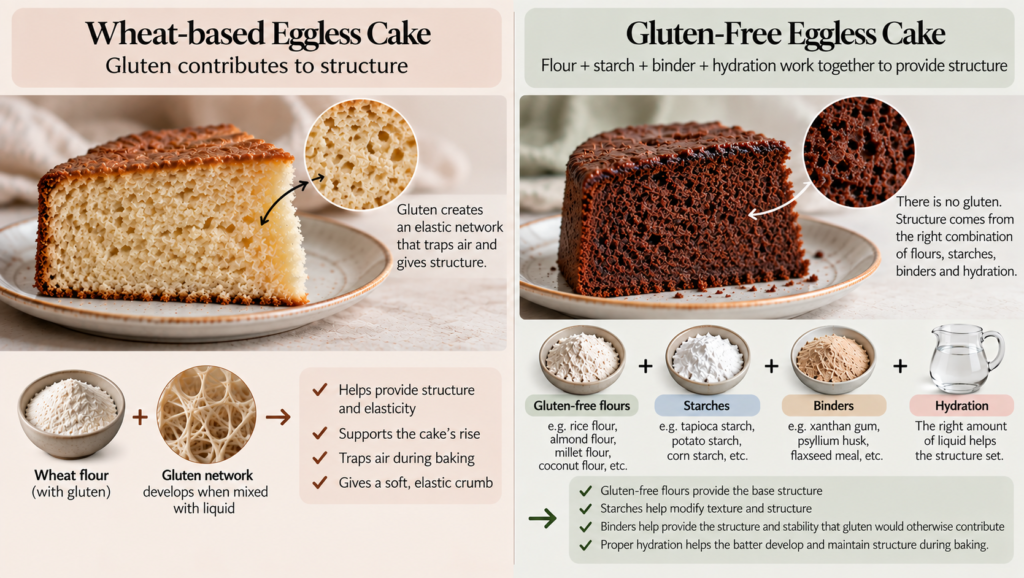
This distinction matters when troubleshooting.
An egg less cake made with wheat flour and a gluten-free egg less cake do not have exactly the same structural system.
In a wheat-based cake, gluten contributes to the structure.
In a gluten-free cake, there is no gluten network.
The structure has to come from the combined effect of:
- gluten-free flours
- starches
- binders
- hydration
- fat
- sugar
- leavening
- aeration
- baking
So if a gluten-free egg less cake sinks, don’t automatically apply advice designed for a wheat-based cake.
For example, reducing mixing is not a universal answer to every dense cake problem.
In gluten-free baking, the more relevant questions may be:
Is the flour blend balanced?
Is there enough structure?
Is the batter properly hydrated?
Is the binder appropriate?
Is the cake setting correctly in the oven?
For a deeper understanding of gluten-free flour, starch, hydration and structure, continue to the Gluten-Free Baking Guide.
What Does the Timing of the Collapse Tell You?
When your cake sinks can be an important troubleshooting clue. This visual shows what each stage can tell you.
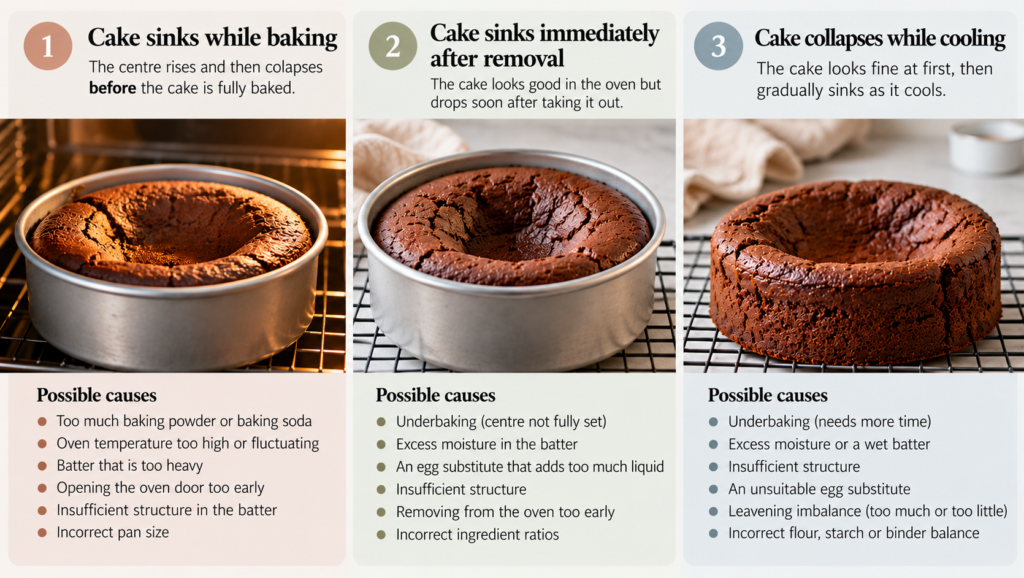
The timing of the collapse doesn’t always identify one single cause, but it helps narrow down where to look first.
It sinks while baking
Look first at:
- excessive leavening
- unstable oven temperature
- opening the oven too early
- batter structure
- excess moisture
It sinks immediately after coming out
Look at:
- under baking
- excessive moisture
- weak structure
- a very soft center
It looks fine at first but sinks as it cools
Look closely at:
- center doneness
- moisture balance
- structural strength
- recipe modifications
This is why I don’t like giving one universal answer to the question, “Why did my cake sink?”
The timing matters.
How I Troubleshoot a Sunken Egg-less Cake
When a cake fails, my first instinct is not to change the recipe.
I first look at the evidence.
1. Look at the center
Is it:
- wet?
- gummy?
- dry?
- dense?
- properly baked?
2. Look at the rise
Did the cake:
- barely rise?
- rise normally?
- rise very quickly?
- rise and then collapse?
3. Think about the batter
Was it:
- thick?
- pourable?
- unusually runny?
- heavy?
- greasy?
4. Check what changed
Did you change:
- the flour?
- the egg substitute?
- the yogurt?
- the milk?
- the oil?
- the sugar?
- the leavening?
- the pan?
5. Check the oven
Was it properly preheated?
Was the temperature accurate?
Did you open the door early?
Was the cake placed correctly in the oven?
This approach may sound simple, but it is much more useful than changing five things at once.
One change at a time. One observation at a time.
That is how you learn what your cake is actually telling you.
How to Prevent an Egg-less Cake from Sinking
You can prevent many common egg less baking problems by paying attention to the fundamentals.
Measure ingredients accurately
Especially flour and liquid ingredients.
Use the correct egg substitute
Choose a substitute according to the function the egg needs to perform.
Don’t increase leavening blindly
More baking powder does not automatically produce a lighter cake.
Watch your moisture balance
A slightly different yogurt, puree or plant milk can change the batter.
Preheat your oven
The cake needs the correct baking environment from the beginning.
Avoid opening the oven too early
Give the structure time to develop.
Use the correct pan size
A deeper cake may require different baking conditions from a shallow one.
Bake until the center is properly set
Don’t judge doneness only by the color of the top.
Allow the cake to cool appropriately
A freshly baked cake is still settling.
Change one thing at a time
This is perhaps the most useful troubleshooting habit of all.
The Bigger Lesson: A Sunken Cake Is a Structural Problem, Not Just a Rising Problem
When an egg less cake sinks, it is tempting to focus entirely on the rise.
But the real question is:
Did the cake develop enough structure to hold the rise?
Leavening creates expansion.
Flour and other structural ingredients help support it.
Moisture affects how the structure develops.
Egg substitutes can provide some of the functions normally contributed by eggs.
The oven determines how quickly the cake sets.
And in gluten-free egg less baking, flour blends, starches and binders become even more important.
Once you start looking at the whole system rather than one ingredient, troubleshooting becomes much easier.
This is something I have learned through years of baking: a failed cake is often giving you useful information.
The sunken center, gummy crumb, heavy texture or uneven rise is a clue.
Instead of asking only, “What went wrong?”, ask:
“What is this cake telling me?”
That is where better baking begins.
Frequently Asked Questions
Why does my egg less cake sink in the middle?
The most common causes are under baking, excess moisture, too much leavening, incorrect oven temperature or insufficient structure. The appearance and timing of the collapse can help identify the likely cause.
Why does an egg less cake rise and then fall?
The cake may be producing more expansion than its developing structure can support. Excess leavening, under baking, moisture imbalance and oven-temperature problems are common possibilities.
Can too much baking powder make an egg less cake sink?
Yes. Excessive leavening can cause rapid expansion followed by collapse when the cake structure cannot support the gas produced.
Why is my egg less cake wet in the middle?
It may be under baked, contain too much moisture or have an imbalance between liquid and structural ingredients. Pan size and oven temperature can also affect how quickly the center sets.
Why does my gluten-free egg less cake sink?
Gluten-free egg less cakes require a different structural balance because they do not contain gluten. Flour and starch balance, binders, hydration, leavening and baking conditions all matter.
Should I add more baking powder if my egg less cake is dense?
Not automatically. Density can result from several factors, including flour measurement, moisture, leavening, mixing and structure. Adding more baking powder may make the problem worse.
Why does my cake sink after I remove it from the oven?
The center may not have developed enough structure before the cake was removed. Excess moisture or an unstable structure can also cause the cake to collapse as it cools.
Can an egg substitute make a cake sink?
Yes. Different egg substitutes contribute different amounts of moisture, binding, acidity and structure. Changing the substitute can therefore change the behavior of the entire batter.
How do I stop my egg less cake from sinking?
Start by checking the leavening, moisture balance, egg substitute, flour measurement, oven temperature, baking time and pan size. Identify one likely cause before changing the recipe.
More Eggless Baking Troubleshooting
If you are troubleshooting another problem, continue with the article that matches what you are seeing:
- Why Is My Egg-less Cake Not Rising? — for cakes that stay flat rather than rising and collapsing.
The idea is simple:
Identify the problem → understand the cause → make one change → bake again.
You don’t need to guess your way through eggless baking.
You need to understand what each ingredient does and how each stage of baking affects the final cake.
Sharmila Sengupta | Baking Expert & Educator | 25+ Years of Baking Experience