
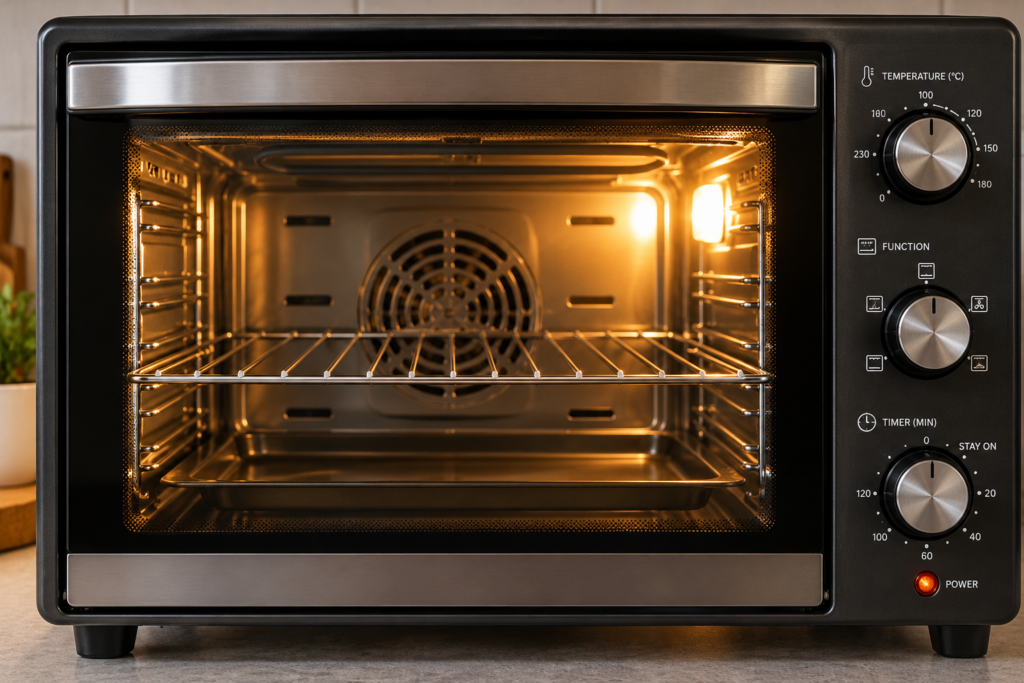
How to Use an Oven for Baking: Temperature, Settings, Rack Position & Common Mistakes
Learning how to use an oven for baking can feel more complicated than it really is.
You set the temperature, choose a setting, place the cake inside and wait. But then the cake comes out pale on one side, too brown on top, dense in the middle, dry around the edges—or it sinks as it cools.
At that point, it is easy to assume that something is wrong with the recipe.
But don’t blame the recipe too quickly. Check the oven first.
After years of baking, I have learned that understanding how your oven behaves is just as important as understanding the recipe. Two ovens set to the same temperature can bake differently. One may run hotter than the dial suggests. Another may have a hot spot. Rack position can change the way a cake bakes, and even a reliable recipe can give disappointing results if the oven is not being used correctly.
In this guide, I’ll take you through the practical side of using an oven for baking—from preheating and choosing the right setting to temperature, rack position, hot spots and knowing when your cake is actually done.
If you are learning eggless baking, you may also find my Eggless Baking Guide useful for understanding the ingredients, techniques and common problems that affect eggless baking.
Already dealing with a baking problem? Start here.
- Cake sinking after it rises? → Check temperature, baking time and cake structure.
- Cake dense or heavy? → Check oven temperature, mixing and leavening.
- Cake gummy in the middle? → Check temperature, baking time and tin depth.
- Cake not rising properly? → Check preheating and oven temperature first.
- Cake dry? → Check excessive heat and baking time.
- Cake browning unevenly? → Check rack position and possible oven hot spots.
I’ll explain how to investigate these problems as we go, because the oven is often one part of the answer—not always the whole answer.
How to Use an Oven for Baking
There are seven basic things I want you to get right:
- Preheat the oven properly.
- Choose the appropriate baking setting.
- Set the temperature required by the recipe.
- Position the baking tin correctly.
- Avoid unnecessary door opening.
- Understand that the temperature on the dial may not be the actual temperature inside.
- Judge the bake by the cake itself, not only by the timer.
That last point is particularly important.
A recipe’s baking time is a guide, not a guarantee.
Your oven, tin size, batter depth and ingredients can all affect how quickly something bakes.
1. Preheat Your Oven Properly
Preheating means bringing the oven to the required baking temperature before placing the batter inside.
This matters because cakes, breads and other baked goods begin responding to heat as soon as they enter the oven.
A cold or inadequately heated oven can affect:
- how quickly the batter sets
- how the cake rises
- the final texture
- baking time
- browning
There is no universal preheating time that works for every oven.
A small OTG may heat up faster than a large oven. Some ovens also indicate that they have reached the selected temperature before the internal temperature has completely stabilized.
If you bake regularly, an oven thermometer can be very useful. It gives you a better idea of what is actually happening inside the oven rather than making you rely entirely on the temperature dial.
2. Which Oven Setting Should You Use for Baking?
For many cakes, a conventional top-and-bottom heating setting is a good starting point.
In this mode, the oven heats from the top and bottom without actively circulating the air with a fan.
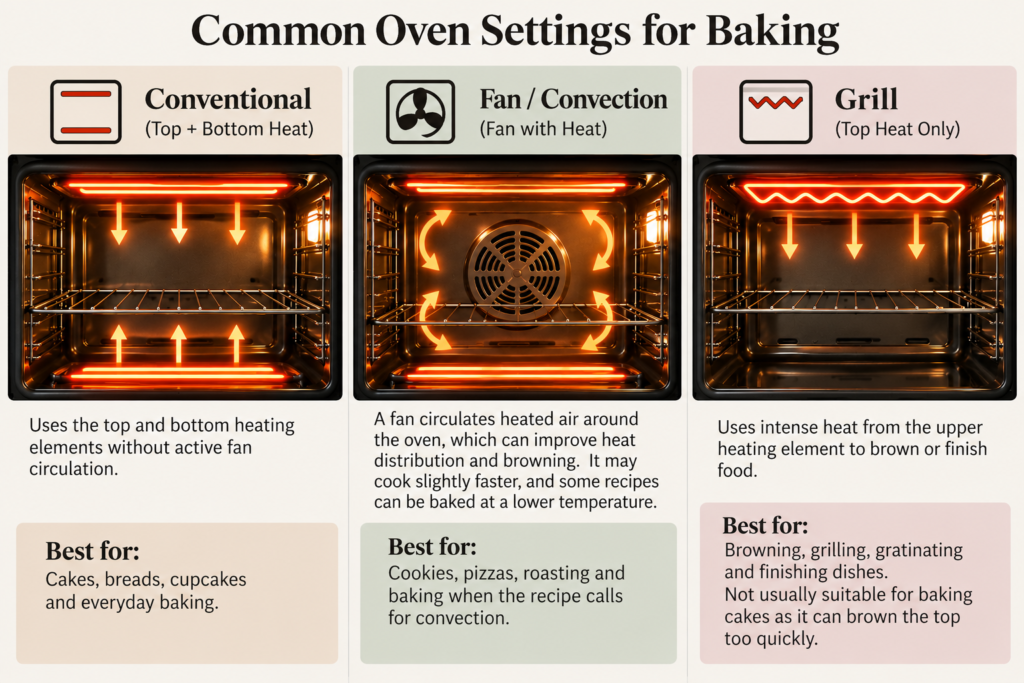
A fan or convection setting circulates hot air around the oven. This can change how quickly food cooks and how strongly it browns.
That doesn’t make convection better or worse. It simply means you need to understand how your particular oven and recipe work with it.
Don’t automatically switch to fan mode just because your oven has one.
If a recipe specifies a particular setting, follow it. Otherwise, use the conventional baking mode as your starting point and learn how your oven behaves.
Your oven manual can also tell you what each symbol or setting is designed to do.
3. What Temperature Should You Use for Baking?
There is no single temperature that is correct for every cake.
You will see recipes using temperatures such as:
- 160°C
- 170°C
- 180°C
- 190°C
All of these can be correct depending on the recipe.
The ideal temperature depends on factors such as:
- the type of batter
- the recipe
- the size and depth of the tin
- the material of the tin
- whether you are using conventional or fan-assisted baking
- your particular oven
So instead of thinking, “All cakes should be baked at 180°C,” ask:
“What temperature does this recipe require, and is my oven actually giving me that temperature?”
That small change in thinking can save you from a lot of unnecessary troubleshooting.
4. Why Your Oven’s Actual Temperature Matters
The number on your oven dial is the temperature you have selected. It does not mean that the oven stays at exactly that temperature throughout the bake.
Ovens cycle their heating elements on and off to maintain the selected temperature, so some fluctuation is normal. Different ovens can also bake a little faster, slower, hotter or cooler than another oven set to the same temperature.
If your oven is running hotter than expected, you may notice:
- the outside browns quickly
- the cake rises rapidly and then collapses
- the edges become dry before the centre is baked
If it is running cooler than expected, you may notice:
- the cake takes longer to set
- the centre remains underbaked
- the cake does not develop enough structure
This is one reason I recommend an oven thermometer if you regularly bake and find that your results are inconsistent.
If you are choosing an OTG for baking, my guide to the best OTG ovens in India explains what to look for in temperature control, heating elements, rack positions, usable space and convection.
If your cake repeatedly refuses to rise, the oven may be part of the problem—but it is not necessarily the only one. I explain the other possible causes in Why Does My Eggless Cake Not Rise?
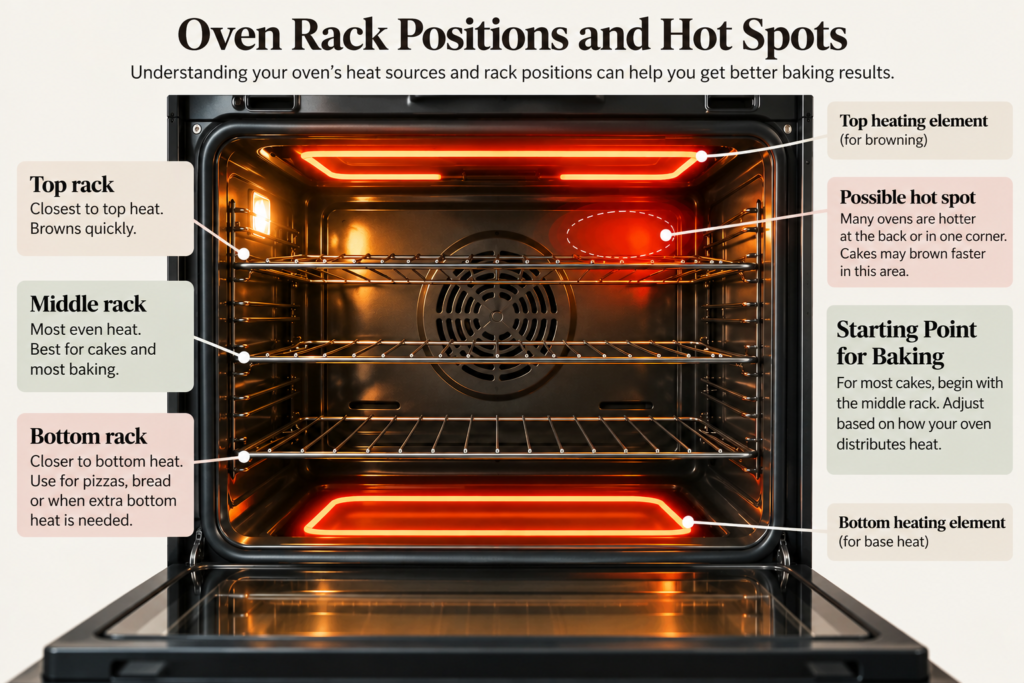
For most cakes, the middle rack is a good starting point.
This generally gives the cake a reasonable distance from both the upper and lower heating elements.
If the tin is too close to the top:
- the surface may brown before the centre is cooked
- the top can become too dark
If it is too close to the bottom:
- the base may brown too quickly
- the bottom can become harder than the rest of the cake
But don’t treat “middle rack” as an absolute rule.
Every oven distributes heat differently. Once you understand your oven, you may find that a slightly different position works better for a particular recipe or tin.
6. Don’t Keep Opening the Oven Door
I know it is tempting to check.
Is the cake rising?
Has it browned?
Is it done yet?
But repeatedly opening the oven door allows heat to escape and can disturb the baking environment.
This matters particularly during the early part of baking, when the structure of the cake is still developing.
So resist the urge to keep checking.
Your cake doesn’t need an audience while it is trying to rise.
Look through the oven glass when possible and wait until the appropriate stage before opening the door.
7. Why Does My Cake Brown More on One Side?
If one side of your cake consistently browns more quickly than the other, don’t immediately assume that the batter is the problem.
Your oven may have a hot spot.
Heating elements, air circulation and the physical design of the oven can create areas that receive more heat than others.
The first step is simply to observe.
Does the left side always brown more?
Does the back of the oven bake faster?
Does one corner of the tray consistently become darker?
Once you identify the pattern, you can adjust your tin position or baking method accordingly.
This is one of the reasons I believe that learning your oven is part of learning to bake.
8. How to Find Hot Spots in Your Oven
One simple way to understand your oven is to use a bread test.
Place slices of plain bread across a baking tray and bake them for a short period.
You may notice that some pieces become darker than others.
The darker areas indicate where your oven may be producing more intense heat.
You don’t need to do this every time you bake. It is simply a useful experiment when you are trying to understand an unfamiliar oven.
Once you know where your oven’s hot spots are, you can make better decisions about rack position and tin placement.
It is not about finding a “perfect” oven.
It is about learning how your oven behaves.
9. Should You Rotate the Baking Tin?
Sometimes—but not automatically.
If your oven has uneven heat, rotating the tin can help the cake bake more evenly.
However, timing matters.
Opening the oven too early or moving a cake before its structure has started to set can cause problems, particularly with delicate cakes.
If a recipe specifically tells you to rotate the tin, follow those instructions.
Otherwise, wait until the cake has developed enough structure before opening the oven and rotating it, if necessary.
The goal is an even bake—not rotating the tin simply because you think you are supposed to.
10. How Do You Know When a Cake Is Done?
Don’t rely only on the recipe’s stated baking time.
Start checking for signs of doneness towards the end of the suggested baking period.
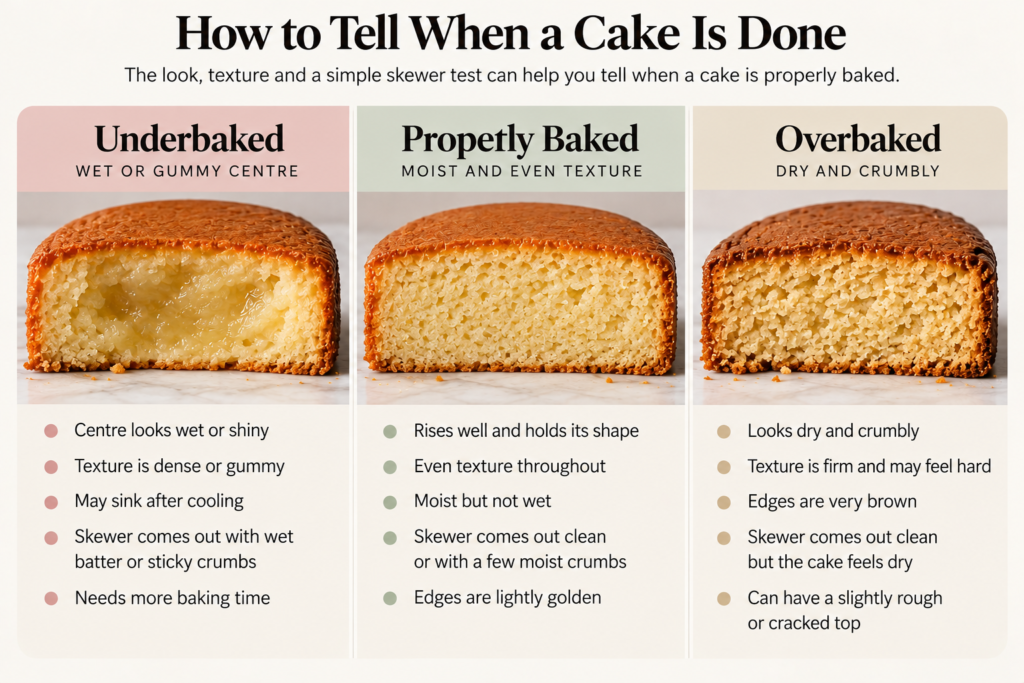
Depending on the type of cake, you may notice:
- the top has set
- the colour looks appropriate for the recipe
- the surface springs back gently when pressed
- the edges have started to pull slightly away from the tin
- a skewer inserted into the centre comes out with a few moist crumbs or relatively clean
 And remember:
A completely dry toothpick is not always the goal.
Some cakes are supposed to remain moist and tender. If you keep baking until the skewer is absolutely dry, you may end up with a dry cake.
Learn to read the cake rather than following the timer blindly.
11. What If the Top Is Brown but the Centre Is Not Done?
This is a common oven problem.
Possible causes include:
- the oven is running hotter than expected
- the tin is positioned too close to the top heating element
- the tin is too deep for the amount of batter
- the cake needs more time at a suitable temperature
Don’t automatically increase the temperature because the centre is taking too long.
That can make the outside even darker while leaving the middle underbaked.
If the centre is gummy or wet, there may be several factors involved. You can read more about this in Why Is My Eggless Cake Gummy in the Middle?
12. What If the Cake Is Pale but Fully Baked?
A pale cake is not necessarily an underbaked cake.
Some cakes naturally have a lighter surface, depending on the ingredients and recipe.
Before changing your oven temperature, check whether the cake is actually baked through.
If the texture is right and the centre is properly cooked, the colour may simply be the expected result.
If you consistently want more browning, look at the oven setting, rack position and recipe before making a large temperature change.
Judge the bake, not just the colour.
13. Why Does My Cake Sink After Baking?
A cake that rises beautifully in the oven and then sinks can be frustrating.
But don’t automatically blame the oven.
Possible causes include:
- incorrect oven temperature
- insufficient baking time
- too much leavening
- an unstable batter structure
- excess liquid
- opening the oven too early
The oven is one part of the equation.
For a deeper look at the possible causes, see Why Does My Eggless Cake Sink?
14. Why Does My Cake Become Dense?
A dense cake is not always an oven problem either.
Temperature can certainly affect the result, but so can:
- incorrect ingredient ratios
- insufficient leavening
- overmixing
- incorrect batter consistency
- handling the batter for too long before baking
So if your cake is dense, simply increasing the oven temperature may not solve the problem.
You need to look at the entire baking process.
For the detailed causes and solutions, see Why Is My Cake Dense?
15. Why Does My Cake Turn Out Dry?
An oven that is too hot or a cake that is baked for too long can lose too much moisture.
But again, the oven is not the only possible cause.
Recipe balance, ingredients, mixing and baking time can all affect the final texture.
If your cake is consistently dry, don’t keep changing the temperature without investigating the other factors. My guide on Why Is My Eggless Cake Dry? goes into this in more detail.
16. The Oven Is Only One Part of Eggless Baking
This is particularly important with eggless cakes.
A good oven cannot compensate for a poorly balanced recipe.
And a good recipe cannot compensate for an unpredictable oven.
The final result depends on several things working together:
Ingredients + mixing + batter consistency + tin size + oven temperature + rack position + baking time
Egg substitutes also affect structure and moisture. Yogurt, flax and banana, for example, don’t behave identically in an eggless batter.
I have compared these three ingredients in Yogurt vs Flax vs Banana in Eggless Baking.
17. Once the Oven Is Right, Work on the Texture
There is an important distinction between a baking problem and a texture preference.
If the cake is properly baked through but you want it softer and moister, repeatedly changing the oven temperature may not be the answer.
First make sure the oven is doing its job.
Then look at the recipe, ingredients and technique.
If your cake is baked correctly but you want a softer, moister crumb, see How to Make Eggless Cake Soft and Moist.
Common Oven Mistakes to Avoid
These are the mistakes I see most often:
- Putting the cake into a cold or inadequately preheated oven
- Assuming the temperature dial is perfectly accurate
- Using the wrong oven mode
- Placing the tin too close to a heating element
- Opening the oven repeatedly
- Following the baking time blindly
- Changing several variables at the same time
- Assuming every cake should be baked at 180°C
If you change the temperature, rack position, baking time and recipe all at once, you won’t know what actually fixed the problem.
Change one variable at a time whenever possible.
My Simple Oven Routine for Baking
Before baking
- Read the recipe completely.
- Check the required temperature and oven setting.
- Position the rack.
- Preheat the oven.
- Prepare the baking tin.
Once the batter is ready
- Don’t leave the batter sitting unnecessarily, especially when the recipe depends on active leavening.
- Put the tin into the properly preheated oven.
- Set the timer according to the recipe.
During baking
- Avoid unnecessary door opening.
- Observe how your oven is behaving.
- Watch the colour through the glass.
- Don’t make temperature changes simply because the cake looks different from what you expected.
Towards the end
- Check for signs of doneness.
- Use a skewer if appropriate.
- Look at the centre, surface and edges—not just the clock.
After baking
- Follow the recipe’s cooling instructions.
- Don’t cut the cake immediately unless the recipe specifically says to.
- Give the cake time to settle before judging its final texture.
The Most Important Thing: Learn Your Oven
Don’t just learn baking temperatures.
Learn your oven.
Notice:
- how long it takes to preheat
- whether the actual temperature differs from the dial
- where its hot spots are
- which rack position works best
- how quickly it browns the top
- whether your cakes generally need more or less time than the recipe suggests
The more you bake, the more familiar these patterns become.
Eventually, instead of wondering, “Why did this happen?”, you start asking:
“What did my oven do differently this time?”
That is when baking becomes much less about guessing.
Your oven has its own personality.
Frequently Asked Questions
Can I put my cake into the oven before it is fully preheated?
Usually, no. Unless the recipe specifically instructs otherwise, place the cake into a properly preheated oven.
Is 180°C the correct temperature for baking a cake?
Not necessarily. The correct temperature depends on the recipe, batter, tin, oven and baking mode.
Which rack should I use for baking a cake?
The middle rack is a good starting point for most cakes, but your particular oven may require some adjustment.
Should I always use fan or convection mode?
No. Convection changes how heat moves around the oven. Use the setting recommended by the recipe or learn which mode gives you the best results in your oven.
Do I need an oven thermometer?
You don’t necessarily need one, but it can be very useful if you bake regularly or suspect that your oven temperature is inaccurate.
Why is my cake cooked outside but raw in the middle?
Possible causes include excessive heat, incorrect rack position, a deep tin, insufficient baking time or recipe-related issues.
Should I rotate my cake while baking?
Only when necessary or when the recipe recommends it. If your oven has uneven heat, rotating the tin at the appropriate stage can help.
Why does my cake sink after baking?
Several factors can cause this, including underbaking, incorrect temperature, excess leavening, batter structure and opening the oven too early.
Final Thought
A good baking result is rarely about one magic temperature or one perfect oven setting.
It comes from understanding what is happening inside the oven and learning how your particular oven behaves.
Use the recipe as your starting point.
Use your oven observations as your guide.
The more you bake, the less you have to guess.
Sharmila Sengupta | Baking Expert & Educator | 25+ Years of Baking Experience