
How to Use Almond Flour in Gluten-Free Baking: Expert Tips & Troubleshooting
Almond flour baking can make gluten-free and egg-free bakes wonderfully tender, moist and rich. But it can also be the reason a cake turns out dense, greasy, crumbly or difficult to slice.
The problem is usually not almond flour on its own. It is how almond flour interacts with the other ingredients in the recipe.
Unlike wheat flour, almond flour contains no gluten and naturally has a higher fat content. When you are also baking without eggs, there is less built-in support to help the cake hold air, set properly and maintain its shape.
That means the balance between flour, liquid, fat, sugar, leavening and binding ingredients becomes especially important.
After years of working with gluten-free and eggless recipes, I have found that troubleshooting becomes much easier when you stop changing several things at once.
Look at the result. Find the likely cause. Change one thing. Bake again.
Quick Problem Finder
If your almond flour bake has gone wrong, start here:
| Problem | What to check first |
|---|---|
| Cake is dense or heavy | Flour balance, batter consistency, leavening and oven temperature |
| Cake is gummy in the middle | Excess moisture, pan size, baking time and oven temperature |
| Cake is dry | Flour quantity, fat, moisture and overbaking |
| Cake crumbles when sliced | Binding, flour combination and cooling |
| Cake rises and then sinks | Leavening, excess liquid, batter stability and baking time |
| Cake does not rise | Leavening, batter consistency and oven temperature |
| Outside is brown but centre is wet | Oven temperature, pan depth and baking time |
| Changing the egg substitute changed the texture | Moisture and binding contribution of the substitute |
| You want to replace wheat flour with almond flour | Do not assume a 1:1 substitution |
For a broader look at common problems in egg-free baking, see my Eggless Baking Guide.
What Is Almond Flour?
Almond flour is made from finely ground almonds. It is commonly made from blanched almonds, meaning the skins have been removed before grinding.
It is different from almond meal, which is usually coarser and may contain the almond skins.
The difference may seem small, but it can affect the texture of a cake or muffin.
Almond flour naturally contains:
- Fat from the almonds
- Protein
- Moisture
- Fiber
- A mild nutty flavour
Because it contains no gluten, it cannot provide the elastic network that wheat flour develops when mixed with liquid.
That is why almond flour behaves very differently in baking.
It can contribute richness, tenderness and moisture, but it needs the right combination of ingredients to help the finished bake hold its shape.
1. Don’t Substitute Almond Flour 1:1 for Wheat Flour
One of the most common mistakes I see is treating almond flour as a direct replacement for wheat flour.
It doesn’t work that way.
Wheat flour contributes starch and gluten-forming proteins. When liquid is added and the batter is mixed, gluten helps create a network that supports the cake as it rises.
Almond flour does not create that network.
It also brings considerably more natural fat into the recipe.
So replacing wheat flour with almond flour changes several things at once:
- Protein and gluten structure
- Fat content
- Moisture balance
- Batter consistency
- Browning
- Crumb texture
- Ability to hold air
This is why a recipe that works perfectly with wheat flour can become heavy or fragile when almond flour is substituted without changing anything else.
A flour substitution is not simply an ingredient substitution. It changes the behaviour of the entire recipe.
2. Almond Flour Changes Cake Texture
One of the reasons bakers love almond flour is the texture it can create.
It can give a cake a soft, tender crumb and a pleasant richness.
But there is a point at which tenderness becomes heaviness.
If your almond flour cake is dense, look beyond the flour itself.
Possible causes include:
- Too much almond flour
- An unbalanced flour blend
- Too much liquid
- Insufficient leavening
- A batter that is too thick or too loose
- Overmixing
- Batter sitting for too long before baking
- An oven that is not hot enough
- A pan that is too small or too deep
If you are dealing with a generally dense cake rather than an almond-flour-specific problem, my guide on why a cake becomes dense will help you troubleshoot it systematically.
3. Balance Almond Flour With Other Gluten-Free Ingredients
I rarely think of almond flour as something that should do all the work in a gluten-free recipe.
Different ingredients have different jobs.
For example:
- Almond flour contributes fat, richness, tenderness and flavour.
- Rice flour can provide a lighter, more neutral base.
- Tapioca or other starches can contribute softness and flexibility.
- Buckwheat flour can add flavour and body.
- Coconut flour absorbs a considerable amount of moisture and therefore needs careful use.
- Xanthan gum can help the bake hold together.
- Psyllium husk can provide additional binding and moisture management in suitable recipes.
The exact combination depends on what you are making.
A cake, bread, cookie and muffin do not need the same flour balance.
If you’re new to working with gluten-free flours, my Gluten-Free Baking Guide explains how different flours, binders and moisture levels affect the final bake.
This is one of the reasons gluten-free baking is more successful when you understand what each ingredient is doing rather than simply following substitutions.
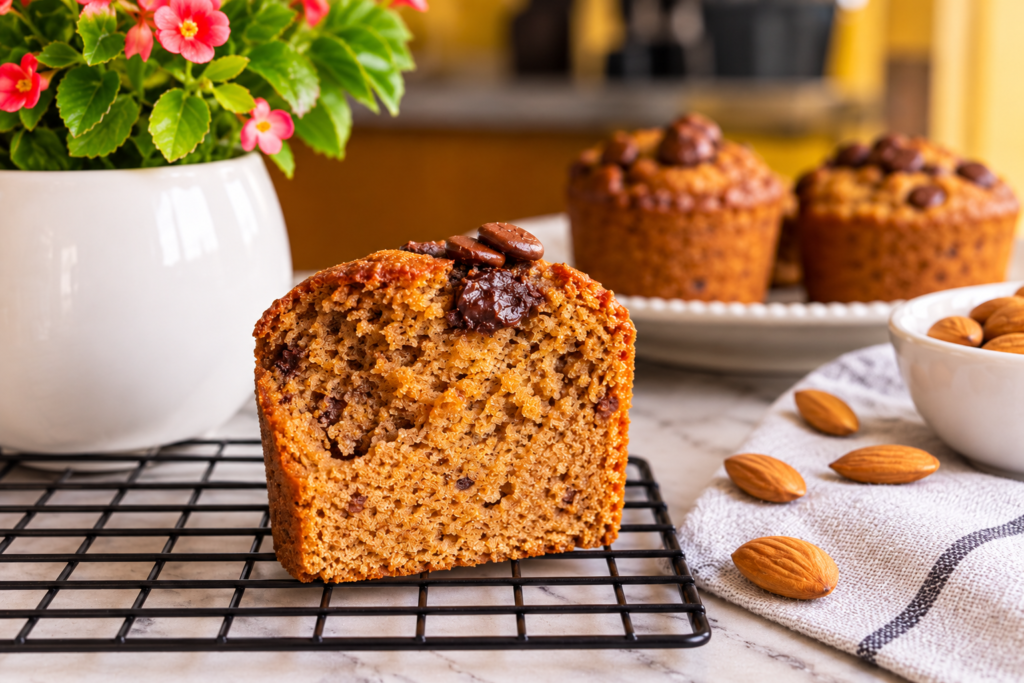
A Practical Example: Gluten-Free & Egg-Free Almond Flour Muffins
One of my favourite ways to demonstrate how almond flour works is through these gluten-free and egg-free almond flour muffins.
This recipe combines blanched almond flour with buckwheat flour.
Here, the almond flour provides richness and tenderness, while the buckwheat flour adds body and flavour.
Instead of eggs, I use a flaxseed gel for binding, supported by xanthan gum.
The result is a good example of how several ingredients can work together rather than expecting one ingredient to perform every function.
Watch: How I Make These Gluten-Free & Egg-Free Almond Flour Muffins
See the batter consistency, mixing technique and baking process in real time.
Delicious Gluten-Free & Egg-Free Almond Flour Muffins
Ingredients
For the flaxseed gel
- 35 g flaxseed powder
- 110 g warm water
For the dry ingredients
- 185 g blanched almond flour
- 85 g buckwheat flour
- 100 g powdered sugar
- ½ teaspoon baking soda
- 2 g xanthan gum
For the wet ingredients
- 105 g honey
- 30 g virgin coconut oil
- 1 teaspoon vanilla extract
- 2 teaspoons apple cider vinegar
- 80 g coconut milk
- 50 g chocolate chips
Method
- Mix the flaxseed powder with the warm water. Leave it for about 10 minutes to form a gel.
- Sift the almond flour, buckwheat flour, powdered sugar, baking soda and xanthan gum together.
- Make a well in the centre of the dry ingredients.
- Add the flaxseed gel, honey, coconut oil, vanilla extract, apple cider vinegar and coconut milk.
- Add the chocolate chips and mix until the ingredients are just combined. Do not overmix.
- Cover the batter and allow it to rest for about 10 minutes.
- Preheat the oven to 160°C / 320°F.
- Fill the muffin cups about three-quarters full. The exact amount will depend on the size of your muffin cups.
- Bake for approximately 45 minutes, or until the muffins are golden and a toothpick inserted into the centre comes out clean.
- Allow them to cool on a wire rack for about 15 minutes before handling.
Storage
Store the muffins in an airtight container at room temperature for about a day, then refrigerate.
They can also be frozen in an airtight container for up to three months.
Allow them to thaw at room temperature, or warm them gently in the microwave in short intervals.
What This Recipe Teaches About Almond Flour
This recipe works because the ingredients are performing different jobs.
Almond flour provides richness, natural fat and tenderness.
Buckwheat flour contributes body and flavour.
Flaxseed gel provides binding in place of eggs.
Xanthan gum gives additional stability.
Baking soda and apple cider vinegar work together as part of the leavening system.
Coconut milk and honey contribute moisture and flavour.
Coconut oil adds additional richness.
This is the principle I use when developing gluten-free and egg-free recipes:
A successful recipe is rarely about finding one perfect substitute. It is about getting the ingredients to work together.
4. Watch the Moisture Balance
Almond flour already contributes natural fat and moisture, so adding extra liquid simply because the batter looks thick can sometimes create a problem later.
On the other hand, removing too much liquid can leave the finished cake dry.
If your cake is gummy in the middle, look at:
- Total liquid
- The amount of almond flour
- Egg substitute
- Pan size
- Batter depth
- Oven temperature
- Baking time
A gummy centre does not automatically mean that you need more flour.
I explain the problem in more detail in why an eggless cake becomes gummy in the middle.
If the finished cake is dry, the opposite approach applies. Check the flour-to-liquid balance, fat, egg substitute and baking time before simply adding more liquid.
5. Egg-Free and Gluten-Free Baking Needs Extra Attention
Eggs do much more than add moisture to a cake.
Depending on the recipe, they can contribute:
- Structure
- Binding
- Moisture
- Emulsification
- Stability
- Richness
- Aeration
When you remove both gluten and eggs, several of these functions need to be provided by other ingredients.
That is why there is no universal “best egg substitute.”
Yogurt, flaxseed, banana, applesauce, aquafaba and commercial egg replacers behave differently.
For example, banana contributes moisture and sweetness, while flaxseed provides a different kind of binding. Yogurt changes the moisture and acidity of a batter.
So when you change the egg substitute, you are not simply changing one ingredient.
You are changing the behaviour of the batter.
6. More Leavening Is Not Always the Answer
When a gluten-free or egg-free cake does not rise, it is tempting to add more baking powder or baking soda.
I would not do that immediately.
Too much leavening can cause a cake to rise rapidly and then lose its shape before it has properly set.
Before changing the quantity, check:
- Is the leavening agent fresh?
- Was it measured accurately?
- Was the oven properly preheated?
- Is the batter too wet?
- Was the flour changed?
- Was the egg substitute changed?
- Is the pan the correct size?
- Was the batter mixed correctly?
If your cake simply refuses to rise, see my guide to why an eggless cake does not rise.
7. Give the Cake Enough Time to Set
Gluten-free and egg-free cakes can be particularly delicate when they first come out of the oven.
The centre may still be setting while the cake cools.
If you cut into it immediately, you may mistake a fragile warm crumb for a recipe failure.
Allow the cake to cool properly before judging its final texture.
This is especially important with cakes containing almond flour because the combination of natural fat and moisture can make the warm crumb feel softer than it will once completely cooled.
Why Does Almond Flour Cake Become Crumbly?
A crumbly cake is usually telling you that it does not have enough binding or cohesion.
Possible causes include:
- Too much almond flour
- An unsuitable flour combination
- Not enough binder
- A change in egg substitute
- Overbaking
- Cutting while the cake is still warm
- Insufficient cooling
Remember that almond flour does not provide the gluten network found in wheat flour.
So a gluten-free cake needs another way to hold its shape.
This may come from the combination of starches, binders, egg substitutes and other ingredients in the formula.
Why Is the Outside Brown but the Centre Still Wet?
This is a particularly common problem with almond flour because the natural fat in almonds can encourage browning.
If the outside looks beautifully baked while the centre is still wet, check:
Oven temperature
An oven that runs too hot can brown the surface before the centre has had enough time to set.
Pan size
A smaller or deeper pan creates a thicker batter layer, which takes longer to bake through.
Baking time
Don’t judge a cake only by its colour.
Oven position
The position of the pan can affect how heat reaches the bake.
If you use an OTG, understanding how your oven heats is particularly important. My guide on how to use an oven for baking covers the basics.
Almond Flour and Egg Substitutes: Don’t Change Two Things at Once
This is one of the most useful troubleshooting habits I can share.
Suppose a cake recipe works well with yogurt as the egg substitute.
You decide to use mashed banana instead.
At the same time, you reduce the oil, add more almond flour and change the baking temperature.
If the cake becomes dense, how will you know what caused it?
You won’t.
When troubleshooting, change one significant variable at a time.
Bake again.
Compare the result.
Then make the next adjustment.
It may feel slower, but it actually gets you to the answer faster.
Almond Flour vs Almond Meal
Although the two terms are sometimes used interchangeably, almond flour and almond meal are not always identical.
Almond flour is generally made from blanched almonds and has a finer texture.
Almond meal is usually coarser and may contain the almond skins.
That difference can affect:
- Crumb texture
- Moisture absorption
- Appearance
- Density
- Overall mouthfeel
For delicate cakes and muffins, a finely ground almond flour usually gives a more refined crumb.
7 Common Almond Flour Baking Mistakes
1. Treating almond flour like wheat flour
It behaves differently because it has no gluten and contains more natural fat.
2. Assuming a 1:1 substitution will work
Replacing wheat flour changes the entire formula.
3. Adding extra liquid too quickly
The batter may look thick but still contain enough moisture.
4. Adding more leavening when the cake does not rise
The problem may be batter consistency, oven temperature or the recipe balance rather than the amount of baking soda or baking powder.
5. Changing the egg substitute without considering moisture
Different substitutes contribute different amounts of moisture and binding.
6. Judging the cake while it is still hot
The crumb continues to settle as it cools.
7. Changing several ingredients at once
You lose the ability to identify what actually fixed—or caused—the problem.
My Simple Troubleshooting Method
When a bake goes wrong, I work backwards from the result.
Dense? Check the flour balance, batter consistency, leavening and oven temperature.
Gummy? Look at moisture, pan depth, baking time and temperature.
Dry? Check flour quantity, fat, moisture and whether the cake was overbaked.
Crumbly? Look at the flour combination, binder and cooling.
Sinks? Check the leavening, liquid level and whether the centre was fully baked.
Doesn’t rise? Check the leavening, batter consistency and oven temperature.
You don’t need to redesign the recipe every time something goes wrong.
Start with the symptom, identify the most likely variable, and change only that.
One change at a time gives you information.
What Almond Flour Does—and Doesn’t—Do
Almond flour can contribute:
- Richness
- Tenderness
- Natural fat
- Moisture
- Nutty flavour
- Browning
But it does not provide:
- Gluten
- The same elastic properties as wheat flour
- Identical moisture absorption
- The same baking behaviour
Once you understand those differences, almond flour becomes much easier to work with.
The goal isn’t to make almond flour behave like wheat flour.
The goal is to build a recipe around what almond flour naturally does well.
If You’re Baking Without Both Gluten and Eggs
When working with this type of recipe, I find it more useful to think about the job of each ingredient rather than searching for a direct substitute.
Ask yourself:
Where is the lift coming from?
What is providing moisture?
What is helping the batter hold together?
What is contributing tenderness?
What will help the bake set in the oven?
Once you start looking at recipes this way, troubleshooting becomes much more logical.
You are no longer asking:
“What can I substitute for this ingredient?”
Instead, ask:
“What job was this ingredient doing, and how is that job being handled now?”
That is a much more useful question.
Almond Flour Baking Troubleshooting Checklist
Before changing your recipe, check:
☐ Am I using almond flour or almond meal?
☐ Is the flour quantity correct?
☐ Have I changed the flour blend?
☐ Is the batter too wet or too dry?
☐ Have I changed the egg substitute?
☐ Is the binder appropriate for the recipe?
☐ Is the leavening fresh?
☐ Was the oven fully preheated?
☐ Is the pan the correct size?
☐ Is the cake fully baked in the centre?
☐ Did I allow it to cool before slicing?
☐ Did I change more than one ingredient at a time?
This simple checklist can prevent a lot of unnecessary experimentation.
Frequently Asked Questions
Can I replace wheat flour with almond flour 1:1?
Usually, no. Almond flour behaves very differently from wheat flour because it contains no gluten and has a higher natural fat content.
Is almond flour good for eggless baking?
Yes. It can produce a rich, tender crumb, but an egg-free recipe needs appropriate binding and support because both gluten and eggs may be absent.
Why does my almond flour cake become dense?
Possible causes include too much almond flour, an unbalanced flour blend, excess liquid, insufficient leavening, overmixing or an oven that is not at the correct temperature.
Why is my almond flour cake gummy?
A gummy centre can result from excess moisture, a thick batter layer, insufficient baking time or an oven temperature that is too low or uneven.
Why does my almond flour cake crumble?
The recipe may not have enough binding or cohesion. Flour balance, the egg substitute, baking time and cooling can all affect how well the cake holds together.
Does almond flour need a binder?
Not every recipe requires the same binder, but gluten-free egg-free recipes often benefit from ingredients that help the batter hold together. Xanthan gum, psyllium or flaxseed may be used depending on the recipe.
Can almond flour be combined with other gluten-free flours?
Yes. Combining different gluten-free flours can often produce a better balance of flavour, moisture, tenderness and texture than relying on almond flour alone.
What is the difference between almond flour and almond meal?
Almond flour is generally finer and made from blanched almonds, while almond meal is usually coarser and may contain the skins. The difference can affect the texture of your bake.
Can I use almond flour in a gluten-free eggless cake?
Yes. Almond flour can work very well in gluten-free eggless cakes when the recipe has been formulated to account for its fat content, moisture and lack of gluten.
The Bigger Lesson About Almond Flour
Almond flour is not difficult to bake with once you understand its personality.
It brings natural richness, tenderness and moisture to a recipe, but it needs to be treated differently from wheat flour.
The same principle applies to egg substitutes. A flax gel, yogurt, banana or aquafaba may all work in different recipes, but they bring different qualities to the batter.
So instead of asking whether one ingredient is “better,” look at what the recipe needs as a whole.
Flour. Moisture. Fat. Binding. Leavening. Heat.
When those elements are balanced, the result can be soft, tender and beautifully satisfying.
And when something goes wrong, don’t immediately start changing everything.
Look at the result. Find the likely cause. Change one thing. Bake again.
That is how troubleshooting becomes a skill rather than guesswork.
Ready to Learn More About Gluten-Free Baking?
If you are learning to bake without gluten, my Gluten-Free Baking Guide is a useful place to continue. It explains how different gluten-free flours, binders, moisture levels and baking techniques affect the final result.
For egg-free baking, you can also explore the related guides on Cookery Expressions to understand how egg substitutes affect texture, moisture and baking performance.
Explore More Gluten-Free Baking
- Gluten-free Avocado Bread
- Gluten free & Egg free Carrot-Coconut Muffins
- Gluten-Free Baking with White Rice Flour
- Gluten-free Pancakes
- Gluten-free Scalloped Corn
A final note from me: gluten-free and egg-free baking becomes much less intimidating when you stop looking for one perfect substitute and start understanding what each ingredient contributes.
Once you understand the role of each ingredient, you can troubleshoot with confidence—and create recipes that work consistently.
Sharmila Sengupta | Baking Expert & Educator | 25+ Years of Baking Experience