
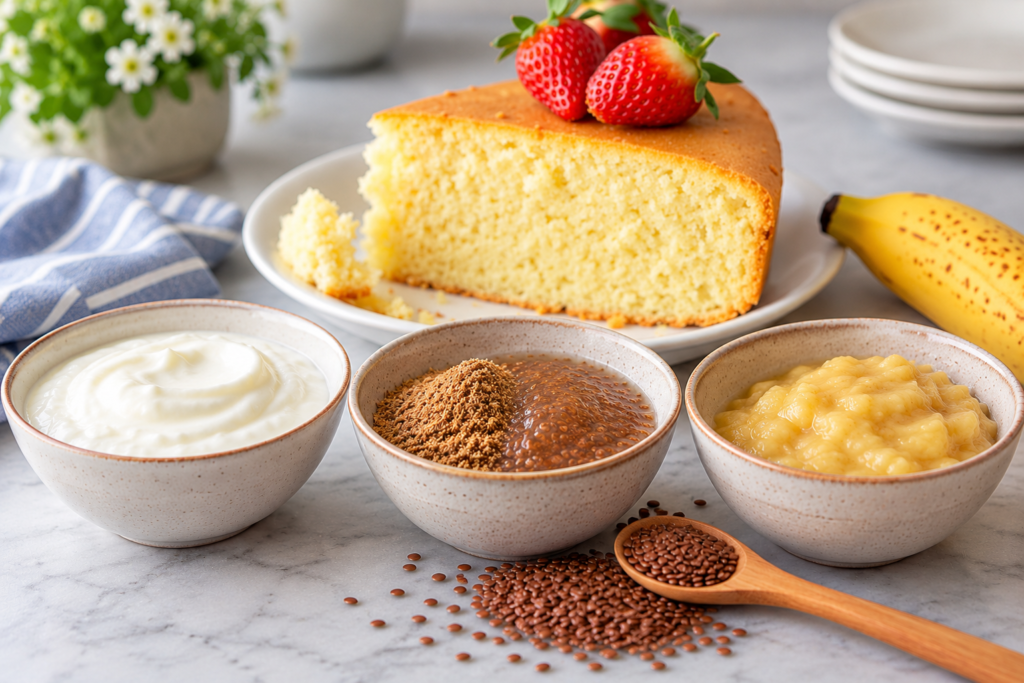
Yogurt vs Flax vs Banana in Eggless Baking: Which Should You Use?
Choosing between yogurt, flax and banana in eggless baking is one of the first decisions you make when baking without eggs.
And this is where many home bakers get stuck.
They know that yogurt, flaxseed and banana can all be used in eggless baking, but they assume they are interchangeable.
They are not.
Yogurt can give you a soft, tender crumb. Flaxseed can provide binding and structure. Banana can add moisture, sweetness and softness while also changing the flavour of the cake.
So the better question is not:
“Which is the best egg substitute?”
It is:
“Which substitute is best for the cake I want to make?”
After more than 25 years of baking, this is how I approach eggless recipes. I don’t choose a substitute simply because it is available in the kitchen. I look at what the recipe needs and what that particular ingredient will contribute.
This guide will help you choose between yogurt, flax and banana, understand how each behaves, and use the one that makes the most sense for your cake.
If you are new to eggless baking or are trying to understand several problems at once, start with my Eggless Baking Guide: Common Problems, Causes & Easy Fixes.
Quick Problem Finder: Start With the Texture You Want
If you already know what you want from your cake, start here.
| What you want | Start by considering |
|---|---|
| Soft, tender cake | Yogurt |
| Better binding and a more substantial crumb | Flaxseed |
| Moist, naturally sweet cake | Banana |
| Vegan cake | Flaxseed or banana |
| Mild flavour with a soft crumb | Yogurt |
| Banana-flavoured cake | Banana |
| A sturdier, more cohesive crumb | Flaxseed |
| Gluten-free eggless cake | Choose according to the flour blend and structure needed |
This is only a starting point.
The rest of the recipe still matters.
First: Don’t Think of Yogurt, Flax and Banana as Three Versions of the Same Thing
This is the most important idea in this article.
When you remove an egg from a cake recipe, you are not simply removing one ingredient.
An egg may have contributed several things to the recipe:
- moisture
- binding
- structure
- emulsification
- richness
- aeration
- stability
Different egg substitutes replace different parts of that job.
Yogurt
Think:
moisture + tenderness + acidity
Flaxseed
Think:
binding + gel structure
Banana
Think:
moisture + sweetness + fruit solids
That is why I would never say that yogurt is “better” than flax or that banana is “better” than yogurt.
They are useful for different reasons.
Yogurt vs Flax vs Banana at a Glance
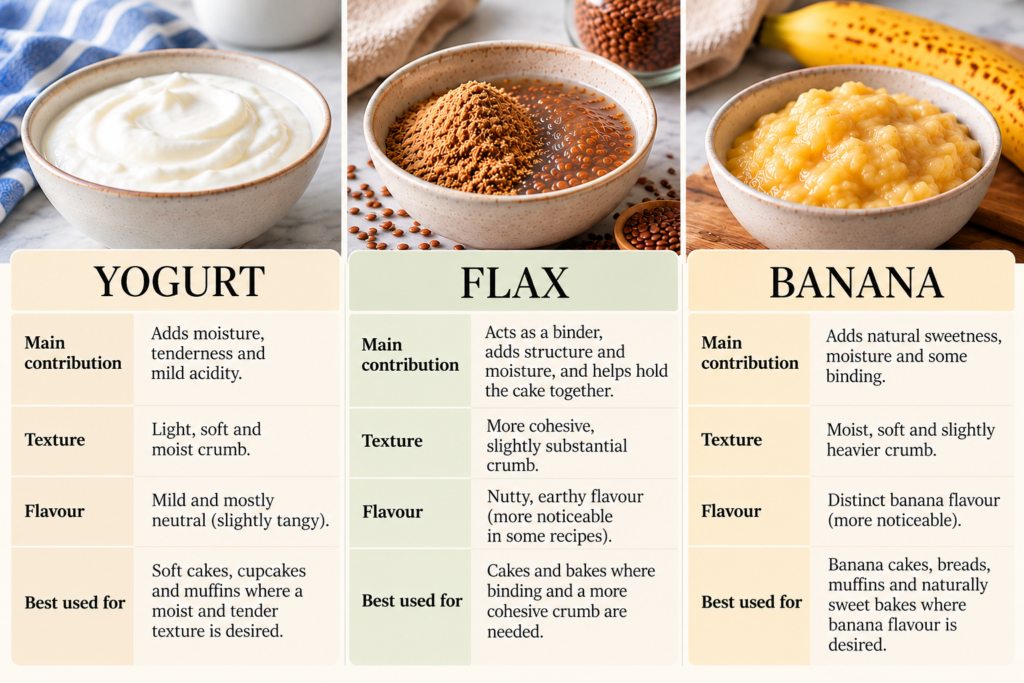
The important word here is “can.”
Yogurt, flax and banana can each help an eggless cake in different ways, but the result still depends on the rest of the formula — the flour, liquid, fat, sugar, leavening and baking method.
1. Yogurt: Choose It When You Want Softness and Tenderness
If someone asks me which of these three I would consider first for a soft, tender eggless cake, yogurt is often high on my list.
Yogurt contributes moisture and tenderness, and its acidity can also be useful in recipes that include baking soda.
That makes it particularly useful for cakes where you want a delicate, soft crumb without adding a strong flavour.
What yogurt brings to an eggless cake
When I use yogurt in an eggless cake, I think of it as more than a source of liquid.
It can contribute:
- moisture
- tenderness
- acidity
- richness
- some binding and structural support
But its consistency matters.
A thick yogurt and a thin, watery yogurt can behave very differently in the same batter.
That small difference can matter more than a recipe reader may realise.
When I would choose yogurt
Yogurt is a good starting point when you want:
- a soft tea cake
- a tender vanilla cake
- a mildly flavoured cake
- a moist crumb without adding fruit flavour
- acidity to work with baking soda
- a softer texture after cooling
It is especially useful when the recipe is already formulated around yogurt or another acidic ingredient.
What I would not do
I would not add extra yogurt simply because I want the cake to be softer.
That is a common mistake.
A cake needs the right amount of moisture for its structure to set properly. If the batter already contains enough liquid, extra yogurt can change the consistency and affect the way the centre bakes.
If your cake becomes gummy after using a wet ingredient, see my guide on why an eggless cake can turn gummy in the middle.
The important lesson here is:
Use yogurt to create tenderness—not simply to add more liquid.
2. Flaxseed: Choose It When Binding and Structure Matter More
Flaxseed behaves quite differently.
When ground flaxseed is mixed with water and allowed to hydrate, it develops a gel-like consistency.
When I use flax, I think of it primarily as a binder.
That makes it particularly useful when the recipe needs more cohesiveness rather than simply more moisture.
What flaxseed brings to an eggless cake
Flax can contribute:
- binding
- gel-like structure
- moisture
- cohesiveness
- a slightly more substantial crumb
This can be useful in vegan baking because flax is completely plant-based.
When I would choose flax
I would consider flax when:
- the cake needs more binding
- the recipe needs a more cohesive crumb
- you are making a vegan cake
- you don’t want to depend mainly on a liquid substitute
- the recipe can accommodate a slightly more substantial texture
Flax is particularly useful when you want the cake to hold together well rather than aiming for an extremely delicate crumb.
What should you expect from a flax-based cake?
Don’t expect exactly the same texture you would get from a yogurt-based cake.
A flax-based cake can feel slightly more substantial.
That is not necessarily a flaw.
In fact, for some cakes, that is exactly what you want.
The mistake is trying to make flax behave like yogurt.
They are doing different jobs.
One thing I would watch carefully
More flax does not automatically mean a better-structured cake.
Too much can make the crumb feel heavy.
So if you are using flax, adjust it as part of the recipe rather than increasing the quantity simply because you want more binding.
3. Banana: Choose It When Moisture, Sweetness and Flavour Work Together
Banana is one of the most useful egg substitutes when its flavour belongs in the cake.
It contributes much more than moisture.
A ripe banana brings:
- water
- natural sugars
- fruit solids
- sweetness
- softness
- some binding
- banana flavour
That makes banana quite different from yogurt.
When I would choose banana
Banana works especially well when you are making:
- banana cake
- banana bread
- chocolate banana cake
- cinnamon banana cake
- cakes where natural sweetness is welcome
- moist, rustic-style cakes
The flavour becomes part of the recipe.
That is why I would not automatically use banana in a delicate vanilla cake simply because I need an egg substitute.
The cake may be soft, but it will no longer have the same flavour profile.
Banana also changes sweetness
This is easy to overlook.
When you add banana, you are not just replacing an egg.
You are adding sweetness.
That can affect:
- the amount of sugar needed
- browning
- moisture retention
- texture
- baking time
This is why I treat banana as an ingredient with its own personality rather than as a neutral egg replacement.
So Which One Should You Choose?
Here is the simplest way I think about it.
Choose yogurt when:
Softness and tenderness are your priority.
You want a relatively mild flavour and a delicate crumb.
Choose flax when:
Binding and structure are your priority.
You want a more cohesive cake and are comfortable with a slightly more substantial texture.
Choose banana when:
Moisture, sweetness and fruit flavour are welcome.
You want the banana to be part of the finished cake rather than simply disappear into the background.
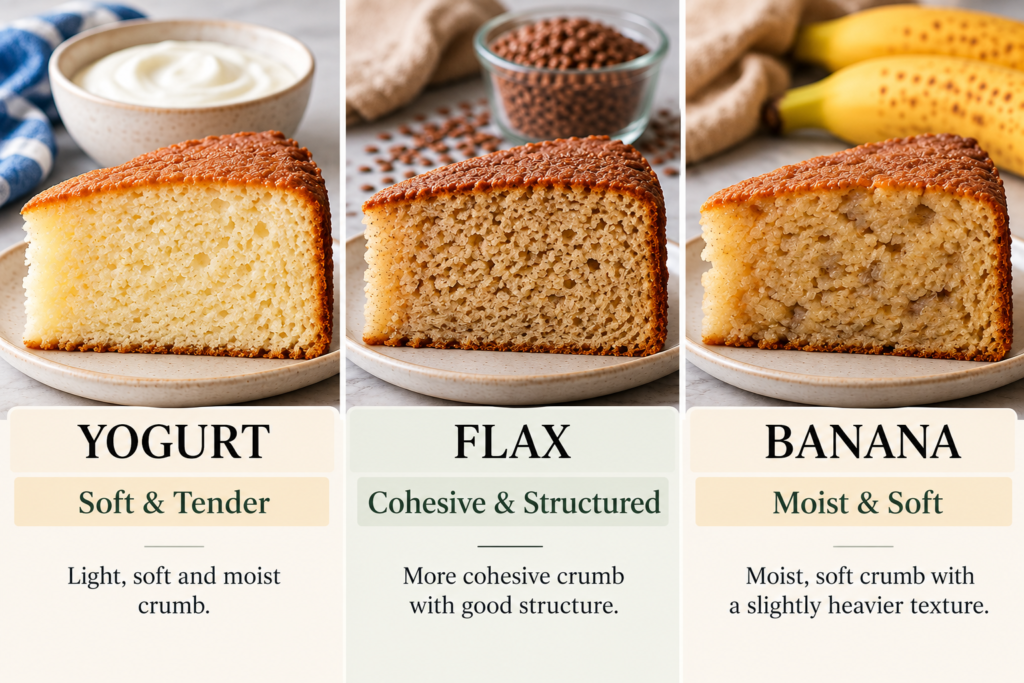
What If I Want a Very Soft Eggless Cake?
Start with the texture you want—not the substitute.
For a soft cake, I would look at the interaction between:
- flour
- liquid
- fat
- sugar
- egg substitute
- leavening
- mixing
- baking temperature
- baking time
Yogurt may be the most natural choice of these three when tenderness is the goal, but it cannot compensate for an incorrectly balanced recipe.
A cake with too much flour will not become wonderfully soft simply because you add yogurt.
Likewise, a cake that is overbaked will not stay moist because you used banana.
And a cake that lacks enough support will not automatically become successful just because you added flax.
I always come back to the same principle: the substitute has to work with the recipe, not against it.
If your goal is specifically a tender crumb, I explain the broader technique in how to make an eggless cake soft and moist.
What If My Cake Is Already Dense?
This is where I would stop and diagnose before changing the egg substitute.
A dense cake can result from several things:
- too much flour
- inaccurate measurement
- insufficient leavening
- excessive mixing
- unsuitable flour balance
- incorrect liquid balance
- oven problems
- an egg substitute that changed the batter significantly
If you simply replace yogurt with banana or flax without understanding the original problem, you may change the texture without actually fixing the cause.
For a detailed diagnosis, see what makes an eggless cake dense and how to fix it.
The important lesson is:
Don’t use an egg substitute as a cure for a problem that belongs somewhere else in the recipe.
What If My Cake Rises and Then Sinks?
This is another situation where changing the substitute blindly can make things worse.
A cake can rise beautifully and then collapse if its internal structure cannot support the expansion.
An egg substitute can influence that balance because it changes the batter’s moisture, density, acidity or binding characteristics.
But it is only one part of the picture.
If your cake rises and then sinks, first work through why an eggless cake rises and then sinks.
Then come back to this article and ask:
Did my substitute change the batter in a way that the original recipe was not designed to handle?
That is a much more useful question than simply asking whether the substitute is “good” or “bad.”
What If My Cake Does Not Rise?
Do not immediately add more baking powder.
This is one of the most common reactions I see in eggless baking.
Leavening creates expansion, but the batter also needs enough support to hold that expansion.
Your egg substitute can influence that balance.
For example:
- yogurt contributes acidity and moisture
- banana adds moisture and fruit solids
- flax contributes gel-like binding
Those are three very different batter environments.
If your cake is staying flat, first work through the common reasons an eggless cake does not rise before changing the formula.
What If My Cake Is Dry?
This is where I would resist the temptation to simply add more yogurt or banana.
A dry cake does not always need more moisture in the batter.
It may be affected by:
- flour quantity
- ingredient ratios
- baking time
- oven temperature
- moisture loss during baking
- the overall formulation
So before increasing the amount of an egg substitute, understand why an eggless cake becomes dry.
Remember:
A moist batter and a moist finished cake are not necessarily the same thing.
Yogurt, Flax and Banana in Gluten-Free Eggless Baking
This is where the choice becomes even more important.
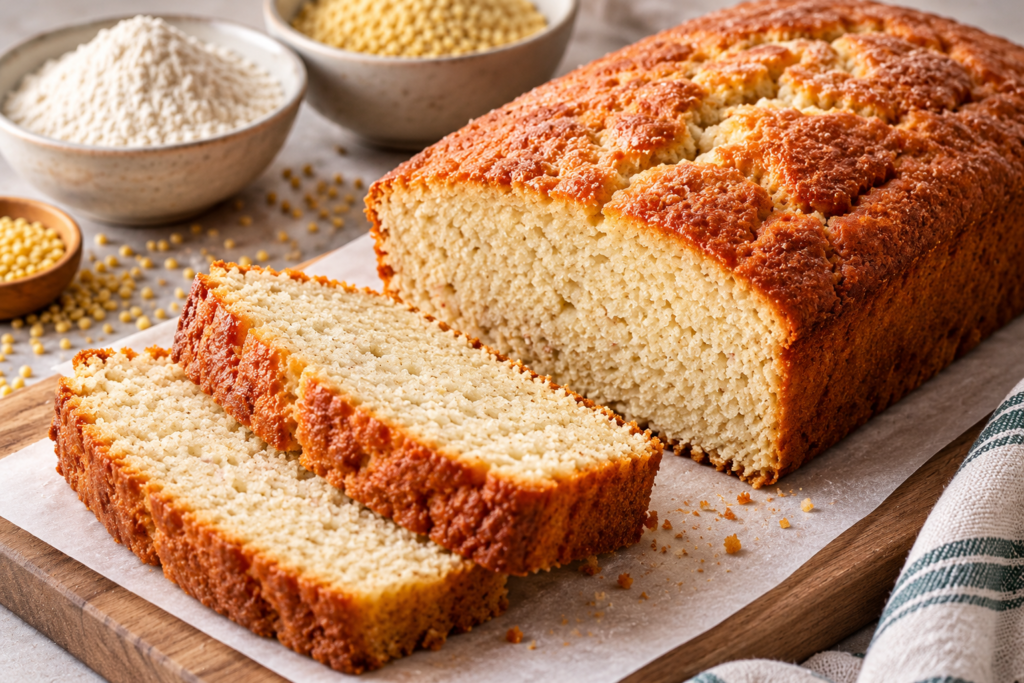
When you remove both eggs and gluten, the recipe has to build structure in other ways. The balance between the flour blend, starches, binders, hydration, fat, leavening and egg substitute becomes much more important.
A gluten-free eggless cake is therefore not simply a wheat-based cake made with a different flour. Each ingredient has to work with the others.
Yogurt in gluten-free baking
Yogurt can contribute moisture and tenderness, but the flour blend must be able to absorb and hold that moisture. Too much liquid in a weak gluten-free structure can leave the crumb heavy or gummy.
Flax in gluten-free baking
Flax can be particularly useful when gluten is absent because its hydrated gel helps bind the ingredients and create a more cohesive crumb.
Banana in gluten-free baking
Banana contributes moisture, natural sweetness and some binding, but it also brings fruit solids and a distinct flavour. The rest of the formula needs to accommodate those changes.
If you are working with millet, rice flour, almond flour, tapioca, potato starch or other gluten-free ingredients, the flour combination matters just as much as the egg substitute.
For the broader principles of gluten-free baking, explore the Gluten-Free Baking Guide.
Don’t Change the Egg Substitute and Flour at the Same Time
This is one of my favourite rules when developing or adapting a recipe.
Suppose your original cake uses yogurt.
You decide to make it vegan.
At the same time, you:
- replace yogurt with flax
- replace wheat flour with a gluten-free blend
- reduce the sugar
- change the oil
- add more baking powder
And then the cake fails.
What did you learn?
Almost nothing.
There were too many variables.
Instead, change one major variable at a time whenever possible.
If you are testing flax instead of yogurt, keep the flour, fat, sugar and baking conditions as consistent as you reasonably can.
Then compare:
- batter consistency
- rise
- crumb
- moisture
- tenderness
- flavour
- how the cake feels after cooling
This is how you begin to understand your own recipes.
The Substitute Should Match the Cake—Not the Other Way Around
This is perhaps the biggest takeaway from this article.
Don’t start with:
“I have yogurt. What cake can I make?”
Instead ask:
“What kind of cake am I trying to create?”
Then choose the ingredient that supports that result.
For a delicate, tender cake
Start by considering yogurt.
For a more structured vegan cake
Consider flax.
For a moist, naturally sweet fruit-based cake
Consider banana.
And then consider what the rest of the recipe is already contributing.
A Simple Eggless Cake Decision Process
When adapting a recipe, I use this thought process.
Step 1: What texture do I want?
Soft and tender?
More substantial?
Moist and fruity?
Step 2: What does the recipe already contain?
Is there already plenty of yogurt?
Milk?
Oil?
Fruit?
Liquid sweetener?
Step 3: What does my substitute add?
Water?
Sugar?
Acidity?
Gel?
Fruit solids?
Step 4: What changes in the batter?
Will it become wetter?
Heavier?
More cohesive?
Sweeter?
More acidic?
Step 5: Am I also baking gluten-free?
If yes, consider the flour blend, starches and binders as part of the same structural system.
Step 6: Change one major variable at a time
This makes troubleshooting much easier.
Don’t Forget the Oven
Even a well-balanced batter can fail if the baking conditions are wrong.
A correctly formulated eggless cake still needs:
- proper preheating
- an appropriate baking temperature
- the correct baking time
- a suitable position in the oven
- enough time to set before being removed
If you are unsure about your OTG, preheating or baking temperature, my guide on how to use your oven correctly for baking can help you understand the baking process more confidently.
Sometimes we blame the egg substitute for a problem that actually happened in the oven.
What I Have Learned From Years of Eggless Baking
One of the biggest changes in my own approach to eggless baking has been moving away from the idea of a “perfect egg replacement.”
There isn’t one.
There is only an ingredient that may be more suitable for a particular recipe.
Yogurt taught me how much tenderness can come from the right moisture and acidity.
Flax taught me the importance of binding and structure.
Banana taught me that an egg substitute can also change sweetness, flavour and the entire character of a cake.
Once you understand that, eggless baking becomes much less about substitution charts and much more about understanding ingredients.
And that is where the real improvement happens.
You stop asking:
“What can replace an egg?”
And start asking:
“What does this cake need?”
That is the question I would encourage you to ask every time you adapt an eggless recipe.
Frequently Asked Questions
Is yogurt better than flax for eggless cakes?
Not necessarily. Yogurt is particularly useful for moisture and tenderness, while flax is more useful when binding and structure are important. The better choice depends on the cake.
Is banana better than yogurt as an egg substitute?
Neither is universally better. Banana adds moisture, sweetness and fruit solids, while yogurt provides moisture, tenderness and acidity with a much milder flavour.
Can I substitute flax for yogurt in any eggless cake?
No. They contribute different properties to a batter. Flax forms a gel and provides binding, while yogurt contributes moisture, tenderness and acidity. A direct swap can change the texture significantly.
Which egg substitute gives the softest cake?
Yogurt is often a good choice when a soft, tender crumb is the goal, but the final texture depends on the complete recipe and baking method.
Which egg substitute is best for vegan cakes?
Flaxseed and banana are both vegan options. The better choice depends on whether you need more binding and structure or more moisture, sweetness and fruit flavour.
Can banana make an eggless cake gummy?
It can if the overall batter contains more moisture than the structure can support or if the cake is not baked sufficiently. Banana also contributes natural sugars and fruit solids, so it changes more than just moisture.
Can flax make an eggless cake dense?
Yes, particularly when too much is used or when the rest of the recipe does not provide enough lightness. Flax is better understood as a binding and structure-building ingredient rather than a shortcut to a lighter cake.
What is the best egg substitute for gluten-free eggless baking?
There is no single best choice. Gluten-free eggless cakes need to be considered as a complete system of flour, starch, binder, hydration, fat, leavening and egg substitute.
Why does changing my egg substitute change the whole cake?
Because an egg substitute does not simply replace an egg. It introduces its own water, solids, acidity, sugars, gel-forming ability, flavour and structural properties. Those changes affect the entire batter.
Final Takeaway
Yogurt, flax and banana can all make excellent eggless cakes—but they do different jobs.
Choose yogurt when tenderness and a mild flavour are your priority.
Choose flax when binding and structure matter more.
Choose banana when moisture, sweetness and fruit flavour are welcome.
And remember:
The best egg substitute is not the one that replaces the egg most closely.
It is the one that gives the cake what it needs.
Sharmila Sengupta | Baking Expert & Educator | 25+ Years of Baking Experience