
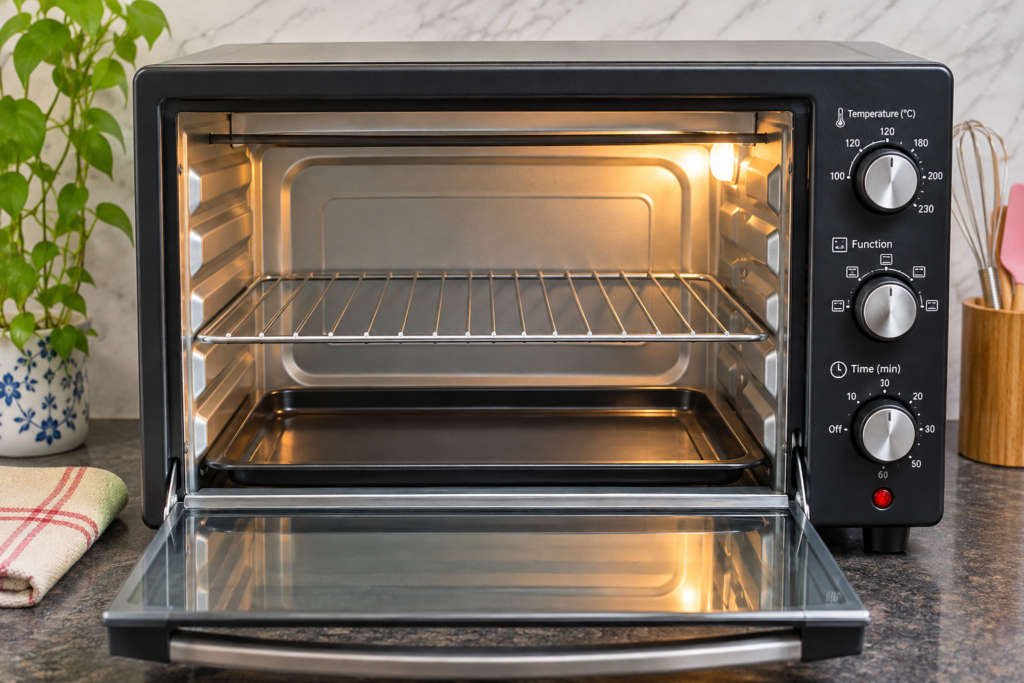
How to Choose an OTG Oven for Baking: 7 Checks Before You Buy
If you are wondering how to choose an OTG oven for baking, you may already have shortlisted two models. One has a larger capacity, while the other offers more heating settings. Both look suitable for home baking. But which one should you buy?
Before comparing brands and features, think about the baking you actually do.
Do you regularly bake 8-inch cakes? Do you use loaf pans for bread? Do you bake cookies in batches? Perhaps you have experienced cakes browning too quickly on top while remaining underbaked inside.
An OTG, or oven toaster grill, is a useful appliance for home baking, but not every model will suit every baker.
After more than 25 years of baking and teaching, I have found that an OTG’s advertised capacity and number of functions do not tell you everything about its suitability for baking. The internal dimensions, position of the heating elements, temperature behaviour and available rack space can matter much more.
I would suggest approaching an OTG purchase in the same way I approach a baking problem: first understand what you need, then identify the factors that could affect the result.
Here are seven practical checks to help you make your decision.
What Should You Check Before Buying an OTG?
If you already have a particular baking requirement in mind, this table will help you identify what to investigate.
| Your concern | What to investigate |
|---|---|
| Your cake tin does not fit or sits too close to the top | Internal dimensions and element clearance |
| You are unsure which oven size to buy | OTG capacity and usable rack space |
| Your cake browns too quickly on top | Upper element position and rack height |
| Your cake takes longer to bake than the recipe suggests | Preheating and actual oven temperature |
| Your bread loaf has insufficient room to rise | Internal height and loaf pan dimensions |
| You need to bake several trays | Convection function and rack arrangement |
| You want an oven that is practical to use regularly | Controls, accessories, ventilation and service |
A baking problem does not always point to an appliance problem. Recipe formulation, tin material, mixing, preheating and rack placement can also influence the result.
1. Will Your Baking Tins Fit Comfortably Inside the OTG?
One of the first things I would check is the actual usable space inside the oven.
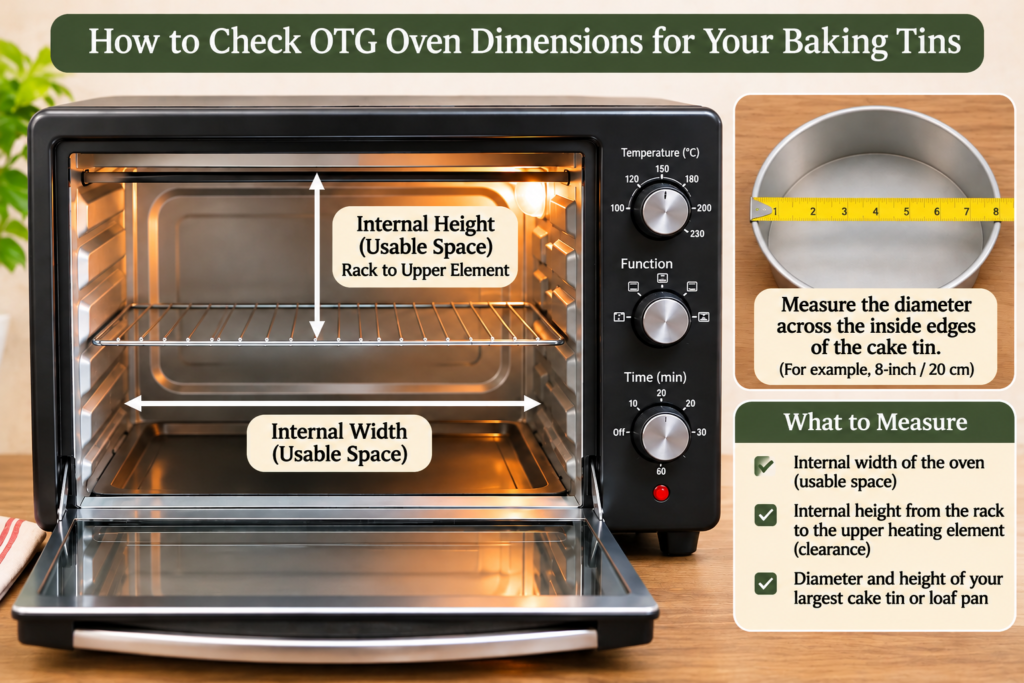
An OTG may be advertised as a 40-litre or 50-litre model, but its capacity alone does not tell you whether your baking tins will fit comfortably.
Two ovens with the same advertised capacity can have different internal dimensions.
Look for:
- Internal width and depth of the oven cavity.
- Available height between the rack positions.
- Distance between the upper heating element and the baking tin.
- Whether the rack can accommodate your largest cake tin or loaf pan.
Remember that fitting a tin inside the oven is not enough. There should be adequate clearance around it for heat circulation.
For example, if you regularly bake an 8-inch cake, measure the tin and compare it with the usable rack space. Also consider the height of your cake tin, particularly if you bake taller cakes.
I have found that a small difference in internal height can become quite important when baking taller cakes. A tin may fit inside the oven, but if it sits too close to the upper heating element, you may have less flexibility when choosing the rack position.
I would suggest measuring your largest cake tin and loaf pan before comparing OTG models. This simple step can prevent a disappointing purchase.
2. Choosing the Right OTG Oven Capacity for Baking
OTG capacity is usually expressed in litres. It gives you a general idea of the oven’s size, but it should not be the only factor in your decision.
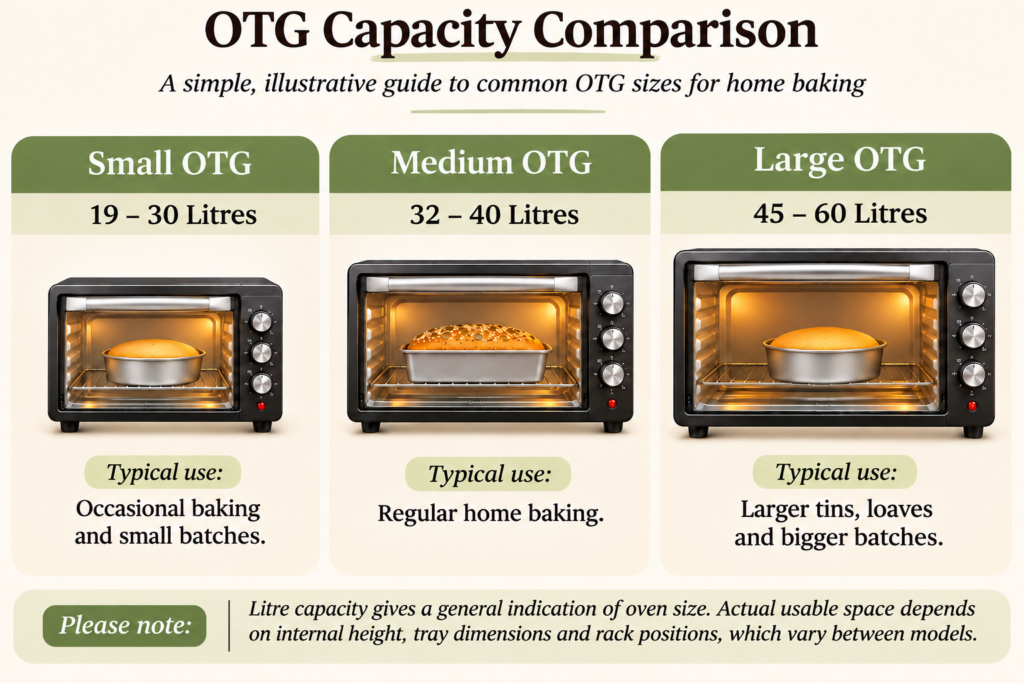
Here are some indicative capacity ranges:
| OTG capacity | Possible suitability |
|---|---|
| 19–30 litres | Occasional baking and smaller batches |
| 32–40 litres | Regular home baking, depending on internal dimensions |
| 45–50 litres | Larger tins, loaves and bigger batches, if the cavity permits |
| 52–60 litres | More generous space for larger baking requirements |
These are broad guidelines rather than fixed rules. The actual usable dimensions and rack arrangement matter more than the litre capacity alone.
A larger OTG may be useful if you bake frequently or prepare several products. However, it will also need more counter space and adequate ventilation around the appliance.
Think about how much you usually bake. If you mostly prepare one cake or a small batch of cookies, you may not need a very large oven.
On the other hand, if you regularly bake bread, larger cakes or multiple trays of cookies, additional space can be useful.
3. Heating elements and rack position
The position and operation of the heating elements are important when choosing an OTG.
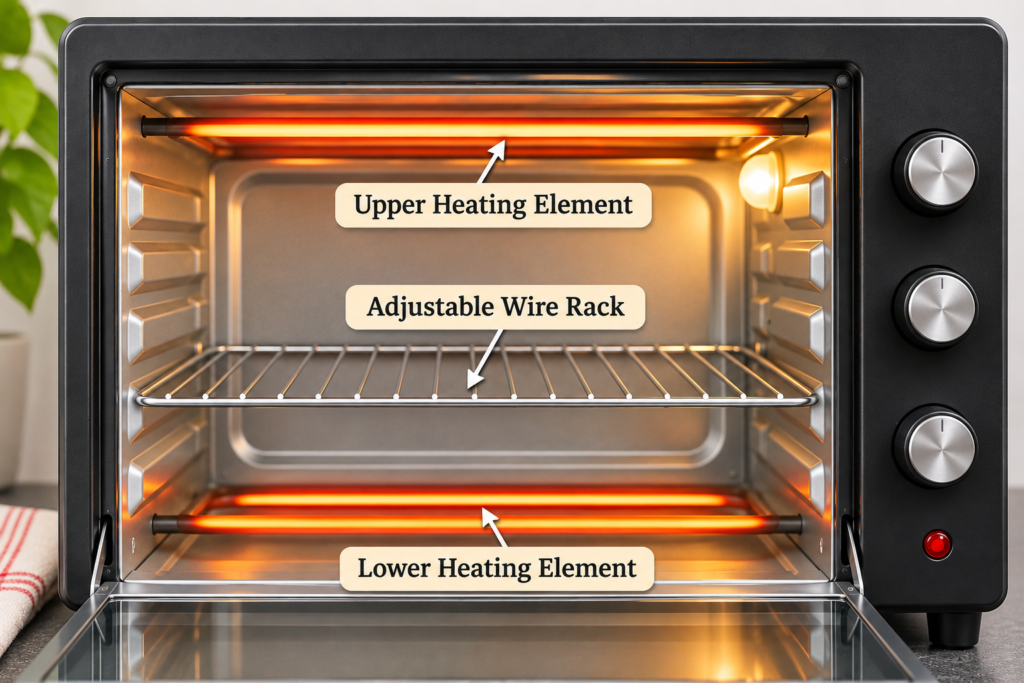
Most OTGs have heating elements at the top and bottom. Depending on the model, you may be able to select the top element, bottom element or both.
This gives you some control over how heat is applied during baking.
I would look at three things:
- Whether the top and bottom elements can be operated separately.
- Whether the oven offers different rack positions.
- Whether the upper element leaves sufficient room above your usual baking tins.
What if the top of your cake browns before the centre is baked?
This is a common concern, but it does not automatically mean the oven is unsuitable.
I would investigate the problem in this order:
- Look at the rack position. If the cake is placed too high, it may receive stronger heat from the upper element. Try a lower suitable rack position if your oven allows it.
- Check the distance from the upper element. A tall cake tin or a small oven cavity may leave very little space above the cake.
- Consider the baking tin. Dark-colored or different tin materials can influence how quickly the cake browns.
- Observe whether the problem occurs repeatedly. If the same pattern appears with different recipes and tins, it is worth investigating the oven’s heating behaviour.
Do not change several things at once. Observe what happens when you adjust one factor, so you can identify the likely cause.
4. Does the OTG Maintain the Temperature You Select?
Temperature control is one of the most important considerations when choosing an oven for baking.
A recipe may specify 170°C, but that does not automatically mean every OTG will maintain exactly that temperature throughout baking.
The thermostat, temperature sensor position, heating cycles and oven design can all influence temperature behaviour.
When comparing models, check:
- The available temperature range.
- Whether temperature settings are easy to adjust.
- The temperature increments available on the controls.
- Whether the user manual explains the heating settings clearly.
- Whether repeated customer reviews mention temperature-related problems.
A product listing cannot establish how accurately an oven maintains its selected temperature.
What if your cake takes longer to bake than the recipe suggests?
Before increasing the temperature or extending the baking time, investigate a few things.
- Check preheating. Starting with an oven that has not reached the required temperature can affect baking time.
- Check the actual temperature. Use an independent oven thermometer to compare the selected setting with the temperature inside the oven.
- Consider the baking tin. A deeper tin or a different material may affect how quickly heat reaches the centre.
- Check the recipe conditions. The quantity of batter, tin size and starting temperature of the ingredients can also influence baking time.
Some temperature fluctuation during heating cycles is normal. What matters is understanding how your particular oven behaves and adjusting your baking accordingly.
After purchasing an OTG, I always recommend checking its actual temperature behaviour with an independent oven thermometer.
If you would like to understand oven settings, rack positions and temperature adjustments in more detail, read my guide: How to Use an Oven for Baking: Temperature, Settings, Rack Position and Common Mistakes.
5. Will a Convection OTG Improve Your Baking Results?
Some OTGs include a convection function. This uses a fan to circulate hot air inside the oven.
The circulating air can help distribute heat and may be useful when baking multiple trays, depending on the oven’s design and the arrangement of the trays.
However, convection does not automatically guarantee even baking.
Before choosing a convection model, check:
- Whether the fan can be switched off.
- Whether the manual explains when to use convection.
- Whether the oven has enough usable space for the baking you intend to do.
- Whether the manufacturer provides guidance on temperature adjustments when using the fan.
Many recipes can be baked successfully using conventional top-and-bottom heating.
For eggless and gluten-free baking, I would not consider convection an essential requirement. The recipe formulation, mixing method, pan size and baking temperature remain important.
Choose convection if you have a practical use for it, rather than paying extra simply because it is an additional feature.
6. Choosing an OTG for Bread Baking
If you regularly bake bread, I would assess an OTG a little differently from someone who mainly makes cakes and cookies.
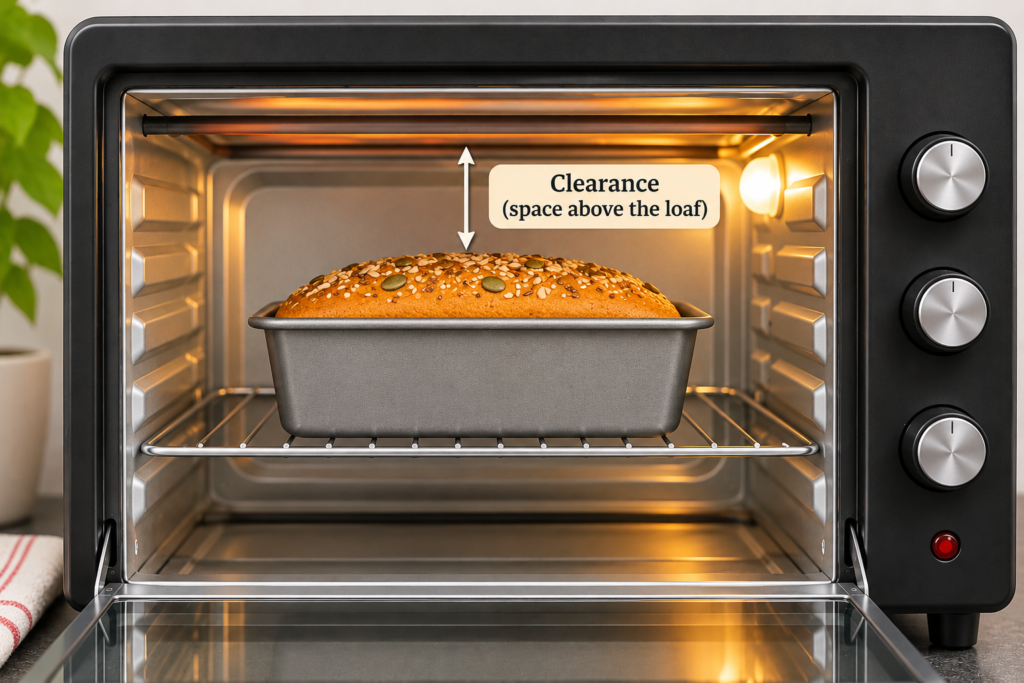
Bread baking places particular demands on an oven. The loaf needs sufficient room to expand, the oven must reach the temperature required by the recipe, and the heat must be suitable for baking the loaf through without excessive browning.
Here are the points I would consider:
- Temperature range: Check whether the OTG reaches the temperatures required by the bread recipes you use.
- Internal height: A tall loaf needs enough space above the pan, including room for expansion during baking.
- Loaf pan dimensions: Make sure your regular bread pans fit comfortably on the rack.
- Rack position: Check whether the available positions allow you to place the loaf at a suitable height.
- Baking duration: Bread often needs a longer baking period than smaller baked products. The oven should be practical for extended use.
- Electrical requirements: Check the wattage and the electrical requirements specified by the manufacturer.
In my experience, the internal height and loaf pan position deserve particular attention when choosing an OTG for bread. A loaf needs room to rise, but it also needs enough space above it to bake without the top sitting too close to the upper heating element.
What if your bread does not bake properly in the OTG?
The appearance and texture of the loaf can help you decide what to investigate.
- The loaf rises close to the upper element: Check the internal height and rack position. The pan may be too close to the top of the oven.
- The top browns much faster than the lower crust: Investigate the upper element’s proximity and rack position. Also check the selected temperature.
- The loaf remains pale or underbaked: Check preheating and actual oven temperature. Then consider whether the baking time and loaf pan size are appropriate.
- The loaf is gummy or compact inside: Do not immediately blame the OTG. In gluten-free bread, hydration, the balance of structural ingredients, mixing, baking time and cooling can all influence the crumb.
This last distinction is particularly important.
An oven can affect how a loaf bakes, but it cannot correct a formulation that contains too much moisture or lacks sufficient structure. Similarly, a loaf sliced while still warm may appear gummy even when it needs no further baking.
If a problem occurs repeatedly with different recipes, pans and batches, investigate the oven. If it occurs with only one recipe, examine the formulation and preparation first.
For gluten-free baking, my Gluten-Free Baking Guide for Beginners explains some of the ingredient and technique considerations involved.
7. Will the OTG Be Practical to Use and Maintain?
An oven may have several features, but it should also be convenient to use regularly.
Look beyond the basic specifications and consider the practical details.
Check whether the OTG includes:
- A sturdy wire rack.
- A suitable baking tray.
- A crumb tray.
- A removable or accessible interior for cleaning.
- Clear operating instructions.
- Adequate ventilation requirements.
- A reasonable warranty and accessible service support.
Also check the appliance’s dimensions against the space available in your kitchen. An OTG needs sufficient clearance around it for ventilation, as specified by the manufacturer.
If you bake frequently, ease of cleaning, reliable controls and accessible service support can become just as important as the advertised features.
How to Compare Two OTG Ovens Before Making Your Decision
Once you understand what you need from an OTG, comparing two or three shortlisted models becomes much easier.
I would suggest looking beyond the advertised capacity and number of functions. Instead, pay attention to the features that will actually make a difference to your baking.
| What to compare | What to look for |
|---|---|
| Usable space | Will your largest baking tin fit comfortably, with enough clearance around it? |
| Heating and temperature | Do the heating settings and temperature range suit the recipes you usually bake? |
| Additional features | Will you actually use convection and the accessories supplied with the oven? |
| Ownership requirements | Are the electrical requirements, warranty and service support suitable for your kitchen? |
To see how these considerations apply to actual appliances, take a look at my guide, Best OTG Oven in India for Baking (2026): Top Picks.
I have shortlisted six OTG models with different capacities and features. I have also explained how their specifications and features relate to everyday home baking. This should help you decide which model is more suitable for the kind of baking you do, rather than choosing simply because it has a larger capacity or more functions.
Before making your final decision, go through this checklist:
- My largest cake tin and loaf pan will fit comfortably.
- There is sufficient clearance around the baking tins.
- The oven capacity suits the quantity I usually bake.
- The heating selections and temperature range suit my recipes.
- I know whether the convection fan can be switched off.
- The oven’s electrical requirements are suitable for my kitchen.
- The accessories, ventilation requirements, warranty and service support meet my needs.
Remember that actual temperature behaviour and baking performance can only be assessed after you start using the oven. An independent oven thermometer is a useful tool for this.
Frequently Asked Questions About Choosing an OTG Oven
Which OTG is best for baking cakes?
Choose an OTG that accommodates your usual cake tins comfortably and offers suitable rack positions and temperature controls. Pay particular attention to the distance between the upper heating element and your cake tin. A larger capacity alone does not guarantee better baking.
What capacity OTG is suitable for home baking?
A 32–40 litre OTG can be a practical starting point for regular home baking. However, if you bake larger cakes, bread or multiple batches, you may need more space. Always compare the internal dimensions rather than relying only on the advertised litre capacity.
Is convection necessary in an OTG for baking?
No. Many cakes, cookies and breads can be baked successfully using conventional top-and-bottom heating. Convection can be useful when you need circulating hot air or want to bake multiple trays, but it is not essential for every home baker.
Which OTG should I choose for gluten-free bread?
Look for an OTG with a suitable temperature range, sufficient internal height and enough room for your loaf pan. Also consider how long your bread recipes need to bake. The oven should accommodate the loaf comfortably without placing it too close to the upper heating element.
Does higher wattage mean better baking?
Not necessarily. Wattage indicates electrical power consumption, not baking quality. Heating element arrangement, temperature behaviour and oven design also influence baking performance. I would compare these factors rather than choosing an OTG simply because it has a higher wattage.
Is a digital OTG better than a manual OTG?
Not automatically. Digital controls may offer convenient temperature and time settings, while manual controls can be straightforward to operate. The important thing is whether the controls are easy to use and whether the oven performs consistently for your baking requirements.
Final Thoughts
Choosing an OTG oven is not simply about buying the largest model or the one with the most features. It is about finding an oven that suits the kind of baking you actually do.
If you regularly bake cakes, you need suitable rack space and enough clearance around your tins. If you bake bread, internal height and temperature range deserve more attention. If you prepare several batches, the available space and convection function may influence your decision.
I have always found that understanding an oven is an important part of becoming a more confident baker. A little investigation before buying can save you considerable frustration later.
If you are also learning to understand why eggless cakes sometimes turn dense, dry or sink in the centre, you may find my Eggless Baking Guide: Common Problems, Causes and Easy Fixes helpful.
Sharmila Sengupta | Baking Expert & Educator | 25+ Years of Baking Experience