
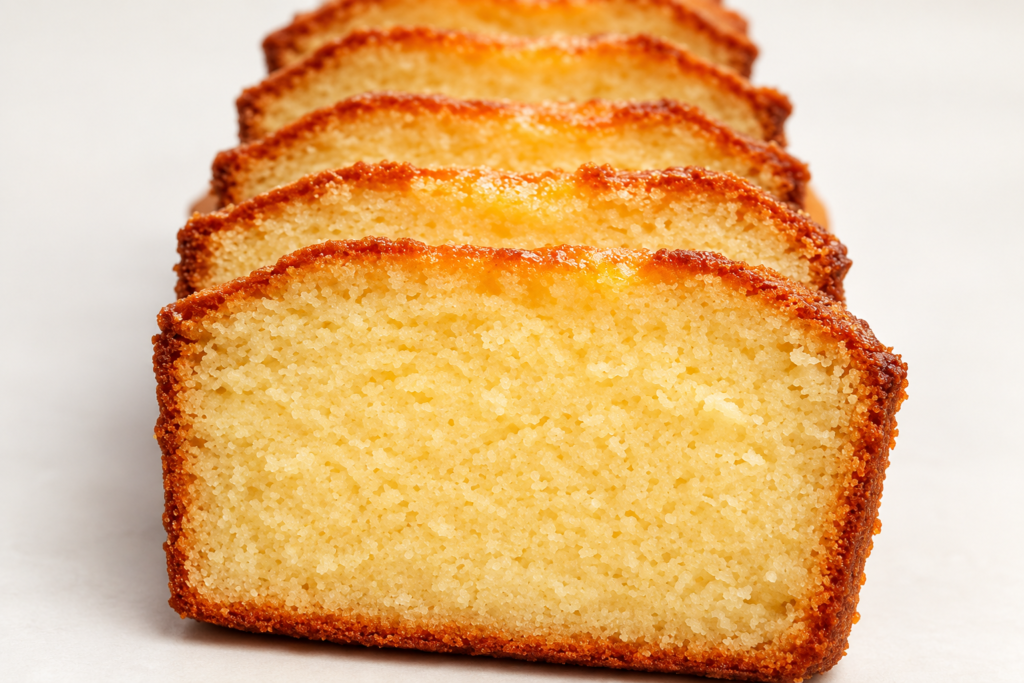
How to Make Eggless Cake Soft and Moist: A Practical Guide to a Tender Crumb
Learn how flour, liquid, fat, sugar, egg substitutes, leavening, mixing and baking work together to create a soft, tender eggless cake.
Want to know how to make eggless cake soft and moist instead of one that turns dry, dense or gummy?
The answer isn’t simply adding more yogurt or milk.
A good eggless cake comes from getting the relationship between flour, liquid, fat, sugar, egg substitute, leavening and baking right.
After more than two decades of baking, I have found that the softest eggless cakes are rarely the result of one secret ingredient. They come from understanding what each ingredient is doing — and knowing when not to add more.
The goal is simple: a cake with a tender crumb, good moisture retention and enough structure to hold together beautifully.
And there is one distinction I always keep in mind:
Moist does not mean wet, and soft does not mean under-baked.
Let’s look at what actually creates that texture.
Quick Problem Finder
Already know what is happening to your cake? Jump to the section that is most relevant.
- Dry? → Check moisture, fat and baking time.
- Dense? → Check flour, leavening and mixing.
- Sinking? → Check structure, leavening and oven temperature.
The individual troubleshooting articles linked later in this guide go deeper into each specific problem. This article focuses on the techniques that help you create a better texture in the first place.
What Makes an Eggless Cake Soft and Moist?
Eggs perform several jobs in a conventional cake.
They contribute moisture, structure, emulsification and richness.
When you bake without eggs, those functions have to be provided by a combination of ingredients and technique.
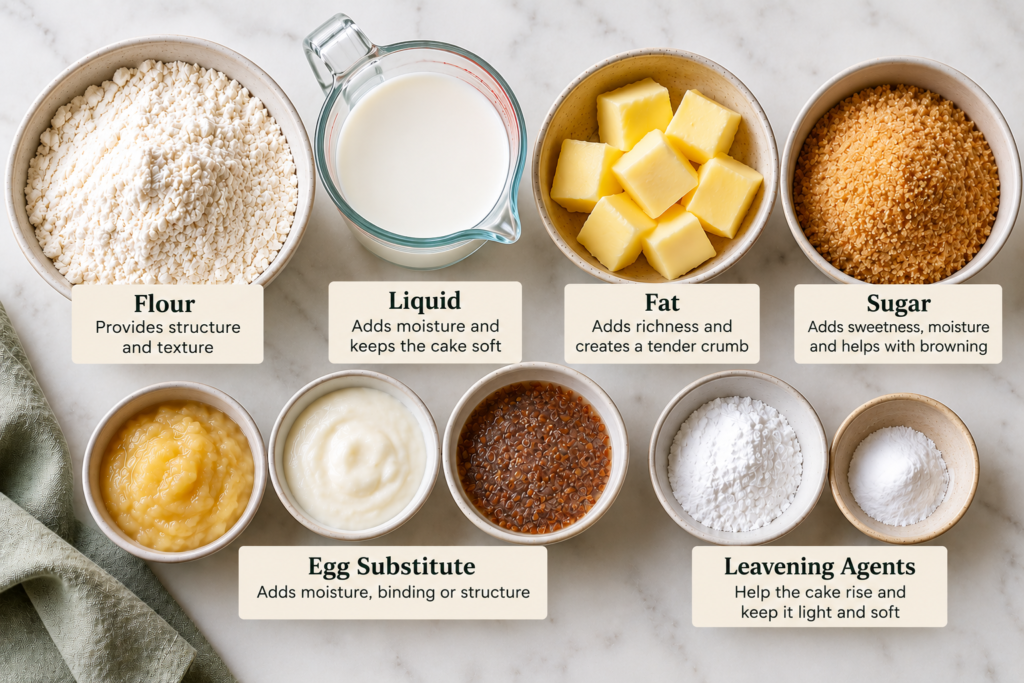
A soft eggless cake generally needs:
- enough liquid for hydration
- sufficient fat for tenderness
- an appropriate egg substitute
- enough sugar to help retain moisture
- controlled flour development
- effective leavening
- the right baking temperature
- enough time for the crumb to set
- proper cooling
- suitable storage
This is why simply adding more liquid isn’t always the answer.
Too little moisture can give you a dry cake. Too much moisture without enough structure can leave you with a gummy centre.
The texture comes from how all these components work together.
For a broader look at how eggless ingredients and techniques interact, see my Eggless Baking Guide.
1. Get the Flour-to-Liquid Ratio Right
This is one of the foundations of a tender cake.
Flour and other dry ingredients absorb liquid during mixing and baking. If there isn’t enough available moisture, the finished crumb can become firm and dry.
But the opposite can also happen.
Too much liquid can weaken the cake’s structure and leave the centre under-set.
This is where accurate measurement matters
I always recommend weighing ingredients when possible, particularly when developing or adapting a baking recipe.
Different flours absorb liquid differently.
Wholegrain flour, millet flour, almond flour and gluten-free flour blends do not behave in exactly the same way. Even two different gluten-free blends can have very different hydration requirements.
This is why I don’t recommend adding extra milk or yogurt simply because a batter looks thick.
Batter consistency has to be judged in the context of the recipe and the flour being used.
2. Use Fat to Create Tenderness
Fat plays an important role in cake texture.
Oil is particularly useful in eggless cakes because it remains liquid at room temperature. This can help the cake retain a softer mouthfeel after cooling.
Butter contributes wonderful flavour, but because it firms up when cool, a butter-based cake may feel firmer than an oil-based cake.
Oil can be useful when you want:
- a tender crumb
- softness after cooling
- a moist mouthfeel
- good texture over the first day or two
Butter can be useful when you want:
- richer flavour
- buttery aroma
- a more traditional cake character
Neither is automatically better.
The amount matters just as much as the type.
Too much fat can interfere with the cake’s structure and leave it heavy or greasy.
So again, I look at the overall formulation, rather than treating one ingredient as the answer to every texture problem.
3. Choose the Egg Substitute for Its Function
There isn’t one universal best egg substitute for eggless cakes.
The right choice depends on what you need the substitute to do.
Yogurt
Yogurt can contribute moisture, tenderness and acidity.
It can be especially useful in cakes where a soft crumb is desired.
Its acidity can also interact with baking soda in recipes where the leavening system has been formulated around an acidic ingredient.
Flax
Ground flax mixed with water forms a gel that can contribute binding and structure.
It can be useful when the batter needs additional cohesiveness, although too much can make a cake feel heavier.
Banana
Mashed banana contributes moisture, binding and sweetness.
It also brings its own flavour, so it works best when that flavour complements the cake.
Milk or buttermilk
Milk contributes liquid and richness.
Buttermilk contributes both liquid and acidity, making it useful in recipes designed around an acidic ingredient.
The important lesson is:
Choose an egg substitute according to the function you need — not simply because it adds moisture.
If you want to understand how yogurt, flax and banana behave differently, see [Yogurt vs Flax vs Banana in Eggless Baking].
4. Sugar Does More Than Sweeten the Cake
Sugar is also involved in moisture retention.
It interacts with water and can help a cake remain softer for longer.
But adding extra sugar is not a shortcut to a moist cake.
Too much sugar can affect:
- structure
- browning
- baking time
- centre setting
- overall texture
Liquid sweeteners such as honey and jaggery also change the formulation because they contribute moisture as well as sweetness.
That means they cannot always be substituted directly for dry sugar.
Whenever I change a sweetener in an eggless recipe, I consider what else that ingredient is bringing into the batter.
5. Mix the Batter Only as Much as Necessary
This is a small step that can make a noticeable difference.
Once the wet and dry ingredients come together, there is usually no benefit in continuing to mix simply to make the batter look smoother.
In wheat-based cakes, overmixing can encourage excessive gluten development and produce a tougher crumb.
Even in gluten-free baking, unnecessary mixing can affect the batter’s aeration and structure.
My rule is simple:
Mix until the ingredients are properly combined — then stop.
The batter does not need to be worked like bread dough.
If there are a few small imperfections that disappear during baking, that’s preferable to overworking the mixture.
6. Get the Leavening Right
Baking powder and baking soda help create the gases responsible for the cake’s rise.
But more leavening does not automatically mean a lighter cake.
Too little can produce a heavy cake.
Too much can make the cake rise quickly and then lose its structure.
The correct amount depends on the complete formulation — including flour, liquid, acidity and the other ingredients.
This is particularly important in eggless baking because you cannot rely on eggs for the same contribution to aeration and structure.
If your cake consistently refuses to rise, look at the complete leavening system rather than simply adding more baking powder.
For that specific problem, see Why Is My Eggless Cake Not Rising?
7. Your Oven Temperature Can Change the Texture
A well-formulated batter still needs the right baking environment.
The oven has to provide enough heat for the batter to rise and the crumb structure to set.
If the temperature is too low, the cake may take too long to set and can remain heavy or under-baked.
If it is too high, the outside can set and brown before the centre has properly cooked.
For consistent results:
- Preheat the oven properly.
- Use the temperature specified in the recipe.
- Use the correct tin size.
- Position the tin appropriately.
- Avoid repeatedly opening the oven during early baking.
- Allow the cake enough time to set.
If you’re using an OTG and want to understand preheating, rack position and baking temperature in more detail, see How to Use an Oven for Baking?
8. Don’t Bake by the Clock Alone
A recipe may say 30 minutes, but your cake may need slightly more or less time.
Oven characteristics, tin material, tin size and batter depth can all affect baking.
Instead of relying only on the timer, look for signs of doneness.
The top should look set, the centre should no longer appear liquid, and a skewer should come out without wet batter.
There is a delicate balance here.
Under-baking leaves an incompletely set crumb. Over-baking removes too much moisture.
Both can give you a cake with poor texture.
9. Let the Cake Finish Setting as It Cools
Cooling is not simply something you do after baking.
It is part of the process.
A cake coming out of the oven is still delicate. Its crumb continues to settle as it cools.
Removing it from the tin too quickly can make the structure fragile.
Leaving it in the tin for too long can allow condensation to affect the base and sides.
I generally let the cake rest briefly in the tin before transferring it to a cooling rack, depending on the recipe and tin being used.
And I resist the temptation to cut into it while it is still very hot.
A cake that feels slightly soft when warm may develop a much better crumb as it cools completely.
10. Store the Cake Properly
Even a well-baked cake can lose its texture if it is stored poorly.
Once completely cool, protect the cake from unnecessary exposure to air.
For most cakes, an airtight container is the simplest solution.
Refrigeration can also change texture because some fats firm up when chilled.
If a cake needs refrigeration, allow it to come closer to room temperature before serving when appropriate. You may notice a softer, more pleasant crumb.
Storage is therefore part of the texture equation.
The cake isn’t finished when it leaves the oven.
Moist Does Not Mean Gummy
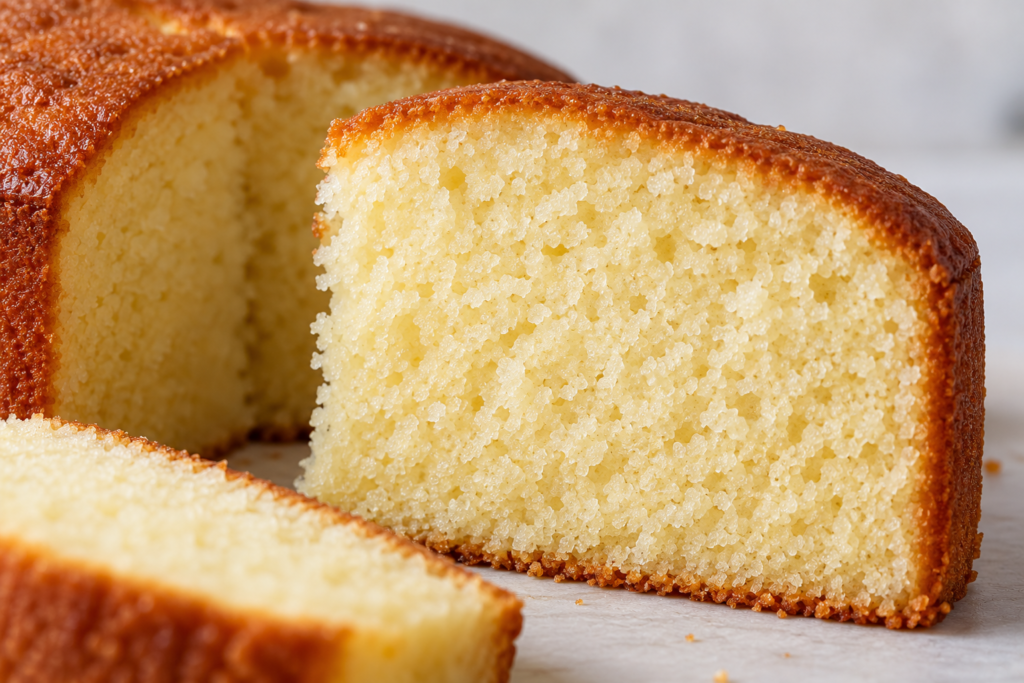
This distinction matters because moisture and gumminess are often confused in eggless baking.
A properly baked moist cake feels tender and moist to the bite, but never sticky or pasty.
A gummy cake often feels:
- sticky
- pasty
- wet in the centre
- heavy despite having plenty of moisture
So if you have increased milk or yogurt because you wanted a softer cake and ended up with a sticky centre, adding even more liquid is unlikely to solve the problem.
The issue may be the relationship between hydration, flour, structure and baking time.
For a dedicated diagnosis, see Why Is My Eggless Cake Gummy in the Middle?
What If Your Cake Is Already Dry, Dense or Sinking?
This guide is about creating the right texture.
If the cake has already failed, don’t start changing several ingredients at once.
Identify the symptom first, then change one variable at a time.
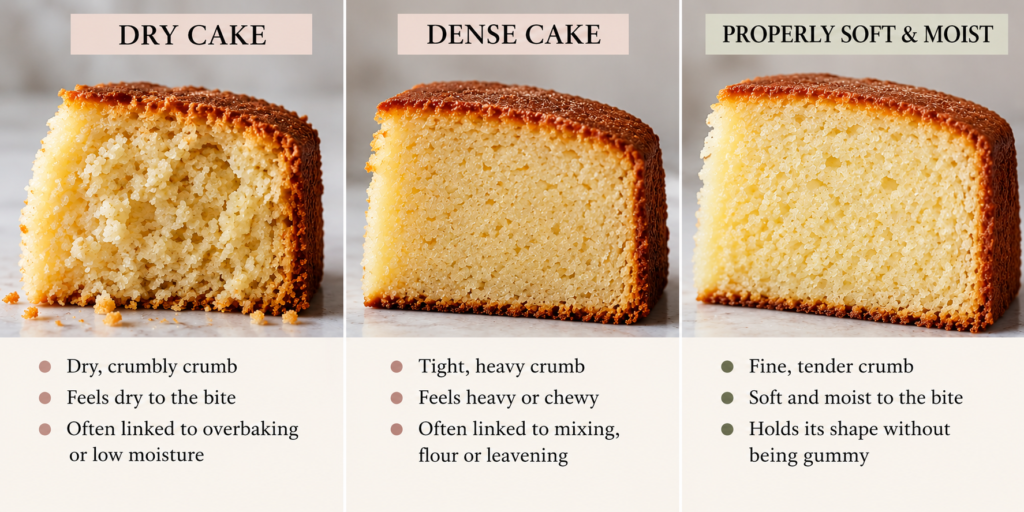
If your eggless cake is dry
Look at the flour, available moisture, fat and baking time.
Over-baking is particularly easy to overlook because even a well-balanced batter can become dry if it stays in the oven too long.
For a detailed diagnosis, see Why Is My Eggless Cake Dry?
If your cake is dense
A dense cake does not automatically need more liquid.
Flour quantity, leavening, mixing, the egg substitute and baking conditions can all affect density.
For the specific causes and fixes, see Why Is My Cake Dense?
If your cake sinks
A cake that rises and then collapses can point to a problem with structure, leavening, excess liquid or baking.
For a deeper diagnosis, see Why Does My Eggless Cake Sink?.
A Special Note About Gluten-Free Eggless Cakes
When you remove both eggs and gluten, structure becomes even more important.
Gluten contributes elasticity and structure in conventional wheat-based cakes.
A gluten-free eggless cake has to achieve that structure differently.
That means flour selection, starch, hydration and binding need to be considered together.
If you are new to gluten-free baking, my Gluten-Free Baking Guide explains how gluten-free flour blends, starches, binders and moisture work together, and why simply replacing wheat flour can produce a dry, dense or crumbly cake.
Ingredients such as xanthan gum or psyllium may be useful in particular gluten-free formulations, but they are not interchangeable and should not simply be added because a cake feels weak.
This is why I prefer developing gluten-free eggless recipes specifically for the flour blend being used rather than taking a conventional cake and replacing the flour as an afterthought.
The flour is not just a substitute.
It changes how the entire batter behaves.
What I Look For When I Test an Eggless Cake
After years of baking, I don’t judge an eggless cake only by how it looks when it comes out of the oven.
I look at the crumb after it has cooled completely.
I check whether it feels tender without being wet, whether the centre has set properly, and whether the cake still feels pleasant after it has rested for a few hours.
That tells me much more than simply asking whether the cake rose.
I’ve also learned that the best corrections are usually small and deliberate.
If a cake is dry, I don’t automatically add more yogurt.
If it is dense, I don’t automatically add more baking powder.
If it is gummy, I don’t automatically bake it for another 20 minutes.
First, I ask what the texture is telling me.
That approach has saved me from making many unnecessary changes to otherwise good recipes.
My Simple Way of Thinking About a Soft Eggless Cake
When I develop or troubleshoot an eggless cake, I think about five things:
1. Moisture
Where is the water coming from?
Milk? Yogurt? Fruit? Another liquid ingredient?
2. Tenderness
What is helping create the eating texture?
Oil? Butter? Another source of fat?
3. Structure
What is holding the cake together?
Flour? Starch? Binding ingredients? The egg substitute?
4. Leavening
What is creating the lift?
Baking powder? Baking soda? Air incorporated during mixing?
5. Setting
How will the oven transform the batter into a stable crumb?
Temperature, tin size and baking time all matter.
When those five elements work together, you have a much better chance of getting the texture you want.
The Biggest Mistake: Changing Everything at Once
This is something I have learned through years of baking.
When a cake doesn’t turn out as expected, it is tempting to change everything in the next batch:
More yogurt.
More milk.
Less flour.
More baking powder.
Lower temperature.
Longer baking time.
The problem is that you then don’t know which change actually helped.
Instead, change one variable at a time.
If the cake is dry, examine moisture and baking time.
If it is dense, examine flour, leavening and mixing.
If it is gummy, examine hydration, structure and doneness.
If it sinks, examine leavening, structure and baking.
That approach gives you information.
And once you understand what your ingredients are doing, you stop baking by guesswork.
Soft Eggless Cake Checklist
Before putting your next cake into the oven, check:
- Ingredients weighed accurately
- Flour measured correctly
- Liquid ingredients measured correctly
- Egg substitute appropriate for the recipe
- Fat measured correctly
- Leavening correctly measured
- Batter mixed only until combined
- Correct tin size used
- Oven properly preheated
- Cake positioned correctly in the oven
- Oven door kept closed during early baking
- Cake checked for doneness rather than relying only on the timer
- Cake cooled properly
- Cake stored in an airtight container
These may look like small details, but together they have a significant effect on the final crumb.
Frequently Asked Questions
How can I make an eggless cake soft and moist?
Use a well-balanced combination of flour, liquid, fat, sugar and an appropriate egg substitute. Mix only until combined and avoid over-baking. Proper cooling and storage also help preserve the texture.
Does yogurt make eggless cake soft?
Yogurt can contribute moisture, tenderness and acidity. It can be particularly useful in recipes designed to work with baking soda. However, adding more yogurt is not automatically better; the quantity needs to fit the rest of the formulation.
Is oil better than butter for a soft eggless cake?
Oil often gives a softer crumb after cooling because it remains liquid at room temperature. Butter provides excellent flavour but can produce a firmer texture when chilled.
Why is my eggless cake moist but gummy?
A moist cake should have a tender, properly set crumb. A gummy cake can indicate excess moisture, an unsuitable flour-to-liquid ratio, insufficient baking or inadequate structure.
Why does my eggless cake become dry the next day?
Possible reasons include over-baking, insufficient moisture retention or exposure to air during storage. The type of fat and whether the cake has been refrigerated can also affect how the crumb feels later.
Can I use any egg substitute in an eggless cake?
No. Different substitutes contribute different properties. Yogurt, flax, banana and other options can affect moisture, binding, structure, flavour and density differently.
How do I make a gluten-free eggless cake soft?
Use a recipe formulated specifically for the gluten-free flour blend and binding system. Gluten-free eggless cakes require careful attention to hydration, starch, binding and structure.
Final Thoughts
A soft eggless cake is not created by one secret ingredient.
It comes from understanding what each ingredient contributes.
Flour provides structure.
Liquid provides hydration.
Fat contributes tenderness.
Sugar helps with sweetness and moisture retention.
The egg substitute performs specific moisture, binding or structural functions.
Leavening creates lift.
The oven sets the crumb.
Cooling allows the structure to settle.
Storage protects the texture.
Once you start looking at eggless baking this way, it becomes much less mysterious.
And this is the approach I have developed through years of baking:
Don’t just ask why a cake failed. Understand what the cake needed in the first place.
Sharmila Sengupta | Baking Expert & Educator | 25+ Years of Baking Experience