
Why Is My Eggless Cake Gummy in the Middle? Causes & Easy Fixes
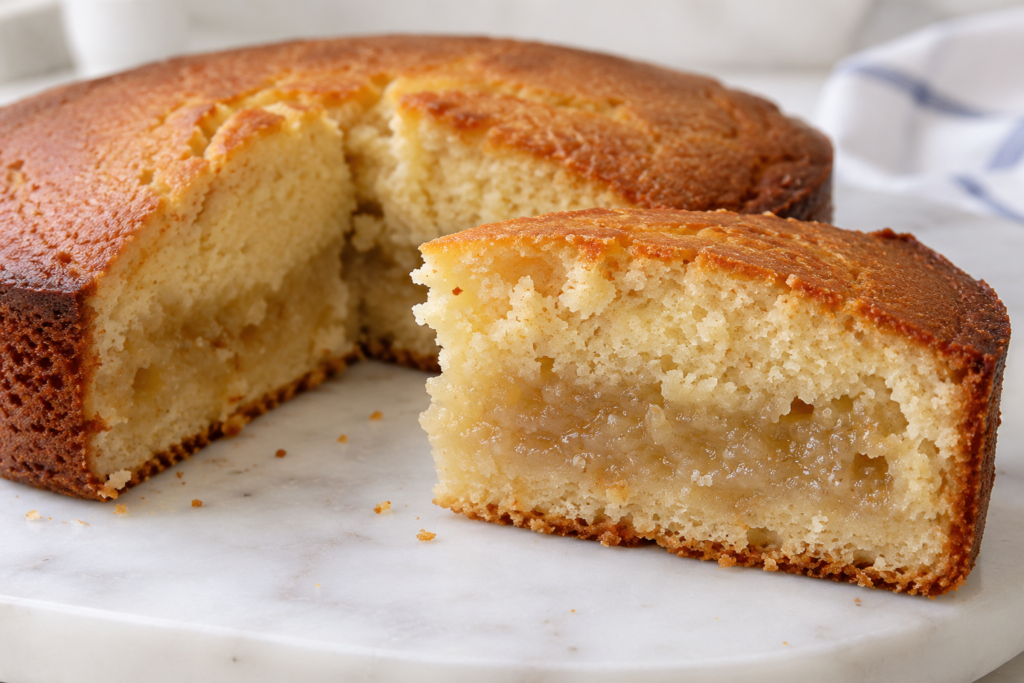
Your eggless cake looks beautifully baked on top, but when you slice it, the centre is sticky, gummy or almost pasty.
If that sounds familiar, you are not alone. A gummy centre is one of the more common eggless baking problems, and it does not always mean that you simply needed to bake the cake longer.
The good news is that a gummy centre usually has a reason. The key is to work out whether you are dealing with underbaking, excess moisture, an oven-temperature problem, a pan-size issue, or a lack of structure.
A good eggless cake can have a soft, moist texture while still having a properly set crumb. A gummy cake is different.
After more than 25 years of baking, I have learned not to change five things at once when a cake goes wrong. I first look at the crumb and ask:
What is the cake telling me?
This guide will help you do the same.
Part of my Eggless Baking Guide: Common Problems, Causes & Easy Fixes. Use this article when the specific problem you are trying to solve is a gummy, sticky or wet centre.
Quick Answer: Why Is My Eggless Cake Gummy in the Middle?
An eggless cake usually becomes gummy in the middle because the centre has not set properly or the batter contains more moisture than its structure can support.
The most common causes are:
- The cake is underbaked.
- The oven temperature is too high.
- The pan is smaller or deeper than the recipe requires.
- There is too much liquid in the batter.
- Too much yogurt or fruit purée has been added.
- The egg substitute has changed the moisture balance.
- There is too much sugar or liquid sweetener.
- The flour-to-liquid ratio is out of balance.
- The leavening is not properly balanced.
- A gluten-free eggless cake does not have enough structural support.
- The cake has been sliced before it has cooled and set.
Do not immediately add more flour or baking powder.
First identify what kind of gummy centre you have. The appearance of the cake can give you a surprisingly good clue.
Quick Problem Finder
If you want a quick diagnosis, find the description that sounds most like your cake.
| What you see | Check this first |
|---|---|
| Brown top but wet centre | Oven temperature and baking time |
| Sticky centre but no raw batter | Moisture balance and cooling |
| Gummy centre and the cake has sunk | Underbaking and excess moisture |
| Dry edges but gummy middle | Oven too hot or pan too deep |
| Whole cake is dense and gummy | Flour/liquid balance and structure |
| Cake is moist but not sticky | It may actually be baked correctly |
| Gluten-free eggless cake is gummy | Flour blend, starch, binder and hydration |
| Problem started after changing egg substitute | Egg substitute and total liquid |
| Cake is gummy only when hot | Allow it to cool completely |
| Same recipe works sometimes but not always | Oven temperature and ingredient measurement |
If your cake has actually collapsed in the middle, rather than simply having a gummy centre, read my detailed guide on Why Does My Eggless Cake Sink?. That article looks specifically at collapse, excess leavening, weak structure and the reasons an eggless cake sinks.
Is Your Eggless Cake Gummy Only in the Centre?
If the edges are properly baked, slightly firm and nicely browned, but the middle is sticky or pasty, the pattern itself gives you an important clue.
Start with these four checks:
1. Oven temperature
Could the oven be running hotter than the displayed temperature?
2. Pan depth
Was the batter deeper than intended because you used a smaller or deeper pan?
3. Baking time
Was the cake removed before the centre had properly set?
4. Moisture
Did you add extra yogurt, fruit, milk, syrup or another liquid?
These four checks will usually tell you more than simply adding more flour.
If this pattern happens repeatedly, an oven thermometer can be useful because the temperature shown on a home oven is not always the actual temperature inside the cavity.
For more on preheating, temperature accuracy and rack position, see my guide on How to Use Your Oven for Baking.
First, Is Your Cake Really Gummy?
This is an important distinction.
A properly baked eggless cake can be soft and moist while still having a tender crumb that holds its shape. When you press it gently, it should have some structure and spring back slightly.
A gummy cake is different.
The centre may:
- feel sticky when touched
- cling to the knife
- look shiny or pasty
- compress instead of springing back
- have a dense, almost pudding-like texture
- contain a wet-looking strip through the middle
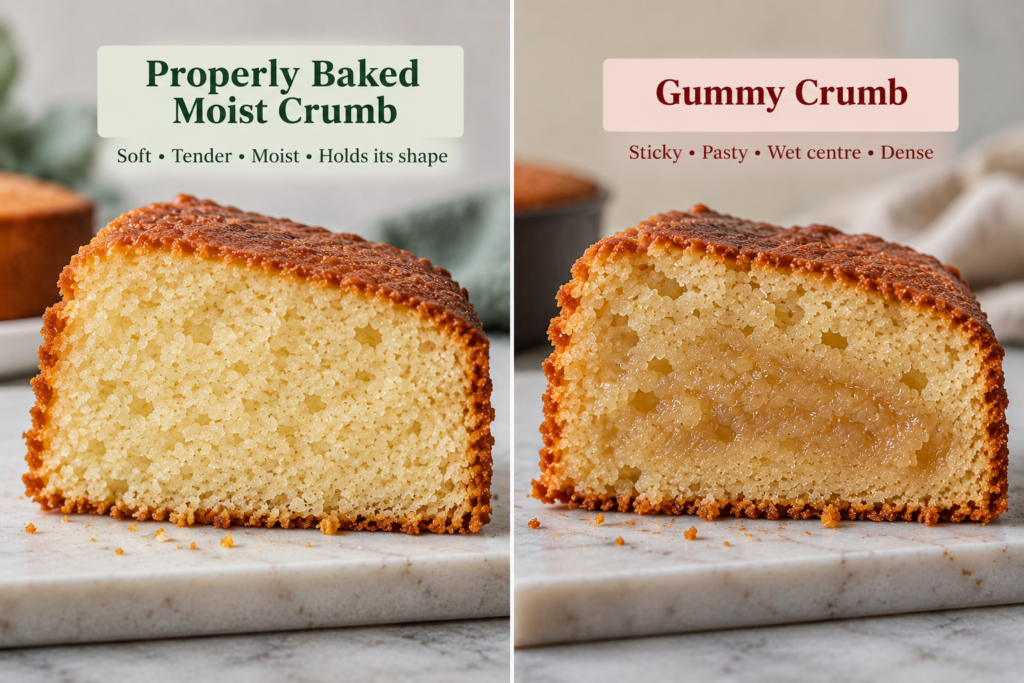
Sometimes, the centre is not simply underbaked. It may contain more moisture than the cake’s structure can hold.
This is particularly important in eggless baking because eggs normally perform several functions in a cake. They contribute to structure, binding, moisture, emulsification and stability.
When eggs are removed, those functions have to come from other ingredients.
That is why eggless baking is not simply a matter of replacing one egg with one particular ingredient. The replacement also changes the moisture, structure and overall balance of the cake.
1. The Cake Is Underbaked
This is the first thing I check when the centre is genuinely wet or gummy.
A cake can look beautifully golden on top while the middle is still not fully set.
The outside of the cake receives heat first. The edges and top can become firm and browned while the centre is still soft.
Signs that underbaking is the problem
Look for several clues together:
- The centre jiggles when the pan is moved.
- A skewer comes out with wet batter.
- The middle feels much softer than the edges.
- The cake sinks shortly after coming out of the oven.
- The crumb looks wet rather than simply moist.
- The centre becomes noticeably firmer with additional baking.
A cake tester should not come out coated in raw batter. A few moist crumbs are very different from wet batter.
How to fix it
Bake until the centre is properly set rather than relying only on the colour of the top.
If the top is browning too quickly while the centre is still underbaked, however, do not automatically increase the oven temperature.
That can make the problem worse.
2. Your Oven Is Too Hot
This is one of the most confusing causes of a gummy centre.
You might think:
“If my oven is hotter, surely the cake will bake faster.”
Not necessarily.
When the oven is too hot, the outside can set and brown very quickly while the centre continues to bake more slowly.
The result can be:
- dark or firm edges
- a well-browned top
- cracks on the surface
- a high dome
- a soft or gummy centre
- sinking as the cake cools
So if your cake is repeatedly brown outside but gummy inside, look at the oven before changing the recipe.
A home oven’s displayed temperature is not always the actual temperature inside the cavity. This is one reason I recommend using an oven thermometer if you are getting inconsistent baking results.
3. The Pan Is Too Small or Too Deep
Pan size affects the thickness of the batter.
Suppose a recipe is designed for a wider pan but you use a smaller one.
The same quantity of batter now sits deeper.
The outside may bake normally, but heat takes longer to reach the centre.
That can leave you with exactly the problem we are trying to solve:
firm edges + baked-looking top + gummy middle.
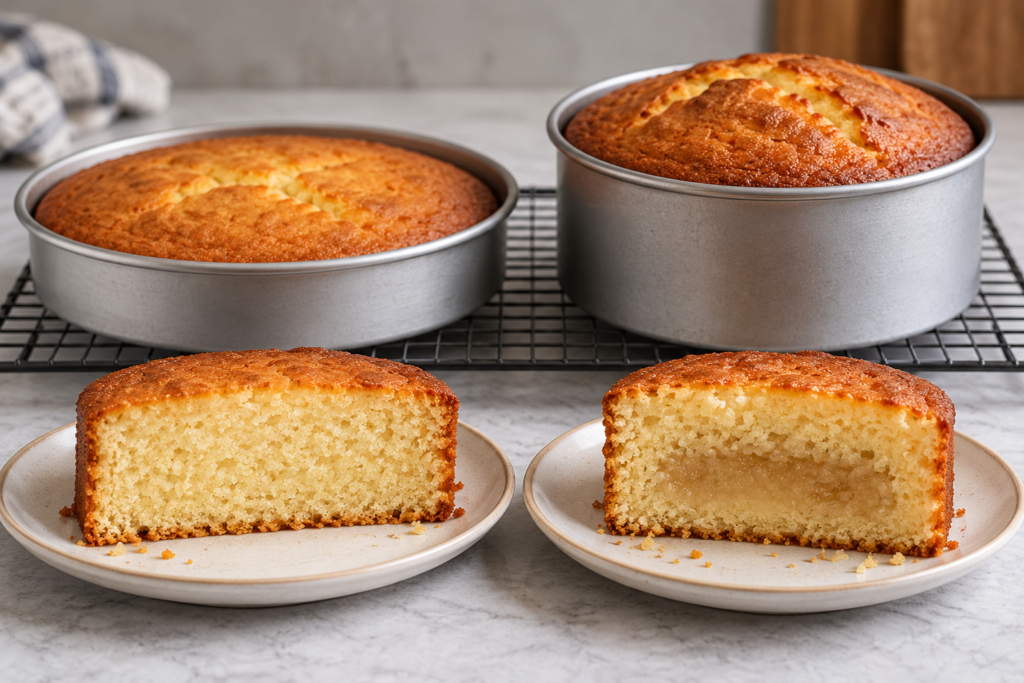
When troubleshooting, check:
- pan diameter
- pan depth
- quantity of batter
- pan material
- oven temperature
- baking time
If you change the pan, do not assume the original baking time will still work.
And try not to change the pan and the recipe at the same time. Otherwise, you won’t know which change caused the improvement.
4. There Is Too Much Liquid in the Batter
Eggless cakes often contain ingredients such as:
- milk
- yogurt
- buttermilk
- fruit purée
- plant milk
- oil
- melted butter
- syrups
- other liquid sweeteners
All of these can affect the final texture.
The important thing is not simply how much liquid you add. It is how much moisture the flour and structural ingredients can absorb and hold.
If the batter contains more moisture than its structure can support, the cake may rise but fail to set properly in the centre.
This is where many troubleshooting attempts go wrong
You bake a gummy cake and think:
“Perhaps I need more flour.”
You add more flour.
The next cake comes out dry and dense.
That is because the problem was not necessarily “too little flour.” The original formula may have had an imbalance between flour, liquid, fat, sugar, leavening and structure.
I always prefer to look at the complete formula rather than correcting one ingredient blindly.
5. Too Much Yogurt Can Make an Eggless Cake Gummy
Yogurt is extremely useful in eggless baking.
It can contribute:
- moisture
- tenderness
- acidity
- richness
- some structural support
But yogurt is not simply interchangeable across recipes.
Different yogurts have different thicknesses, water content and acidity.
If you add extra yogurt because you want a softer cake, you may accidentally increase the moisture beyond what the recipe can handle.
If your cake became gummy after adding more yogurt
Check:
- How much yogurt was originally specified?
- Did you change the type of yogurt?
- Is the yogurt much thinner than the one used when the recipe was developed?
- Did you add yogurt in addition to another liquid?
- Did you change the flour at the same time?
This is why I always recommend changing one variable at a time.
6. Fruit Purée or Banana Can Add More Moisture Than You Expect
Fruit purées can be excellent egg substitutes, but they also bring water and natural sugars into the batter.
Banana, applesauce and other fruit purées can affect:
- moisture
- sweetness
- density
- browning
- structure
- baking time
If you increase the amount of fruit purée simply because you want a softer cake, you may end up with a cake that is soft on the outside but gummy in the middle.
The same principle applies when adapting recipes.
If you replace an egg with fruit purée, you are not only replacing the function of the egg—you are also introducing a different ingredient with its own water, solids and sugars.
7. Your Egg Substitute May Be Changing the Whole Formula
This is one of the most important things to understand about eggless baking.
There is no universal egg substitute that behaves exactly like an egg in every cake.
For example:
Yogurt
Useful for moisture, tenderness and acidity.
Flaxseed gel
Useful primarily for binding and structure, but it also contributes moisture.
Fruit purée
Can add moisture, sweetness and softness.
Aquafaba
Can contribute moisture and, in some applications, aeration.
Starches and commercial egg replacers
Can provide different types of binding or structure depending on the formulation.
So instead of asking:
“What can I use instead of an egg?”
I find it much more useful to ask:
“What was the egg doing in this particular cake?”
If the egg was contributing structure and you replace it mainly with a high-moisture ingredient, the cake may become too wet for the structure available.
That is when you can end up with a gummy centre.
This is also why I recommend starting with a properly developed Eggless Baking Guide when learning how different egg substitutes behave, rather than treating every eggless recipe as if the same substitution will work.
8. Too Much Sugar Can Affect the Centre
Sugar does much more than sweeten a cake.
It also affects:
- moisture retention
- browning
- tenderness
- setting
- texture
If you increase sugar, add syrup, or replace granulated sugar with a liquid sweetener without adjusting the rest of the formula, the cake may hold more moisture.
The outside may brown beautifully while the middle remains softer than expected.
This is particularly important when adapting eggless recipes.
If the original recipe works well, avoid changing the sweetener and egg substitute simultaneously.
Otherwise, troubleshooting becomes guesswork.
9. Leavening Is Not Always the Answer
When a cake is gummy, some bakers immediately think:
“It didn’t rise enough. I need more baking powder.”
Be careful.
Too little leavening can certainly contribute to a heavy cake, but adding extra baking powder does not automatically fix a gummy centre.
Too much leavening can make a cake rise rapidly before its structure has developed enough to support it.
The cake may look impressive in the oven and then collapse as it cools.
When troubleshooting leavening, check:
- Is the baking powder fresh?
- Was it measured accurately?
- Is baking soda being used with enough acidity?
- Did the recipe require both baking powder and baking soda?
- Did the batter sit for too long before baking?
- Did you add extra leavening while trying to make the cake lighter?
More is not automatically better.
If your cake rises and then collapses, rather than simply staying gummy, Why Does My Eggless Cake Sink? is the more useful next read.
10. Flour-to-Liquid Balance Matters
Flour provides much of the structure that allows a cake to hold its shape.
Too little flour relative to the liquid can leave the batter without enough structure.
Too much flour can create a dense, dry or heavy cake.
That is why I strongly prefer weighing flour rather than measuring it by volume.
This becomes even more important in gluten-free baking.
Different gluten-free flours behave very differently.
Rice flour, almond flour, millet flour, coconut flour, tapioca flour and potato starch do not absorb moisture in the same way.
So you cannot always replace one gluten-free flour with another at the same quantity and expect the same result.
If your cake is both gummy and dense, read Why Is My Cake Dense?. That article goes deeper into flour measurement, mixing, leavening and other causes of a dense crumb.
11. Gluten-Free Eggless Cakes Need a Different Troubleshooting Approach
This is an important distinction:
Eggless and gluten-free are not the same thing.
A wheat-based eggless cake still has gluten available to contribute structure.
A gluten-free eggless cake does not.
So if you are troubleshooting a gluten-free eggless cake, you need to look at the entire structural system:
- gluten-free flour blend
- starch
- binder
- hydration
- fat
- sugar
- leavening
- aeration
- baking temperature
- baking time
For example, almond flour naturally contributes fat and moisture, while coconut flour absorbs a great deal of liquid. Tapioca starch behaves differently again.
So I would not troubleshoot a gluten-free eggless cake simply by saying, “You overmixed it.”
In wheat-based cakes, excessive mixing after flour is added can develop more gluten and create a tighter crumb.
In gluten-free cakes, there is no gluten network to develop. The more useful questions are often:
Is the flour blend balanced?
Is the batter properly hydrated?
Is there enough structural support?
Is the binder appropriate?
Has the centre actually set?
If you are still learning how gluten-free flours work together, my Gluten-Free Baking Guide for Beginners is a better starting point. It covers flour balance, hydration, binders and the structural differences that matter in gluten-free baking.
If almond flour is part of your formula, you may also find my guide to Almond Flour in Gluten-Free Baking useful because its fat and moisture contribution can affect cake texture.
12. Your Cake May Need Time to Cool and Set
Sometimes the cake is not as gummy as you think.
Eggless cakes can be delicate while they are hot.
The crumb continues to settle as the cake cools, and slicing too early can make a perfectly good cake appear wetter and softer than it really is.
So don’t judge the final eggless cake texture immediately after removing it from the oven.
Allow it to cool properly before slicing.
If the centre becomes firm and the crumb looks normal after cooling, you may have been dealing with a soft, moist cake rather than a genuinely underbaked one.
If it remains sticky and pasty after cooling completely, go back to the moisture, structure and baking checks.
Can You Fix an Eggless Cake That Is Already Gummy?
Sometimes, yes—but it depends on why it is gummy.
If you discover the problem while the cake is still warm and the centre is clearly underbaked, you can return it to the oven and continue baking until the centre sets.
However, if the cake has completely cooled and the formulation itself contains too much moisture, additional baking may dry the edges without completely correcting the texture.
That is why prevention is much better than trying to rescue the cake afterwards.
Before your next batch, identify the likely cause and change only that variable.
My Simple Eggless Cake Troubleshooting Method
When a cake fails, I don’t recommend immediately rewriting the recipe.
Instead, go through these questions in order.
Step 1: Look at the centre
Is it:
- wet?
- sticky?
- pasty?
- dense?
- simply moist?
Step 2: Look at the edges
Are they:
- dry?
- firm?
- properly baked?
- much darker than the centre?
Step 3: Think about the timing
Did the cake:
- never rise properly?
- rise and sink in the oven?
- sink immediately after removal?
- look fine and then sink during cooling?
Step 4: Check the formula
Did you change:
- flour?
- yogurt?
- fruit purée?
- egg substitute?
- sugar?
- oil or butter?
- liquid?
Step 5: Check the oven
Was it:
- properly preheated?
- at the correct temperature?
- checked with an oven thermometer?
- using the recommended rack position?
Step 6: Check the pan
Was it the same size and depth specified in the recipe?
Step 7: Change one thing
This is perhaps my most important rule in eggless cake troubleshooting.
Don’t change the flour, egg substitute, sugar, liquid and baking temperature all at once.
You may get a better cake, but you won’t know why.
Change one variable, bake again and observe.
That is how you learn your recipe.
How to Prevent a Gummy Centre Next Time
Before putting your next eggless cake into the oven, run through this checklist:
- ✔ Weigh the flour accurately.
- ✔ Use the specified egg substitute.
- ✔ Don’t add extra yogurt or fruit purée without adjusting the formula.
- ✔ Measure baking powder and baking soda carefully.
- ✔ Use fresh leavening agents.
- ✔ Use the recommended pan size.
- ✔ Preheat the oven properly.
- ✔ Check your oven temperature if baking results are inconsistent.
- ✔ Avoid opening the oven too early.
- ✔ Bake until the centre is properly set.
- ✔ Don’t judge doneness only by the colour of the top.
- ✔ Allow the cake to cool before slicing.
- ✔ Change only one variable when troubleshooting.
What About a Gluten-Free Eggless Cake?
If your cake is both gluten-free and eggless, don’t stop at the basic checklist.
Look more closely at:
- the combination of gluten-free flours
- starch content
- binder
- hydration
- fat
- sugar
- egg substitute
- leavening
- batter consistency
- baking time
- oven temperature
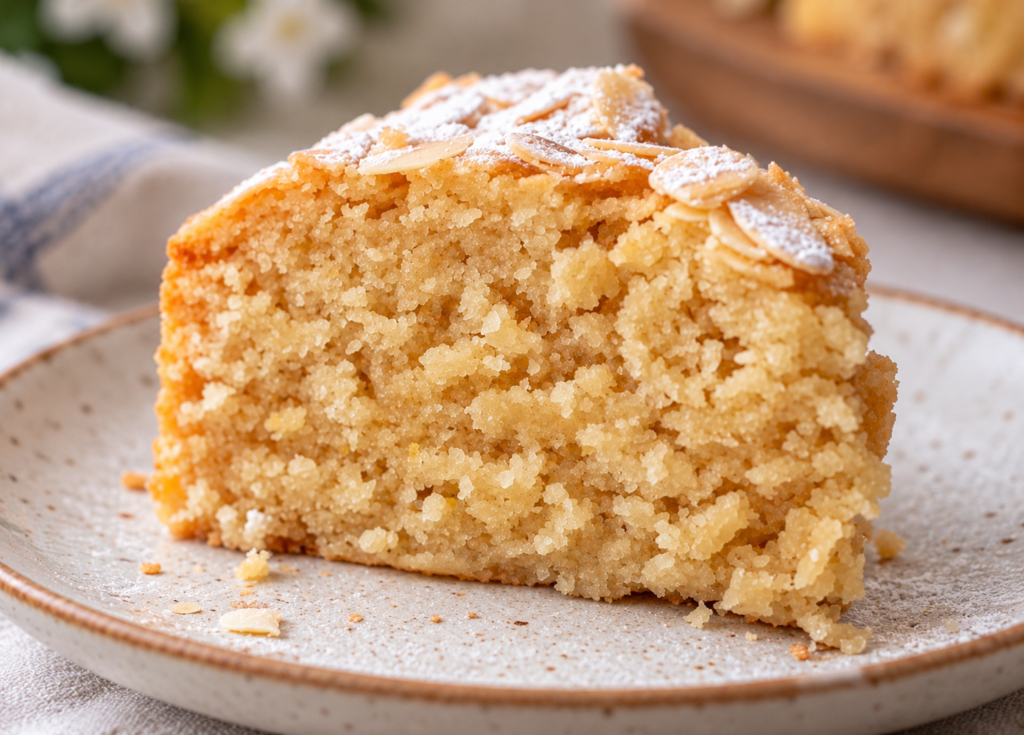
This is where understanding the ingredients becomes much more useful than simply following a list of “cake fixes.”
For example, almond flour contributes fat and moisture, while starches can help modify structure and texture. Binders such as flax, xanthan gum or psyllium may also have a role depending on the recipe.
If you want to see an example of a properly baked, moist gluten-free cake texture, my Gluten-Free Orange Pound Cake is a useful example.
Frequently Asked Questions
Why is my eggless cake gummy in the middle but cooked on the outside?
The most common possibilities are underbaking, an oven that is too hot, a pan that is too small or deep, or too much moisture in the batter. Check the centre, pan size, oven temperature and liquid balance before changing the recipe.
Can too much yogurt make an eggless cake gummy?
Yes. Yogurt contributes moisture, and adding more than the recipe requires can upset the balance between moisture and structure. The type and thickness of yogurt also matter.
Does too much baking powder make an eggless cake gummy?
Not directly in every case, but excessive leavening can cause a cake to rise rapidly before its structure is strong enough to support it. The cake may then collapse and leave a dense or gummy centre.
Why is my eggless cake wet in the middle but dry around the edges?
This often points to uneven baking. A high oven temperature, a deep pan or insufficient baking time can cause the edges to set before the centre.
Why does my gluten-free eggless cake become gummy?
Gluten-free eggless cakes need structure from the combination of flour, starches, binders, hydration, fat and leavening rather than gluten and eggs. An imbalance in moisture or structure can therefore produce a gummy centre.
Can I add more flour to fix a gummy cake?
Not automatically. If excess moisture is the problem, the formula may need adjustment, but simply adding flour can turn the next cake dense and dry. Look at the entire flour-to-liquid balance first.
Why is my cake gummy when hot but fine after cooling?
Some eggless cakes are naturally delicate when hot. Allow the cake to cool properly before judging its final crumb. If it becomes firm and tender after cooling, it may simply have needed time to set.
Should I bake a gummy cake for longer?
If the centre is genuinely underbaked, additional baking may help. But don’t automatically keep baking indefinitely. If the formulation contains too much moisture, prolonged baking can dry the outside without completely solving the centre.
Final Thoughts
A gummy eggless cake is usually not a mystery.
The centre is giving you information.
If it is wet, start with doneness and oven temperature.
If the edges are dry while the middle is gummy, check pan depth and heat.
If you recently changed yogurt, fruit purée or an egg substitute, check moisture balance.
If the cake is both gummy and dense, look at flour, liquid, leavening and structure.
And if the cake is gluten-free as well as eggless, remember that the troubleshooting approach needs to change because there is no gluten network providing structure.
Most importantly, don’t change everything at once.
After years of baking, I have found that troubleshooting becomes much easier when you stop treating a failed cake as a failure and start treating it as information.
Read the crumb. Find the clue. Change one thing. Bake again.
That is how consistent baking is learned.