
The Complete Gluten-Free Baking Guide: Common Problems, Flours, Techniques and Fixes
Introduction
Gluten-free baking can be wonderfully rewarding, but when a cake turns dense or a loaf comes out gummy, simply trying again is not always enough. You need to understand what caused the problem.
After more than 25 years of baking and teaching, I have learnt that the best way to troubleshoot a recipe is to look at the result carefully before changing ingredients.
In this guide, I’ll help you choose suitable gluten-free flours, understand the role of binders and identify common problems with cakes, breads and cookies.
1. Understanding Gluten-Free Baking
Gluten gives conventional wheat dough elasticity and helps it retain the gases produced during fermentation or chemical leavening. This contributes to the structure of many baked goods.
Gluten-free flours do not form the same elastic network. Their performance depends on how the ingredients behave during mixing, rising and baking.
This difference explains why gluten-free recipes need to be formulated carefully. Replacing wheat flour with a single alternative does not automatically produce the same texture or structure.
A Note on Gluten-Free Ingredients
If you are baking for someone who needs to avoid gluten strictly, check ingredient labels and choose appropriately la-belled gluten-free ingredients. Also take care to prevent cross-contact from shared equipment, utensils, baking pans and work surfaces. Even naturally gluten-free ingredients can become contaminated during handling or preparation.
2. Choosing the Right Gluten-Free Flour
There is no single gluten-free flour that works equally well in every recipe. Each has its own flavour, texture and absorption characteristics.
Here is a practical guide to some commonly used options.
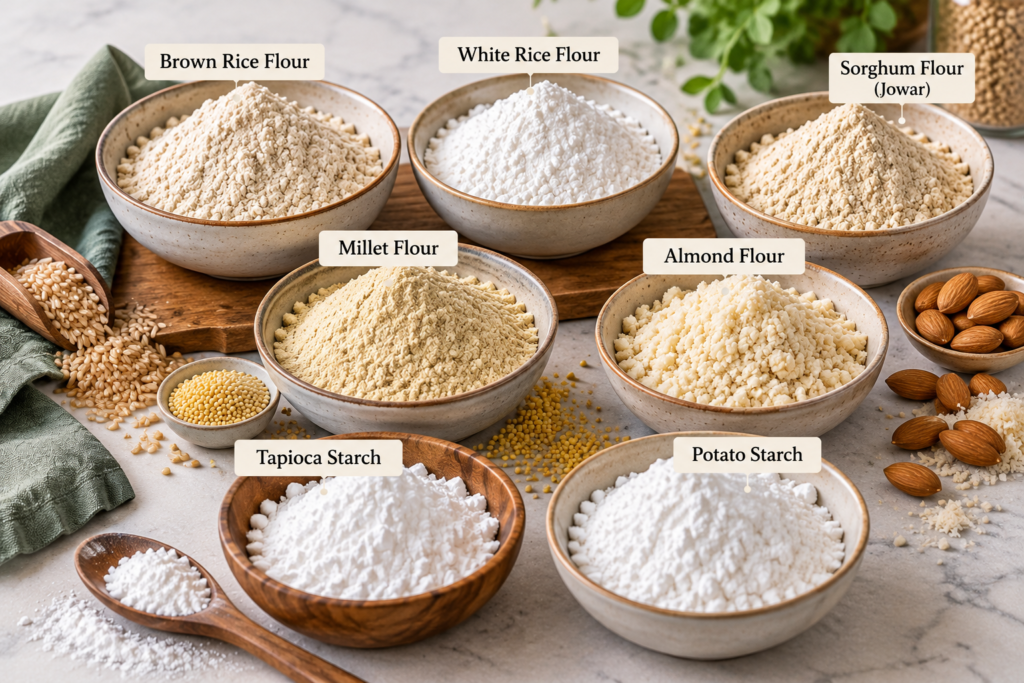
| Gluten-free flour or starch | Main characteristics | Common uses |
|---|---|---|
| Brown rice flour | Mild flavour; texture depends on how finely it is milled | Cakes, cookies and flour blends |
| White rice flour | Neutral flavour; coarser flour may produce a gritty texture | Cakes, cookies and flour blends |
| Sorghum flour (jowar) | Mild, slightly earthy flavour | Breads, cakes, crackers and blends |
| Millet flours | Flavour and liquid absorption vary by millet | Breads, cookies, cakes and blends |
| Almond flour | Adds richness and tenderness through its natural fat content | Cakes, cookies and brownies |
| Coconut flour | Highly absorbent and rich in fibre | Small quantities in specially formulated recipes |
| Tapioca starch | Helps provide flexibility and a lighter texture | Breads, pizza bases and flour blends |
| Potato starch | Contributes to tenderness and crumb texture | Cakes, breads and flour blends |
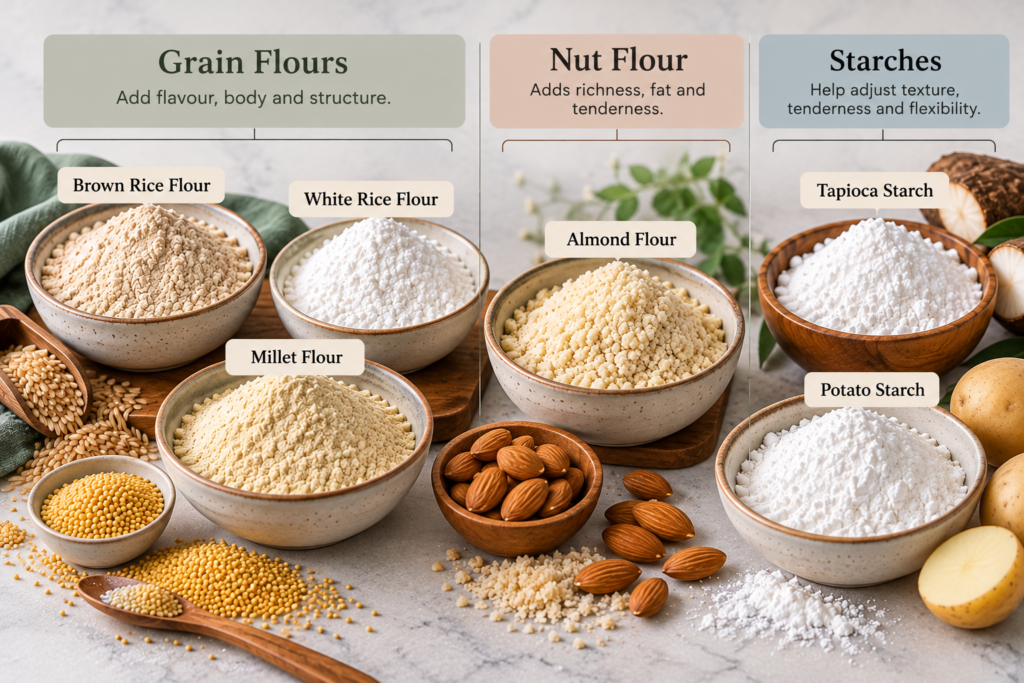
Choose a flour for its role in the recipe, not just because it is gluten-free. A flour that works well in cookies may not provide the structure needed for bread.
White Rice Flour: Why Texture Matters
White rice flour is useful in gluten-free baking because of its relatively neutral flavour. However, the texture of the finished bake can vary depending on the fineness of the flour and the recipe in which it is used.
Finely milled flour may give a smoother result than a coarse flour, although the overall formulation and baking method matter too.
It is also important to distinguish ordinary white rice flour from sweet rice flour, sometimes called glutinous rice flour. Despite its name, glutinous rice flour contains no gluten. It has different starch properties and does not behave exactly like ordinary white rice flour.
Use the type specified in your recipe, especially when the texture of the finished bake is important.
Almond Flour in Gluten-Free Baking
Almond flour adds richness and tenderness because it contains natural fat. It behaves differently from grain-based flours, so replacing grain flour with almond flour gram for gram can change the structure and moisture of a recipe.
If you enjoy baking with almond flour, read my guide to almond flour in gluten-free baking, including its benefits, uses and expert tips.
Why Gluten-Free Flour Blends Matter
A flour blend combines ingredients to achieve the texture a particular recipe needs. Grain flours contribute flavour and body, while starches can help modify tenderness or flexibility.
The proportions matter, and a blend developed for bread may not behave like one designed for cake or cookies. For reliable results, begin with a tested recipe and use the specified blend rather than substituting flours in equal quantities.
3. The Role of Binders in Gluten-Free Baking
Binders help ingredients hold together and can improve the texture of gluten-free baked goods. However, different binders perform different functions, so they are not automatically interchangeable.
Common options include:
- Psyllium husk: Absorbs water and forms a gel that helps provide flexibility and structure in gluten-free bread.
- Xanthan gum: Improves cohesion and can reduce crumbling in suitable recipes.
- Flaxseed gel: Helps bind ingredients in some eggless recipes.
- Chia seed gel: Provides binding and contributes moisture.
- Applesauce: Adds moisture and can provide some binding in selected cakes and brownies, but it does not replace every function of an egg.
Eggs themselves contribute several things to baking, including moisture, richness, aeration and structure. When replacing eggs, consider which of these functions your recipe needs.
Adding extra binder simply because a gluten-free batter looks different is not always helpful. Too much can produce a dense, firm or gummy texture. Follow the recipe’s specified quantity.
For example, my fudgy gluten-free and vegan brownie recipe uses raw banana flour, applesauce, oil and flaxseed gel to create the rich, fudgy texture the recipe is designed to achieve.
4. Why Is My Gluten-Free Cake Dense?
A dense cake has a heavy, compact crumb rather than the lighter texture you expected.
Start by checking the batter consistency against the recipe. If it is unusually thick, the flour may be absorbing more liquid than expected, or the ingredients may have been measured incorrectly.
If the batter consistency seems right, check whether the ingredients were mixed as instructed and whether the leavening agent is fresh and accurately measured.
If the cake is fully baked but still heavy, investigate the formulation and mixing method before adding more baking powder. Extra leavening will not correct every cause of a dense crumb.
5. Why Does My Gluten-Free Cake Not Rise?
If your cake remains flat and never develops the expected height, check the leavening agent first.
Make sure your baking powder is fresh and correctly measured. Also check whether the recipe requires the batter to go into the oven soon after mixing; delaying baking can affect some formulations.
If these checks do not explain the problem, review the mixing instructions and confirm that the oven was properly preheated. Avoid increasing the baking powder without identifying the cause.
6. Why Does My Gluten-Free Cake Rise and Then Sink?
A cake that rises and then collapses has a different problem from one that never rises. Here, the key is to find out why the centre failed to hold its shape.
If the centre is wet or underbaked, check the baking time, pan depth and oven temperature.
If the cake is fully baked but still sinks, review the amount of leavening and the recipe’s proportions. The cake may have risen faster than its structure could support.
Avoid disturbing the cake before it has set, and make sure it is baked through before removing it from the oven.
7. Why Is My Gluten-Free Cake Dry or Crumbly?
A dry cake and a crumbly cake may look similar when sliced, but the way they feel tells you a great deal about what went wrong.
A dry, firm crumb often points to overbaking or insufficient moisture. Check whether the cake was baked for longer than the recipe requires, and avoid extending the baking time simply because the top has not browned as much as expected.
A moist cake that breaks apart easily suggests a different problem. The flour blend or binder may not be providing enough cohesion. In this case, adding more liquid can make the cake heavier without helping it hold together.
You may also notice that the edges are dry while the centre remains softer. This can indicate uneven baking, so check the pan position and oven conditions.
If the cake is pleasant when freshly baked but becomes dry during storage, consider how it is being stored and how quickly it is losing moisture.
Before making changes, decide whether you are trying to correct dryness or improve the cake’s ability to hold together. The two problems need different solutions.
8. Why Does My Gluten-Free Eggless Cake Fall Apart?
A gluten-free cake can crumble even when it is not particularly dry. This becomes especially important in eggless baking, where the recipe must provide structure without relying on either gluten or eggs.
When a gluten-free eggless cake breaks into pieces as you slice or lift it, the problem may be structural rather than simply a lack of moisture.
Without gluten and eggs, the recipe needs an appropriate balance of flour, starch, moisture and binding ingredients to hold the crumb together.
Start by identifying when the cake falls apart:
- It crumbles into dry particles: Check the flour quantity, moisture balance and baking time.
- It breaks into large pieces when sliced: Check whether the cake has cooled completely and whether the recipe provides enough binding and structure.
- It feels gummy and then breaks apart: Investigate excess moisture, incomplete baking or an unsuitable flour-to-liquid balance.
- The edges hold, but the centre breaks: Check whether the centre is fully baked and whether the batter is too deep for the tin.
Check Your Gluten-Free Flour Blend
A single gluten-free flour may not provide the same balance of structure, tenderness and moisture as a well-formulated flour blend. The proportions of whole-grain flours and starches can influence how well the cake holds together.
Depending on the recipe, suitable binders such as psyllium husk, xanthan gum or flax may help improve the structure. However, these ingredients are not interchangeable, and adding more binder or liquid without checking the recipe can make the texture worse.
Allow the Cake to Cool Completely
An eggless gluten-free cake may be fragile while warm. Its crumb needs time to settle after baking, so slicing it too early can cause it to break apart even when it is properly baked.
Allow the cake to cool completely before removing it from the tin or slicing it, following the recipe’s instructions.
If it still falls apart after cooling, change one variable at a time, starting with the flour blend, binding system and baking time.
The goal is not to make the cake harder or drier. It is to create a crumb that is tender enough to eat and strong enough to hold its shape.
9. Why Is My Gluten-Free Bread Gummy Inside?
A gluten-free loaf can look perfectly baked on the outside and still have a sticky centre. One of the first things I would check is when the bread was sliced.
If you cut the loaf while it was still warm, the crumb may not have had enough time to settle. Allow it to cool completely before judging the texture.
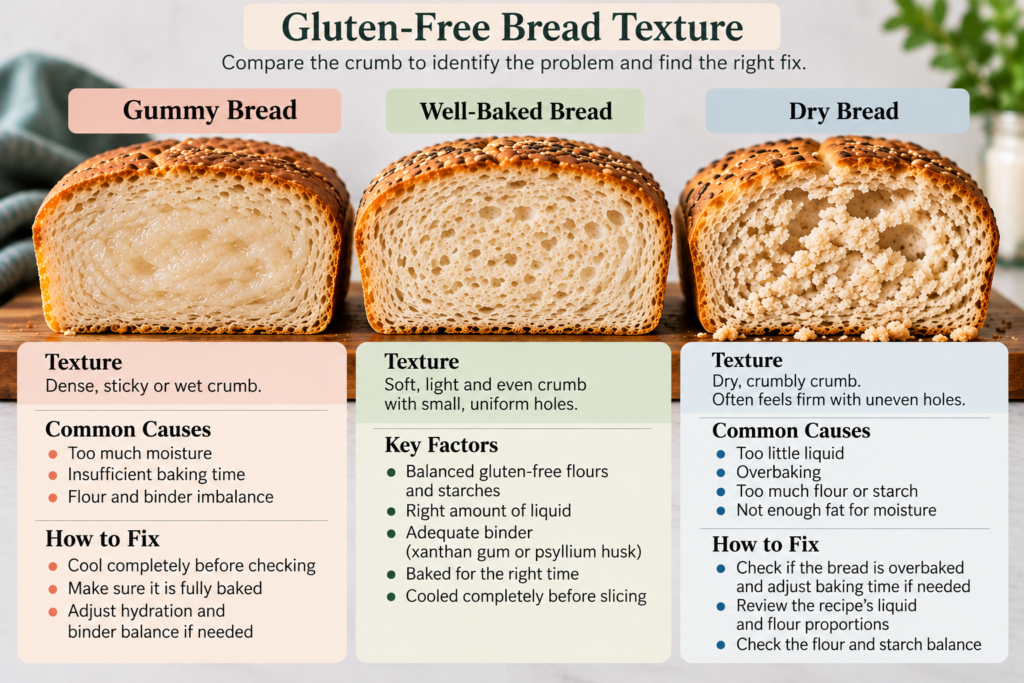
If the centre remains gummy even after full cooling, review the recipe’s hydration and baking time. The loaf may need longer in the oven, or the formulation may require closer attention.
The dough itself can also provide clues. If the loaf struggles to hold its shape, the flour and binder combination may not be providing enough structure.
Do not add extra flour simply because gluten-free dough feels wetter or stickier than wheat dough. Many gluten-free bread recipes are designed around a higher hydration level, and changing it by eye can produce a different problem.
My gluten-free vegan red lentil bread recipe illustrates how soaked lentils, psyllium and selected flours can be used in a bread formulation designed to provide structure.
10. Why Do My Gluten-Free Cookies Spread Too Much?
Before changing the flour or adding more of it, check the temperature of the fat and the dough. Fat that is too warm can make cookies spread before they have a chance to set in the oven.
If the dough feels unusually soft or oily, follow the recipe’s instructions for chilling. A warm baking tray can also cause the next batch to spread too quickly, so use a cool tray for each batch.
If the cookies continue to spread after chilling, look more closely at the proportions of flour, fat and sugar. The blend itself may also affect how well the cookies hold their shape.
Avoid adding flour by eye. Although it may reduce spreading, too much can leave the cookies dry or alter their intended texture.
For an example of how gluten-free ingredients are used in a formulated cookie recipe, try my eggless gluten-free almond coconut cookies, made with almond flour, coconut and flaxseed gel.
11. Why Does My Gluten-Free Bake Have a Gritty Texture?
If your batter already feels grainy before it goes into the oven, the flour itself is a good place to start investigating.
Coarsely milled flour can leave a noticeable texture in the finished bake. Where possible, choose a finer-milled flour that is suitable for your recipe.
If the batter feels reasonably smooth but the baked product has a sandy texture, the flour may not have hydrated sufficiently, or the blend may not be suitable for that particular recipe.
Some methods include a resting period to allow the flour to absorb moisture. Follow that instruction when it is part of the recipe.
Adding extra liquid is not an automatic fix. It may not resolve the gritty texture and could leave the finished bake too wet.
12. How Does Your OTG Oven Affect Gluten-Free Baking?
Sometimes the recipe is not the main problem. If your cake repeatedly browns too quickly, bakes unevenly or takes much longer than expected, check what your OTG is doing.
Is the top browning before the centre is baked? Look at the rack position, heating mode and pan placement. The top heating element may be browning the surface before the centre has finished baking.
Does baking take longer than the recipe suggests? Your oven’s displayed temperature may not match its actual temperature. Check it with an oven thermometer before repeatedly extending the baking time.
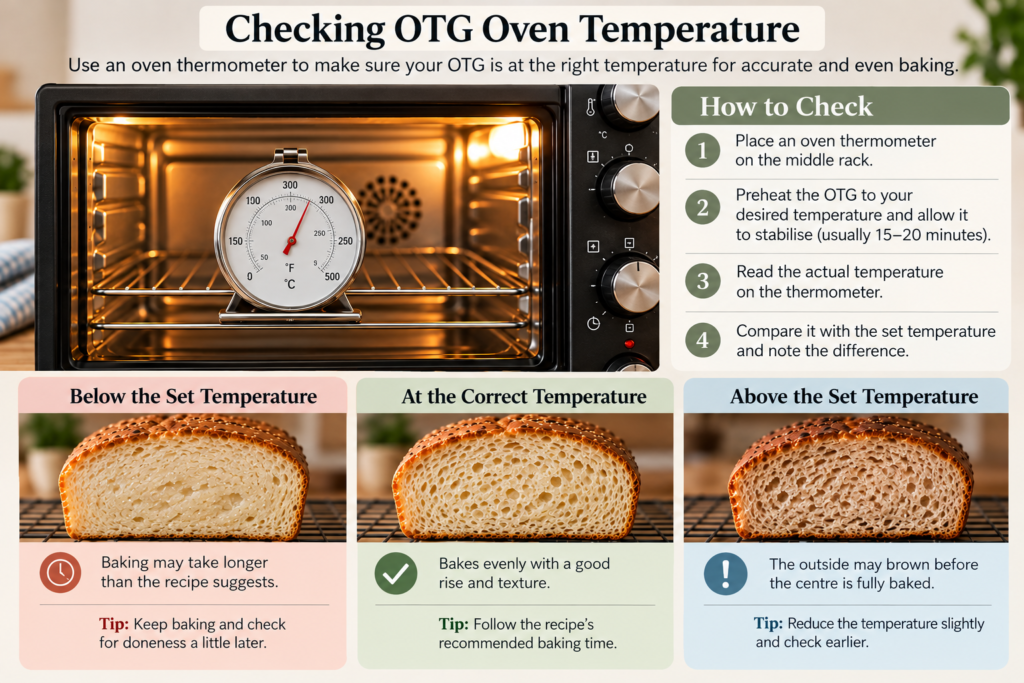
Is one side browning more than the other? Uneven heat or pan positioning may be responsible. Follow the recipe’s guidance about rotating the pan, if rotation is appropriate for that bake.
If several different recipes rise poorly or sink, check the oven’s preheating and actual temperature. If the problem occurs with just one recipe, investigate its formulation and method as well.
For more detail, read my guide on how to use an oven for baking. If you are choosing an appliance, my best OTG ovens for baking in India: 2026 beginner’s guide can help you compare options.
13. Essential Tools for More Consistent Gluten-Free Baking
You do not need a kitchen full of specialised equipment to begin gluten-free baking. A few reliable tools can make it easier to follow a recipe accurately and identify what went wrong.
- Digital kitchen scale: Weighing ingredients is more reliable than measuring flour by volume.
- Oven thermometer: Helps you check the actual oven temperature.
- Suitable baking pans: Use the size and material specified in the recipe whenever possible.
- Measuring spoons: Useful for accurately measuring small quantities of leavening agents, salt and binders.
- Mixing bowls and a spatula: Help you mix and scrape the batter consistently.
- Cooling rack: Allows baked goods to cool properly after coming out of the oven.
Accurate measurement matters because small changes in flour, liquid or binder quantities can affect the texture of a gluten-free bake.
14. Gluten-Free Baking Resources
Frequently Asked Questions About Gluten-Free Baking
Can I replace wheat flour with gluten-free flour in any recipe?
No. A direct substitution can change the texture and structure. Use a tested gluten-free recipe whenever possible.
Do all gluten-free cakes need xanthan gum or psyllium husk?
No. The need for a binder depends on the recipe. Use the type and quantity specified.
Can I use millet flour on its own instead of a flour blend?
It depends on the recipe. Millet flour has its own flavour and absorption characteristics, so replacing an entire blend with millet flour can change the texture and structure.
Is gluten-free baking always eggless or vegan?
No. Gluten-free, eggless and vegan describe different dietary requirements. A recipe may meet one, two or all three.
Why does my gluten-free bake turn out differently each time?
Flour brands, ingredient measurements, pan size, oven temperature and handling can all affect the result. Keep these factors consistent while troubleshooting.
Conclusion
Gluten-free baking becomes easier when you learn to recognise what a finished bake is telling you. Start with one problem, check the most likely cause and change one variable at a time.
If you would like to take your gluten-free baking further, explore my Gluten-Free Bread Baking Course. I’ll guide you through the techniques that help you understand gluten-free dough and work towards better, more consistent bread.
Explore my gluten-free recipes collection for more recipes to try, or visit Cookery Expressions for baking resources and classes.
Sharmila Sengupta | Baking Expert & Educator | 25+ Years of Baking Experience