
OTG vs Convection Oven for Baking: Which Is Better for Cakes, Cookies & Bread?
The OTG vs convection oven comparison is not simply about deciding which appliance is better for baking. What matters is understanding how each oven heats and how that affects the food you bake. An oven that works beautifully for cookies may need a different setting for a delicate cake or a gluten-free loaf.
You may have experienced a cake that browns on top but remains underbaked in the centre, cookies that turn darker on one side of the tray, or gluten-free bread with a well-colored crust but a gummy crumb. It is tempting to blame the oven immediately, but the heating method, rack position, temperature, baking tin and recipe can all influence the result.
In this guide, I will explain how OTG and convection ovens work, where their differences matter in everyday baking, and how you can identify the possible cause of common baking problems. My aim is to help you understand your oven better so that you can make adjustments with confidence rather than changing several settings at once.
Quick problem finder: What is happening in your oven?
| What you notice | What may be happening | What to check first |
|---|---|---|
| Cake browns on top but remains raw inside | Surface browning is happening faster than the centre is setting | Rack position, upper heat and tin size |
| Cake rises and then sinks | The cake structure may not have set properly | Recipe balance, leavening and baking time |
| Cookies brown unevenly | Portions may differ in size, or the oven may have hot spots | Cookie thickness and tray position |
| Cookies become too crisp | Fan-assisted baking may be drying them out faster | Baking time and fan setting |
| Gluten-free bread has a dark crust but gummy centre | The crust may be ready before the interior | Hydration, loaf size, baking time and cooling |
| Bread remains pale underneath | The base may not be receiving enough heat | Rack position, tin material and lower heat |
These are useful starting points, but they are not fixed diagnoses. The same symptom can have different causes. I would always look at how the bake develops before deciding what needs adjusting.
1. How does an OTG oven heat food?
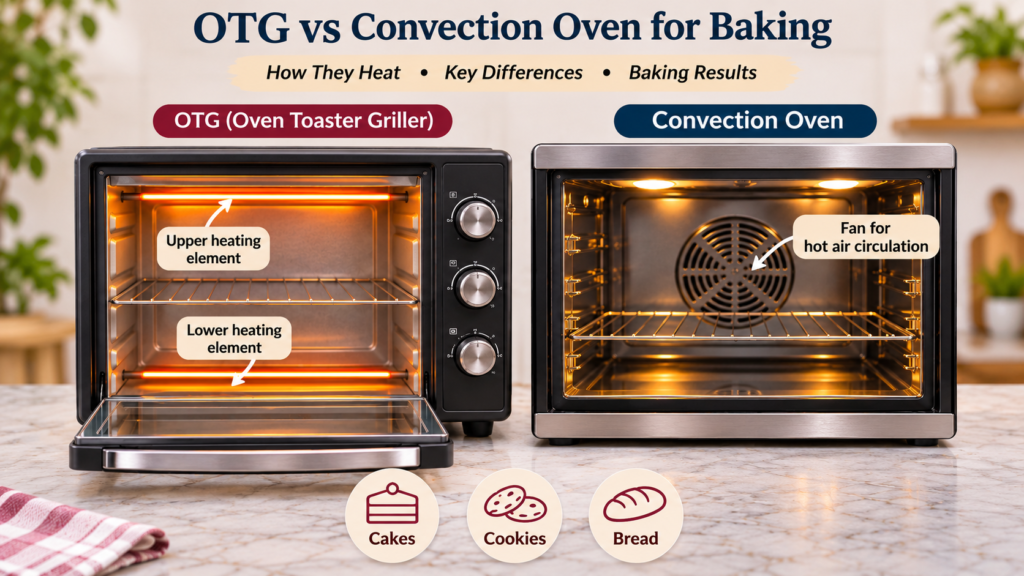
An OTG, or Oven Toaster Griller, uses electric heating elements to generate heat. In most conventional OTGs, there is one element at the top and another at the bottom of the oven cavity.
They serve different purposes:
- Upper heating element: Supplies heat from above. It is useful for grilling and browning. During baking, however, too much direct upper heat can darken the surface before the centre is ready.
- Lower heating element: Supplies heat from below. It helps heat the baking tin and cook the base of cakes, bread and other bakes.
- Both elements together: Many OTGs offer a setting that uses both elements for general baking. The intensity and control vary between models.
Some OTGs allow you to select the upper and lower elements independently. Others offer preset combinations, so you may not have the same level of control. The symbols and functions also differ between brands. It is worth checking your appliance manual rather than assuming that every OTG works in the same way.
The position of the baking tin matters as well. A cake placed too close to the upper element may develop a dark top while its centre is still wet. A tin positioned too close to the lower element may develop a darker base.
Here is what I would watch for: If your cakes consistently brown too quickly on top, check the rack position and heating-element setting before making a substantial temperature reduction. Sometimes moving the tin one level lower is enough to improve the result.
Your OTG baking settings should be chosen according to the recipe and the behaviour of your particular oven. An independent oven thermometer is useful for checking whether the displayed temperature is reasonably close to the actual temperature.
2. How does a convection oven work?
A convection oven uses a fan to circulate hot air inside the oven cavity. This changes how heat reaches the food and can make baking more efficient.
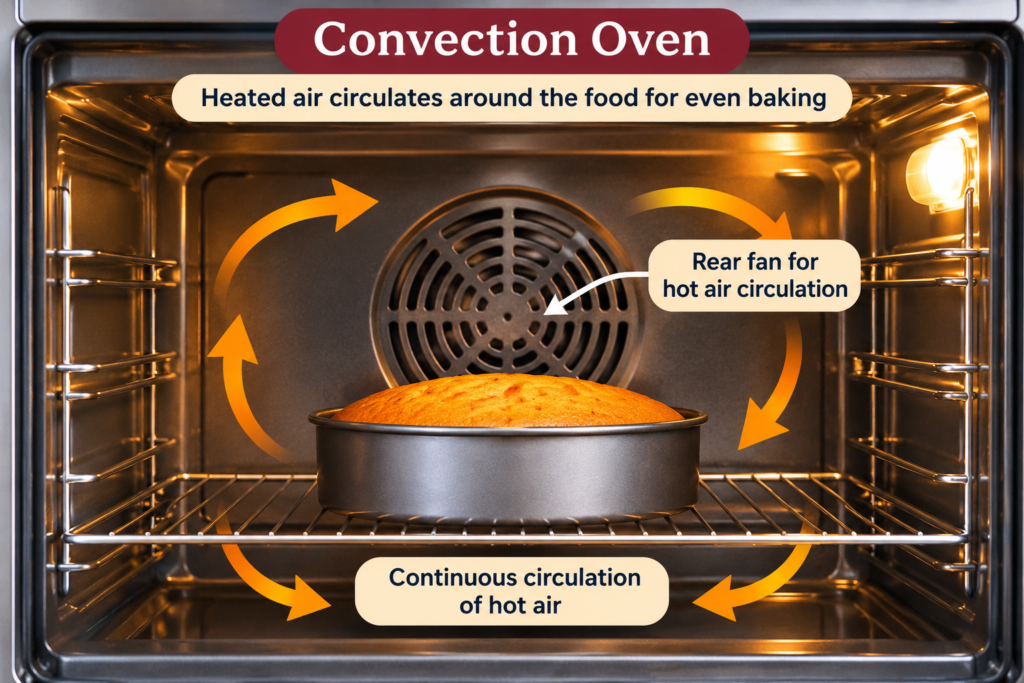
The moving air can improve heat transfer around the food and may encourage faster surface browning. How noticeable this effect is depends on the oven’s design, fan speed, temperature and the recipe being baked. You may notice the difference more with cookies and pastries than with some delicate cakes.
Convection can also be useful when baking more than one tray, although results may still vary between rack positions.
There is an important distinction here: faster surface browning does not mean the centre is fully baked. A large cake or gluten-free loaf may develop a well-colored exterior while still needing time for its interior to set.
A convection fan improves air movement, but it does not eliminate every difference in heat distribution. The oven’s design, fan position, tray arrangement and amount of food inside all influence the result.
3. What is a convection OTG?
A convection OTG combines the heating elements of a conventional OTG with a fan that circulates hot air.
Its main advantage is that it offers two heating approaches in one appliance. You can use conventional heating for recipes that respond better to direct heat from the elements, and fan-assisted heating when you want air circulation.
The controls vary between models. Some convection OTGs allow you to select conventional or fan-assisted modes, while others offer more limited combinations.
If you regularly bake delicate cakes, check whether the fan can be switched off independently. This gives you the option of testing both heating methods with the same recipe rather than being restricted to fan-assisted baking.
4. OTG vs convection oven for baking: How do the results compare?
The better choice depends on what you bake and how much control you want over the heating method.
| Feature | Conventional OTG | Convection oven |
|---|---|---|
| Heating method | Electric heating elements | Heating elements with fan-assisted circulation |
| Heat movement | Radiant heat from elements and surrounding hot air | Hot air circulated by a fan |
| Cake baking | Works well with suitable rack placement and temperature | Can bake well; delicate cakes may need testing with the fan off |
| Cookie baking | Good results with careful tray positioning | Often useful for faster surface browning |
| Bread baking | Suitable for a wide range of breads | Can brown the crust faster; the centre still needs adequate baking |
| Multiple trays | Results may vary between rack positions | Fan assistance can help, but does not guarantee identical results on every rack |
| Temperature adjustment | Follow the recipe and your oven’s behaviour | May need adjustment depending on the oven and recipe |
An OTG is not automatically inferior to a convection oven. A well-understood OTG can produce excellent cakes, cookies and breads.
Similarly, a convection oven cannot correct problems caused by an unbalanced recipe, incorrect hydration or insufficient baking.
For home bakers, understanding how the appliance behaves is often more valuable than choosing one heating method simply because it sounds more advanced.
5. OTG vs convection microwave: Are they the same?
No. An OTG and a convection microwave are different appliances, even though both may offer a convection setting.
A convection microwave uses microwave technology for certain cooking functions and a heating element with a fan for convection baking. The combination of features and the way heat is delivered depend on the model.
An OTG uses electric heating elements and does not use microwave energy.
| Feature | OTG | Convection microwave |
|---|---|---|
| Main heating system | Electric heating elements | Microwave system and convection heating element |
| Convection fan | Available in convection models | Available in convection mode |
| Baking controls | Often offers separate upper and lower heating options | Controls vary considerably by model |
| Bread baking | Suitable for many types of bread | Can bake bread, but results depend on the model and its heating arrangement |
| Browning underneath | Depends on rack position, tin and lower heat | Some bakers find the base browning less satisfactory in certain models |
If you regularly bake bread, especially larger loaves, I would suggest checking how well the appliance browns the underside before making a purchase.
Some home bakers find that certain convection microwaves produce a paler bread base than they would like. This is not true of every model, so it is worth checking the performance of the particular appliance you intend to buy.
6. Why does my cake brown on top but remain under baked inside?
This is one of the most common problems home bakers encounter, and the pattern of browning can tell you quite a lot.
When the top of a cake becomes dark while the centre is still wet, the surface is receiving more heat or browning faster than the interior can set.
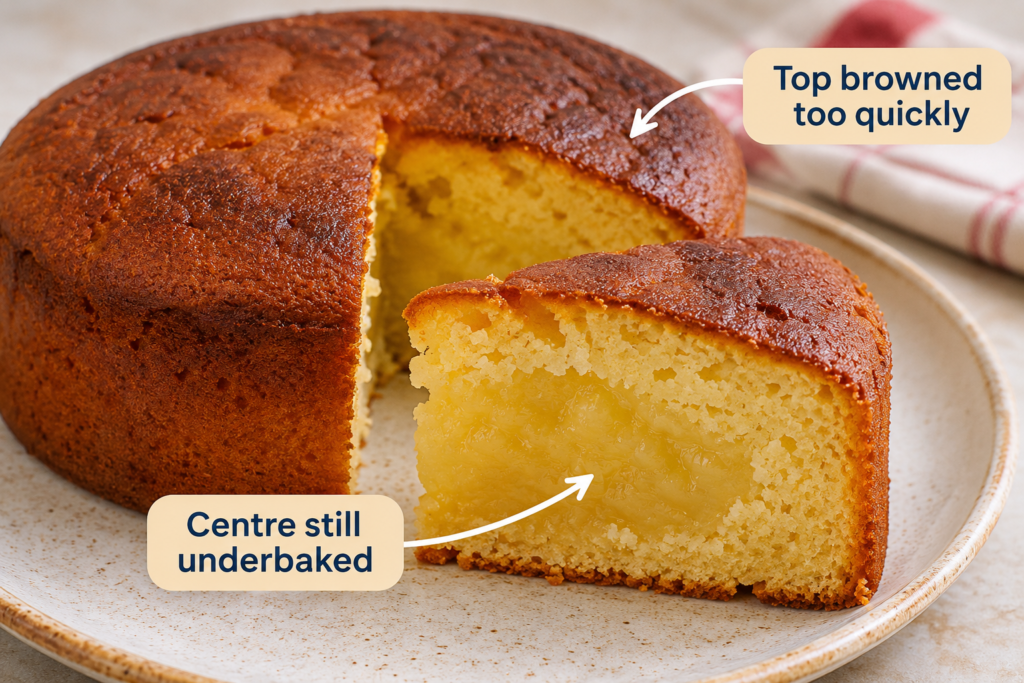
There are two situations worth distinguishing.
The top becomes dark quite early in baking, while the centre is still wet.
I would first check whether the tin is too close to the upper heating element. The oven may also be running hotter than its displayed setting. Try a slightly lower rack position and check the temperature with an independent thermometer.
The cake browns evenly, but the centre remains wet.
Here, I would look beyond the oven. The tin may be too small, the batter layer too deep, or the recipe may contain too much liquid for its flour balance. A cake that simply has not been given enough baking time can show the same symptom.
I would avoid repeatedly opening the oven door to check the cake. Frequent opening can cause temperature fluctuations, particularly during the early stages when the structure is developing.
For delicate cakes, you can compare conventional and fan-assisted baking. Some bakers find that switching the fan off gives them better results with certain cakes. This is not a universal rule, so test it with your own recipe and oven.
7. Why does an eggless cake rise and then sink?
A cake that rises beautifully in the oven but collapses as it cools may not have developed enough internal structure to support itself.
This is not necessarily an oven problem.
In eggless baking, the balance between flour, liquid, fat, sugar and the chosen egg substitute is particularly important. Too much leavening can also cause a cake to rise rapidly and then collapse before its structure has set.
The timing of the collapse can offer useful clues:
- The cake sinks while still in the oven: The structure may be too weak, the oven temperature may be too low, or the cake may have been disturbed before it set.
- The cake sinks shortly after removal: It may be underbaked in the centre, or the recipe may not have enough structural support.
- The centre sinks while the edges remain firm: The middle may be too wet, or the batter may be too deep for the tin.
A toothpick test can help with many cakes, but do not rely on it as the only measure. Check whether the centre springs back gently and whether the cake has pulled slightly away from the sides of the tin, where appropriate for that recipe.
If your cake rises well but sinks as it cools, I have explained the possible causes and corrections in my guide to why eggless cakes sink.
8. Why do my cookies brown unevenly?
If some cookies are golden while others on the same tray are much darker, look at their size and position before blaming the oven.
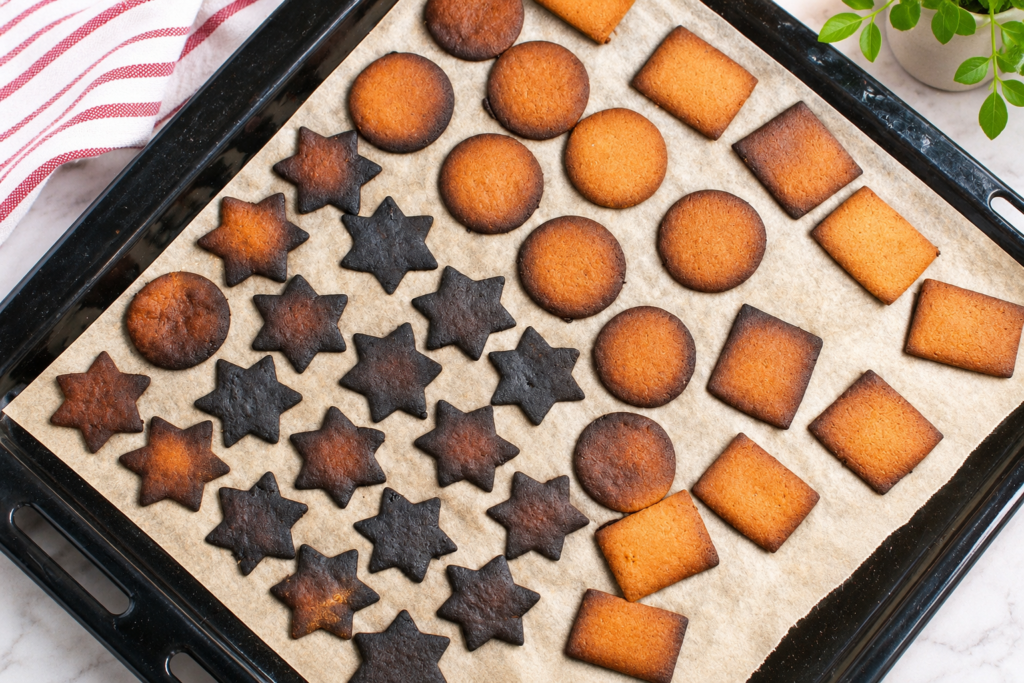
Even a small difference in thickness can affect baking time. Thinner cookies will generally brown faster than thicker ones.
There are three different patterns to look for.
If individual cookies are browning differently across the tray: Check whether the portions are evenly weighed and shaped. Thinner cookies will naturally bake faster than thicker ones.
If all the cookies have darker bottoms but their tops are properly baked: Look at the baking tray and the heat coming from below. A dark-colored tray or a rack positioned too close to the lower heating element may encourage excessive browning underneath.
If one side of the entire tray is consistently darker: Your oven may have a hot spot. Try another rack position and observe whether the same pattern continues.
Rotating the tray may help in some ovens, but I would first identify which of these patterns you are dealing with. The correction depends on the cause.
9. Why do cookies become too crisp in a convection oven?
Convection baking can make cookies brown and dry out more quickly because moving hot air increases heat transfer at the surface.
If your usual recipe produces crisp cookies in a fan-assisted oven, do not immediately change the ingredient quantities.
Try a small comparison using the same dough:
- Bake one batch using the conventional setting, if available.
- Bake another batch using the convection setting.
- Keep the tray, cookie size and baking time as consistent as possible.
- Compare the colour and texture after cooling.
One detail that is easy to overlook is that cookies often feel soft when they first come out of the oven. They firm up as they cool. If you continue baking until they feel completely firm while hot, they may become hard once cooled.
I always suggest allowing a cookie to cool on the tray before deciding whether it needs more baking time. This is particularly important with cookies that are meant to have a soft centre.
10. Why Does Gluten-Free Bread Have a Dark Crust but a Gummy Centre?
This is a problem I would investigate carefully before changing the oven setting.
Gluten-free bread behaves differently from conventional wheat bread. Its structure depends on the combination of flours, starches, binders and hydration. The loaf also needs sufficient baking time to set properly.
A dark crust with a gummy centre can occur when the outside browns faster than the interior finishes baking. A convection fan may make this more noticeable, but it is not necessarily the underlying cause.
These are the areas I would examine first.
Hydration:
Too much water for the particular flour combination can leave the crumb excessively wet. Different gluten-free flours absorb water differently, so the hydration cannot be judged by looking at another recipe.
Flour and starch balance:
The proportion of whole-grain flour to starch affects the structure and texture of the loaf. An unsuitable balance can produce a weak or sticky crumb even when the crust looks well baked.
Binder:
Psyllium husk and xanthan gum contribute differently to the structure. Their quantities and the way they are incorporated and hydrated also matter.
If you are baking my Gluten-Free Red Lentil Bread, pay particular attention to the balance of lentils, psyllium husk, rice flour and water. These ingredients work together to determine the structure and texture of the loaf.
Loaf size:
A large or deep loaf takes longer for heat to reach the centre than a smaller loaf. A crust that looks ready is not a reliable indication that the middle has finished baking.
Baking and cooling:
Gluten-free bread needs sufficient baking time, followed by complete cooling. Cutting it while warm can make the crumb appear gummy because its internal structure has not finished setting.
Here is an important distinction. If the crumb feels gummy immediately after baking, do not judge the recipe at that stage. Allow the loaf to cool completely on a wire rack. Then cut through the centre and examine the crumb.
If it is still sticky or wet after cooling, investigate the hydration, flour and starch balance, binder and baking time. A gummy slice cut from a warm loaf does not, by itself, prove that the bread is underbaked.
A probe thermometer can be useful when checking whether a loaf is sufficiently baked, but the target internal temperature should be based on the particular recipe and its flour, starch and binder combination. Do not apply one temperature as a universal rule for all gluten-free breads. Use the thermometer alongside the appearance and texture of the cooled crumb.
If you are still working out how flour combinations, starches, binders and hydration affect your gluten-free bakes, my Gluten-Free Baking Guide explains these fundamentals. Understanding these ingredient relationships can help you distinguish an oven-related problem from one caused by the recipe.
11. Why is the bottom of my bread pale?
If the top and sides of your bread are well browned but the base remains pale, the lower part of the loaf may not be receiving enough heat.
Here, I would concentrate on the tin and its position rather than changing the entire baking temperature.
A light-colored tin may produce a paler base than a darker metal tin. A rack positioned too high may also reduce the effect of the lower heating element.
Try moving the loaf one rack position lower, provided it is still at a safe distance from the heating element. You can also compare the result using a suitable metal loaf tin.
If the top is already dark, avoid simply increasing the overall temperature to brown the base. That may make the crust too hard before the underside improves.
12. Should you reduce the temperature for convection baking?
You may come across advice suggesting that convection baking always requires a reduction of 20–25°C. I would not treat this as a fixed rule.
The adjustment depends on the oven, the recipe and the food being baked. Some manufacturers provide specific temperature guidance for fan-assisted baking, so check your appliance manual first.
If your recipe was developed for a conventional oven, begin by following the manufacturer’s recommended conversion, if available. Then observe how quickly the food browns.
An oven thermometer can help you check the temperature at the position where you bake. Remember, however, that it measures the temperature at its own location. It does not tell you whether every part of the oven cavity is at exactly the same temperature.
When comparing two settings, use the same recipe, tin and quantity of batter. Change only the heating mode or temperature setting. This makes it easier to see whether the difference comes from the oven setting rather than another part of the baking process.
13. Which heating mode should you use?
Here is a quick reference for choosing a setting. These are starting points rather than universal rules; your recipe and oven may behave differently.
| What you are baking | Setting to consider |
|---|---|
| Delicate cakes and eggless sponges | Conventional heating; test fan-off baking if the cake browns too quickly |
| Cookies | Convection can be useful, but watch the baking time |
| Pastries | Convection may help with surface browning |
| Bread | Either method can work; check the crust and centre |
| Multiple trays | Convection may help, but check each tray individually |
Keep a note of the settings that work for recipes you bake regularly. This is particularly useful when you use the same oven for different types of cakes, cookies and breads.
14. How to check whether your oven has hot spots
If you suspect that your oven heats unevenly, a simple bread-slice test can help.
Place evenly sized slices of white bread across a baking tray, leaving a little space between them. Bake them briefly at a moderate temperature and observe how they brown.
If some slices become noticeably darker than others, your oven may have areas that receive more heat.
You can repeat the test at another rack position to see whether the pattern changes.
This test does not measure the exact temperature of each part of the oven. It simply gives you a practical indication of how evenly the oven browns food.
Once you know where the hotter areas are, you can position your baking tins more sensibly.
15. How to compare two ovens fairly
If you have access to both an OTG and a convection oven, do not judge them using two different recipes.
Choose one familiar recipe and keep the following consistent:
- Use the same ingredient quantities and mixing method.
- Use identical baking tins, if possible.
- Keep the batter or dough quantity the same.
- Use the same rack position where the oven design allows.
- Record the temperature, heating mode and baking time.
- Compare the finished result after it has cooled sufficiently.
Look beyond the colour of the crust. For a cake, check the crumb, moisture and texture. For cookies, compare the spread, colour and crispness after cooling. For bread, examine the crust, crumb and whether the centre has baked through.
This is the most reliable way to understand how your oven responds to different settings. If you change several things together, it becomes difficult to know which adjustment actually improved the result.
16. What should you consider before buying an OTG?
If you are choosing an oven mainly for baking, consider your usual recipes, the quantity you bake and the space available in your kitchen.
A few features deserve attention:
- Capacity: Choose a size that accommodates your regular cake tins and loaf pans.
- Temperature control: Reliable temperature adjustment is important for consistent baking.
- Heating elements: Check whether you can select the upper and lower elements independently.
- Convection fan: If you want fan-assisted baking, check whether the fan can be switched off.
- Rack positions: More than one usable rack position gives you flexibility.
- Interior dimensions: Capacity alone does not tell you whether your regular baking tins will fit comfortably.
I would also recommend using an independent oven thermometer. It is a simple tool that helps you understand how your oven performs rather than relying entirely on the temperature displayed on the control panel.
For a detailed comparison of models, capacities and features available in India, read my main guide: Best OTG Oven in India for Baking (2026): Top Picks & Buying Guide.
Frequently Asked Questions
1. Is an OTG or convection oven better for baking?
Both can produce excellent results. An OTG uses electric heating elements, while a convection oven adds fan-assisted circulation. The right choice depends on your baking needs and the controls available in the appliance.
2. Is a convection oven better for baking cakes?
Not always. Some delicate cakes bake better with conventional heating. Test both settings with your recipe to see which gives you the more reliable result.
3. Can I bake bread in an OTG?
Yes. An OTG can bake many types of bread, including gluten-free bread. Pay attention to hydration, loaf size, baking time and complete cooling.
4. Is a convection microwave suitable for baking bread?
It can be, but performance varies by model. Check whether it gives you satisfactory browning underneath and enough space for your bread tin.
5. Should I reduce the temperature when using convection?
Follow your appliance manufacturer’s guidance and observe how quickly your bake browns. There is no universal temperature reduction for every recipe.
6. Why does my cake bake unevenly even in a convection oven?
Fan circulation does not eliminate every hot spot. Rack position, tin size, batter depth and oven loading can still affect the result.
7. Do I need an oven thermometer for baking?
I would recommend one, particularly if you are troubleshooting inconsistent results. It helps you check the temperature at your baking position.
Final thoughts
When comparing an OTG vs convection oven for baking, it is easy to focus only on the heating method. But good baking depends on more than the appliance.
The recipe, ingredient balance, tin size, rack position, actual oven temperature and baking time all influence the final result. A fan may help a tray of cookies brown more evenly, but it will not correct an unbalanced cake batter or make an overly hydrated gluten-free loaf bake properly.
I always recommend getting familiar with how your own oven behaves. Observe where food browns first, how quickly cakes set and whether bread needs more time than the crust suggests. Keep a note of the settings that give you reliable results.
Once you understand these small details, you will be in a much better position to get consistent results from whichever oven you use.
Sharmila Sengupta | Baking Expert & Educator | 25+ Years of Baking Experience