
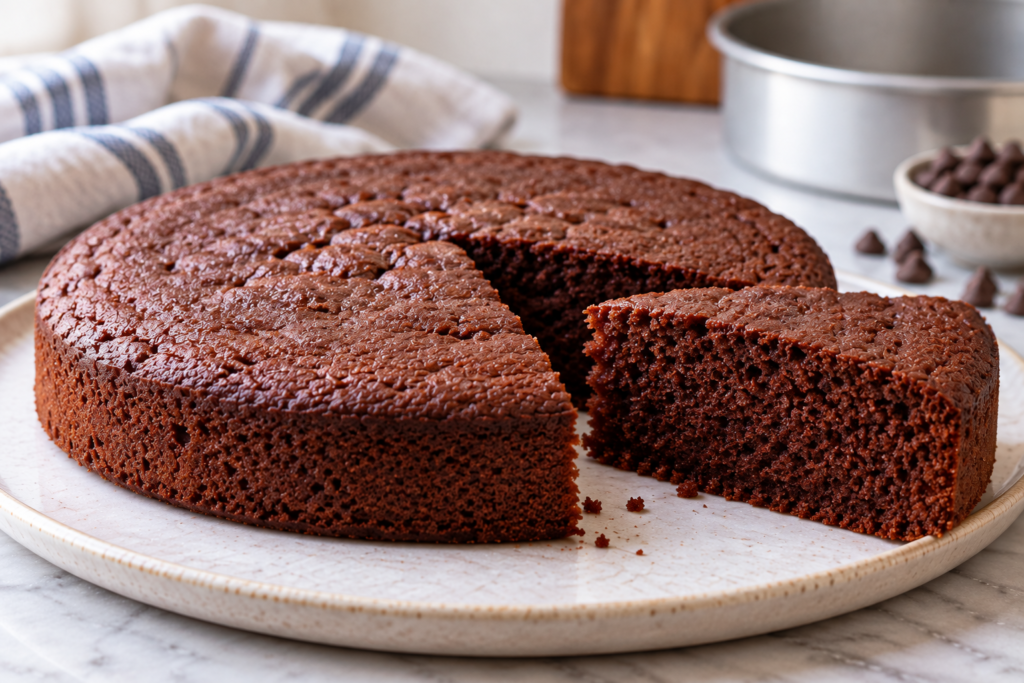
Why Is My Egg-less Cake Not Rising? Causes & Easy Fixes
Your cake goes into the oven, you wait for that lovely rise—and it barely moves.
If your egg-less cake is not rising, start by checking the freshness and quantity of your baking powder or baking soda, the oven temperature, batter consistency, and flour-to-liquid balance. If the cake rises and then sinks, however, you are dealing with a different problem: the batter has expanded, but its structure hasn’t been able to hold that rise.
That distinction matters.
After more than 25 years of baking and teaching, I have seen many bakers try to fix a flat egg-less cake by simply adding more baking powder. I rarely start there. A cake that doesn’t rise may have a leavening problem, but it can just as easily have too much flour, excess moisture, an unsuitable egg substitute, or an oven that isn’t behaving as expected.
Before changing the recipe, look at what actually happened to your cake.
This guide will help you do exactly that.
This article is part of my Eggless Baking Guide: Common Problems, Causes & Easy Fixes, where I explain the most common egg-less cake problems and how to troubleshoot them step by step.
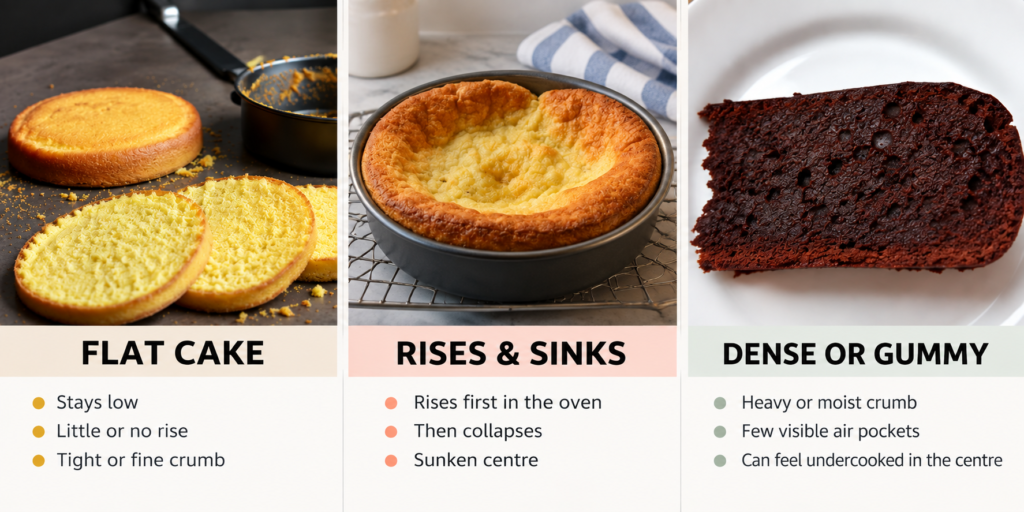
Quick Problem Finder: Why Is Your Egg-less Cake Not Rising?
Use the image above, then find the symptom that most closely matches your cake.
| What happened to your cake? | Check this first |
|---|---|
| Stayed almost completely flat | Leavening, oven temperature, batter |
| Rose only a little and feels dense | Flour quantity, mixing, batter consistency |
| Rose around the edges but stayed low in the centre | Oven temperature, pan size, batter consistency |
| Rose well and then collapsed | Moisture, leavening, underbaking |
| Flat with a wet or gummy centre | Moisture, baking time, pan depth |
| Flat, heavy and compact | Flour-to-liquid balance, mixing, leavening |
| Problem started after changing the egg substitute | Moisture, binding and structure |
| Gluten-free and egg-less cake won’t rise | Flour blend, starch, binder, hydration |
| Browns quickly but remains underbaked inside | Oven temperature, pan depth |
Did your cake rise and then sink?
That isn’t quite the same problem as a cake that never rose.
If it initially developed good height but then collapsed, go to Why Does My Eggless Cake Sink?.
Is the middle wet, sticky or pasty?
Read Why Is My Eggless Cake Gummy in the Middle?.
Is the whole cake heavy and compact?
Go to Why Is My Cake Dense?.
If your cake simply never developed enough height, let’s troubleshoot it step by step.
What Actually Makes an Egg-less Cake Rise?
Before looking at individual problems, it helps to understand what is happening inside the batter.
Leavening creates gas.
Air already present in the batter expands as it heats.
Heat encourages that expansion and helps the cake set.
Flour, starches, binders and other ingredients provide the framework that holds the expanding batter.
Moisture affects hydration and crumb development.
Egg substitutes can contribute some of the binding, moisture, emulsification, stability or aeration that eggs normally provide.
The important part is that these elements have to work together.
A cake can have perfectly good leavening and still fail to rise well if the batter is too heavy or doesn’t have enough support to retain the expansion.
So I don’t think of cake rise as simply:
“Did I use enough baking powder?”
I think of it as:
“Did the batter create enough lift, and could it hold that lift?”
That is a much more useful way to troubleshoot an egg-less cake.
1. Your Baking Powder or Baking Soda Is No Longer Active
If a cake stays almost completely flat, leavening is one of the first things I would check.
Baking powder and baking soda help produce the gases that expand inside the batter during baking.
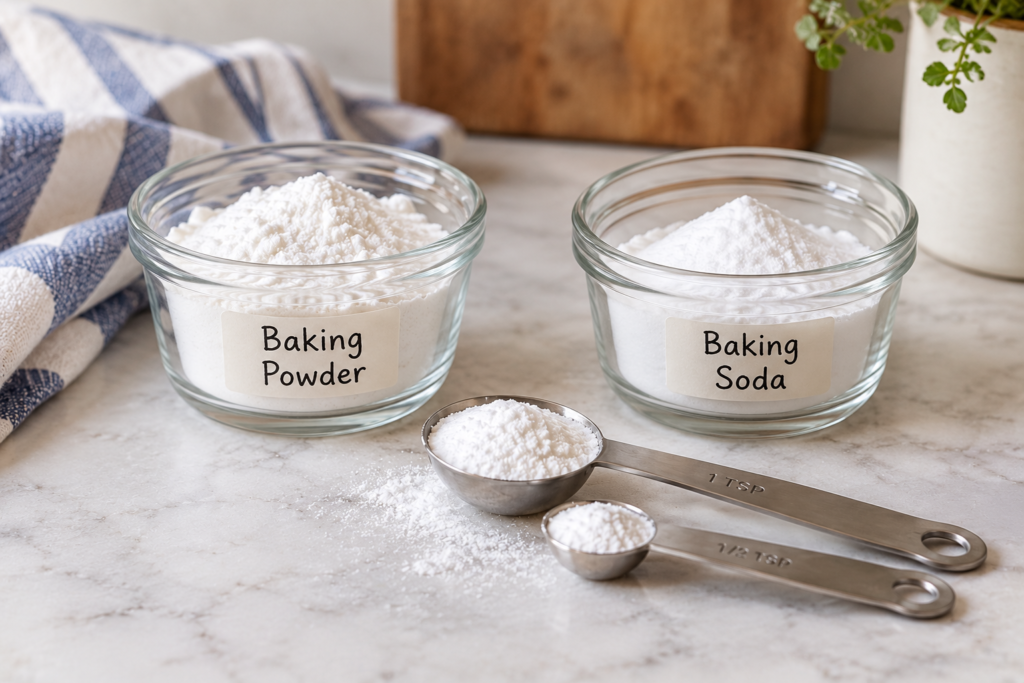
If your leavening agent is old, poorly stored or no longer sufficiently active, there may not be enough gas production for the cake to develop good volume.
Check:
- Is your baking powder fresh?
- Is your baking soda fresh?
- Has it been stored in a dry, airtight container?
- Did you measure it accurately?
- Did you use the leavening agent specified in the recipe?
Also remember that baking powder and baking soda are not interchangeable.
Baking soda requires sufficient acidity in the recipe to react properly. Depending on the formula, that acidity may come from ingredients such as yogurt, buttermilk, lemon juice or vinegar.
That reaction produces carbon dioxide, which contributes to the cake’s expansion.
But the gas still needs a batter structure capable of holding it.
2. You Used Too Much or Too Little Leavening
It is tempting to think:
Flat cake = not enough baking powder.
Sometimes that is true.
But too much leavening can create another problem.
The batter may expand rapidly before its internal framework has set sufficiently. The cake can rise impressively and then lose that height.
This is why I don’t recommend increasing baking powder simply because a previous cake was flat.
The goal is controlled expansion, not maximum expansion.
If your cake rose well and then collapsed, continue with Why Does My Eggless Cake Sink? rather than changing the leavening again.
3. Your Oven Wasn’t Properly Preheated
An egg-less cake needs the right baking environment from the moment it enters the oven.
During the early stages of baking:
- gases expand
- air pockets enlarge
- starches begin to set
- the crumb starts developing
- the cake gradually acquires its final structure
If the oven hasn’t reached the required temperature, these processes may not happen at the expected rate.
The result can be a cake that is:
- low
- dense
- heavy
- unevenly baked
I always recommend allowing the oven to preheat fully before putting the cake inside rather than placing the batter in as soon as you switch the OTG on.
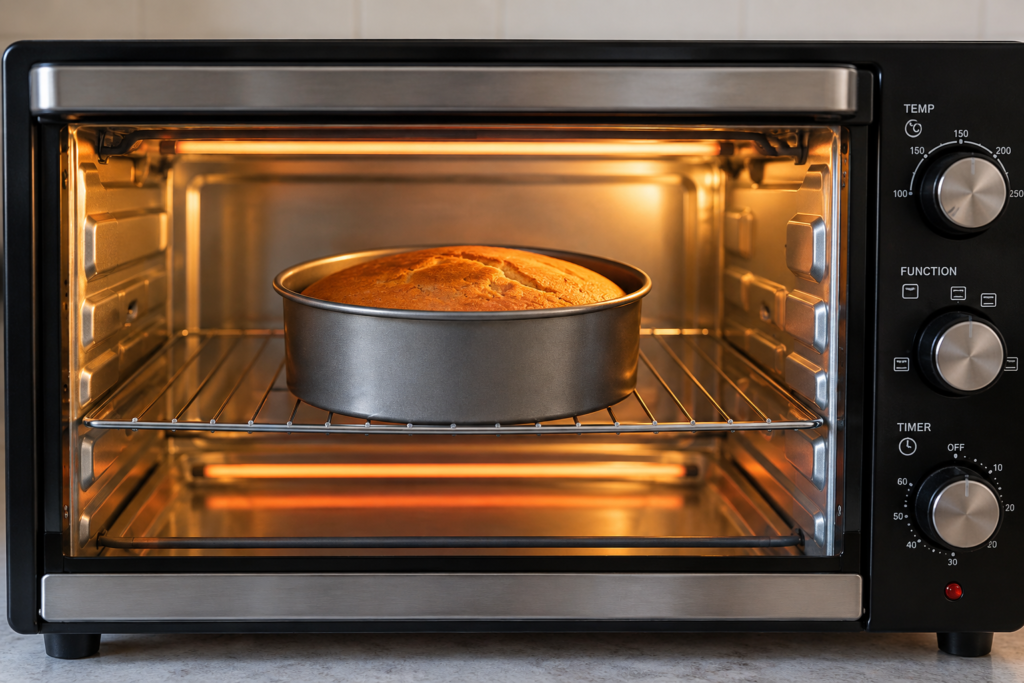
Place the cake on the middle rack of a properly preheated OTG for more even baking.
If you use an OTG and regularly get inconsistent results, an oven thermometer can also help you determine whether the actual temperature matches the dial.
For more on preheating, rack position and oven temperature, read How to Use an Oven for Baking.
4. Your Oven Temperature Is Too Low
A cake needs sufficient heat to expand and then set.
If your oven is significantly cooler than the recipe requires, the batter may develop slowly and the final crumb can remain heavy.
You may eventually get a baked cake, but it may be:
- flat
- dense
- pale
- overly moist
- slow to set
If a recipe works well sometimes but not at other times, check the oven before changing the formula.
5. Your Oven Is Too Hot
A very hot oven can cause the opposite problem.
The outside of the cake may set quickly while the centre is still expanding.
You may notice:
- rapid initial rise
- a pronounced dome
- cracks on top
- very brown edges
- an underbaked centre
- collapse during or after baking
So increasing the temperature is not automatically the answer to a cake that lacks height.
Look at the pattern.
Never rises: investigate leavening, batter and temperature.
Rises quickly and collapses: investigate moisture, leavening, structure and baking time.
6. You Opened the Oven Too Early
I know how tempting it is to check a cake before it is ready.
But during the early stages of baking, the crumb is still developing.
Opening the oven allows heat to escape and can cause a sudden temperature change. If the cake hasn’t developed enough strength to support its rise, that disruption can affect the final volume.
My simple rule
Avoid opening the oven during the early part of baking unless the recipe specifically requires it.
Wait until the cake is reasonably close to its expected baking time before checking.
7. Your Batter Sat Too Long Before Baking
Once wet and dry ingredients are combined, chemical reactions can begin, depending on the recipe’s leavening system.
If the batter sits around while you prepare the pan or wait for the oven, some of that activity may occur before the cake starts baking.
Prepare first
Before combining the final batter:
- preheat the oven
- prepare the pan
- measure the ingredients
- keep your tools ready
Then mix and bake according to the recipe without unnecessary delay.
This is especially important for recipes where baking soda reacts with an acidic ingredient.
8. Your Batter Is Too Thick or Heavy
Sometimes the leavening is perfectly fine.
The problem is the batter itself.
A very heavy batter may not expand easily.
This can happen because of:
- too much flour
- too little liquid
- a different flour
- a thick egg substitute
- reduced fat
- an ingredient substitution
- inaccurate measurement
If the batter looks noticeably thicker than the recipe describes, don’t immediately compensate with more baking powder.
Ask why the batter changed.
Did you measure the flour differently?
Did you use another type of flour?
Did you change the yogurt?
Did you reduce the liquid?
Did you add an ingredient that absorbs a lot of moisture?
The consistency of the batter can tell you a great deal before the cake even reaches the oven.
9. You Added Too Much Flour
If your cake is flat and dense, flour measurement is one of the first things I would investigate.
Too much flour makes the batter heavier and can produce a cake that is:
- compact
- dry
- firm
- heavy
- poorly risen
This is particularly easy to do when flour is measured by volume.
The amount of flour that fits into a cup can vary depending on how it is filled.
For baking, I prefer weighing ingredients whenever possible because it removes one unnecessary variable.
If your cake has a noticeably tight, heavy crumb, continue with Why Is My Cake Dense?.
10. Your Egg Substitute Changed the Batter
This is one of the most important areas of egg-less baking.
There isn’t one universal ingredient that can replace an egg in every cake and perform exactly the same functions.
Eggs can contribute:
- structure
- binding
- moisture
- emulsification
- stability
- aeration
Different substitutes contribute different combinations of these qualities.
For example:
Yogurt can provide moisture, tenderness and acidity.
Flaxseed gel provides binding and changes batter viscosity.
Fruit purées add moisture and softness but may also make some batters heavier.
Aquafaba can contribute aeration in suitable applications.
Starches and commercial egg replacers can provide different types of binding and structural support.
So rather than asking:
“What can I use instead of an egg?”
I prefer to ask:
“What was the egg doing in this particular cake?”
That question usually leads to a better substitution.
If your cake stopped rising after changing the egg replacement, read Best Egg Substitutes for Eggless Cakes before changing the leavening.
11. You Added Too Much Moisture
More moisture does not automatically mean a softer cake.
This is a common issue when adapting egg-less recipes.
You may add extra:
- yogurt
- milk
- fruit purée
- oil
- liquid sweetener
because you want a softer crumb.
But if the recipe doesn’t have enough support for that additional moisture, the batter may become too weak or heavy.
The result can be:
- low volume
- a heavy crumb
- a gummy centre
- a sunken middle
The important relationship isn’t simply:
More liquid = softer cake.
It is the balance between moisture, structure, leavening and heat that determines the final texture.
If your cake is flat and the centre feels wet, sticky or pasty, read Why Is My Eggless Cake Gummy in the Middle?.
12. You Overmixed the Batter
Mixing affects cake texture too.
In wheat-based cakes, excessive mixing after flour is incorporated can contribute to a tighter crumb.
But I don’t like using “overmixing” as the explanation for every dense egg-less cake.
Different cakes require different mixing methods.
An oil-based cake, a creamed butter cake and a gluten-free cake don’t behave in exactly the same way.
Follow the mixing method specified for the particular recipe.
If your cake is poorly risen and compact, also check the flour quantity, batter consistency and overall formula.
13. Your Cake Pan Is the Wrong Size
Pan size affects more than the shape of the finished cake.
It changes the depth of the batter, which affects how quickly the centre sets.
If a recipe is designed for a wider pan and you use a smaller one, the batter becomes deeper.
The outside may appear ready while the centre still needs more time.
A pan that is too large creates the opposite situation: a shallower layer of batter that may bake differently and produce a flatter-looking cake.
Whenever possible, follow the recipe’s recommended:
- pan diameter
- pan depth
- batter quantity
If you change the pan, expect the baking time to change as well.
14. Your Gluten-Free Egg-less Cake Doesn’t Have Enough Support
This deserves special attention because gluten-free and egg-less baking presents two structural challenges at the same time.
That doesn’t mean a gluten-free egg-less cake has to be flat or heavy. It can rise beautifully.
But because you’re working without both gluten and eggs, the recipe needs to create that structure through other ingredients.
Depending on the formula, this may involve a combination of:
- gluten-free flours
- starches
- binders
- hydration
- fat
- an egg substitute
- leavening
And this is where gluten-free baking becomes very different from conventional baking.
Rice flour, millet flour, almond flour, coconut flour, tapioca starch and potato starch all behave differently. They don’t absorb water or contribute to structure in the same way.
This is why simply replacing wheat flour with an equal quantity of a single gluten-free flour often doesn’t produce the same cake.
The flour blend and hydration need to work together, while the binder and other ingredients help provide the structure that gluten and eggs would normally contribute.
15. Your Flour-to-Liquid Ratio Is Out of Balance
A cake batter needs the right relationship between its dry and wet ingredients.
Too much flour can make the batter too heavy.
Too little flour can leave insufficient support.
Too much liquid can weaken the batter.
Too little liquid can make it excessively thick.
And when you change the egg substitute, the balance can shift again because different substitutes contain different amounts of water and solids.
This is why changing one ingredient in isolation often doesn’t solve the problem.
A cake recipe is a system.
When you change one component, consider what that change does to the rest of the formula.
16. You Changed Too Many Ingredients at Once
This is one of my most important troubleshooting rules:
Change one variable at a time.
Suppose your cake doesn’t rise and, on the next attempt, you:
- increase the baking powder
- reduce the yogurt
- add more milk
- change the flour
- increase the oven temperature
- use a different pan
And the cake works.
What fixed it?
You don’t know.
When I troubleshoot a recipe, I prefer making one considered change, baking again and observing the result.
That way, every bake teaches you something.
How I Troubleshoot an Egg-less Cake That Won’t Rise
If your cake comes out flat, don’t immediately start changing ingredients.
Work through these questions.
1. Look at the height
Did the cake:
- never rise?
- rise only slightly?
- rise and then collapse?
- rise more around the edges?
2. Look at the crumb
Once the cake has cooled sufficiently, cut it and examine the crumb.
Is it:
- light?
- tight?
- compact?
- dry?
- sticky?
- wet?
- gummy?
- crumbly?
The crumb often tells you more than the height alone.
3. Think about what happened during baking
Did the cake:
- rise slowly?
- rise very quickly?
- brown unusually fast?
- remain pale?
- crack?
- stay wet in the centre?
- collapse after leaving the oven?
4. Check the leavening
Ask:
- Was it fresh?
- Was it measured accurately?
- Did you use the specified leavening?
- Did you change the quantity?
- Did you change an acidic ingredient?
5. Check the batter
Look at:
- flour
- liquid
- fat
- sugar
- egg substitute
- yogurt
- fruit purée
- starches
- binders
Was the consistency noticeably different from the recipe?
6. Check the oven
Was it fully preheated?
Was the correct temperature used?
Was the cake positioned correctly?
Did you open the door too early?
For recurring oven problems, read How to Use an Oven for Baking.
7. Check the pan
Was it the same size and depth specified in the recipe?
8. Change one thing
Then bake again.
This is what turns troubleshooting from guesswork into a repeatable process.
How to Get More Consistent Rise in Egg-less Cakes
Once you’ve identified the problem, prevention becomes much easier.
Before baking
- Use fresh baking powder and baking soda.
- Weigh ingredients where possible.
- Read the entire recipe before starting.
- Use the recommended pan.
- Prepare the pan before mixing.
- Preheat the oven properly.
While making the batter
- Use the egg substitute specified in the recipe.
- Follow the recommended mixing method.
- Measure liquids accurately.
- Don’t add extra liquid simply because you want a softer cake.
- Don’t increase the leavening without understanding the formula.
- Avoid unnecessary ingredient substitutions.
Before the cake goes into the oven
Check the batter consistency.
If it looks substantially thicker or thinner than expected, stop and work out why before baking.
While baking
- Maintain the recommended temperature.
- Don’t open the oven too early.
- Use the correct rack position.
- Allow enough time for the centre to set.
After baking
Don’t judge the cake only by its height.
Once cooled, examine the crumb as well.
A good crumb can tell you whether the final problem was related to moisture, structure, leavening or baking.
What If Your Cake Still Doesn’t Rise?
If you’ve checked the obvious causes and the problem continues, don’t keep changing the baking powder.
Go back to the recipe itself.
Ask:
Is the batter too heavy?
Is the flour-to-liquid ratio appropriate?
Is the egg substitute suitable for this cake?
Has the substitute introduced extra moisture?
Is the pan the right size?
Is the oven temperature accurate?
And if the cake is gluten-free:
Does the flour blend provide enough support?
At this point, looking at the relationship between leavening, moisture, structure and heat is more useful than blaming one ingredient.
A Simple Way to Understand Egg-less Cake Structure
Think of your cake as a balance.
Leavening creates the gas needed for lift.
Air and gas expand as the batter heats.
Flour, starches, binders and other ingredients provide the framework that holds that expansion.
Liquid hydrates the ingredients and influences crumb texture.
Fat contributes tenderness.
Sugar affects moisture, tenderness and browning.
The egg substitute contributes some combination of binding, moisture, emulsification, structure or aeration.
Heat allows the expanding batter to become a set cake.
If the cake produces plenty of gas but cannot hold it, it may collapse.
If the batter is too heavy, it may barely rise.
If there is too much moisture, the centre may struggle to set.
If there isn’t enough moisture, the crumb may become dry and tight.
The goal isn’t simply to make an egg-less cake rise.
It is to create a batter that can rise, set and hold that volume after baking.
Once you understand that, troubleshooting becomes much more logical.
Frequently Asked Questions
Why is my egg-less cake not rising?
Start by checking your baking powder or baking soda, oven temperature, batter consistency and flour-to-liquid balance. Egg substitutes and insufficient structural support can also affect how well an egg-less cake rises and holds its volume.
Why is my egg-less cake flat but still soft?
If the cake is flat but the crumb isn’t particularly dense or gummy, check the freshness and quantity of the leavening, oven temperature and whether the batter sat for too long before baking.
Why is my egg-less cake flat and dense?
A flat, dense cake may have too much flour, insufficient leavening, a very heavy batter or an oven-temperature problem.
Read Why Is My Cake Dense? for a more detailed diagnosis.
Why does my egg-less cake rise and then sink?
If the cake rises successfully but then collapses, it has produced enough expansion but hasn’t been able to hold it. Excess moisture, too much leavening, underbaking and insufficient structural support are common areas to investigate.
Read Why Does My Eggless Cake Sink? for the full troubleshooting guide.
Can too much baking powder stop an egg-less cake from rising properly?
Too much baking powder can cause rapid expansion before the cake has set sufficiently. The cake may rise dramatically and then collapse rather than retaining that volume.
Can yogurt affect how an egg-less cake rises?
Yes. Yogurt contributes moisture and acidity, and different yogurts vary in thickness and water content. Changing the type or quantity can therefore alter batter consistency and the final cake structure.
Can the wrong egg substitute affect cake rise?
Yes. Different egg substitutes contribute different amounts of moisture, binding, aeration and structure. A substitute that works in one cake may not perform the same function in another.
Read Best Egg Substitutes for Eggless Cakes if you’re unsure which function your replacement ingredient needs to perform.
Why is my egg-less cake flat and gummy in the middle?
Look at moisture, structural support, baking temperature, baking time and pan depth. Too much yogurt, fruit purée or other liquid can also affect how well the centre sets.
Read Why Is My Eggless Cake Gummy in the Middle? for a detailed diagnosis.
Why isn’t my gluten-free egg-less cake rising?
Because both gluten and eggs contribute to cake structure, a gluten-free egg-less recipe needs other sources of support. The flour blend, starches, binders, hydration and leavening all need to work together.
The Gluten-Free Baking Guide explains these relationships in more detail.
Can I make a gluten-free cake without eggs and still get a good rise?
Absolutely. A well-balanced gluten-free egg-less cake can have good volume and a soft crumb. The key is balancing the flour blend, starches, binders, moisture, egg substitute and leavening rather than relying on any one ingredient.
The Bottom Line
When your egg-less cake doesn’t rise, don’t automatically add more baking powder.
First look at what the cake is telling you.
Did it never rise?
Did it rise only slightly?
Did it rise and then collapse?
Is the crumb dense?
Is the centre gummy?
Did you change the egg substitute?
Is the cake both gluten-free and egg-less?
Each clue points towards a different cause.
After years of baking and teaching, I’ve found that this approach is far more useful than changing several ingredients and hoping for a better result.
Troubleshooting starts with observation.
Once you learn to read the rise, crumb, moisture and structure, egg-less baking becomes much easier to understand—and much easier to repeat successfully.
Continue Troubleshooting Your Egg-less Cake
Choose the guide that matches your result:
Start with the main guide:
Eggless Baking Guide: Common Problems, Causes & Easy Fixes
Your cake rose and then collapsed:
Why Does My Eggless Cake Sink?
Your cake is wet or sticky inside:
Why Is My Eggless Cake Gummy in the Middle?
Your cake is heavy and compact:
Why Is My Cake Dense?
You changed the egg replacement:
Best Egg Substitutes for Eggless Cakes
You suspect an oven problem:
How to Use an Oven for Baking
Your cake is also gluten-free:
Gluten-Free Baking Guide