
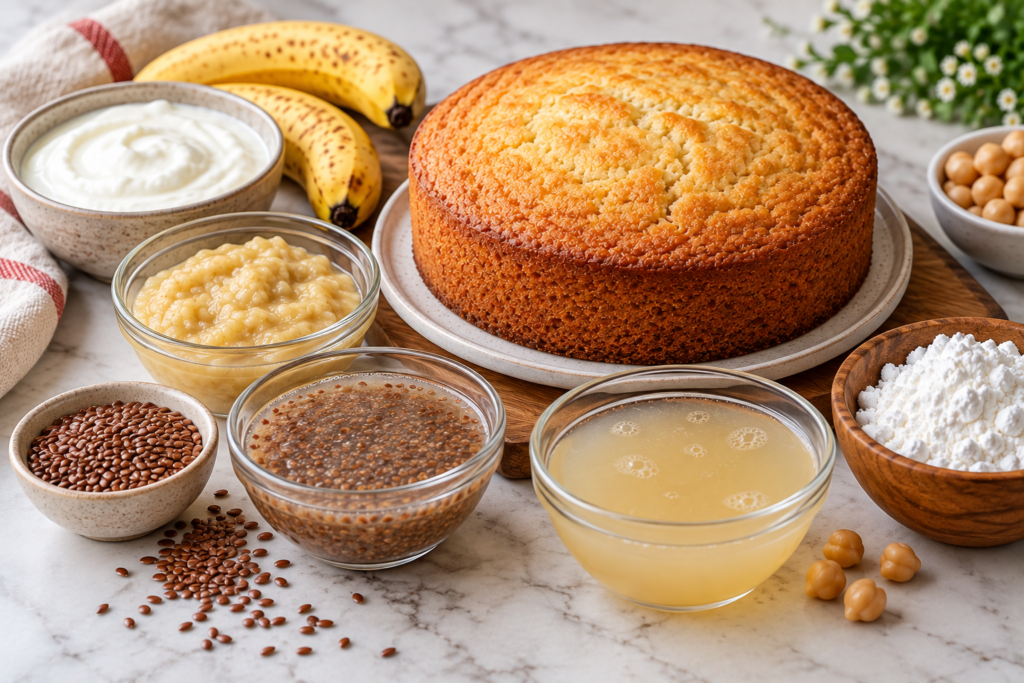
Best Egg Substitutes for Eggless Cakes: What Each One Does and When to Use It
What should you use instead of an egg in a cake?
Choosing the right egg substitutes for eggless cakes is not simply about replacing one ingredient with another. Eggs can contribute moisture, binding, structure, richness, emulsification and aeration.
Yogurt? Flaxseed? Banana? Applesauce? Aquafaba? A commercial egg replacer?
The answer depends on what the egg was doing in the recipe.
Choosing an egg substitute for an eggless cake is not simply about replacing one ingredient with another. Eggs can contribute moisture, binding, structure, richness, emulsification and aeration. Different substitutes provide some of these functions—but rarely all of them.
That is why a substitute that works beautifully in one eggless cake may leave another cake dense, gummy, fragile or sunken.
After more than 25 years of baking, teaching and developing recipes, I have learned to look at the function of an ingredient, not just its name.
If your eggless cake has already gone wrong, don’t start by changing several ingredients. Start by identifying the problem.
Quick Problem Finder: What Went Wrong With Your Eggless Cake?
If you’re here because your cake has already failed, start here.
| What happened to your cake? | What to check first |
|---|---|
| The cake rose and then sank | Moisture, leavening, structure, baking time and the egg substitute |
| The centre is gummy or sticky | Excess moisture, underbaking, pan size and oven temperature |
| The cake is dense or heavy | Flour quantity, liquid balance, mixing, leavening and structure |
| The cake is dry | Too much flour, insufficient moisture or fat, or overbaking |
| The cake crumbles when sliced | Binding, moisture, flour balance and whether it was sliced while warm |
| The cake doesn’t rise properly | Leavening, oven temperature, batter consistency and structure |
| The cake is moist but not gummy | It may be perfectly baked—don’t keep adding flour |
| The problem started after changing the egg substitute | Compare the water, solids, sugar and acidity introduced by the new ingredient |
| Your gluten-free eggless cake is dense or crumbly | Flour blend, starch, binder, hydration and structure |
If your cake has sunk in the middle, read Why Does My Eggless Cake Sink?.
If the problem is specifically a gummy or sticky centre, read Why Is My Eggless Cake Gummy in the Middle?.
For a heavy or compact crumb, see Why Is My Cake Dense?.
These articles are part of my larger Eggless Baking Guide: Common Problems, Causes & Easy Fixes.
What Does an Egg Actually Do in a Cake?
Before choosing an egg substitute, ask a more useful question:
What role was the egg playing in this particular recipe?
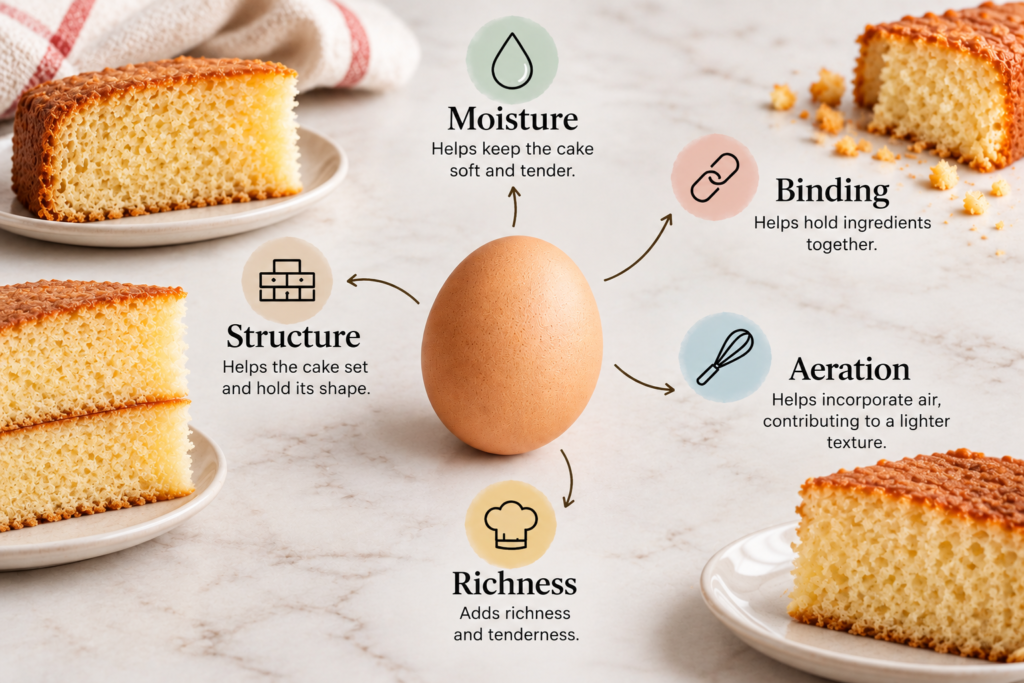
An egg can contribute several things at the same time.
Structure
As the cake bakes, egg proteins help set the crumb and give the cake a framework.
Binding
Eggs help hold ingredients together, which is particularly important in delicate cakes.
Moisture
Eggs contain water, so removing them changes the moisture balance of the batter.
Emulsification
The yolk contains emulsifying components that help fat and water work together.
Aeration
Whipped eggs can incorporate air into certain cakes and desserts.
Richness and tenderness
The fat in the yolk contributes richness and affects the mouthfeel of the finished cake.
Colour
Egg yolks also contribute to colour and browning.
This is why choosing an egg substitute is really about matching functions, not simply matching quantities.
Egg Substitute vs Egg Replacement: Why the Difference Matters
An egg substitute is an ingredient used in place of an egg—such as yogurt, flaxseed gel or banana.
But it doesn’t necessarily reproduce every function of an egg.
For example:
- yogurt contributes moisture, tenderness and acidity
- flaxseed contributes binding and gel-like structure
- banana contributes moisture, sweetness and fruit solids
- aquafaba can contribute aeration
- starches can support structure and texture
So replacing an egg does not mean reproducing an egg exactly.
This distinction becomes particularly important when troubleshooting an eggless cake. If a substitute solves one problem but introduces another, look at what the new ingredient has changed in the overall batter.
Don’t Replace an Egg by Volume Alone
This is where many eggless baking problems begin.
A recipe calls for one egg, so a baker may assume that an equal volume of yogurt, banana or another ingredient will behave in the same way.
It won’t.
Yogurt has its own water content, solids and acidity. Banana contains water, sugars and fruit solids. Flaxseed develops a gel. Aquafaba behaves differently again.
When you make a substitution, you are changing the batter as a whole.
So instead of asking:
“What can I use instead of this egg?”
ask:
“What does this ingredient contribute, and what else is already in my recipe?”
That simple change in thinking can prevent a lot of unnecessary troubleshooting.
Egg Substitute Comparison: What Does Each One Actually Do?
There is no single egg substitute that works equally well in every cake.
| Egg substitute | What it does | Best for |
|---|---|---|
| Yogurt | Moisture, tenderness & acidity | Soft, tender cakes |
| Flaxseed gel | Binding & structure | Vegan, hearty cakes |
| Banana purée | Moisture, sweetness & binding | Banana & flavoured cakes |
| Applesauce / fruit purée | Moisture & tenderness | Moist cakes |
| Aquafaba | Aeration & moisture | Foaming-based cakes |
| Commercial egg replacer | Binding & structure | Consistent egg-free baking |
| Buttermilk | Moisture, tenderness & acidity | Tender cakes |
| Starches | Structure & texture | Gluten-free cakes |
Think of this table as a starting point, not a set of universal substitutions.
A few things to watch:
- Yogurt & buttermilk: Too much can make the batter overly wet.
- Flaxseed gel: Can produce a slightly heavier crumb.
- Banana: Adds sweetness and fruit solids.
- Applesauce: Can soften the crumb considerably.
- Aquafaba: Works best when the recipe is designed to take advantage of its foaming ability.
- Commercial replacers: Results vary between brands.
- Starches: Too much can make the cake dense or gummy, particularly in gluten-free baking.
The rest of the recipe still matters.
1. Yogurt: Moisture, Tenderness and Acidity
Yogurt is one of the most useful ingredients in eggless cake baking.
It can contribute:
- moisture
- tenderness
- acidity
- richness
- some binding and structure
It is particularly useful when you want a soft, tender crumb.
Yogurt can also work alongside baking soda because its acidity can contribute to the leavening reaction.
When yogurt is a good choice
Yogurt can be useful when the recipe needs:
- a tender crumb
- additional moisture
- acidity
- a soft texture
What should you watch?
The consistency of yogurt matters.
A thick Greek-style yogurt and a thinner homemade yogurt can introduce very different amounts of water into the batter.
Also look at the other liquids already present in the recipe. If the batter is already quite wet, adding a large amount of yogurt can change the final texture considerably.
2. Flaxseed: Binding and Structure
Ground flaxseed mixed with water is a popular egg substitute, particularly in vegan baking.
As it hydrates, flaxseed develops a gel-like consistency that helps bind ingredients together.
It can contribute:
- binding
- some structure
- moisture
- a slightly more substantial texture
When flaxseed works well
Flaxseed can be useful when you need a cake or bake to hold together better without eggs.
It is particularly helpful when binding is more important than creating an extremely light crumb.
What should you expect?
A flaxseed-based cake may have a slightly more substantial texture than one made with yogurt or another lighter substitute.
That isn’t necessarily a problem.
The goal isn’t to make every eggless cake identical to an egg-based cake. The goal is to create a good texture for the particular recipe.
Too much flaxseed, however, can make a bake feel heavy, dense or slightly gummy.
3. Banana and Other Fruit Purées: Moisture and Tenderness
Mashed banana, applesauce and other fruit purées can be useful in eggless baking.
They can provide:
- moisture
- sweetness
- tenderness
- some binding
- fruit flavour
- additional solids
Banana works particularly well when its flavour complements the cake.
But fruit purée is not simply replacing an egg. It is also changing the recipe.
You are introducing water, sugars and fruit solids, which can affect:
- sweetness
- browning
- baking time
- crumb texture
- overall density
This is why a banana-based cake can behave very differently from a vanilla cake using yogurt.
Choose the substitute according to the recipe you are making—not simply according to what is available in the kitchen.
4. Aquafaba: Moisture and Aeration
Aquafaba is the liquid from cooked chickpeas.
It is particularly interesting because it can be whipped and used to incorporate air into certain recipes.
It can contribute:
- moisture
- aeration
- some binding
When aquafaba is useful
It can be helpful when a recipe benefits from incorporated air and is formulated to take advantage of a whipped component.
But aquafaba isn’t automatically a solution for a dense cake.
If the underlying problem is an incorrect flour-to-liquid balance, adding more liquid won’t necessarily improve the texture.
This is another reason to identify the actual problem before changing the recipe.
5. Cornstarch, Potato Starch and Other Starches: Structure and Texture
Starches can play an important supporting role in eggless baking.
Depending on the recipe, they can contribute to:
- softness
- tenderness
- structure
- moisture management
- crumb texture
Starch becomes particularly useful in gluten-free eggless baking, where there is no gluten network.
But starch isn’t a magic replacement for an egg.
Too much can produce a crumb that feels:
- dry
- fragile
- rubbery
- gummy
The appropriate amount depends on the flour blend and the rest of the recipe.
6. Commercial Egg Replacers: Convenient Binding and Structure
Commercial egg replacers are formulated to replace some of the functions of eggs.
Depending on the product, they may contain combinations of starches, gums, fibres or other ingredients.
Their advantage is consistency.
But “egg replacer” doesn’t mean “works identically to an egg in every cake.”
Always follow the manufacturer’s recommended quantity and check what type of baking the product is designed for.
Some are better suited to:
- cakes
- cookies
- pancakes
- binding
- batters
The formulation matters.
7. Buttermilk: Moisture, Tenderness and Acidity
Buttermilk can be useful in eggless cakes because it contributes:
- moisture
- tenderness
- acidity
- richness
Its acidity can also work with baking soda.
This makes it useful in recipes where the leavening system has been formulated around an acidic ingredient.
Buttermilk is still a liquid ingredient, so it needs to be considered as part of the total liquid in the recipe rather than as an isolated egg replacement.
Which Egg Substitutes Work Best for Eggless Cakes?
Instead of memorising one “best” substitute, think about the function you need.
| What you need | Ingredients that may help |
|---|---|
| Moisture and tenderness | Yogurt, fruit purée, buttermilk |
| Binding | Flaxseed gel, commercial egg replacer, suitable starches |
| Aeration | Aquafaba in appropriately formulated recipes |
| Acidity | Yogurt, buttermilk |
| Softness | Yogurt, suitable starches, some fruit purées |
| Gluten-free structure | A combination of flour, starches and binders |
The final texture is determined by the whole recipe, including flour, liquid, fat, sugar, leavening, mixing and baking conditions.
Why the Wrong Egg Substitute Can Make a Cake Sink
One common eggless baking problem is choosing a substitute without considering the rest of the formula.
Imagine a cake that already contains yogurt, milk and oil.
If you then add a large amount of fruit purée in place of the egg, the batter may contain considerably more moisture than the recipe was designed to support.
The cake may rise in the oven, but its structure may not be strong enough to hold that expansion.
As it cools, the centre can sink.
So a sinking eggless cake isn’t necessarily a sign that you need more baking powder.
It may be a balance problem between expansion and structure.
For a complete troubleshooting guide, read Why Does My Eggless Cake Sink?.
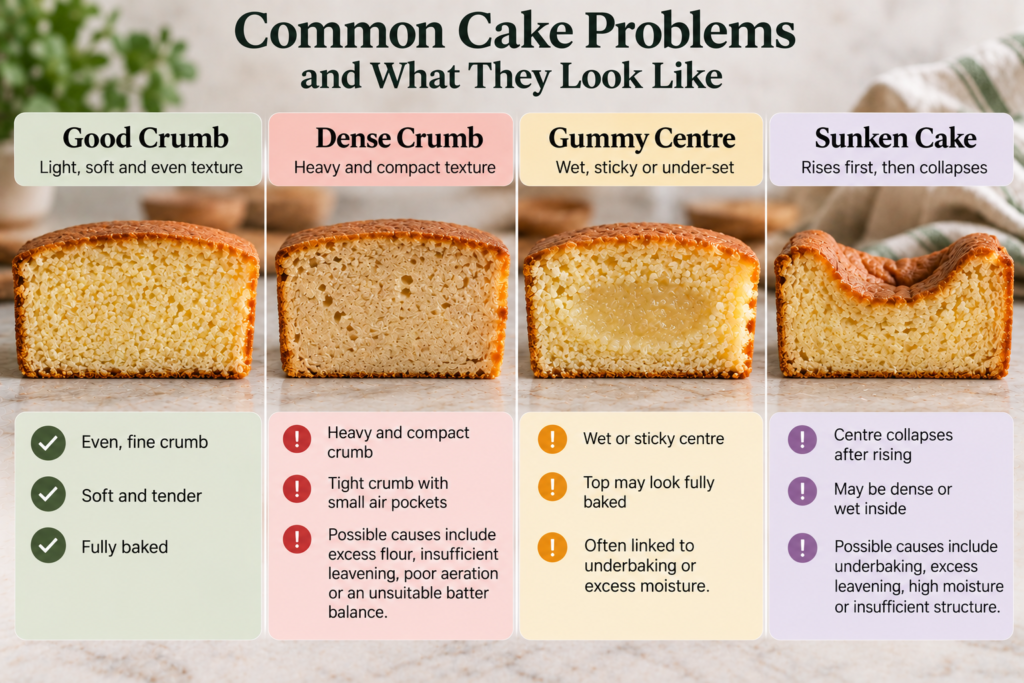
Why an Eggless Cake Can Become Dense
A dense cake isn’t automatically caused by using the “wrong” egg substitute.
Look at the entire recipe.
Common causes include:
- too much flour
- inaccurate measuring
- an unsuitable liquid balance
- insufficient or ineffective leavening
- excessive mixing
- inadequate aeration
- incorrect oven temperature
- overbaking
- an ingredient that has changed the batter’s consistency
This is why I prefer troubleshooting the whole formula rather than immediately blaming one ingredient.
For a detailed breakdown, see Why Is My Cake Dense?.
Eggless Baking and Leavening: More Baking Powder Isn’t the Answer
When a cake doesn’t rise, many bakers instinctively add more baking powder.
I would pause before doing that.
Leavening creates expansion, but the cake also needs enough structure to hold that expansion.
Too much leavening can cause a cake to rise rapidly and then collapse.
This becomes especially important when you change the egg substitute because the new ingredient may also change the batter’s acidity, viscosity or density.
My approach is simple:
Change one variable at a time.
That way, the cake can actually teach you what went wrong.
What Changes When You Make a Cake Both Eggless and Gluten-Free?
This is where I want you to be particularly careful.
A wheat-based eggless cake and a gluten-free eggless cake should not always be troubleshot in exactly the same way.
In a wheat-based cake, gluten can provide part of the structural framework.
In gluten-free baking, there is no gluten network.
So when you remove both eggs and gluten, the recipe may depend more heavily on:
- flour combinations
- starches
- binders
- hydration
- fat
- leavening
- the setting behaviour of the batter
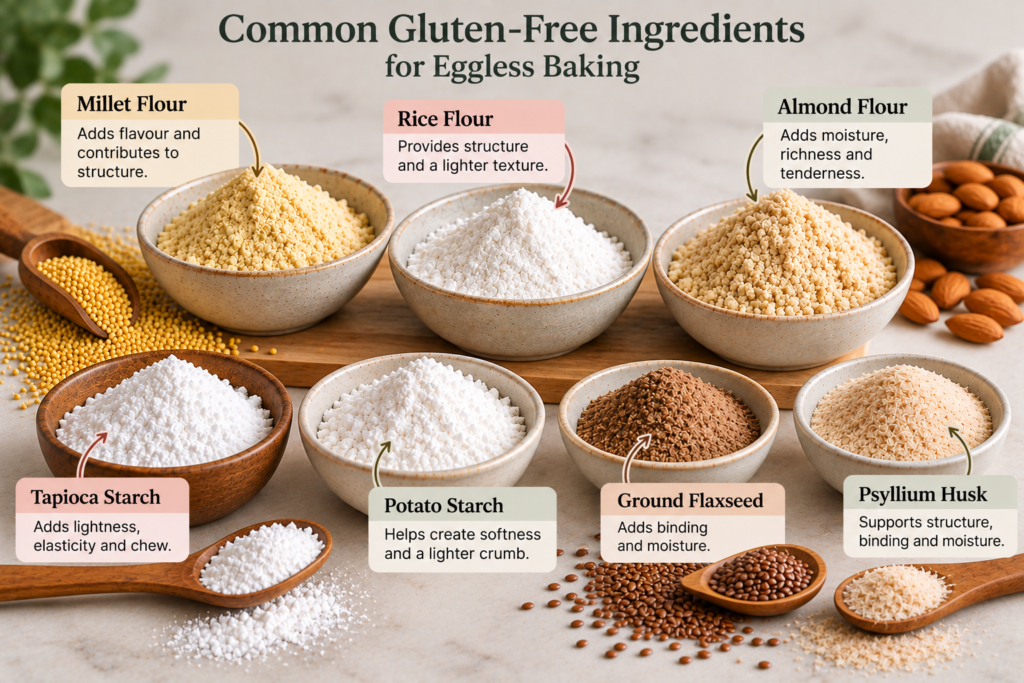
Rice flour, millet flour, almond flour, coconut flour, tapioca flour and potato starch do not behave identically.
For example, coconut flour is highly absorbent, while tapioca starch can contribute elasticity and a softer texture. Almond flour contributes fat and richness but does not behave like a structural wheat flour.
This is why I don’t recommend taking an ordinary wheat-based eggless cake and simply replacing the flour with one gluten-free flour.
You may need to reformulate the recipe.
For more on gluten-free flour blends, starches, binders, hydration and texture, see my Gluten-Free Baking Guide.
You can also explore my Gluten-Free Recipes to see how different gluten-free ingredients behave in actual recipes.
Don’t Forget the Oven
Sometimes you can choose the right egg substitute and measure everything carefully, yet still end up with a poor cake.
The oven may be the missing piece.
An oven that runs hotter than its displayed temperature can cause the outside of a cake to set and brown before the centre has properly baked.
That can produce:
- dry edges
- a gummy centre
- cracks
- uneven rise
- sinking after baking
Similarly, an oven that is too cool can affect rise and setting.
If your results are inconsistent even when the recipe hasn’t changed, check your oven temperature.
My guide How to Use an Oven for Baking covers preheating, temperature control, positioning and common oven-related problems.
My Practical Rule for Choosing an Egg Substitute
When I’m troubleshooting an eggless recipe, I don’t ask:
“What is the most popular egg substitute?”
I ask:
1. What did the egg need to do?
Was it mainly providing moisture, binding, structure or aeration—or several of these functions?
2. What does my substitute bring to the recipe?
Does it add water, fat, sugar, acidity, solids, air or gel?
3. What is already in the batter?
If the recipe already contains plenty of yogurt and liquid, another high-moisture ingredient may not be the best choice.
4. What texture am I trying to achieve?
A tea cake, sponge cake, muffin, brownie and loaf don’t all need the same type of structure.
5. Am I also removing gluten?
If the answer is yes, flour balance and structural support become just as important as the egg substitute.
This way of thinking has saved me from making many unnecessary changes over the years.
The Biggest Eggless Baking Mistake: Changing Too Many Things at Once
Suppose your cake is dense.
You change:
- the egg substitute
- the flour
- the yogurt
- the baking powder
- the oven temperature
The next cake turns out better.
But you don’t actually know why.
Maybe the original problem was simply too much flour.
Perhaps the oven temperature was inaccurate.
Or perhaps the substitute was adding more liquid than you realised.
Instead, make one controlled change.
Bake again.
Compare the crumb.
Then make the next adjustment if necessary.
This may feel slower, but it is actually one of the fastest ways to understand your own baking.
A Simple Way to Think About Eggless Cake Structure
I like to think of an eggless cake as a small balancing system.
Flour and starches
Provide the framework.
Egg substitute
Provides one or more functions such as moisture, binding, acidity or aeration.
Liquid
Hydrates the dry ingredients.
Fat
Contributes tenderness and richness.
Sugar
Adds sweetness but also affects moisture and browning.
Leavening
Creates expansion.
Heat
Sets the structure.
If one part changes significantly, the rest of the recipe may need to adjust.
That is why successful eggless baking is less about finding a magical egg substitute and more about understanding how ingredients work together.
Frequently Asked Questions About Egg Substitutes for Eggless Cakes
What is the best egg substitute for an eggless cake?
There isn’t one best substitute for every cake. Yogurt, flaxseed, fruit purée, aquafaba, starches and commercial egg replacers perform different functions. Choose according to what the egg was contributing to the particular recipe.
Can yogurt replace eggs in a cake?
Yogurt can work well in many eggless cakes because it contributes moisture, tenderness and acidity. The amount needs to be appropriate for the rest of the recipe.
Can banana replace eggs in cake?
Banana can be used in some cakes as an egg substitute, particularly when its flavour suits the recipe. It also adds moisture, sweetness and fruit solids.
Why does my eggless cake become gummy after using a fruit purée?
Fruit purées introduce moisture and natural sugars. If the batter contains more moisture than its structure can support, the centre may remain gummy or under-set.
Is flaxseed good for eggless cakes?
Flaxseed can be useful when binding is important. It forms a gel when hydrated, helping hold ingredients together. Too much can contribute to a heavier texture.
Can aquafaba make an eggless cake lighter?
Aquafaba can contribute aeration when it is used in a recipe designed to take advantage of whipped or foamed ingredients. It isn’t automatically a solution for every dense cake.
Why does my eggless cake sink after replacing the egg?
The replacement may have changed the moisture, density, acidity or structural balance of the batter. Underbaking, excess leavening and oven temperature can also contribute.
For a complete diagnosis, read Why Does My Eggless Cake Sink?.
Can I use the same egg substitute in every cake?
No. A substitute that works in one recipe may not work equally well in another because different cakes need different combinations of moisture, binding, aeration and structure.
What is the best egg substitute for gluten-free cakes?
There is no single answer. Gluten-free eggless cakes often need a combination of flour, starches, binders and moisture rather than relying on one ingredient to replace everything an egg and gluten would normally contribute.
For the bigger picture, read my Gluten-Free Baking Guide.
Why is my eggless cake dense even though I used an egg substitute?
The substitute may not be the problem. Check flour measurement, liquid balance, mixing, leavening and oven temperature before changing the recipe again.
For a detailed troubleshooting checklist, see Why Is My Cake Dense?.
The Takeaway: Choose the Function, Not Just the Substitute
Eggless baking becomes much easier when you stop thinking of an egg as a single ingredient that needs a one-for-one replacement.
Think about the job the egg was doing.
If you need moisture and tenderness, yogurt may be useful.
If you need binding, flaxseed or an appropriate commercial replacer may help.
If you need aeration, aquafaba may have a role in the right recipe.
If you are baking gluten-free as well as eggless, flour combinations, starches and binders become even more important.
And if your cake has already failed, don’t immediately change the recipe.
Read the cake first.
Look at the crumb.
Look at the centre.
Think about when it rose and when it failed.
Think about what you changed.
Then make one adjustment at a time.
That is how eggless baking becomes more predictable—and, over time, much less frustrating.
If you are working through eggless baking problems one by one, start with my Eggless Baking Guide: Common Problems, Causes & Easy Fixes and then move to the specific troubleshooting article that matches your cake.
The goal isn’t simply to find a substitute for an egg.
It is to understand what your cake needs.