
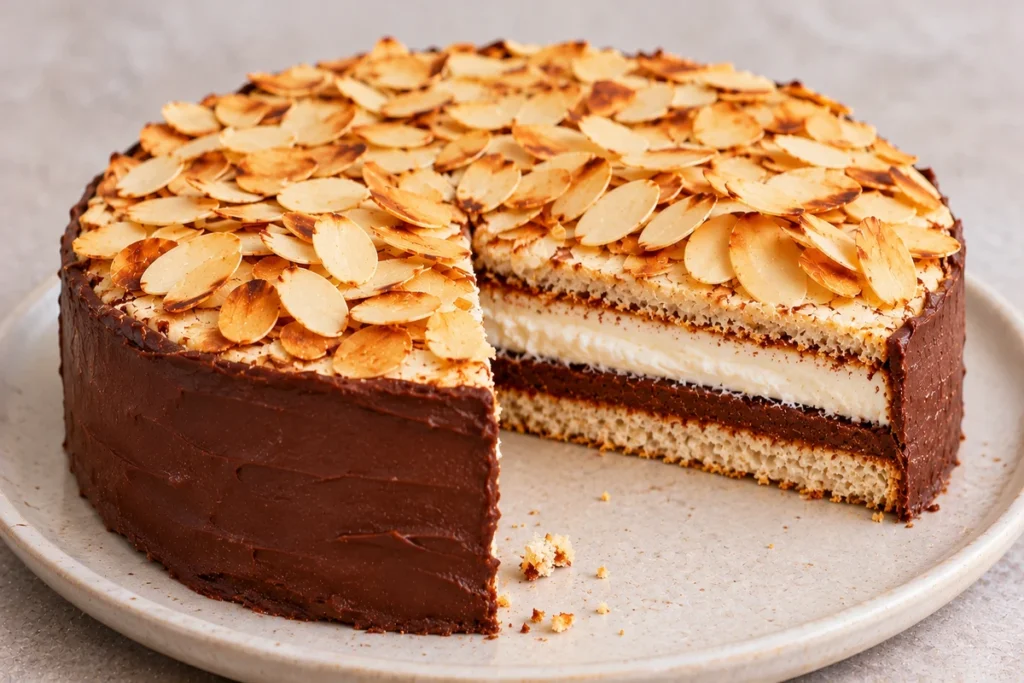
Why Is Your Aquafaba Dacquoise Spreading, Breaking or Turning Soft?
A dacquoise is a delicate, nut-based meringue layer traditionally made with ground nuts and whipped egg whites. In a vegan version, aquafaba—the liquid from cooked chickpeas—replaces the egg whites.
Aquafaba dacquoise problems can range from meringue that fails to reach stiff peaks to layers that spread, crack or become soft after baking.
Unlike a conventional cake batter, an aquafaba dacquoise depends on the aeration of a well-whipped meringue. The dry ingredients need to be incorporated gently, and the layers must be baked and cooled properly.
If your dacquoise loses volume, spreads in the oven, breaks during handling or becomes soft after filling, it helps to identify exactly when the problem begins.
I explored this technique while working with D10 – Gluten-Free Baking by Terra Vegan and also tested the formulation in my own kitchen. My trial was successful. In this article, I have kept my own observations separate from the original method and from possible explanations for problems you may encounter.
| Problem | What to Look at First |
|---|---|
| Aquafaba does not reach stiff peaks | Aquafaba consistency, bowl cleanliness and whipping |
| Meringue becomes loose after adding sugar | Whether stiff peaks had formed and how the sugar was incorporated |
| Mixture loses volume after adding almonds | Folding technique and how much air has been retained |
| Mixture spreads before or during baking | Meringue stability, folding and shaping |
| Layers bake unevenly | Disc thickness and oven temperature |
| Discs crack or break during assembly | Whether they have cooled completely and baked sufficiently |
| Dacquoise becomes soft | Whether the softness is expected or the centre is underbaked |
A Note About the D10 Formulation
The formulation I worked with comes from Chapter 4, Layered Vegan Dacquoise, in D10 – Gluten-Free Baking by Terra Vegan.
It makes two 20 cm dacquoise discs.
| Ingredient | Quantity |
|---|---|
| Aquafaba, at room temperature | 160 ml |
| Cream of tartar | ¼ teaspoon |
| Caster sugar | 120 g |
| Very finely ground almonds | 150 g |
| Cornflour | 20 g |
| Flaked almonds | 50 g |
The flaked almonds are sprinkled over one of the discs, which becomes the top layer.
The method begins by whipping aquafaba with cream of tartar until stiff peaks form. Sugar is then added gradually until the meringue becomes glossy and thick. The sifted ground almonds and cornflour are folded in gently in two batches.
The mixture is spread into two 20 cm circles, approximately 1 cm thick, and baked in a fan oven at 150°C for 25–30 minutes, until the surface is dry and lightly golden.
I am not reproducing the complete recipe here. My focus is on understanding the behaviour of the mixture and identifying what to look at when the finished layers do not turn out as expected.
Does Aquafaba Dacquoise Need Xanthan Gum or Psyllium Husk?
You may notice that this formulation does not include xanthan gum or psyllium husk.
That is intentional. In this particular preparation, the structure comes from the whipped aquafaba and ground almonds, with cornflour included in the dry mixture. A gluten-free recipe does not automatically need a gum or additional binder. It depends on how the preparation is designed to hold its structure.
1. Why Is Your Aquafaba Not Reaching Stiff Peaks?
The meringue provides the aeration and structure for an aquafaba dacquoise. In the D10 method, aquafaba is whipped with cream of tartar until stiff peaks form.
A properly whipped aquafaba meringue should be glossy and thick, with a firm peak that holds its shape when the whisk is lifted.
To check, lift the whisk and look at the peak. It should stand upright and hold its shape. If it bends over or slowly sinks back into the bowl, the aquafaba needs more whipping.
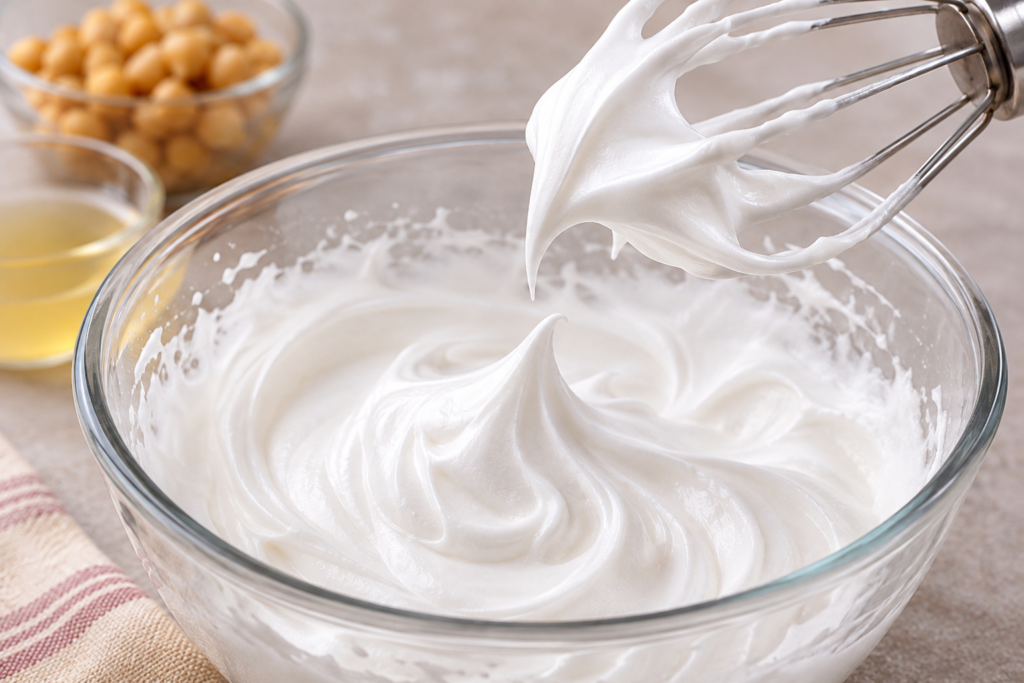
Stop here and continue whipping. Do not add the almond mixture until the peaks hold their shape.
A few things are worth considering:
- Is the aquafaba unusually thin or watery?
- Is the bowl and whisk completely clean and free from grease?
- Was cream of tartar included?
- Has the aquafaba been whipped sufficiently?
Aquafaba can vary in consistency, so different batches may not behave identically. If the foam is not holding its shape, investigate the aquafaba and whipping stage before moving on to the dry ingredients.
2. Why Does the Meringue Lose Its Structure When Sugar Is Added?
In the D10 method, sugar is added gradually after the aquafaba has reached stiff peaks. The aim is to obtain a glossy, thick meringue.
Watch the mixture as you add the sugar. A slight change in the definition of the peaks is not necessarily a problem. What matters is whether the meringue continues to hold its structure.
If the peaks become poorly defined and the mixture starts looking loose, pause and consider whether the aquafaba had reached stiff peaks before you began adding sugar.
Keep these points in mind:
- Add the sugar gradually rather than all at once.
- Make sure the aquafaba has reached stiff peaks first.
- Look for a glossy, thick meringue before moving to the next stage.
- Avoid continuing to mix longer than necessary once the intended consistency is achieved.
The sugar quantity is part of the original formulation. I would not reduce or increase it casually to correct a problem with the meringue.
3. Why Does the Meringue Lose Volume During Folding?
This is the stage at which the ground almonds and cornflour are incorporated. Some reduction in volume is normal because the dry ingredients make the meringue heavier. In vegan dacquoise, the aim is to fold them in gently while retaining as much of the air incorporated during whipping as possible.
What I look for is a mixture that still appears aerated and falls from the spatula in a thick mass. If it runs like a thin batter, too much air may have been lost.
D10 recommends folding the sifted dry ingredients into the meringue in two batches, using gentle movements.
A few things make a difference here:
- Add the dry ingredients in two batches.
- Fold gently rather than beating or stirring.
- Scrape around the bowl and underneath the mixture so the ingredients are incorporated evenly.
- Stop folding once the dry ingredients are incorporated.
Do not expect the mixture to look as voluminous as the original whipped aquafaba. The aim is to retain enough aeration to give the dacquoise its structure.
4. Why Does Your Dacquoise Spread During Baking?
Spreading is different from losing volume during folding. Here, the mixture may appear reasonably stable before baking but lose its shape in the oven.
Keeping the dacquoise layers evenly spread and approximately 1 cm thick helps them bake more uniformly.
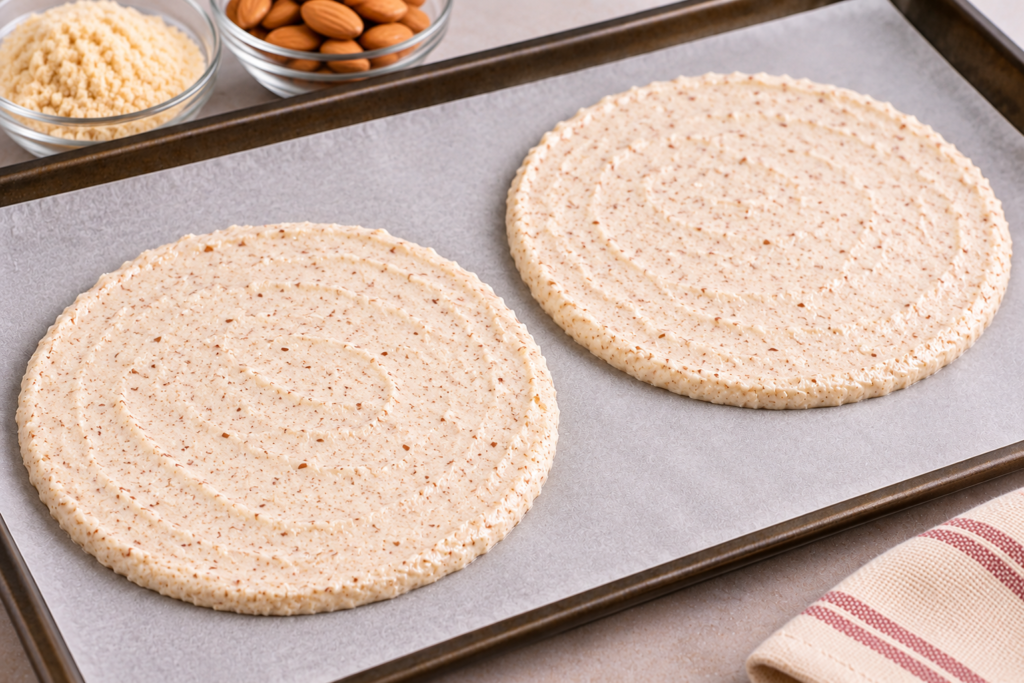
I would first look at how the mixture behaves on the baking paper.
- If it spreads immediately after piping or shaping: Revisit the whipping and folding stages. The mixture may already have become too loose before baking.
- If it holds its outline but flattens in the oven: The mixture may not be retaining enough structure during baking. Its stability and the oven conditions are both worth investigating.
- If it loses its shape unevenly: Look at how consistently the mixture was spread and whether the oven is distributing heat evenly.
D10 specifies a fan oven at 150°C. If you are using an OTG or another domestic oven, remember that the displayed temperature may not be the actual temperature inside.
An oven thermometer can help you compare the temperature setting with the temperature your oven is actually reaching.
The important distinction is whether the mixture is already spreading before baking or whether it holds its shape initially and flattens in the oven. These are not necessarily the same problem.
5. Why Are Your Dacquoise Layers Not Baking Evenly?
When spreading the meringue mixture, try to keep both discs as even as possible. This is more important than it may seem. If the centre is thicker than the edges, the edges may bake sooner while the centre remains soft.
In the D10 method, each disc is approximately 1 cm thick. Maintaining a uniform thickness helps the layers bake more evenly.
If you notice that your dacquoise is not baking evenly, look closely at the result:
-
The edges are cooked, but the centre is still soft: The mixture may be thicker in the middle. Check whether you have spread it evenly.
-
One side is more golden than the other: Your oven may be distributing heat unevenly. Check the positioning of the baking tray and your oven’s heat distribution.
-
The surface still looks damp: The disc may need more baking. However, first check its thickness and whether your oven is reaching the correct temperature.
D10 specifies a fan oven at 150°C for 25–30 minutes, until the surface is dry and lightly golden. If you are using an OTG or a domestic oven, do not rely entirely on the temperature displayed on the dial. An oven thermometer will help you check the actual temperature.
My suggestion is to check the thickness of the discs and your oven’s heat distribution before changing the temperature or baking time. Even a small difference in thickness or oven performance can affect the finished layers.
6. Why Do Dacquoise Layers Break?
Aquafaba dacquoise discs are delicate, but they should be firm enough to lift and assemble once completely cooled. Allow them to cool on the baking paper before handling to reduce the risk of cracking or breaking.
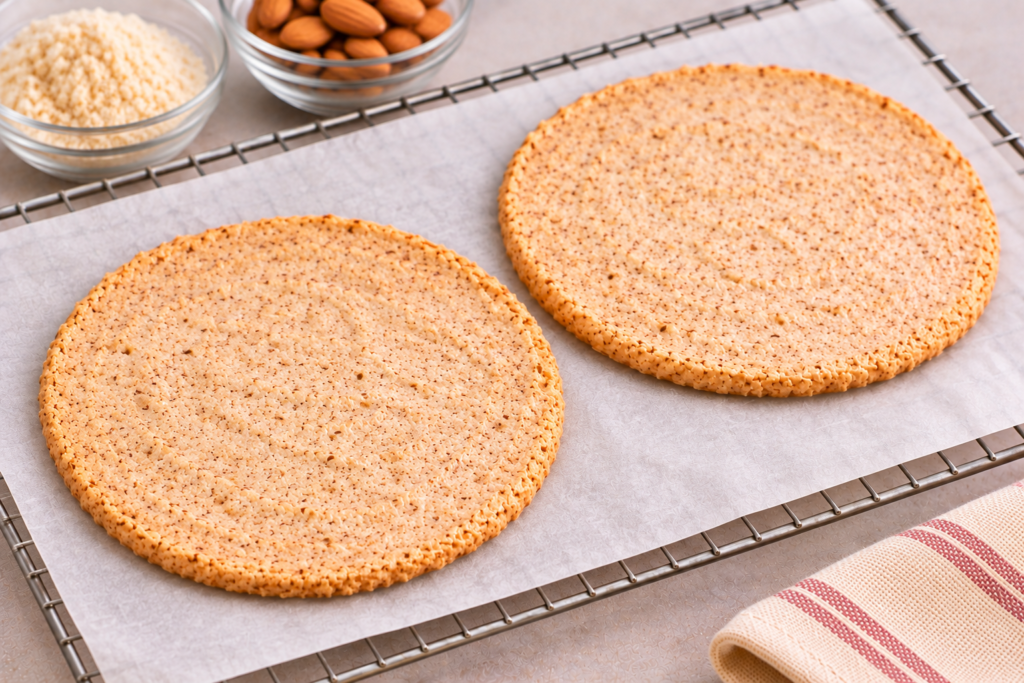
If a disc sticks to the baking paper, resist the temptation to pull it away immediately. Give it more time to cool before attempting to lift it.
There is another important point here. D10 specifically mentions two possible reasons why the discs may break during assembly: they may still be warm, or the meringue may not have baked sufficiently.
When this happens, I would first look at the baking and cooling stages rather than changing the ingredients.
Make sure the surface has become dry and lightly golden, and allow the discs to cool completely before handling them. If they are still fragile after cooling, revisit whether they were sufficiently baked.
7. Why Does Your Dacquoise Become Soft?
A soft dacquoise is not necessarily a failed dacquoise. Before deciding that something has gone wrong, first consider whether you are looking at a freshly baked disc or an assembled dessert.
Some softening is expected once the layers are filled. In a vegan dacquoise, the meringue gradually softens when it comes into contact with the cream.
D10 explains that aquafaba dacquoise is more delicate and slightly less crisp than traditional egg-white dacquoise. The intended texture is slightly crisp at the edges and soft in the centre.
Here is how I would distinguish between the two:
- A soft centre with a dry surface and slightly crisp edges: This is consistent with the texture described in D10.
- A wet, pasty or unset centre before assembly: This is different from the expected soft centre. Revisit the thickness of the disc and the baking conditions.
- Layers becoming softer after filling: Some softening is expected as the dacquoise absorbs moisture from the filling.
I would not judge the texture only after the dessert has been assembled. First look at a cooled, unfilled disc. This helps you understand whether the softness is part of the natural texture of the dacquoise or whether the centre has not baked sufficiently.
My Kitchen Trial: Making Aquafaba Dacquoise
I tested the D10 formulation in my own kitchen without changing the ingredients or baking conditions.
Here is what I observed:
- The aquafaba whipped well and reached stiff peaks.
- The almond mixture folded into the meringue without significant loss of volume.
- The mixture held its shape when piped.
- I baked the discs at 150°C for 25–30 minutes.
- The finished layers were crisp after cooling.
- The discs released easily from the baking paper without breaking.
- The assembled dessert had clean, even layers.
I used chocolate ganache and whipped plant-based spread for the filling.
The trial was successful, and I did not need to make any adjustments to the formulation or baking conditions.
These are my observations from one successful kitchen trial. The troubleshooting explanations above are intended to help you investigate if your results differ; I have not tested every possible failure or variation.
Assembling and Storing the Dacquoise
Once both discs have cooled completely, you can assemble the dessert.
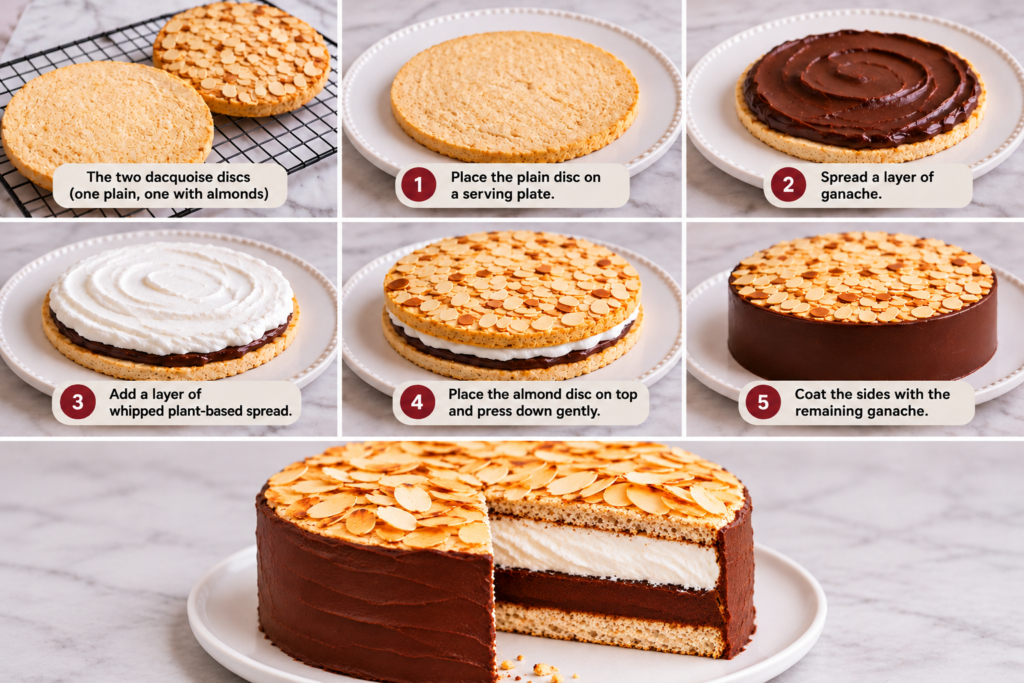
D10 places the plain disc on the serving plate, followed by a layer of chocolate ganache and whipped plant-based spread. The almond-topped disc is then placed above it and pressed down gently. The remaining ganache is used to coat the sides.
Handle the discs carefully while transferring them. They are delicate, and trying to lift one before it has cooled properly can cause it to crack.
After assembly, chill the dessert for at least four hours before serving. The filling will gradually soften the dacquoise, which is part of the character of this layered dessert.
D10 recommends storing it in the refrigerator for up to two days.
Frequently Asked Questions
1. What is aquafaba, and why is it used in vegan dacquoise?
Aquafaba is the liquid from cooked chickpeas. It can be whipped to form a foam and is used as a plant-based alternative to egg whites in preparations such as vegan meringue and dacquoise.
2. Is aquafaba dacquoise gluten-free?
The D10 formulation uses ground almonds and cornflour rather than wheat flour, making it a gluten-free formulation. If you have coeliac disease, check that all ingredients are certified or labelled gluten-free where necessary, and take care to avoid cross-contamination.
3. Can aquafaba dacquoise be used in layered cakes?
Yes. Dacquoise is commonly used as a layer in assembled desserts. In the D10 preparation, two almond meringue discs are layered with chocolate ganache and whipped plant-based spread.
4. How is aquafaba dacquoise different from traditional dacquoise?
Traditional dacquoise is generally made with whipped egg whites and ground nuts. The vegan version uses aquafaba instead of egg whites. As described in D10, the aquafaba version is more delicate and softens more readily when it comes into contact with the filling.
Final Thoughts
Aquafaba dacquoise is a delicate preparation, and the meringue stage is where much of its structure is established. Paying attention to the peaks, folding gently, spreading the discs evenly and allowing them to cool completely can make a real difference.
When something goes wrong, try to identify the stage at which the change occurs before altering the formulation. This will help you understand the behaviour of the mixture and make more informed adjustments.
Book reference: D10 – Gluten-Free Baking, Terra Vegan, Chapter 4: “Layered Vegan Dacquoise”.
Related reading:
Sharmila Sengupta | Baking Expert & Educator | 25+ Years of Baking Experience