
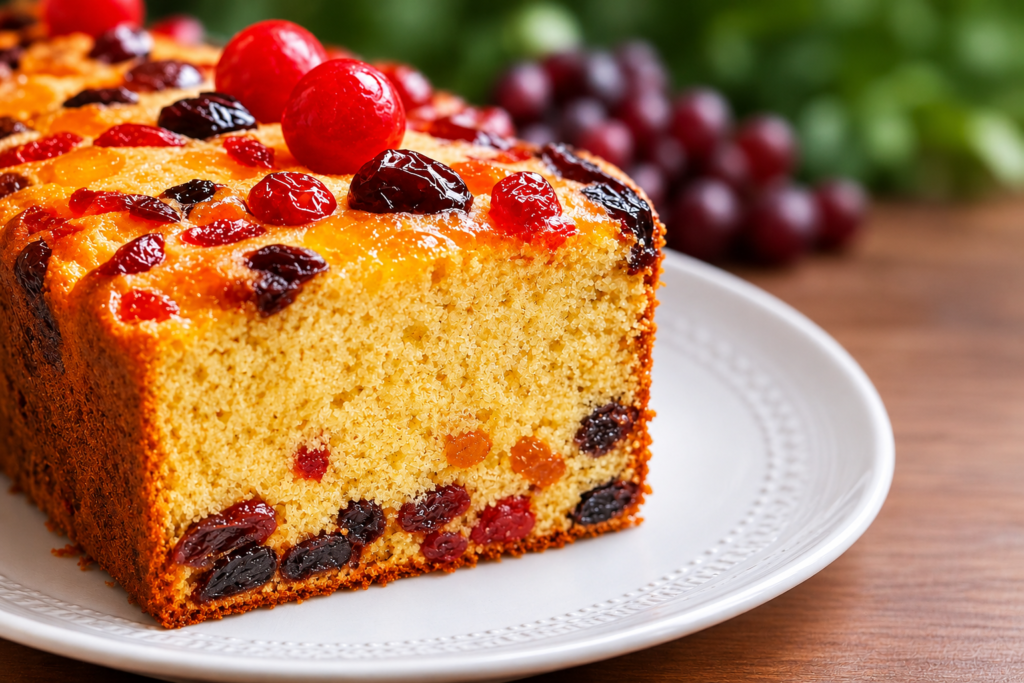
How to Stop Dried Fruits from Sinking in Gluten-Free Cake
If you are struggling with dried fruits sinking in gluten-free cake, simply coating the fruit with flour may not solve the problem. The result depends on how the fruit is prepared, how much moisture it carries, the consistency of the batter and how well the cake structure sets during baking.
Before changing the flour blend or adding more flour to the recipe, look at where the fruit has settled. Fruit collecting at the bottom, larger pieces sinking or sticky fruit forming clumps can point to different problems.
The position of the fruit after baking can tell you quite a bit about what went wrong. Here is how to identify each problem and what you can do to correct it.
Why Are Your Dried Fruits Sinking?
The way the fruit settles in your cake gives you a useful starting point. Look at the symptom that most closely matches your result.
| What you notice | What may be happening | What to examine |
|---|---|---|
| Most of the fruit collects at the bottom | The fruit moves through the batter before the crumb sets. | Fruit quantity, added liquid and batter consistency |
| Only dates or larger fruit pieces sink | Larger or heavier pieces are difficult for the batter to hold. | Fruit size and preparation |
| Fruit sinks despite being coated with flour | The coating has not addressed the underlying batter or structure problem. | Fruit preparation and batter consistency |
| Fruit forms clumps | Sticky pieces have not been separated properly. | Fruit preparation and mixing |
| Fruit sinks and the cake is dense | The cake structure may not be strong enough. | Flour blend, liquid balance and leavening |
| Fruit sinks and the centre is gummy | The centre may not have baked sufficiently, or the batter may contain too much moisture. | Baking time, flour blend and liquid balance |
| Cake rises and then collapses | The structure has not set firmly enough. | Doneness, leavening and baking conditions |
The important point is not to change several ingredients at once. First identify the pattern, then work on the factor most likely to be responsible.
Why Do Dried Fruits Sink During Baking?
Dried fruits are heavier than the surrounding cake batter. Whether they remain distributed throughout the cake depends partly on how quickly the batter develops enough structure to hold them in place.
As the cake heats in the oven, the batter can temporarily become more fluid before the flour, starches and other ingredients begin to set. During this stage, heavier fruit pieces may move downwards. If the crumb sets in time, the fruit is held in position. If the batter remains too fluid for too long, or the fruit is particularly large or heavy, more of it may collect near the bottom.
This is why simply tossing fruit in flour does not always prevent sinking. A coating may help separate sticky pieces, but it cannot compensate for excess liquid, too much fruit or a cake structure that is slow to set.
This balance is particularly important in gluten-free baking because different flour blends and binders behave differently.
Did the Fruit Sink During Baking or Was It Unevenly Distributed Before Baking?
Sometimes the problem begins before the cake enters the oven.
After folding the fruit into the batter, check whether it is evenly distributed. If you find a concentration of fruit at the bottom of the mixing bowl, some of it may already have settled before you transfer the batter to the tin.
A few things can contribute to this:
- The batter is thinner than the recipe intends.
- The fruit is added too early and settles while you prepare the tin.
- Sticky fruit pieces have clumped together.
- The fruit is not folded evenly through the batter.
If the fruit looks evenly distributed in the mixing bowl but collects at the bottom after baking, the problem is more likely to involve the batter’s behaviour during baking or the time needed for the cake structure to set.
Most of the Dried Fruit Has Collected at the Bottom
When almost all the fruit settles at the bottom, start by checking the quantity of fruit and the liquid balance.
Check the amount of fruit
A cake batter can hold only a certain quantity of dried fruit. Adding extra raisins, dates or other fruit without adjusting the recipe can make the mixture too heavy.
This is particularly relevant to fruit cakes, where it can be tempting to add more fruit for a richer result. If you want a cake with a higher fruit content, it is better to use a recipe formulated for that quantity rather than increasing the fruit in an ordinary cake recipe.
Check the flour and liquid measurements
Gluten-free flour blends do not all absorb liquid in the same way. If you have changed the blend or altered the liquid quantities, the batter may be thinner than intended.
I would return to the original measurements before making further adjustments. Avoid adding flour simply because the batter looks loose. Too much flour can make the finished cake dense and dry.
Check the soaking liquid
If you have soaked your fruit in juice, tea or another liquid, drain it thoroughly before adding it to the batter. The fruit should remain moist inside, but it should not carry excess liquid on its surface.
Make these checks before changing the binder or flour blend.
Only the Larger Pieces of Fruit Have Sunk
If raisins and sultanas remain distributed but dates, figs or larger pieces of apricot settle at the bottom, the size and weight of the fruit are likely contributing to the problem.
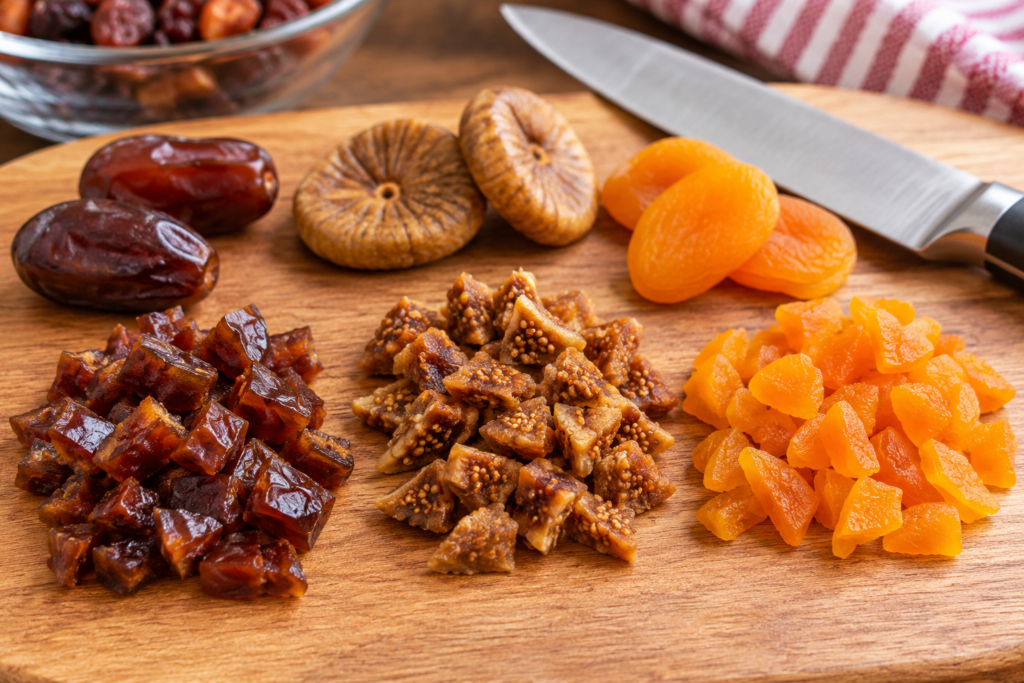
Here is how I would prepare different dried fruits:
| Dried fruit | What can cause difficulty | What I recommend |
|---|---|---|
| Dates | Large, dense pieces can sink and may stick together | Chop into small, similar-sized pieces |
| Figs | Whole or roughly cut pieces can be heavy | Remove the hard stem and chop evenly |
| Dried apricots | Large chunks may not distribute well | Cut into smaller pieces |
| Candied peel | Sticky pieces can form clumps | Separate the pieces before adding |
| Glacé cherries | Whole cherries are relatively heavy | Halve or quarter them, as appropriate |
| Raisins and sultanas | They can stick together, particularly after soaking | Separate gently before folding into the batter |
Try to keep the pieces reasonably uniform. Very large pieces are more likely to settle than smaller pieces distributed throughout the batter.
If only the larger pieces sink, there is no immediate reason to change the flour blend or increase the xanthan gum. Correct the fruit preparation first.
The Fruit Still Sinks After Being Coated with Flour
Coating dried fruit with a little flour is a familiar baking tip, but it is not a guaranteed solution.
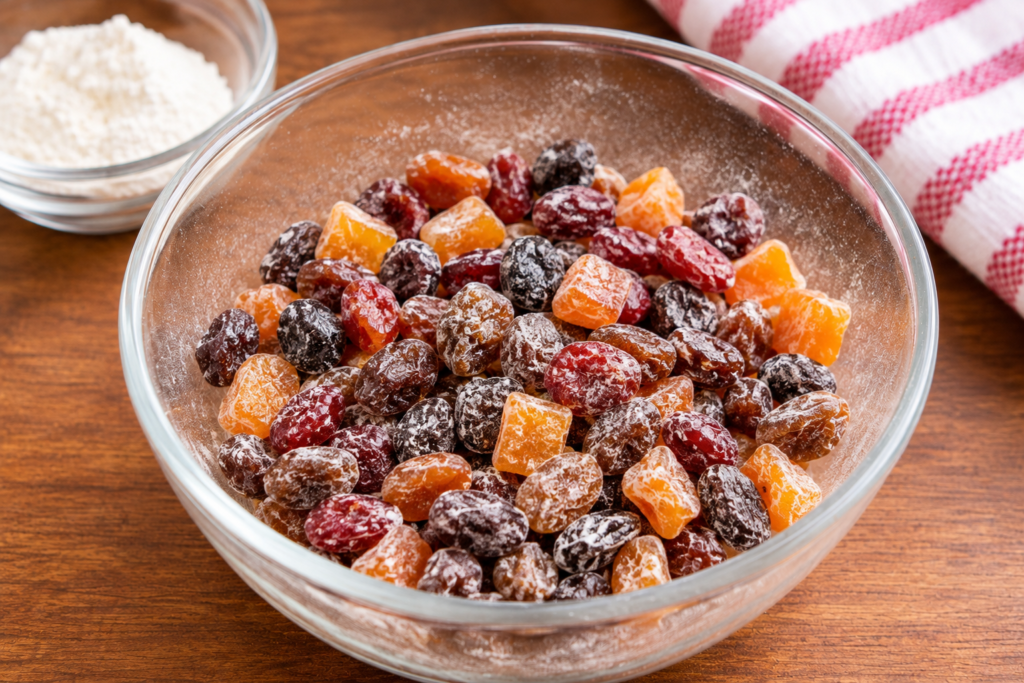
A light coating can help separate sticky pieces and reduce clumping. It does not make heavy fruit weightless, nor does it correct a batter that is too fluid.
If you want to use this method:
- Measure a small amount of flour from the recipe.
- Toss the prepared fruit lightly in it.
- Separate any pieces that are sticking together.
- Shake off excess flour before adding the fruit to the batter.
There is no need to coat the fruit heavily. Too much flour around the pieces can leave dry patches in the finished cake.
Think of flour coating as a preparation step, not a substitute for the right batter consistency.
The Fruit Is Clumped Together or Unevenly Distributed
When fruit appears in clusters rather than being spread throughout the cake, it may not have been distributed evenly during mixing.
This is especially common with soaked raisins, chopped dates and other sticky fruit.
A few simple adjustments help:
- Separate sticky pieces before adding them.
- Chop larger fruits into smaller, uniform pieces.
- Add the fruit towards the end of mixing.
- Fold gently but thoroughly.
- Scrape the bottom and sides of the bowl so that fruit is not left concentrated in one area.
Once the fruit is incorporated, transfer the batter to the prepared tin without leaving it standing for too long.
The Cake Is Dense and the Fruit Has Sunk
When the fruit sinks and the cake is also dense, the problem may be bigger than fruit preparation.
A dense crumb can indicate that the batter has not developed enough structure to hold the fruit in place. It is worth reviewing the flour blend, liquid quantity, leavening and binder balance.
In gluten-free baking, xanthan gum and psyllium husk do not perform exactly the same function.
- Xanthan gum helps bind ingredients and improve the structure of the crumb. However, using too much can produce a gummy or overly firm texture.
- Psyllium husk absorbs water and forms a gel. It can contribute to structure and moisture retention, but its effect depends on the quantity used and how the liquid is balanced.
Adding more of either ingredient simply because the fruit has sunk is not a reliable correction. An unsuitable quantity can create another texture problem.
I would first check whether you have followed the flour blend and binder quantities specified in the recipe. Also confirm that the baking powder or other leavening agent is fresh and measured correctly.
For a broader understanding of how gluten-free flours and binders affect baking results, see my Gluten-Free Baking Guide.
The Fruit Has Sunk and the Centre Is Gummy
A gummy centre and a dense cake are not quite the same problem. A cake can be dense without being gummy, while a gummy centre often feels pasty, sticky or underbaked.
It is useful to distinguish a naturally moist crumb from one that has not set properly.
| What you notice | What it may indicate |
|---|---|
| Soft crumb that holds its shape when sliced | The cake may simply be moist. |
| Slightly softer crumb around pieces of fruit | Moisture released by the fruit. |
| Pasty or sticky crumb that compresses easily | Gummy texture or insufficient baking. |
| Wet batter on a skewer | The centre may need more baking. |
| Heavy, sticky crumb even after complete cooling | Possible imbalance in liquid, flour or binder quantities. |
Soaked fruit can contribute moisture to the cake, particularly when it has not been drained properly. However, a gummy centre should not automatically be blamed on the fruit.
Check whether you have added extra soaking liquid, changed the flour blend or altered the binder quantity. Also make sure the cake has baked through.
A skewer inserted into the centre can help, but avoid testing directly through a large piece of fruit. If it comes out with wet batter, the cake needs more baking. A few moist crumbs are not necessarily a problem.
If the cake has cooled completely and the centre is still pasty or sticky, increasing the baking time in the next batch may not be enough. The liquid and flour balance may need attention.
The Cake Rises but Collapses During Cooling
If the cake rises well in the oven but sinks as it cools, the structure may not have set firmly enough to support its own weight.
Dried fruit can make this more noticeable, but it is not necessarily the cause.
Check the following:
- Baking time: The centre may not have baked sufficiently, even if the top looks done.
- Liquid balance: Too much liquid can delay the setting of the crumb.
- Leavening: Excess baking powder or baking soda can make the cake rise quickly and then collapse.
- Flour blend and binder: Changes in the blend or binder quantity can affect the cake’s ability to hold its shape.
- Oven temperature: An oven that is not properly preheated or does not maintain the required temperature can affect the rise and setting of the cake.
Allow the cake to bake until the centre is properly set. Do not rely only on the colour of the crust or the height of the cake.
Should You Try Layering the Fruit Through the Batter?
You may come across the suggestion of placing a thin layer of plain batter at the bottom of the tin, followed by the fruit-containing batter.
This can help when fruit settles towards the bottom of the mixing bowl or while the batter is being transferred to the tin. It is not a reliable solution if the batter is too fluid and the fruit continues to move during baking.
If you try this method, spread a small amount of plain batter over the base of the tin and then add the remaining batter containing the fruit. Do not use it as a substitute for preparing the fruit properly or correcting the batter consistency.
Special Checks for Gluten-Free Christmas Plum Cake
A gluten-free Christmas plum cake usually contains a much larger quantity of dried fruits than an ordinary cake. The fruit may also be soaked for several hours or overnight.
This makes preparation particularly important.
Before adding soaked fruit to the batter:
- Drain it thoroughly in a sieve.
- If the surface still looks visibly wet, gently pat the fruit with kitchen paper.
- Chop large pieces into smaller, similar-sized portions.
- Separate sticky pieces so that they do not form clusters.
- Follow the fruit quantity specified in the recipe.
- Fold the fruit evenly through the batter.
The aim is not to dry the fruit completely. It should remain moist inside without carrying excess soaking liquid into the cake batter.
If you are preparing a festive bake, you can follow my Eggless Gluten-Free Christmas Plum Cake with Sorghum Flour.
For advice on retaining moisture in a gluten-free Christmas cake without making the crumb gummy, read How to Keep Gluten-Free Christmas Cake Moist.
Can an OTG Oven Cause Dried Fruits to Sink?
An OTG oven is not usually the direct reason dried fruits sink. However, an incorrect temperature or uneven heating can affect how quickly the cake rises and sets.
A few checks are useful:
- Preheat the oven properly before placing the cake inside.
- Use the rack position recommended for your recipe.
- Check the actual oven temperature with an oven thermometer if you suspect the thermostat is inaccurate.
- Avoid opening the door repeatedly during the early stages of baking.
If you bake regularly in an OTG, my guide to the Best OTG Oven in India for Baking explains what to consider when choosing and using one.
Frequently Asked Questions
Why do dried fruits sink in gluten-free cake?
Dried fruits can sink when the batter is too fluid to hold them in place before the crumb sets. Excess fruit, large pieces and an imbalance in the cake structure can all contribute.
Does coating dried fruits with flour prevent them from sinking?
Not always. A light flour coating can help separate sticky fruit pieces, but it cannot correct excess liquid, unsuitable batter consistency or a cake that does not set properly.
Should soaked dried fruits be dried completely before adding them to cake batter?
No. They should remain moist inside. Drain them thoroughly and remove excess surface liquid before adding them to the batter.
Can I add more xanthan gum to stop dried fruits from sinking?
I would not recommend increasing xanthan gum just to prevent fruit from sinking. Too much can make the crumb gummy or overly firm. Follow the quantity specified for your flour blend and recipe.
Why do raisins stay in the cake but dates sink?
Dates are often larger, denser and stickier than raisins. Chop them into smaller, uniform pieces and separate them before folding them into the batter.
Is a gummy centre always caused by dried fruits sinking?
No. A gummy centre can result from excess liquid, an unsuitable flour or binder balance, or insufficient baking. The fruit may contribute moisture, but sinking fruit alone does not explain a gummy crumb.
Final Thoughts
When dried fruits sink in a gluten-free cake, the pattern usually gives you a useful starting point.
If most of the fruit has settled at the bottom, pay attention to the fruit quantity and added liquid. If only dates or larger pieces have sunk, their size and preparation are worth checking. If the cake is also dense, gummy or collapsing, the problem may lie in the cake structure or baking conditions rather than the fruit itself.
Do not assume that every fruit-sinking problem needs more flour or a different binder. The fruit, the batter and the baked crumb each tell you something different.
I always recommend changing one factor at a time. This makes it much easier to understand what actually improved the result, instead of changing several ingredients and still being unsure what went wrong.
Sharmila Sengupta | Baking Expert & Educator | 25+ Years of Baking Experience