
Have you ever replayed a conversation in your head long after it ended?
Do you worry about whether someone misunderstood you, judged you, or disapproved of your choices?
Do you find yourself changing your behavior to avoid criticism or seeking reassurance before making even simple decisions?
If so, you are not alone.
Many people spend an enormous amount of emotional energy worrying about what others think of them. While caring about relationships and social connection is normal, constantly seeking approval can become exhausting. It can affect your confidence, your decision-making, and your ability to live authentically.
The truth is that when other people’s opinions determine your mood, choices, or self-worth, you may be looking outside yourself for reassurance that can only come from within.
Why We Care So Much About Other People’s Opinions
Humans are wired for connection.
For most of human history, belonging to a group was essential for survival. Being accepted meant safety, support, and protection. Being rejected could have serious consequences.
Although modern life is very different, our brains still respond strongly to social approval and criticism. We naturally want to be liked, respected, and accepted.
The problem begins when approval becomes a requirement rather than a preference.
Instead of using our own values as a guide, we begin using other people’s reactions as a measure of our worth. We start asking:
- Do they approve of me?
- Did I say the right thing?
- What if they think I’m wrong?
- What if they don’t like my decision?
Over time, this creates anxiety, self-doubt, emotional exhaustion, and a constant fear of judgment.
If this sounds familiar, you may also enjoy reading The Mental Exhaustion of Seeking Approval, which explores how validation-seeking can quietly drain your energy and confidence.
Why Validation Can Become Addictive
One reason people struggle to stop caring what others think is that approval feels good.
When someone praises us, agrees with us, or validates our choices, we experience temporary relief from self-doubt. The brain begins to associate approval with safety and reassurance.
The problem is that relief is not the same as confidence.
The more validation you seek, the more dependent you become on receiving it. What starts as a desire to be liked can gradually become a need for constant reassurance.
This is why approval-seeking behavior often leaves people feeling anxious, insecure, and emotionally drained. No amount of external validation can permanently solve an internal lack of self-trust.
This theme is explored further in You Win When You Don’t Play: 10 Lessons in Letting Go and Finding Quiet Power, where one of the core lessons is learning to stop outsourcing your self-worth to other people’s opinions.
Many people spend years trying to earn approval, avoid criticism, or manage how they are perceived by others. Yet lasting confidence rarely comes from external validation. It comes from developing enough self-trust that your sense of worth is no longer dependent on someone else’s opinion.
The more you rely on approval to feel secure, the more fragile your confidence becomes. The more you trust yourself, the less power other people’s judgments have over your life.
Why Caring What People Think Often Starts Earlier Than You Realize
Many people assume their need for approval appeared out of nowhere.
In reality, approval-seeking behavior often develops gradually over time.
You may have learned that being liked kept the peace. Perhaps you were praised for being agreeable, helpful, responsible, or accommodating. Some people grow up in environments where criticism feels particularly painful, making them highly sensitive to rejection later in life.
Over time, these experiences can create a habit of looking outward for validation instead of inward for guidance.
The result is a pattern where self-worth becomes tied to other people’s reactions.
You may find yourself constantly wondering:
- Did I say the right thing?
- Are they upset with me?
- What if they don’t approve?
- What if they judge me?
When this happens repeatedly, approval-seeking becomes automatic.
The good news is that these patterns are learned, which means they can also be unlearned.
Understanding where your need for validation comes from is an important step toward building self-trust and emotional freedom.
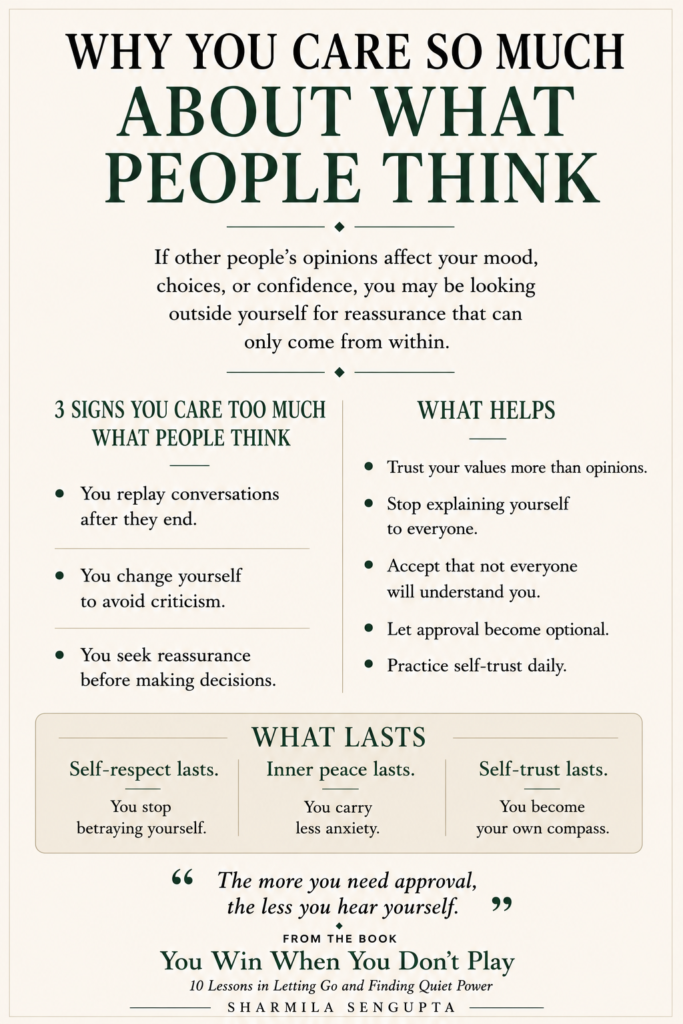
3 Signs You Care Too Much About What People Think
1. You Replay Conversations After They End
Do you constantly revisit conversations in your mind?
You may analyze every word, tone, or facial expression, wondering whether you said something wrong.
This habit often comes from a fear of judgment. Instead of allowing a conversation to end naturally, your mind keeps searching for reassurance.
The problem is that no amount of replaying can change what happened. It only increases stress and mental fatigue.
This pattern often overlaps with overthinking and emotional exhaustion, creating a cycle that becomes difficult to break.
You may also find helpful insights in Overthinking and Emotional Exhaustion, where we explore why the mind becomes trapped in repetitive thought patterns.
2. You Change Yourself to Avoid Criticism
People who seek approval often adjust their opinions, preferences, or behavior based on what they think others will accept.
You might:
- Stay quiet when you disagree.
- Say yes when you want to say no.
- Avoid pursuing goals that others may criticize.
- Hide parts of yourself to fit in.
At first, this may seem like a way to avoid conflict. But over time, it creates a painful disconnect between who you are and how you present yourself to the world.
The cost of avoiding criticism is often the loss of authenticity.
This is one of the most common signs of people-pleasing behavior.
For a deeper look at this pattern, read Why People Pleasing Feels So Exhausting.
3. You Seek Reassurance Before Making Decisions
Do you frequently ask others what they think before making choices?
Seeking advice is healthy. Constantly needing reassurance is different.
When every decision requires validation from someone else, you gradually stop trusting yourself.
You may become dependent on approval because it temporarily reduces anxiety. However, the more reassurance you seek, the less confidence you develop in your own judgment.
Self-trust grows through making decisions, not through outsourcing them.
The Hidden Cost of Seeking Approval
Many people assume that seeking approval helps them feel safer and more accepted.
In reality, it often creates the very feelings they are trying to avoid.
When your self-worth depends on other people’s opinions:
- Your confidence becomes fragile.
- Criticism feels devastating.
- Rejection feels personal.
- Decision-making becomes difficult.
- Anxiety increases.
- Overthinking becomes a daily habit.
- Fear of judgment grows stronger.
Most importantly, you give away control of your emotional well-being.
Instead of deciding how you feel about yourself, you allow other people to decide for you.
That is a heavy burden to carry because people will always have different opinions, expectations, and perspectives.
No amount of approval can provide lasting peace if you do not trust yourself.
How Social Media Makes Approval-Seeking Worse
Social media has amplified our natural desire for acceptance.
Every like, comment, share, and reaction can feel like a small form of validation.
The problem is that social media encourages comparison.
You see carefully curated versions of other people’s lives and may unconsciously measure your worth against what you see.
This often leads to:
- Increased self-doubt
- Fear of missing out
- Comparison anxiety
- Validation-seeking behavior
- Lower self-esteem
The more attention you pay to how you appear to others, the less attention you pay to how you feel within yourself.
Signs You May Be Seeking Too Much Validation
Sometimes approval-seeking becomes so normal that we no longer recognize it.
The following table highlights some of the most common signs.
| Sign | What It Looks Like |
|---|---|
| Overthinking | Replaying conversations long after they end |
| People-Pleasing | Saying yes when you want to say no |
| Validation-Seeking | Constantly asking others for reassurance |
| Fear of Judgment | Avoiding criticism at all costs |
| Low Self-Trust | Doubting your own decisions even when you know what you want |
| Emotional Exhaustion | Feeling mentally drained from trying to keep everyone happy |
If several of these feel familiar, you may be relying too heavily on external validation rather than your own judgment.
Recognizing the pattern is the first step toward changing it.
What Helps: How to Stop Caring So Much About What People Think
The goal is not to stop caring completely.
The goal is to stop making other people’s opinions the foundation of your identity.
1. Trust Your Values More Than Opinions
Opinions change.
Values endure.
When you know what matters most to you, it becomes easier to make decisions without seeking constant approval.
Ask yourself:
- What do I believe?
- What kind of person do I want to be?
- What values guide my choices?
Your answers matter more than someone else’s temporary judgment.
2. Stop Explaining Yourself to Everyone
Not everyone needs an explanation.
Many people spend hours trying to justify their choices because they hope others will finally understand and approve.
But understanding is not always necessary.
You can make decisions that are right for you without obtaining unanimous agreement.
3. Accept That Not Everyone Will Understand You
This realization is incredibly freeing.
No matter how thoughtful, kind, or careful you are, some people will misunderstand you.
Some will disagree with your choices.
Some will criticize you.
That does not mean you are wrong.
It means you are human.
Trying to gain universal approval is a battle you can never win.
4. Let Approval Become Optional
Approval feels good.
There is nothing wrong with enjoying encouragement and support.
The difference is learning to view approval as a bonus rather than a necessity.
When approval becomes optional, you stop chasing it.
You begin making decisions based on alignment rather than acceptance.
5. Practice Self-Trust Daily
Self-trust is built through action.
Start small:
- Make simple decisions without asking for reassurance.
- Honor your boundaries.
- Speak honestly about your needs.
- Follow through on commitments to yourself.
Every time you trust your own judgment, you strengthen your confidence.
A Simple Exercise to Build Self-Trust
The next time you face a decision, pause before asking someone else for advice.
Ask yourself:
- What do I genuinely want?
- What choice aligns with my values?
- What would I choose if I wasn’t afraid of being judged?
Write down your answer.
Then act on it.
Small moments of self-trust eventually become lasting confidence.
What Lasts
When you stop living for approval, something remarkable happens.
Self-Respect Lasts
You stop betraying yourself to keep others comfortable.
You begin honoring your values, boundaries, and needs.
Learning to protect your peace often begins with healthy boundaries. You may enjoy reading Protecting Your Peace Is Not Selfish.
Inner Peace Lasts
You spend less time worrying about criticism and more time enjoying your life.
The mental noise begins to quiet down.
Self-Trust Lasts
You become your own compass.
Instead of constantly looking outward for direction, you learn to rely on your own wisdom.
That confidence stays with you regardless of what others think.
What I Have Learned About Approval-Seeking
Through conversations with readers and through my own observations, I have noticed that people rarely struggle because they care what others think.
They struggle because they care what others think more than what they think.
Many people know what they want. They know what feels right. They know which boundaries need to be set and which decisions need to be made.
The problem is not a lack of clarity.
The problem is often a fear of disapproval.
Over time, I have noticed that the turning point usually comes when someone realizes they cannot control how they are perceived.
They cannot control other people’s opinions, expectations, or judgments.
They can only control whether they remain true to their values.
That shift from seeking approval to building self-trust is where lasting peace begins.
It is also where overthinking starts to lose its grip.
When your focus moves from earning approval to honoring your own values, you stop giving other people the power to define your worth.
That is where genuine confidence begins.
Key Takeaways
- Caring about other people’s opinions is normal, but approval-seeking can become emotionally exhausting.
- Replaying conversations, changing yourself to avoid criticism, and constantly seeking reassurance are common signs.
- Validation provides temporary relief but cannot create lasting confidence.
- Self-trust grows when you make decisions based on your values rather than other people’s approval.
- Learning how to stop caring what people think can reduce anxiety, overthinking, and emotional exhaustion.
Final Reflection
Most people spend years believing that approval will bring them confidence.
In reality, confidence grows when you stop chasing approval.
The more you need validation from others, the less you listen to yourself.
The more you trust yourself, the less power other people’s opinions have over your life.
Learning how to stop caring what people think is not about becoming indifferent or ignoring the people around you. It is about building enough self-trust that approval becomes optional rather than necessary.
When you stop seeking constant validation, you reduce overthinking, strengthen self-worth, improve your emotional well-being, and create the inner peace that comes from living according to your own values.
You stop asking, “What will they think?”
And you begin asking, “What feels right to me?”
That shift changes everything.
Freedom begins when you realize that your worth is not determined by someone else’s approval.
It is determined by the relationship you have with yourself.
A Lesson From You Win When You Don’t Play
One of the central lessons in You Win When You Don’t Play: 10 Lessons in Letting Go and Finding Quiet Power is that peace comes from releasing the need to control how others see you.
You cannot control people’s opinions, expectations, or judgments.
What you can control is whether you allow those opinions to define you.
When you stop seeking permission to be yourself, you create space for something far more valuable than approval: self-respect, inner peace, and lasting self-trust.
If these ideas resonate with you, you’ll find them explored more deeply in You Win When You Don’t Play: 10 Lessons in Letting Go and Finding Quiet Power.
Learn More About the Book
If something in this article felt familiar, you’re not alone.
Many of us spend years carrying things we were never taught how to release.
We carry overthinking long after the situation has ended.
We carry the weight of other people’s expectations.
We carry disappointment when life doesn’t go as planned.
We carry old stories about who we should be and struggle to understand why they still have so much power over us.
These are the questions that eventually led me to write You Win When You Don’t Play: 10 Lessons in Letting Go and Finding Quiet Power.
The book explores many of the themes woven throughout this article, including:
- How to stop overthinking and find greater mental clarity
- Letting go of validation-seeking and the need for approval
- People-pleasing, self-abandonment, and learning to set healthy boundaries
- Emotional exhaustion, burnout, and carrying too much for too long
- Rebuilding self-worth after disappointment and difficult life experiences
- Finding peace when life doesn’t go as planned
- Grieving lost dreams and letting go of expectations
- Emotional resilience during difficult life transitions
- Self-discovery, inner peace, and emotional freedom
- Learning how to trust yourself again
But more than anything, it explores a simple idea I’ve returned to again and again:
Not every struggle deserves your energy.
Not every battle needs to be won.
And not every burden needs to be carried.
Along the way, the book explores the invisible competitions, emotional pressures, and exhausting patterns that many of us carry without realizing how much they cost us.
Not to offer perfect answers.
But to help us see ourselves more clearly.
To understand ourselves more honestly.
And to recognize what may finally be ready to be released.
Because peace is rarely found by becoming more.
It is often found by needing less.
Less approval.
Less proving.
Less carrying what was never ours to hold.
Perhaps that’s why letting go often feels less like losing something and more like coming home to yourself.
Buy the Book on Amazon
Whether you’re struggling with overthinking, emotional exhaustion, people-pleasing, difficult relationships, self-worth, chronic stress, or the feeling that you’ve lost yourself beneath other people’s expectations, I hope the book offers the same thing I try to offer through my writing:
A different perspective.
A little more clarity.
And a gentler way forward.
You can learn more about the book or get your copy here:
Ask Sharmila – Personal Guidance for Overthinking, Emotional Exhaustion, Self-Worth, and Life’s Difficult Questions
Sometimes the hardest part isn’t finding advice.
It’s making sense of what you’re carrying.
Perhaps you’ve been overthinking the same situation for weeks. Perhaps you’re emotionally exhausted from trying to keep everyone happy. Or maybe you’re struggling to let go of a difficult relationship, rebuild your self-worth after disappointment, or find peace when life doesn’t go as planned.
Many of us carry questions that don’t have simple answers.
Questions about boundaries.
Questions about people-pleasing.
Questions about validation.
Questions about emotional healing, difficult life transitions, and how to stop carrying responsibilities that were never ours to hold.
You don’t have to figure it all out alone.
Through Ask Sharmila, you’re invited to share a question that’s been weighing on you.
Together, we’ll look beneath the surface of the situation—not to find perfect answers, but to uncover a clearer perspective and a gentler way forward.
Over Time, I’ve Noticed That Many Questions Tend to Circle Around the Same Themes
- How to stop overthinking and replaying conversations
- Emotional exhaustion and feeling drained by life
- People-pleasing recovery and setting healthy boundaries
- Seeking validation from others
- Rebuilding self-worth after disappointment
- Difficult relationships and emotional resilience
- Letting go of expectations that no longer fit your life
- Grieving the life you thought you’d have
- Learning how to let go when life doesn’t unfold as expected
- Finding inner peace during challenging life transitions
- Living more intentionally and trusting yourself again
One thing I’ve learned is that a new perspective doesn’t always change the situation.
I’ve seen people spend months stuck in the same thought loop, only to discover that what they needed wasn’t another solution.
It was a different way of seeing the situation.
And sometimes that’s where healing begins.
Personal Reflection and Written Guidance – ₹499
Every question is read personally by me, and every response is written thoughtfully and individually.
You Will Receive
- A personal written response tailored to your situation
- Thoughtful reflection grounded in emotional healing, self-discovery, and personal growth
- Practical perspective and gentle guidance
- Support for overthinking, emotional exhaustion, people-pleasing, self-worth struggles, boundaries, validation, difficult relationships, and major life transitions
- A response within 5 days

Personal Written Guidance for Overthinking, Emotional Exhaustion, Self-Worth, and Life’s Difficult Questions
The goal is not to have all the answers.
The goal is to understand yourself more clearly, carry less emotional weight, and discover a calmer, more compassionate way forward.
Sometimes clarity begins when we stop asking,
“How do I fix this?”
and start asking,
“What is this situation trying to teach me?”
Often, that’s where a gentler way forward begins.
Frequently Asked Questions
Why do I care so much about what people think?
People often care deeply about others’ opinions because humans are wired for connection and belonging. However, when self-worth becomes dependent on approval, criticism and rejection can feel overwhelming.
Is caring what people think a sign of low self-esteem?
Not always. However, excessive concern about other people’s opinions is often linked to low self-worth, fear of rejection, people-pleasing, or a lack of self-trust.
How do I stop worrying about what others think?
Start by identifying your values, setting healthy boundaries, reducing reassurance-seeking behaviors, and practicing self-trust through small daily decisions.
Why do I replay conversations in my head?
Replay often happens because the brain is searching for certainty or reassurance. Unfortunately, it usually increases anxiety rather than providing clarity.
About Sharmila Sengupta
I’m Sharmila Sengupta, author of You Win When You Don’t Play: 10 Lessons in Letting Go and Finding Quiet Power.
Over the years, I’ve become fascinated by the quiet struggles many of us carry but rarely talk about openly—the exhaustion of overthinking, the weight of people-pleasing, the search for validation, the challenge of setting healthy boundaries, and the grief that comes when life doesn’t go as planned.
Much of my writing begins with things I’ve noticed—in my own life, in conversations with others, and in the quiet struggles many of us carry without talking about them.
I’ve noticed how often we replay old conversations, question our self-worth, compare our lives to others, or carry emotional burdens that were never ours to hold. I’ve also noticed that many of us are quietly grieving lost dreams, coping with disappointment in life, navigating difficult life transitions, or learning how to let go of expectations about the future.
Perhaps you’ve found yourself asking some of those same questions.
How do I stop overthinking?
How do I let go of expectations that no longer fit my life?
Why do I feel emotionally exhausted even when everything seems fine on the surface?
How do I find peace when life doesn’t go as planned?
How do I stop seeking validation from other people?
How do I rebuild self-worth after disappointment or difficult relationships?
These are the questions that often inspire my writing.
Again and again, they seem to lead back to the same lesson: peace often begins when we stop carrying what was never ours to hold.
Through my articles and books, I reflect on emotional healing, personal growth, self-discovery, emotional resilience, and the quiet work of learning how to let go of what no longer serves us. Not as someone with all the answers, but as a fellow traveller who continues to learn what it means to let go, trust life a little more, and find strength in quieter ways.
My hope is that readers leave feeling less alone, more understood, and a little gentler with themselves than they were before they arrived.