
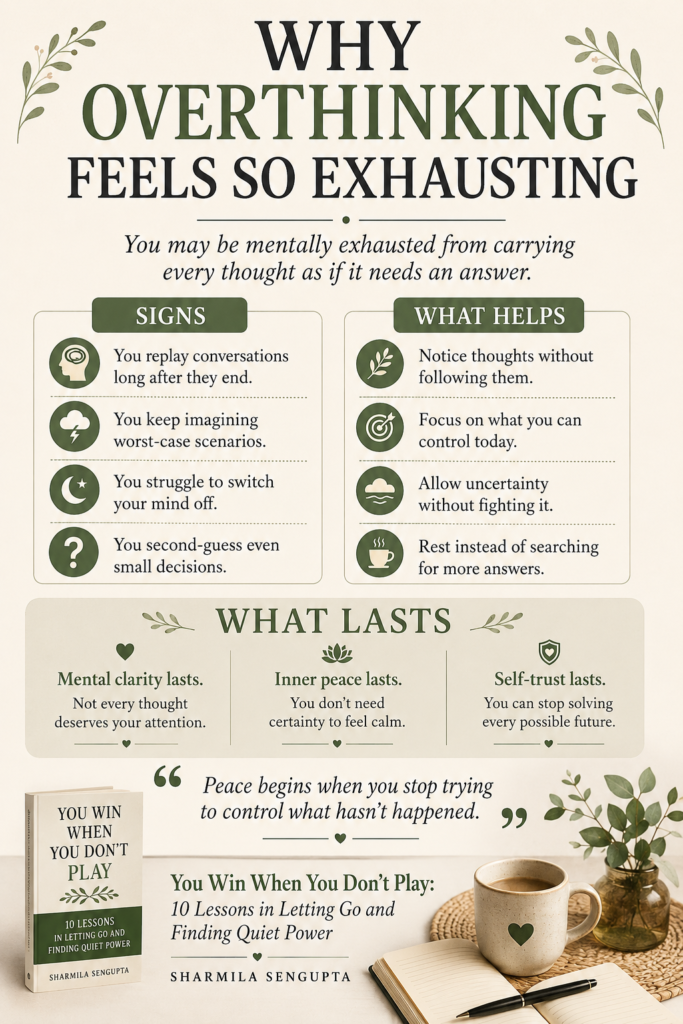
Many psychologists and emotional wellness experts believe overthinking becomes stronger when the brain treats uncertainty like danger. Instead of creating peace, constant mental analysis often increases emotional stress, anxiety, and nervous system exhaustion.
Watch: Mel Robbins on Overthinking and Mental Patterns
If you have ever replayed a conversation for hours, struggled with racing thoughts at night, or felt mentally exhausted from trying to predict every outcome, this video may help you better understand why the brain gets trapped in overthinking loops.
In this conversation, Mel Robbins explains how fear-based thinking, emotional overwhelm, and the constant need for certainty can quietly keep people stuck in constant mental noise.
As a result, many people experience:
- relationship overthinking
- anxiety-driven thought loops
- emotional attachment
- intrusive thoughts
- emotional burnout
- nervous system stress
- mental exhaustion from overthinking
Rather than trying to “think your way out” of anxiety, she focuses on emotional awareness, nervous system regulation, and learning how to stop reacting to every fearful thought immediately.
Over time, this shift can help reduce emotional overwhelm while creating more emotional resilience, mental clarity, and inner peace.
Additionally, her approach helps explain why the mind often stays trapped in repetitive thinking even when it is emotionally exhausted. Instead of forcing control, the focus becomes learning how to feel emotionally safe without engaging with every anxious thought.
Video credit: Jay Shetty Podcast and Mel Robbins on YouTube
Key Takeaway: Overthinking often feels productive. However, many thought loops are actually the mind searching for emotional safety, certainty, and control. Learning to pause instead of reacting to every thought can reduce emotional stress, calm an overactive mind, and help you build a healthier relationship with your thoughts.
Over time, this constant search for certainty can leave the nervous system emotionally exhausted. As a result, the mind may struggle to fully relax, think clearly, or experience lasting inner peace.
Prefer reading? Chapter 3 of You Win When You Don’t Play explores why emotional attachment quietly keeps thought loops alive—and how letting go creates space for lasting peace.
| Instead of… | Try… |
|---|---|
| Replaying every conversation | Notice the thought and let it pass |
| Chasing certainty | Accept uncertainty |
| Reacting immediately | Pause before responding |
| Trying to control everything | Focus on what you can influence |
| Fighting every thought | Observe it without engaging |
Remember: Lasting peace doesn’t come from controlling every thought. It comes from choosing which thoughts deserve your attention.
Signs Your Mind Never Fully Rests
Many people assume overthinking is simply thinking too much.
In reality, it often appears through subtle mental habits that quietly drain your emotional energy. These patterns can become so familiar that you stop noticing them—even as they contribute to mental exhaustion, racing thoughts, emotional burnout, anxiety, and chronic stress.
The five signs below don’t just describe what chronic overthinking looks like. They reveal why your mind struggles to switch off, why it feels difficult to enjoy a calm mind, and why many common attempts to stop overthinking provide only temporary relief.
As you read, notice which patterns feel most familiar. Recognizing these overthinking symptoms is often the first step toward breaking the cycle, reducing mental fatigue, and finding greater emotional balance.
1. You Replay Past Conversations
You may revisit old conversations repeatedly, trying to understand what someone meant, what you should have said differently, or whether you missed something important.
At first, this can feel like self-awareness. However, constantly replaying conversations often increases emotional overwhelm instead of creating mental clarity.
This pattern is especially common in relationship overthinking, where the mind keeps searching for reassurance, certainty, or emotional safety long after the moment has passed.
Sometimes the exhaustion does not come from the situation itself.
It comes from reliving it over and over again.
2. You Constantly Prepare for Worst-Case Scenarios
Another common sign of overthinking is preparing for problems that have not happened yet.
The mind tries to stay in control by predicting every possible outcome. However, instead of creating peace of mind, this habit keeps the nervous system in a constant state of alertness.
As a result, even small situations begin to feel emotionally overwhelming.
This is why people struggling with overthinking and anxiety often feel mentally tired before anything has actually gone wrong.
The mind believes preparation will create inner peace.
Yet it often creates more mental overload instead.
3. Reassurance Never Feels Like Enough
When the mind never fully rests, reassurance can temporarily feel calming.
You may seek repeated confirmation from others, replay situations looking for certainty, or constantly question whether everything is okay.
However, reassurance rarely creates lasting calm because the real struggle is not always the situation itself.
It is often the mind’s attachment to certainty.
That is why reassurance works for a moment before new racing thoughts appear again.
Eventually, this cycle creates emotional burnout, strengthens self-doubt, encourages self-criticism, and makes it harder to feel mentally calm without external validation.
4. Relaxing Feels Surprisingly Difficult
People trying to stop overthinking often feel physically present but mentally somewhere else.
Even during rest, the mind continues analysing, replaying, planning, or preparing for possible outcomes.
Because of this, slowing down can feel uncomfortable.
Silence creates space for the thoughts you usually distract yourself from.
As a result, many people stay mentally busy—not because they want to, but because stillness feels unfamiliar.
When the nervous system becomes accustomed to constant mental activity, a quiet mind can feel strangely unfamiliar at first.
5. Mental Exhaustion Becomes Your Normal
One of the biggest signs of chronic overthinking is feeling emotionally exhausted even after doing very little physically.
Constant mental analysis quietly drains emotional energy over time.
As a result:
- decision fatigue increases.
- focus becomes harder.
- simple tasks feel heavier than they should.
Because the mind never fully disconnects from thought loops, true rest becomes difficult.
This is why overthinking at night often feels worse. Without distractions, the mental noise becomes more noticeable, making it harder to sleep, relax, or feel emotionally balanced.
Sometimes the mind is not tired because life is too heavy.
It becomes exhausted because it never stops engaging with every thought.
Read FREE with Kindle Unlimited.
Ready to Move Beyond Mental Exhaustion?
If these signs feel familiar, You Win When You Don’t Play expands on these patterns and offers a practical framework for letting go of overthinking, emotional exhaustion, people-pleasing, emotional attachment, and the constant need for certainty—so you can build lasting inner peace, one small shift at a time.
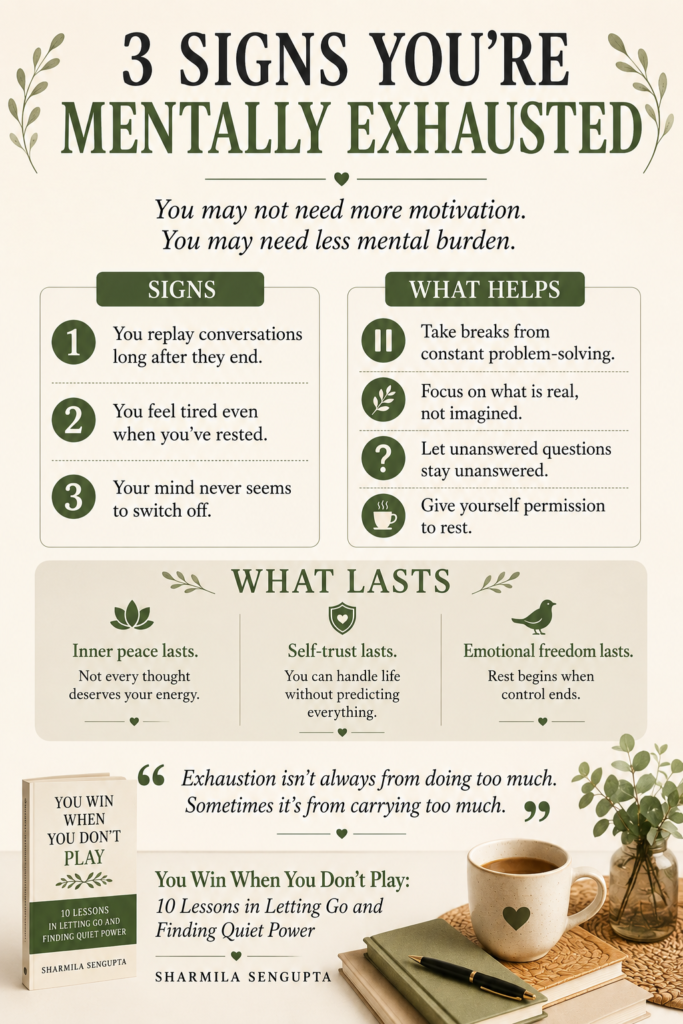
Overthinking and anxiety often grow together because the mind was never designed to remain in a constant state of mental activity.
When your thoughts keep replaying problems, worries, predicting outcomes, and searching for certainty, the nervous system begins responding as though something is always wrong—even during ordinary moments.
At first, this can feel like being responsible, prepared, or emotionally aware. However, constant mental analysis gradually creates emotional exhaustion, mental fatigue, and chronic stress throughout the body.
As a result, an overactive mind can feel physically draining even when nothing stressful is happening around you.
The brain also struggles to distinguish imagined threats from real ones. Because of this, repetitive thought loops—often called rumination—continue triggering the body’s stress response again and again.
Over time, this pattern may lead to:
- emotional burnout
- decision fatigue
- reduced mental clarity
- racing thoughts
- difficulty relaxing
- constant mental noise
- growing self-doubt
This is one reason people who struggle to stop overthinking often feel mentally tired all the time. The mind rarely experiences genuine rest because it keeps treating every thought as though it requires immediate attention.
According to the American Psychological Association, chronic stress and repetitive thinking patterns can negatively affect emotional well-being, focus, and overall mental health.
Similarly, the National Institute of Mental Health explains that persistent anxiety and repetitive mental patterns can increase emotional distress and place ongoing strain on the nervous system.
The difficult part is that overthinking often feels productive.
The mind believes more thinking will finally create peace of mind, emotional safety, reassurance, or certainty.
Instead, excessive mental engagement usually creates more confusion, emotional overwhelm, and nervous system stress.
This is the hidden cycle many people never notice:
The more attention you give every thought, the louder the mind becomes.
Eventually, mental noise stops feeling like ordinary thinking.
Instead, it begins to feel as though your mind is constantly trying to protect you from something.
That is why learning how to stop overthinking and anxiety naturally is not about controlling every thought.
It is about reducing unnecessary mental engagement, strengthening emotional regulation, building self-trust, and allowing your nervous system to recognise that not every thought deserves a response.
Because peace rarely comes from solving every thought.
Sometimes it comes from allowing thoughts to pass without turning them into another mental battle.
Read FREE with Kindle Unlimited.
When Relationships Become Mentally Exhausting
Sometimes the relationship itself is not what feels draining.
Instead, it is the constant mental noise surrounding it.
You replay conversations.
You analyse delayed replies.
You read emotions into silence.
You worry about what someone really meant.
Over time, relationship overthinking quietly transforms connection into emotional exhaustion.
The mind keeps searching for certainty because emotional attachment often creates a fear of losing emotional safety. As a result, even small interactions can trigger racing thoughts, emotional overwhelm, reassurance-seeking, and constant mental noise.
In many cases, the clearest signs of relationship overthinking are not dramatic arguments or obvious conflict.
They are the quiet habits—replaying conversations, second-guessing yourself, worrying about hidden meanings, and searching for reassurance—that slowly leave you emotionally exhausted.
If these patterns feel familiar, You Win When You Don’t Play explores why emotional attachment, people-pleasing, and the need for certainty keep these cycles alive—and how letting go creates space for healthier relationships and lasting inner peace.
Read FREE with Kindle Unlimited.
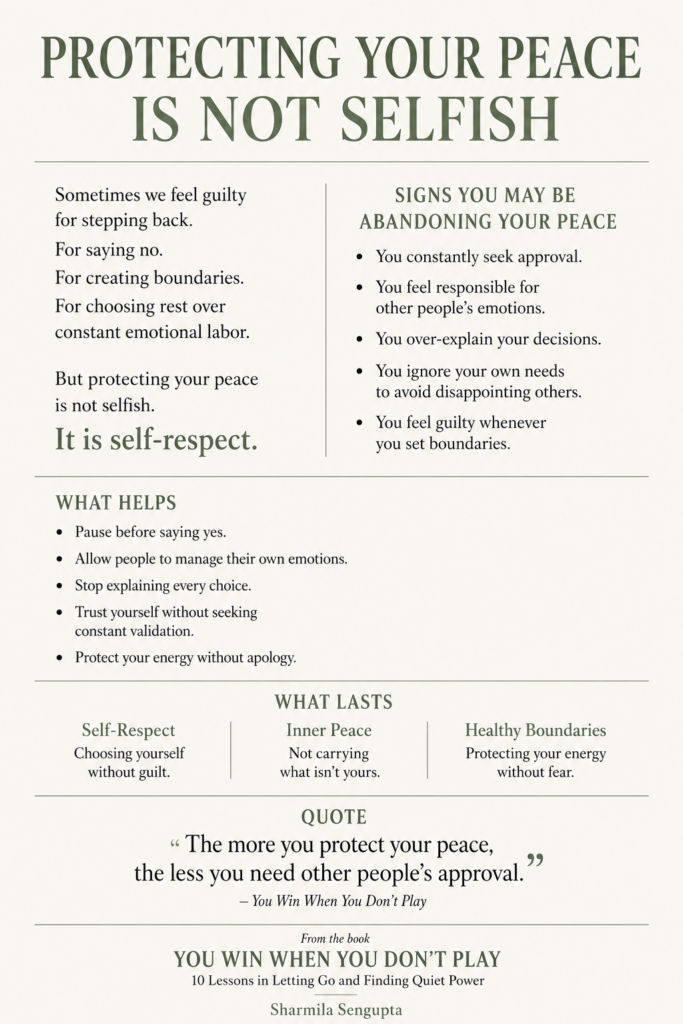
For years, I believed that overthinking was helping me.
I thought replaying conversations, worrying about mistakes, second-guessing decisions, and imagining every possible outcome would keep me prepared and protected.
Instead, it left me mentally exhausted.
What I did not realize at the time was that overthinking often disguises itself as problem-solving. In reality, constant worrying, self-doubt, and racing thoughts can increase stress, anxiety, emotional fatigue, and even burnout.
One of the most important lessons I learned is this:
The mind keeps spinning when we believe every problem must be solved immediately.
Not every question needs an answer today.
Not every uncertainty needs to be controlled.
Not every opinion deserves our attention.
Peace begins when we stop trying to manage everything and start trusting ourselves to handle what comes when it comes.
In my book, You Win When You Don’t Play: 10 Lessons in Letting Go and Finding Quiet Power, I explore how overthinking, people-pleasing, perfectionism, and the need for validation quietly drain our mental energy. I also share how letting go, building healthy boundaries, and developing self-awareness can create more clarity, confidence, emotional well-being, and inner peace.
Sometimes the strongest move is not to think more.
Sometimes it is to let go.
Reading about change is helpful. Practising a new way of responding is what creates lasting peace. The book walks through this process step by step.
Ask Sharmila – Personal Guidance for Overthinking, Emotional Exhaustion, Self-Worth, and Life’s Difficult Questions
Sometimes the hardest part isn’t finding advice.
It’s making sense of what you’re carrying.
Perhaps you’ve been overthinking the same situation for weeks. Perhaps you’re emotionally exhausted from trying to keep everyone happy. Or maybe you’re struggling to let go of a difficult relationship, rebuild your self-worth after disappointment, or find peace when life doesn’t go as planned.
Many of us carry questions that don’t have simple answers.
Questions about boundaries.
Questions about people-pleasing.
Questions about validation.
Questions about emotional healing, difficult life transitions, and how to stop carrying responsibilities that were never ours to hold.
You don’t have to figure it all out alone.
Through Ask Sharmila, you’re invited to share a question that’s been weighing on you.
Together, we’ll look beneath the surface of the situation—not to find perfect answers, but to uncover a clearer perspective and a gentler way forward.
Over Time, I’ve Noticed That Many Questions Tend to Circle Around the Same Themes
- How to stop overthinking and replaying conversations
- Emotional exhaustion and feeling drained by life
- People-pleasing recovery and setting healthy boundaries
- Seeking validation from others
- Rebuilding self-worth after disappointment
- Difficult relationships and emotional resilience
- Letting go of expectations that no longer fit your life
- Grieving the life you thought you’d have
- Learning how to let go when life doesn’t unfold as expected
- Finding inner peace during challenging life transitions
- Living more intentionally and trusting yourself again
One thing I’ve learned is that a new perspective doesn’t always change the situation.
I’ve seen people spend months stuck in the same thought loop, only to discover that what they needed wasn’t another solution.
It was a different way of seeing the situation.
And sometimes that’s where healing begins.
Personal Reflection and Written Guidance – ₹499
Every question is read personally by me, and every response is written thoughtfully and individually.
You Will Receive
- A personal written response tailored to your situation
- Thoughtful reflection grounded in emotional healing, self-discovery, and personal growth
- Practical perspective and gentle guidance
- Support for overthinking, emotional exhaustion, people-pleasing, self-worth struggles, boundaries, validation, difficult relationships, and major life transitions
- A response within 5 days

Personal Written Guidance for Overthinking, Emotional Exhaustion, Self-Worth, and Life’s Difficult Questions
The goal is not to have all the answers.
The goal is to understand yourself more clearly, carry less emotional weight, and discover a calmer, more compassionate way forward.
Sometimes clarity begins when we stop asking,
“How do I fix this?”
and start asking,
“What is this situation trying to teach me?”
Often, that’s where a gentler way forward begins.
Continue the Journey
If overthinking, people-pleasing, seeking validation, and mental exhaustion feel familiar, you may find deeper insights in my book, You Win When You Don’t Play: 10 Lessons in Letting Go and Finding Quiet Power.
The book explores how to stop giving away your peace, break free from overthinking, set healthy boundaries, and find the quiet confidence that comes from trusting yourself.
Whether you are struggling with anxiety, emotional fatigue, self-doubt, or the need to control every outcome, these lessons will help you let go of what drains you and focus on what truly matters.
Final Thoughts
Overthinking does not protect your future.
It steals your present.
The more we try to control every outcome, the more mentally exhausted we become. Constant worry, negative thinking, and the pressure to have all the answers can leave us feeling stressed, overwhelmed, and emotionally drained.
You do not need all the answers right now.
You do not need certainty before taking the next step.
You do not need to carry every problem in your mind.
Give yourself permission to pause.
Give yourself permission to trust.
And most importantly, give yourself permission to let go.
When we stop chasing certainty and start focusing on what we can control, we reduce anxiety, protect our mental health, and make space for greater emotional balance.
Because peace is not found by thinking about everything.
It is found by releasing what was never yours to carry.
Ready to Move Beyond Overthinking?
If you’ve reached this point, you’ve probably recognised more than one of these patterns in yourself.
You Win When You Don’t Play brings these ideas together into a practical framework for letting go of overthinking, emotional exhaustion, people-pleasing, and the constant need for control.
Read FREE with Kindle Unlimited or discover it on Amazon.
Important: This article is for educational purposes and is not a substitute for professional medical or mental health advice. If overthinking or anxiety is severely affecting your daily life, consider speaking with a qualified mental health professional.
Frequently Asked Questions About Overthinking and Mental Exhaustion
Why Do I Overthink Everything?
Overthinking often develops when the mind tries to create emotional safety by predicting outcomes, avoiding mistakes, or reducing uncertainty. While this can feel protective, it often creates mental clutter, emotional stress, and constant worry.
Over time, overthinking can lead to anxiety, self-doubt, decision fatigue, and mental exhaustion.
Can Overthinking Cause Mental Exhaustion?
Yes. Constantly analyzing situations, replaying conversations, and worrying about future outcomes drains mental energy.
Common symptoms include:
- Emotional burnout
- Brain fog
- Difficulty concentrating
- Fatigue
- Feeling mentally overwhelmed
- Trouble relaxing
When the brain remains in a state of hypervigilance, even small decisions can feel exhausting.
Why Does Overthinking Increase Anxiety?
Overthinking and anxiety often reinforce each other.
Repeated thought loops keep the nervous system activated and encourage the brain to search for potential threats, problems, or worst-case scenarios. As a result, anxiety grows stronger and mental peace becomes harder to maintain.
What Are the Signs of Overthinking?
Common signs include:
- Racing thoughts
- Replaying conversations
- Difficulty making decisions
- Constant worry about the future
- Seeking reassurance
- Trouble sleeping
- Fear of making mistakes
- Mental fatigue
Many people also experience physical symptoms such as muscle tension, headaches, or digestive discomfort.
How Can I Stop Overthinking Naturally?
Reducing overthinking starts with learning that not every thought requires action.
Helpful strategies include:
- Mindfulness
- Journaling
- Deep breathing
- Limiting overstimulation
- Spending time in nature
- Focusing on what you can control
The goal is not to eliminate thoughts but to reduce the urge to engage with every one of them.
How Do I Calm Racing Thoughts?
Racing thoughts often improve when the nervous system feels safe.
Try:
- Slow breathing exercises
- Reducing screen time before bed
- Grounding techniques
- Mindful movement
- Listening to calming audio
- Returning attention to the present moment
Small interruptions to the thought cycle can create significant relief over time.
Can Overthinking Affect Sleep?
Yes. Overthinking is a common cause of sleep difficulties.
Many people experience:
- Difficulty falling asleep
- Nighttime anxiety
- Mental replaying
- Restlessness
- Emotional exhaustion
Creating a calming bedtime routine and reducing mental stimulation can help improve sleep quality.
Why Do I Replay Conversations in My Head?
Replaying conversations is often driven by a desire for reassurance, certainty, or emotional safety.
People may repeatedly analyze what they said, how others responded, or whether they made a mistake. Unfortunately, this habit usually increases self-doubt and social anxiety rather than providing relief.
Can Overthinking Cause Decision Fatigue?
Yes. Overthinking makes the brain work harder than necessary when evaluating choices.
This can lead to:
- Analysis paralysis
- Procrastination
- Self-doubt
- Fear of making the wrong decision
- Reduced mental clarity
Over time, decision fatigue contributes to stress and emotional burnout.
Why Do I Overanalyze Social Interactions?
Overanalyzing social situations often stems from fear of rejection, criticism, or misunderstanding.
People may focus excessively on text messages, facial expressions, delayed replies, or tone of voice while searching for certainty. This can increase social anxiety and emotional overwhelm.
Can Social Media Increase Overthinking?
Yes. Constant exposure to social media can increase mental noise, comparison anxiety, and emotional overstimulation.
Many people experience:
- Attention fatigue
- Fear of judgment
- Comparison stress
- Difficulty focusing
- Increased self-doubt
Reducing digital overstimulation often helps calm an overactive mind.
Can Overthinking Affect Physical Health?
Yes. Chronic overthinking activates the body’s stress response and can contribute to:
- Muscle tension
- Headaches
- Fatigue
- Digestive discomfort
- Jaw clenching
- Appetite changes
- Sleep problems
Mental stress frequently shows up in the body as well as the mind.
Can Mindfulness Reduce Overthinking?
Yes. Mindfulness helps break the cycle of automatic thought loops by bringing attention back to the present moment.
Benefits may include:
- Reduced anxiety
- Improved emotional regulation
- Better focus
- Increased self-awareness
- Greater inner peace
Regular mindfulness practice can help create distance between thoughts and emotional reactions.
Final Thoughts
You don’t have to silence every thought to find peace.
You only need to stop believing every thought deserves your attention.
Overthinking often promises certainty but quietly creates exhaustion.
Peace begins when you learn to step back from the mental battles that never needed to be fought.
About Sharmila Sengupta
I’m Sharmila Sengupta, author of You Win When You Don’t Play: 10 Lessons in Letting Go and Finding Quiet Power, a practical guide to emotional resilience, healthy boundaries, and finding peace without constantly trying to control life.
Over the years, I’ve become fascinated by the quiet struggles many of us carry but rarely talk about openly—the exhaustion of overthinking, the weight of people-pleasing, the search for validation, the challenge of setting healthy boundaries, and the grief that comes when life doesn’t go as planned.
Much of my writing begins with things I’ve noticed—in my own life, in conversations with others, and in the quiet struggles many of us carry without talking about them.
I’ve noticed how often we replay old conversations, question our self-worth, compare our lives to others, or carry emotional burdens that were never ours to hold. I’ve also noticed that many of us are quietly grieving lost dreams, coping with disappointment in life, navigating difficult life transitions, or learning how to let go of expectations about the future.
Perhaps you’ve found yourself asking some of those same questions.
How do I stop overthinking?
How do I let go of expectations that no longer fit my life?
Why do I feel emotionally exhausted even when everything seems fine on the surface?
How do I find peace when life doesn’t go as planned?
How do I stop seeking validation from other people?
How do I rebuild self-worth after disappointment or difficult relationships?
These are the questions that often inspire my writing.
Again and again, they seem to lead back to the same lesson: peace often begins when we stop carrying what was never ours to hold.
Through my articles and books, I reflect on emotional healing, personal growth, self-discovery, emotional resilience, and the quiet work of learning how to let go of what no longer serves us. Not as someone with all the answers, but as a fellow traveller who continues to learn what it means to let go, trust life a little more, and find strength in quieter ways.
My hope is that readers leave feeling less alone, more understood, and a little gentler with themselves than they were before they arrived.
Buy the Book on Amazon
Whether you are dealing with overthinking and emotional exhaustion, struggling with difficult relationships, or searching for greater inner peace, a different perspective can sometimes make all the difference.