
The Hidden Psychology of Staying Stuck
Why do we stay in situations we’ve already outgrown?
Understanding why familiar pain feels safer than change can help us recognize emotional patterns, overcome the fear of uncertainty, and build the self-trust needed for lasting personal growth.
Familiar pain often feels safer than change because the brain prefers certainty over uncertainty. Even when a situation creates emotional discomfort, predictability can create the illusion of safety. This is one reason people remain in relationships, careers, habits, and emotional patterns they have already outgrown.
Most of us believe that if something hurts enough, we will eventually leave it behind.
If a relationship becomes painful, we’ll walk away.
If a job drains us, we’ll find something better.
If a pattern keeps disappointing us, we’ll finally stop repeating it.
At least that’s what we tell ourselves.
Yet life often tells a different story.
People stay in situations they’ve already outgrown all the time.
Not because they don’t know better.
Not because they enjoy suffering.
And often not because they lack courage.
I’ve become increasingly convinced that something else is happening.
Sometimes we stay because what hurts us is also what we know.
And what we know often feels safer than what we don’t.
That realization changed the way I think about personal growth.
Because it suggested that the challenge was never simply about becoming stronger.
The challenge was learning how to leave something familiar before knowing exactly what would replace it.
And that is far more difficult than most advice makes it sound.
Why We Stay in Situations We’ve Already Outgrown
Most of us like to believe that if something no longer serves us, we will eventually leave it behind.
If a relationship becomes too painful, we’ll walk away.
If a job no longer reflects who we are, we’ll make a change.
If a familiar pattern keeps creating the same disappointment, we’ll finally stop repeating it.
At least that’s what we tell ourselves.
Yet many of life’s experiences suggest otherwise.
People stay in situations they’ve already outgrown all the time.
Not because they don’t recognize the signs.
Not because they enjoy suffering.
And often not because they lack courage.
I’ve become increasingly convinced that something deeper is happening.
Sometimes we stay because what hurts us is also what feels familiar.
And familiarity has a powerful influence on the choices we make.
A relationship can stop supporting our growth, yet still feel difficult to leave.
A role we have carried for years can become emotionally exhausting, yet still feel tied to our identity.
An old pattern of people pleasing can continue long after we recognize its cost.
Not because these things bring us peace.
But because they bring us certainty.
One lesson I continue to learn is that familiarity and safety are not the same thing.
Yet they often feel remarkably similar.
The mind tends to trust what it recognizes.
Even when what it recognizes is no longer healthy.
This is one reason personal growth can feel so uncomfortable.
Growth asks us to move beyond what is known.
It asks us to release emotional patterns that once helped us survive.
It asks us to tolerate uncertainty long enough to discover what exists on the other side of it.
And uncertainty rarely feels comfortable.
For many of us, the challenge is not a lack of self-awareness.
A part of us often knows long before we are ready to admit it.
We know something has changed.
We know a situation no longer aligns with who we are becoming.
We know we are emotionally exhausted.
We know we are carrying responsibilities that no longer belong to us.
Yet we hesitate.
Because leaving what is familiar means stepping into the unknown.
And the fear of uncertainty can sometimes feel stronger than the discomfort of staying stuck.
I remember periods in my own life when I kept looking for one more reason to stay.
One more sign.
One more conversation.
One more piece of reassurance.
Looking back, I wasn’t searching for information.
I was searching for certainty.
What I eventually learned is that certainty rarely arrives before change.
More often, it arrives afterward.
Perhaps that is why so many of us remain in situations we’ve already outgrown.
Not because we don’t know what needs to change.
But because we are still learning how to trust ourselves enough to change it.
And maybe that is part of the journey.
Learning that self-trust is not built by waiting for guarantees.
It is built by taking small steps toward a life that feels more aligned, even when the path ahead is not completely clear.
Why Familiar Pain Feels Safe
Familiar pain feels safe because predictability reduces uncertainty. Even when a situation is emotionally difficult, knowing what to expect can feel less threatening than stepping into the unknown. The mind often prioritizes familiarity over possibility, which is why many people remain in situations they have already outgrown.
One of the questions I continue to return to is:
Why does familiar pain feel safe when it clearly isn’t?
I’ve wondered the same thing.
The answer, I think, has less to do with pain and more to do with predictability.
The human mind likes certainty.
It likes knowing what comes next.
Even when an outcome disappoints us, there is comfort in being able to anticipate it.
The familiar argument.
The familiar disappointment.
The familiar feeling of not being seen.
The familiar habit of putting everyone else’s needs ahead of our own.
None of these experiences are pleasant.
Yet they are predictable.
And predictability can easily masquerade as safety.
The unknown asks more of us.
It asks us to trust ourselves.
It asks us to tolerate uncertainty.
It asks us to move without guarantees.
That is why fear of change and fear of uncertainty are often inseparable.
The issue is not always the change itself.
The issue is what we imagine might happen if we let go of what we already know.
Why Change Feels So Hard
One of the most common questions in personal growth is:
If I know something isn’t working, why is it so difficult to change?
The answer is rarely a lack of awareness.
More often, it is a conflict between what we know and what we fear.
A part of us recognizes that something has run its course.
Another part worries about what will happen if we let it go.
We want the certainty of the old situation and the freedom of the new one.
Unfortunately, growth rarely offers both at the same time.
This is why fear of uncertainty plays such a powerful role in personal development.
We are not simply changing circumstances.
We are changing our relationship with predictability.
And that can feel surprisingly vulnerable.
The Difference Between Familiarity and Safety
One lesson I continue to revisit is that familiarity and safety are not the same thing.
The problem is that they often feel remarkably similar.
Something can be deeply familiar and quietly harmful at the same time.
A relationship can be familiar.
A pattern of people pleasing can be familiar.
Emotional exhaustion can become familiar.
Even self-doubt can become familiar.
And once something becomes familiar, we stop questioning it.
We adapt.
We adjust.
We learn how to carry it.
The danger is that adaptation can sometimes disguise misalignment.
Just because we have learned how to carry something does not mean it was ours to carry.
A Personal Observation About Familiarity
One thing I have noticed in my own life is how often I confused familiarity with evidence.
If something had been part of my life for a long time, I assumed it must still belong there.
I rarely stopped to ask whether it was helping me grow.
I only noticed how familiar it felt.
Looking back, I can see how easily routine becomes justification.
We tell ourselves we are staying because something matters.
Sometimes we are staying because we have forgotten there is another option.
That realization was uncomfortable.
But it taught me something important.
Time invested and value received are not always the same thing.
Just because something has occupied years of our lives does not automatically mean it deserves years more.
The Psychology Behind Staying Stuck
Comfort zone psychology is often misunderstood.
Most people imagine the comfort zone as a pleasant place.
But comfort and familiarity are not necessarily the same thing.
You can be emotionally exhausted and still remain inside your comfort zone.
You can feel disconnected from yourself and still remain inside your comfort zone.
You can know a situation is unhealthy and still remain inside your comfort zone.
Because the comfort zone is not defined by happiness.
It is defined by familiarity.
The known disappointment often feels less frightening than the unknown possibility.
The known struggle feels safer than the uncertain opportunity.
The known version of ourselves feels safer than discovering who we might become without it.
Perhaps that is why change feels so hard.
We are not only changing circumstances.
We are changing our relationship with certainty.
Emotional Conditioning and the Stories We Learn
Many of our emotional patterns begin long before we recognize them.
If approval felt unpredictable, we may become highly sensitive to rejection.
If conflict felt unsafe, we may become peacekeepers.
If love felt conditional, we may become people pleasers.
If expressing our needs created tension, we may learn to ignore them.
At first these behaviors help us adapt.
Over time they become identity.
We stop saying:
“I learned this.”
And begin saying:
“This is just who I am.”
That shift matters.
Because once a pattern becomes identity, changing it can feel like losing part of ourselves.
And that is where fear often enters.
Not fear of failure.
Fear of becoming unfamiliar to ourselves.
A Specific Memory I Continue to Return To
I remember sitting with a decision I had already made in my heart.
The situation was no longer working.
Part of me knew that.
Yet I spent weeks looking for reasons to stay.
Not because I believed staying was the better choice.
Because leaving required uncertainty.
I kept searching for one more sign.
One more confirmation.
One more reason to delay.
Eventually I realized I wasn’t looking for information.
I was looking for certainty.
And certainty never arrived.
The only thing that arrived was the realization that waiting was also a decision.
That experience changed the way I think about self-trust.
Sometimes growth begins when we stop looking for proof and start listening to what we already know.
Reflection
Perhaps the real question is not:
“What am I afraid of losing?”
Perhaps the deeper question is:
“Who would I be without this familiar struggle?”
That question has followed me for years.
Because familiar pain does not simply occupy our lives.
It often shapes our identity.
And letting go of it can feel like letting go of a version of ourselves.
Yet every meaningful chapter begins the same way.
With uncertainty.
With curiosity.
With a willingness to believe there may be another way forward, even before we can see exactly where it leads.
The Hidden Cost of Staying Stuck
One of the most difficult things about familiar pain is that, after a while, it stops feeling painful.
Not because it hurts less.
Because we become accustomed to carrying it.
What once felt heavy begins to feel normal.
The relationship that leaves us feeling unseen becomes routine.
The habit of overexplaining ourselves becomes automatic.
The constant need for validation starts to feel reasonable.
The emotional exhaustion becomes part of everyday life.
This is one of the hidden dangers of staying stuck.
We do not always notice the damage while it is happening.
We adapt.
We adjust.
We lower our expectations.
And slowly, without realizing it, we begin organizing our lives around things that no longer support us.
The problem is that adaptation is not the same thing as healing.
Surviving something for a long time does not mean it is healthy.
It only means we have learned how to endure it.
Perhaps that is why personal growth often begins with a simple realization:
What feels normal is not always what is good for us.
And what we have learned to tolerate may be the very thing preventing us from moving forward.
Why Do People Stay in Unhealthy Situations?
Why do people stay in situations they know are hurting them?
People often stay in unhealthy situations because familiarity feels safer than uncertainty. Even when a relationship, job, or emotional pattern causes distress, the predictability of what is known can feel less frightening than the possibility of change.
For a long time, I assumed that people stayed because they lacked courage.
Now I think the answer is more complicated.
Many people know something isn’t working.
They are aware of the pattern.
They feel the exhaustion.
They recognize the disappointment.
Yet they stay.
Not because they enjoy the pain.
Because they have learned how to survive it.
The unknown asks more of us.
It asks us to trust ourselves without guarantees.
And that can feel frightening, even when the familiar situation is no longer serving us.
Perhaps this is why so many people remain in places they have already outgrown.
Not because they want the pain.
Because they fear the uncertainty that comes after it.
Signs You’ve Outgrown a Situation
Growth rarely announces itself dramatically.
More often, it arrives as a quiet feeling that something no longer fits.
The relationship still exists.
The role still exists.
The routine still exists.
Yet something feels different.
You feel different.
1. You Feel More Drained Than Fulfilled
Every meaningful commitment requires effort.
But there is a difference between effort and depletion.
When something consistently leaves you emotionally exhausted, it may be asking more from you than it gives back.
This does not mean every difficult season requires a dramatic change.
But it does mean the feeling deserves attention.
Exhaustion is not always a sign that we need more discipline.
Sometimes it is a sign that we need more honesty.
2. You Keep Repeating the Same Emotional Patterns
The people change.
The circumstances change.
Yet the emotional experience remains remarkably familiar.
You feel overlooked.
Responsible.
Anxious.
Unappreciated.
Afraid of disappointing others.
Constantly seeking reassurance.
At some point, the question shifts from:
“Why does this keep happening to me?”
to:
“Why do I keep returning to what feels familiar?”
That question is uncomfortable.
But it often opens the door to genuine self-awareness.
3. You Spend More Time Hoping Than Living
Hope is a beautiful thing.
But there is a version of hope that quietly keeps us stuck.
It sounds like:
“Maybe next month will be different.”
“Maybe they will finally understand.”
“Maybe one more conversation will change everything.”
I have spent longer than I care to admit waiting for situations to become what I hoped they could be.
Sometimes they did.
Many times they didn’t.
What I eventually learned is that hope works best when it is accompanied by honesty.
Without honesty, hope can become a way of postponing reality.
The Hidden Cost of Repeating Emotional Patterns
When we think about staying stuck, we usually focus on what we are tolerating.
We rarely think about what we are sacrificing.
That is the greater cost.
Every emotional pattern requires an investment.
Time.
Energy.
Attention.
Hope.
The longer we repeat the same cycle, the less energy remains for something new.
A person who spends years seeking validation often has less energy available for building self-worth.
A person who spends years avoiding conflict often has less energy available for authentic connection.
A person who spends years trying to earn love may never experience what it feels like to receive it freely.
The tragedy is not only the pain itself.
It is everything the pain prevents.
The boundaries never established.
The opportunities never explored.
The self-trust never developed.
The life never fully lived.
How Familiar Pain Erodes Self-Trust
How do you build self-trust if you’ve spent years doubting yourself?
The first step is recognizing how self-trust is lost.
Familiar pain changes the relationship we have with ourselves.
Every time we ignore our instincts, we send ourselves a message.
Every time we dismiss our needs, we send ourselves a message.
Every time we remain in a situation that consistently violates our values, we send ourselves a message.
The message is subtle.
But powerful.
It says:
“Your truth matters less than your fear.”
No single decision creates this belief.
It develops gradually.
The same way self-trust develops.
Through repetition.
Eventually we stop listening to ourselves.
We seek reassurance for things we already know.
We look outside ourselves for answers that already exist within us.
Not because we lack wisdom.
Because we have spent years practicing self-doubt.
A Personal Observation About Self-Trust
I remember a period when I kept asking other people what they thought I should do.
Not because I lacked awareness.
Because I lacked trust.
The answer was usually obvious.
What I wanted was reassurance.
I wanted someone to tell me that choosing change was the right decision.
Eventually I realized that no amount of reassurance could replace self-trust.
At some point we all reach a place where the question is no longer:
“What should I do?”
The question becomes:
“Do I trust myself enough to do what I already know?”
That shift changed the way I think about difficult decisions.
Because growth is often less about discovering answers and more about trusting the ones we already have.
Emotional Exhaustion Is Often a Sign of Misalignment
Many people assume emotional exhaustion comes from doing too much.
Sometimes it does.
But there is another kind of exhaustion that receives far less attention.
The exhaustion that comes from being divided against yourself.
Part of you knows something needs to change.
Another part is afraid to change it.
Part of you wants freedom.
Another part wants familiarity.
Part of you wants growth.
Another part wants certainty.
Living inside that tension requires enormous energy.
It is like trying to walk in two directions at once.
Eventually something has to give.
This is why emotional resilience matters.
The goal is not to eliminate uncertainty.
The goal is to stop abandoning yourself in an attempt to avoid it.
Why Growth Often Feels Lonely
One reason people remain inside familiar pain is because growth often feels lonely before it feels liberating.
When we begin changing old emotional patterns, relationships often shift.
People who benefited from our people pleasing may resist our boundaries.
People who relied on our emotional labor may struggle when we stop providing it.
People who were comfortable with the previous version of us may not understand the new one.
This does not mean growth is wrong.
It simply means growth creates movement.
And movement changes relationships.
The loneliness is often temporary.
The alignment lasts much longer.
What I Have Learned About Staying Too Long
One lesson I continue to learn is that staying too long often disguises itself as virtue.
I have mistaken endurance for wisdom.
Patience for progress.
Loyalty for love.
There have been moments when I kept investing energy because I believed letting go meant failure.
What I eventually learned was that not every ending is a failure.
Sometimes an ending is simply recognition.
Recognition that something has run its course.
Recognition that growth requires honesty.
Recognition that holding on and moving forward are often incompatible choices.
The difficult truth is that familiar pain asks very little of us.
It asks us to stay.
Growth asks more.
It asks us to trust ourselves.
And perhaps that is why growth feels harder.
Not because it is wrong.
Because it requires a different kind of courage.
Reflection
The greatest cost of staying stuck is not the discomfort itself.
It is the life that remains unexplored because we never leave it behind.
Every familiar pattern occupies space.
Every fear-based decision occupies space.
Every unhealthy attachment occupies space.
Eventually we have to decide whether that space belongs to the past or the future.
Because no matter how familiar a burden becomes, it is still a burden.
And sooner or later, we have to decide whether we want to continue carrying it.
Choosing Growth Over Familiarity
There comes a moment when what once felt familiar no longer feels right.
Nothing dramatic may have happened.
The relationship is still the relationship.
The job is still the job.
The routine is still the routine.
From the outside, very little appears different.
Yet something inside us has shifted.
What once felt manageable now feels exhausting.
What once felt acceptable now feels misaligned.
What once felt familiar now feels too small.
I think many of us spend years believing that growth arrives as certainty.
A sudden moment of clarity.
A decision that feels obvious.
A path that appears fully illuminated before we take the first step.
Life rarely works that way.
More often, personal growth begins with discomfort.
A quiet awareness that something is no longer working.
A realization that the life we have built no longer reflects the person we are becoming.
And perhaps that is why change feels so difficult.
Not because we don’t know what needs to happen.
Because we are being asked to leave behind something that once helped us survive.
Even when that thing no longer helps us grow.
How to Build Self-Trust During Change
How do you trust yourself when everything feels uncertain?
Self-trust is not built by eliminating uncertainty.
It is built by learning that you can survive it.
For a long time, I believed confidence came first.
Then action.
Then growth.
Experience taught me something different.
More often, action comes first.
Then confidence follows.
The people I know who trust themselves most are not people who always know what to do.
They are people who have learned they can handle not knowing.
They have learned that uncertainty is uncomfortable, but not dangerous.
And that realization changes everything.
Because when self-trust grows, fear loses some of its authority.
The situation may still feel uncertain.
But uncertainty no longer gets the final vote.
Why Letting Go Feels Harder Than Holding On
One of the biggest misconceptions about letting go is that it should feel liberating from the beginning.
Sometimes it does.
More often, it feels like loss.
Loss of certainty.
Loss of identity.
Loss of familiar routines.
Loss of expectations we quietly built our lives around.
This is something I wish more people talked about.
Growth and grief often arrive together.
We are not only moving toward something new.
We are saying goodbye to something old.
Even when that old thing no longer serves us.
That is why emotional healing can feel complicated.
Part of us wants freedom.
Another part wants familiarity.
And both parts are trying to protect us in their own way.
A Personal Observation About Growth
One of the most surprising things about growth is that it rarely feels like winning in the beginning.
It often feels like loss.
Loss of certainty.
Loss of identity.
Loss of familiar routines.
Loss of expectations that quietly shaped our lives.
Perhaps that is why so many meaningful changes feel difficult at first.
We are not only moving toward something new.
We are grieving something old.
Understanding that made me far more patient with myself whenever a necessary change felt harder than expected.
For a long time, I assumed difficulty meant I was making the wrong decision.
Now I see that difficulty often means I am leaving something familiar behind.
And familiarity has a way of holding on long after it stops helping us.
What Helps When You Are Afraid of Change
Fear is not the problem.
At least, I don’t think it is.
Fear is a natural response to uncertainty.
When something important is shifting, it makes sense that part of us would feel nervous about what comes next.
The problem begins when fear becomes the loudest voice in the room.
When every decision is filtered through worst-case scenarios.
When the desire for certainty becomes stronger than the desire for growth.
I’ve spent periods of my life believing that if I thought about a decision long enough, I would eventually feel completely certain.
That moment never arrived.
What arrived instead was the realization that certainty is often a moving target.
The more we wait for it, the further away it seems.
Perhaps that is why personal growth rarely begins with confidence.
More often, it begins with willingness.
A willingness to take a step before we know exactly where the path leads.
A willingness to trust ourselves without guarantees.
A willingness to believe that uncertainty does not automatically mean danger.
That shift has helped me more than any advice about being fearless.
Because fearlessness was never the goal.
Self-trust was.
1. Stop Waiting to Feel Ready
One lesson I continue to learn is that readiness is often overrated.
Many of us imagine that change will feel easier once we are fully prepared.
Once we feel confident.
Once we have all the answers.
Once there is no doubt left.
Yet most meaningful decisions don’t arrive that way.
The people I admire most are not people who never felt afraid.
They are people who moved forward while carrying some uncertainty with them.
The readiness came after the first step.
Not before it.
2. Focus on the Next Honest Step
When we are overwhelmed by change, we often try to solve the entire future at once.
We want to know how everything will work out.
We want reassurance that the decision will be worth it.
We want proof before we begin.
But life rarely offers proof in advance.
I’ve found it more helpful to focus on the next honest step rather than the entire journey.
The next conversation.
The next boundary.
The next truth.
The next act of self-respect.
Small steps rarely feel dramatic.
Yet they are often how lasting change begins.
3. Build Self-Trust Instead of Seeking Certainty
For a long time, I believed the answer was certainty.
If I could just be sure, I thought, I would know what to do.
What I eventually learned is that certainty and self-trust are not the same thing.
Certainty depends on circumstances.
Self-trust depends on our relationship with ourselves.
One comes and goes.
The other can grow stronger over time.
The goal is not to eliminate uncertainty from our lives.
The goal is to trust ourselves enough to navigate it.
Because uncertainty is part of every meaningful chapter.
Every new relationship.
Every healthy boundary.
Every act of letting go.
Every season of personal growth.
4. Remember What Change Is Making Space For
When we are afraid of change, we naturally focus on what we might lose.
The familiar routine.
The familiar identity.
The familiar certainty.
What we rarely consider is what change might create space for.
Greater self-awareness.
Healthier boundaries.
Stronger self-worth.
Emotional freedom.
Inner peace.
Not every change leads exactly where we expect.
But remaining in situations we have already outgrown has a cost as well.
The question is not whether change feels uncomfortable.
The question is whether the discomfort of staying has become greater than the discomfort of growing.
That is often where transformation begins.
Not with certainty.
But with the quiet realization that there may be more waiting for us than what we are afraid to leave behind.
A Practical Exercise for Building Self-Awareness
Whenever I find myself resisting change, I return to a simple question:
What is this pattern giving me that I am afraid to lose?
The answer is rarely obvious.
Sometimes it is certainty.
Sometimes it is approval.
Sometimes it is belonging.
Sometimes it is the illusion of control.
Write down what staying gives you.
Then write down what growth might give you.
Not what you hope it will give you.
What it could realistically create space for.
Perhaps:
- Greater self-trust
- Healthier boundaries
- Emotional freedom
- Stronger self-worth
- More authentic relationships
- Inner peace
Read both lists slowly.
The benefits of staying are often immediate.
The benefits of growth are often lasting.
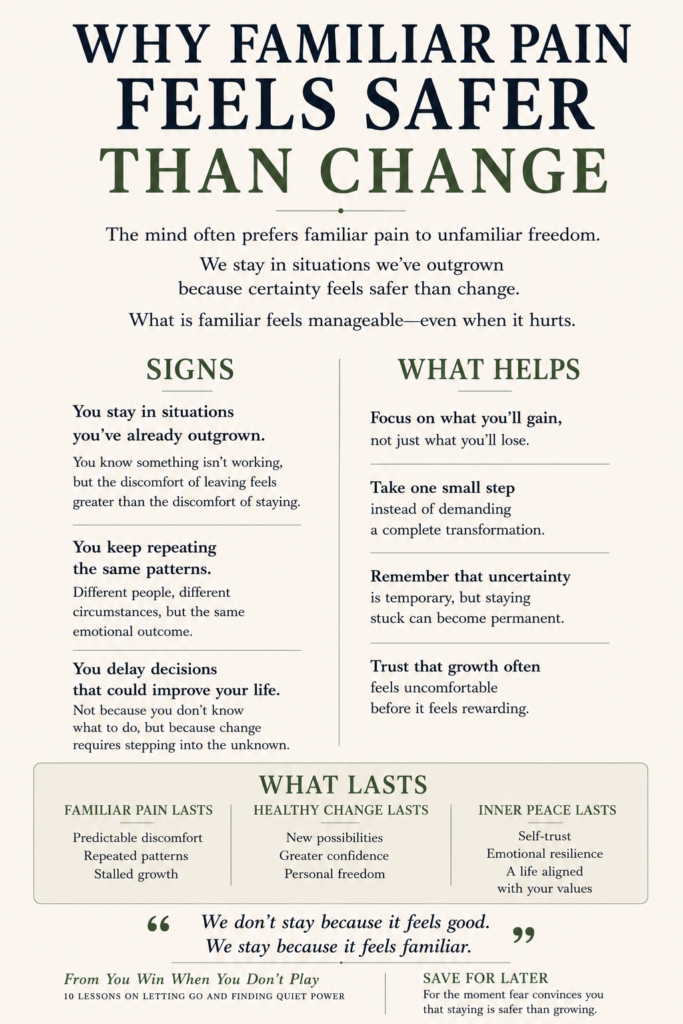
What Lasts
When we are afraid of change, we naturally focus on what we might lose.
We rarely consider what lasts.
Familiar Pain Lasts
- Predictable discomfort
- Repeated emotional patterns
- Stalled personal growth
Healthy Change Lasts
- New possibilities
- Greater confidence
- Personal freedom
Inner Peace Lasts
- Self-trust
- Emotional resilience
- A life aligned with your values
One offers familiarity.
The other offers expansion.
Only one creates room for the future.
What I Have Learned About Letting Go
One lesson I continue to learn is that letting go is rarely a single decision.
It is usually a series of decisions.
A gradual loosening of our grip.
A willingness to stop forcing what no longer fits.
For years, I thought letting go meant giving up.
Now I see it differently.
Sometimes letting go is the most honest thing we can do.
Not because we no longer care.
Because we finally care enough about ourselves to stop carrying what no longer belongs in our lives.
There is a quiet kind of strength in that.
Not dramatic strength.
Not performative strength.
The kind of strength that emerges when we stop arguing with reality.
Key Takeaways
- Familiar pain often feels safer than change because predictability can create the illusion of safety, even when a situation no longer supports your well-being.
- Many emotional patterns are rooted in emotional conditioning, making it difficult to recognize when a relationship, role, or habit has outlived its purpose.
- Fear of change is often less about the change itself and more about the uncertainty that accompanies personal growth.
- Self-trust is not built through certainty. It develops when we make decisions aligned with our values, even when outcomes are unknown.
- Repeating unhealthy emotional patterns can gradually contribute to emotional exhaustion, self-doubt, and a disconnect from our own needs.
- Signs you’ve outgrown a situation often include persistent misalignment, emotional fatigue, recurring frustration, and the feeling that you are no longer growing where you are.
- Healthy boundaries are not barriers to connection. They are an important part of emotional well-being, self-respect, and personal development.
- Emotional resilience grows when we learn to tolerate uncertainty rather than constantly seeking reassurance or external validation.
- Letting go is rarely a single decision. More often, it is a gradual process of releasing what no longer aligns with who we are becoming.
- Lasting inner peace comes not from predictability, but from living in alignment with your values, strengthening self-awareness, and trusting yourself through change.
Final Reflection
We don’t stay because it feels good.
We stay because it feels familiar.
That may be one of the most important truths we can learn about ourselves.
The challenge is not learning how to let go.
The challenge is learning how to trust ourselves after we do.
Because the opposite of familiar pain is not certainty.
It is possibility.
And every meaningful life is built by people willing to choose possibility before they can fully see where it leads.
A Lesson From You Win When You Don’t Play
One lesson I return to again and again is that peace rarely arrives through control.
It arrives through release.
Sometimes the battle is not with another person.
Sometimes it is with the belief that familiar suffering is safer than unfamiliar freedom.
The moment we stop protecting old pain, we create room for something new.
And that space is often where healing begins.
If these ideas resonate with you, you’ll find them explored more deeply in You Win When You Don’t Play: 10 Lessons in Letting Go and Finding Quiet Power.
Learn More About the Book
If something in this article felt familiar, you’re not alone.
Many of us spend years carrying things we were never taught how to release.
We carry overthinking long after the situation has ended.
We carry the weight of other people’s expectations.
We carry disappointment when life doesn’t go as planned.
We carry old stories about who we should be and struggle to understand why they still have so much power over us.
These are the questions that eventually led me to write You Win When You Don’t Play: 10 Lessons in Letting Go and Finding Quiet Power.
The book explores many of the themes woven throughout this article, including:
- How to stop overthinking and find greater mental clarity
- Letting go of validation-seeking and the need for approval
- People-pleasing, self-abandonment, and learning to set healthy boundaries
- Emotional exhaustion, burnout, and carrying too much for too long
- Rebuilding self-worth after disappointment and difficult life experiences
- Finding peace when life doesn’t go as planned
- Grieving lost dreams and letting go of expectations
- Emotional resilience during difficult life transitions
- Self-discovery, inner peace, and emotional freedom
- Learning how to trust yourself again
But more than anything, it explores a simple idea I’ve returned to again and again:
Not every struggle deserves your energy.
Not every battle needs to be won.
And not every burden needs to be carried.
Along the way, the book explores the invisible competitions, emotional pressures, and exhausting patterns that many of us carry without realizing how much they cost us.
Not to offer perfect answers.
But to help us see ourselves more clearly.
To understand ourselves more honestly.
And to recognize what may finally be ready to be released.
Because peace is rarely found by becoming more.
It is often found by needing less.
Less approval.
Less proving.
Less carrying what was never ours to hold.
Perhaps that’s why letting go often feels less like losing something and more like coming home to yourself.
Buy the Book on Amazon
Whether you’re struggling with overthinking, emotional exhaustion, people-pleasing, difficult relationships, self-worth, chronic stress, or the feeling that you’ve lost yourself beneath other people’s expectations, I hope the book offers the same thing I try to offer through my writing:
A different perspective.
A little more clarity.
And a gentler way forward.
You can learn more about the book or get your copy here:
Ask Sharmila – Personal Guidance for Overthinking, Emotional Exhaustion, Self-Worth, and Life’s Difficult Questions
Sometimes the hardest part isn’t finding advice.
It’s making sense of what you’re carrying.
Perhaps you’ve been overthinking the same situation for weeks. Perhaps you’re emotionally exhausted from trying to keep everyone happy. Or maybe you’re struggling to let go of a difficult relationship, rebuild your self-worth after disappointment, or find peace when life doesn’t go as planned.
Many of us carry questions that don’t have simple answers.
Questions about boundaries.
Questions about people-pleasing.
Questions about validation.
Questions about emotional healing, difficult life transitions, and how to stop carrying responsibilities that were never ours to hold.
You don’t have to figure it all out alone.
Through Ask Sharmila, you’re invited to share a question that’s been weighing on you.
Together, we’ll look beneath the surface of the situation—not to find perfect answers, but to uncover a clearer perspective and a gentler way forward.
Over Time, I’ve Noticed That Many Questions Tend to Circle Around the Same Themes
- How to stop overthinking and replaying conversations
- Emotional exhaustion and feeling drained by life
- People-pleasing recovery and setting healthy boundaries
- Seeking validation from others
- Rebuilding self-worth after disappointment
- Difficult relationships and emotional resilience
- Letting go of expectations that no longer fit your life
- Grieving the life you thought you’d have
- Learning how to let go when life doesn’t unfold as expected
- Finding inner peace during challenging life transitions
- Living more intentionally and trusting yourself again
One thing I’ve learned is that a new perspective doesn’t always change the situation.
I’ve seen people spend months stuck in the same thought loop, only to discover that what they needed wasn’t another solution.
It was a different way of seeing the situation.
And sometimes that’s where healing begins.
Personal Reflection and Written Guidance – ₹499
Every question is read personally by me, and every response is written thoughtfully and individually.
You Will Receive
- A personal written response tailored to your situation
- Thoughtful reflection grounded in emotional healing, self-discovery, and personal growth
- Practical perspective and gentle guidance
- Support for overthinking, emotional exhaustion, people-pleasing, self-worth struggles, boundaries, validation, difficult relationships, and major life transitions
- A response within 5 days

Personal Written Guidance for Overthinking, Emotional Exhaustion, Self-Worth, and Life’s Difficult Questions
The goal is not to have all the answers.
The goal is to understand yourself more clearly, carry less emotional weight, and discover a calmer, more compassionate way forward.
Sometimes clarity begins when we stop asking,
“How do I fix this?”
and start asking,
“What is this situation trying to teach me?”
Often, that’s where a gentler way forward begins.
Frequently Asked Questions
Why does familiar pain feel safer than change?
Familiar pain feels safer than change because the brain often prefers predictability over uncertainty. Even when a situation creates emotional discomfort, knowing what to expect can feel less threatening than stepping into the unknown. This is one reason people remain in situations they have already outgrown.
Why do people stay in unhealthy relationships even when they know they should leave?
People often stay in unhealthy relationships because familiarity can feel safer than uncertainty. Leaving requires facing the unknown, while staying allows them to remain inside a pattern they understand. Fear of change, emotional attachment, hope, and the desire for certainty can all contribute to staying longer than they intended.
How do I know if I’ve outgrown a relationship, friendship, or situation?
One of the most common signs you’ve outgrown a situation is persistent misalignment. You may feel emotionally exhausted, disconnected from yourself, or constantly question whether something still belongs in your life. Often, growth begins when what once felt right no longer feels true.
Why is change so hard even when I know it’s necessary?
Change is difficult because it asks us to leave certainty before we can see what comes next. Most people are not afraid of change itself. They are afraid of uncertainty. The challenge is learning how to trust yourself when there are no guarantees.
What is the psychology behind staying stuck?
The psychology of staying stuck often involves emotional conditioning, fear of uncertainty, comfort zone psychology, and learned emotional patterns. People tend to repeat what feels familiar, even when those patterns no longer support their well-being or personal growth.
How do I stop repeating the same emotional patterns?
The first step is awareness. Repeating emotional patterns often become visible when different situations create the same emotional outcome. Once you recognize the pattern, you can begin exploring what emotional need it serves and whether it still aligns with the person you are becoming.
How do I build self-trust after years of self-doubt?
Self-trust develops through consistent self-honesty. It grows when you listen to your instincts, honor your values, establish healthy boundaries, and follow through on decisions that reflect what you know to be true. Like confidence, self-trust is built gradually through experience.
Why do I keep seeking reassurance from other people?
Many people seek reassurance because they have learned to trust other people’s opinions more than their own. Often, reassurance is not a search for information but a search for certainty. Building self-trust involves becoming more comfortable making decisions without constant external validation.
What are the signs of emotional exhaustion?
Common signs of emotional exhaustion include feeling drained most of the time, difficulty making decisions, irritability, resentment, overthinking, lack of motivation, and feeling disconnected from yourself. Emotional exhaustion often develops when we spend too much energy managing situations that no longer align with our values.
What is the difference between comfort and inner peace?
Comfort comes from familiarity. Inner peace comes from alignment. Something can feel familiar while still creating stress, resentment, or self-abandonment. Inner peace tends to emerge when our choices reflect our values rather than our fears.
How can I overcome the fear of change and uncertainty?
Overcoming the fear of change does not mean eliminating uncertainty. It means developing enough self-trust to move forward despite uncertainty. Growth often begins when we stop waiting for guarantees and start trusting our ability to handle what comes next.
Can personal growth feel lonely?
Yes. Personal growth can feel lonely because changing emotional patterns often changes relationships. As you establish healthier boundaries, stronger self-worth, and greater emotional responsibility, some relationships may shift. While this can be difficult, it often creates space for more authentic connections.
Why do people struggle with letting go?
People struggle with letting go because letting go often involves grieving a familiar version of life. Even when a situation is unhealthy, it can feel difficult to release because it represents certainty, identity, history, or hope. Letting go is rarely about losing something. It is often about making space for something new.
How do healthy boundaries support emotional well-being?
Healthy boundaries protect your energy, strengthen self-respect, and help you take responsibility for your own emotions without carrying responsibilities that belong to others. Boundaries are not about controlling people. They are about creating clarity around what you will and will not accept in your life.
What creates lasting inner peace?
Lasting inner peace is often built through self-awareness, self-trust, emotional responsibility, healthy boundaries, and the willingness to let go of patterns that no longer serve you. Peace rarely comes from controlling circumstances. More often, it comes from changing your relationship with them.
About Sharmila Sengupta
I’m Sharmila Sengupta, author of You Win When You Don’t Play: 10 Lessons in Letting Go and Finding Quiet Power.
Over the years, I’ve become fascinated by the quiet struggles many of us carry but rarely talk about openly—the exhaustion of overthinking, the weight of people-pleasing, the search for validation, the challenge of setting healthy boundaries, and the grief that comes when life doesn’t go as planned.
Much of my writing begins with things I’ve noticed—in my own life, in conversations with others, and in the quiet struggles many of us carry without talking about them.
I’ve noticed how often we replay old conversations, question our self-worth, compare our lives to others, or carry emotional burdens that were never ours to hold. I’ve also noticed that many of us are quietly grieving lost dreams, coping with disappointment in life, navigating difficult life transitions, or learning how to let go of expectations about the future.
Perhaps you’ve found yourself asking some of those same questions.
How do I stop overthinking?
How do I let go of expectations that no longer fit my life?
Why do I feel emotionally exhausted even when everything seems fine on the surface?
How do I find peace when life doesn’t go as planned?
How do I stop seeking validation from other people?
How do I rebuild self-worth after disappointment or difficult relationships?
These are the questions that often inspire my writing.
Again and again, they seem to lead back to the same lesson: peace often begins when we stop carrying what was never ours to hold.
Through my articles and books, I reflect on emotional healing, personal growth, self-discovery, emotional resilience, and the quiet work of learning how to let go of what no longer serves us. Not as someone with all the answers, but as a fellow traveller who continues to learn what it means to let go, trust life a little more, and find strength in quieter ways.
My hope is that readers leave feeling less alone, more understood, and a little gentler with themselves than they were before they arrived.