
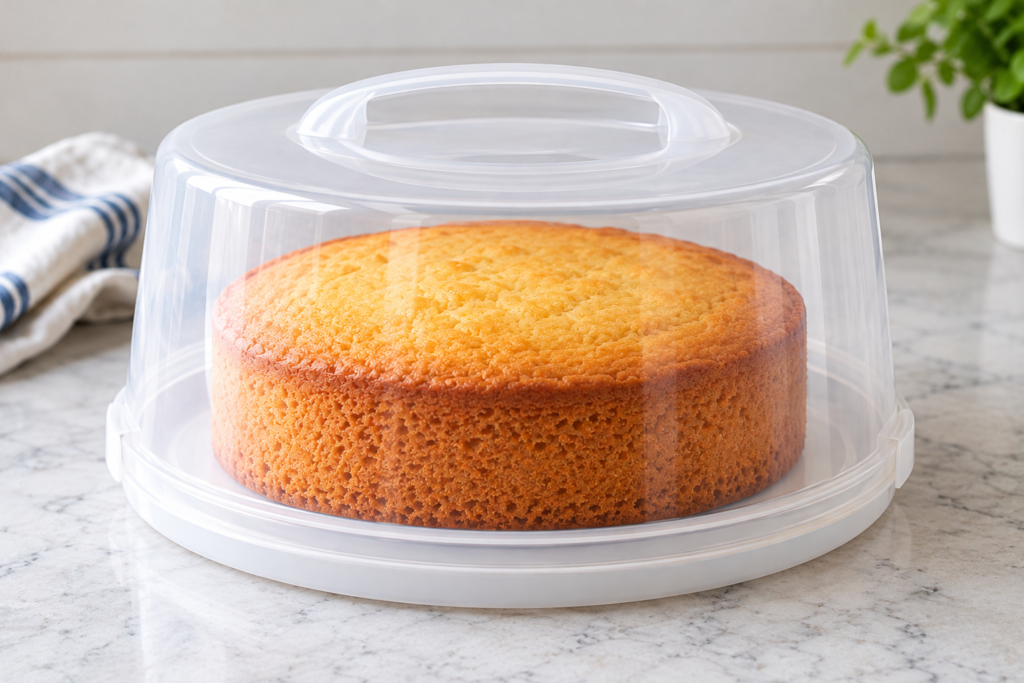
How to Store Cake Properly: Keep It Soft & Fresh
Knowing how to store cake properly helps preserve its moisture, texture and freshness. A cake can come out of the oven beautifully soft and still become dry, firm or sticky after storage. Sometimes the cut surface loses moisture because it has been left uncovered. At other times, refrigeration or condensation changes the texture.
The right way to store a cake depends on its ingredients, frosting and filling, as well as the conditions in which it is kept.
In this guide, I’ll explain how to keep cake moist, when refrigeration is necessary, and what to do when the texture changes.
This article is part of my Eggless Baking Guide: Common Problems, Causes & Easy Fixes.
What Is Happening to Your Cake?
Before changing your storage method, look at what has actually happened to the cake.
| What you observe | What it may mean | What to do |
|---|---|---|
| Cut edge dry, centre soft | Moisture loss from the exposed surface | Cover the cut face and store airtight |
| Cake dry throughout | Possible baking or recipe issue | Review baking time, oven temperature and ingredient measurements |
| Cake firm only when cold | Chilling may have firmed the crumb | Compare a portion at a safe serving temperature |
| Droplets under the cover | Condensation | Check cooling, wrapping and temperature changes |
Use these clues to decide which section to read next. They point towards possible causes, but the cake’s ingredients and storage history matter too.
1. Why Does Cake Become Dry After Storage?
The first thing I would check is whether the cake was already dry when it was cut or became dry afterwards. That distinction helps you decide where to look for the cause.
If the cake is dry from the beginning
If the crumb is dry throughout, storage may not be the main problem. Look at the baking process and ingredient balance.
Common causes include:
- Baking the cake for too long.
- An oven temperature higher than intended.
- Measuring too much flour.
- An imbalance between flour, fat and liquid.
- Substituting ingredients without accounting for differences in absorption.
This deserves particular attention in gluten-free baking. Rice flour, millet flour, almond flour and other ingredients behave differently, so a substitution can change the texture even when the other quantities remain the same.
If the cake is dry from the first slice, I would review the recipe and baking conditions before trying to correct it through storage.
For a more detailed explanation, read Why Is My Eggless Cake Dry?
If the cake becomes dry overnight
If the cake was soft when freshly baked but the edges become dry the next day, check how it was covered.
Once the cake has cooled completely, wrap it well or place it in an airtight container. If it has already been cut, protect the exposed surface especially carefully.
For a larger cake, you can place food-safe wrap directly against the cut face before covering the rest of the cake. This helps reduce moisture loss from that area.
Better storage can prevent further drying, but it cannot restore moisture already lost through overbaking.
2. Should You Store Cake at Room Temperature or in the Refrigerator?
This decision depends on the ingredients, not just the type of cake.
A plain, unfrosted cake may keep well at room temperature for a short period in suitable conditions. A cake containing fresh cream, custard or another perishable filling needs refrigeration.
| Type of cake | Storage approach |
|---|---|
| Plain, unfrosted cake | Store covered in an airtight container at room temperature if conditions are suitable |
| Cake with buttercream | Follow the recipe’s storage instructions; the formulation and room temperature matter |
| Cake with cream cheese or mascarpone frosting | Refrigerate |
| Cake with whipped cream or custard filling | Refrigerate promptly |
| Cake with fresh fruit or other perishable fillings | Refrigerate when required by the ingredients and recipe |
| Cake with ganache | Follow the recipe’s guidance, as formulations differ |
A note about food safety
As general food-safety guidance, refrigerate perishable foods within two hours, or within one hour when the surrounding temperature is above 32°C. Keep the refrigerator at or below 4°C.
These are general guidelines, not a substitute for recipe-specific instructions. When a cake contains several components, follow the storage requirements of the most perishable component.
In warm weather, room-temperature storage may be less suitable. Do not leave a cake containing perishable ingredients out simply to preserve its softness.
3. How to Store an Unfrosted Cake
For an unfrosted cake, focus on proper cooling, protection from air and a suitable storage location.
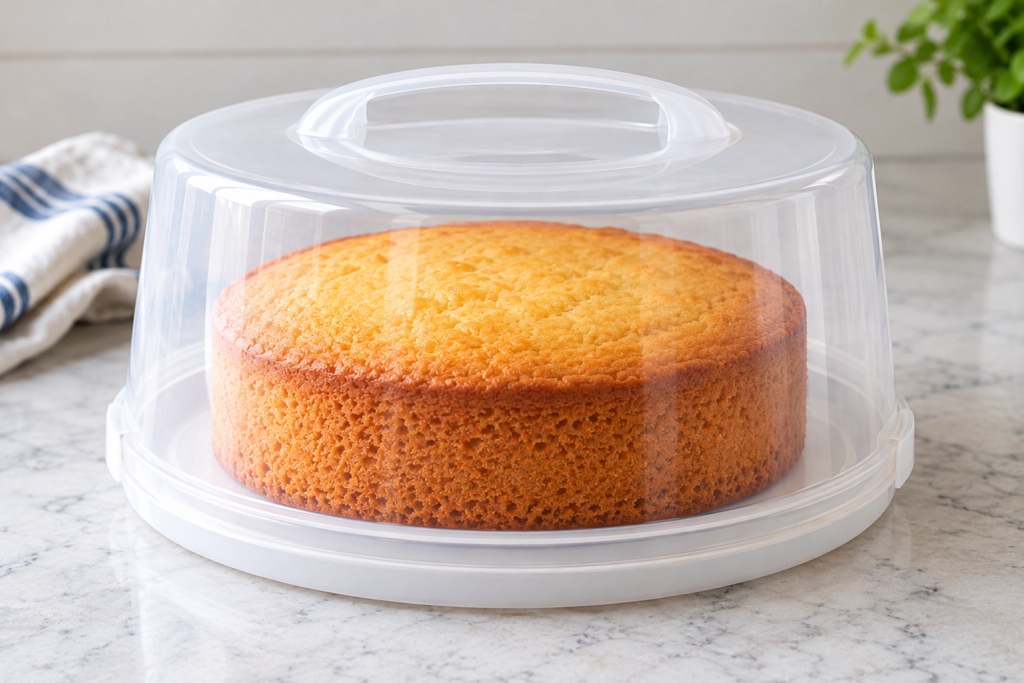
Step 1: Cool the cake completely
Follow the recipe’s cooling instructions. Once the cake is ready to leave its tin, transfer it to a wire rack if directed and let it cool completely before wrapping.
Wrapping a warm cake tightly can trap steam, leading to condensation and a damp surface.
If you need guidance on this stage, read How to Cool a Cake Properly.
Step 2: Wrap or cover the cake
Once completely cool, wrap the cake securely in food-safe wrap or place it in an airtight container.
If you have cut the cake, protect the exposed face particularly well. This is where moisture loss is often most noticeable.
Step 3: Choose the storage location
If the cake is suitable for room-temperature storage, keep it in a cool, dry place away from direct sunlight and heat.
If refrigeration is necessary, use suitable wrapping or an airtight container. This helps reduce moisture loss and prevents the cake from absorbing odours from other foods.
4. How to Store a Frosted Cake
Frosted cakes need protection from air, accidental contact and temperature changes. The best approach depends on the frosting and filling.
Protect the frosting
A cake carrier or tall container is useful because it protects the decoration without touching the frosting. Choose one with enough space above the cake to accommodate piped rosettes and other delicate details.
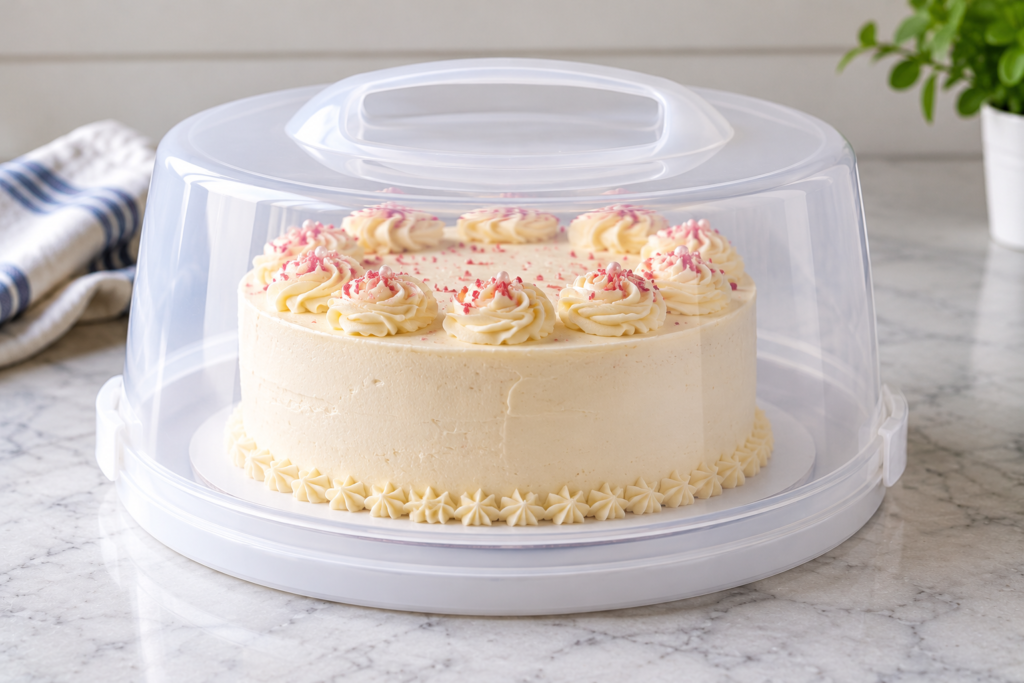
Avoid pressing plastic wrap against a delicate finish, as it can leave marks or pull away the frosting. If the cake needs refrigeration, use a suitable covered container and follow the storage requirements for its frosting and filling.
Check the frosting ingredients
- American buttercream: Room-temperature storage suitability depends on the formulation and conditions.
- Swiss or Italian meringue buttercream: Follow the recipe’s storage guidance, as texture can change with temperature.
- Cream cheese or mascarpone frosting: Refrigerate.
- Whipped cream or custard fillings: Refrigerate promptly.
- Ganache: Follow the recipe’s instructions, as ingredients and proportions vary.
A frosting that looks firm is not necessarily safe to leave at room temperature. Ingredients and handling matter more than appearance alone.
What about decorations?
Fresh fruit, chocolate decorations and other toppings may react differently to refrigeration and humidity. If you are preparing a cake for an occasion, consider how the decoration will hold up during storage and transport.
5. How Long Can You Store Cake?
The following ranges are general storage-quality guidance from King Arthur Baking’s article, How Long Does Cake Last in the Fridge? They are not guarantees that every cake will remain fresh or safe for the stated period.
| Cake type | General storage guidance |
|---|---|
| Plain, unfrosted cake | About 2–3 days at room temperature in suitable conditions; up to 1 week refrigerated |
| Cake with American, Italian or Swiss buttercream | Up to 2 days at room temperature when the recipe and conditions permit; up to 1 week refrigerated |
| Cake with cream cheese or mascarpone frosting | Generally 3–4 days refrigerated |
| Cake with whipped cream, custard or curd | Generally 3–5 days refrigerated |
| Cake topped or filled with fresh fruit or jam | About 1–2 days at room temperature; 3–5 days refrigerated, with refrigeration recommended |
| Cake with ganache | Depends on the formulation and ingredients; follow the recipe’s storage guidance |
The ingredients, preparation, handling and storage temperature all affect how long a cake keeps well. If your recipe gives specific storage instructions, follow those first, particularly for cakes made with fresh cream, custard or other perishable fillings.
When a cake contains several fillings or toppings, use the storage method and timeframe appropriate to the component with the strictest requirements.
How can you tell if a cake is no longer suitable to eat?
Look for mould, unusual odours or unexpected changes that suggest spoilage. Do not taste a cake to test whether it is safe. If a perishable cake has been stored incorrectly or you are unsure of its storage history, the safer choice is to discard it.
A cake can become stale or dry without being unsafe, so freshness and food safety are related but different questions.
6. Why Does Cake Become Firm or Develop Condensation?
These two changes need different responses: a cold cake may feel firmer, while condensation leaves moisture on the surface.
If the cake feels firm when cold
Chilling can firm the fats in a cake and change how the crumb feels. If the cake can safely be served at room temperature, compare a small portion straight from the refrigerator with another portion after it has lost some of its chill.
If the texture improves, the firmness may have been temperature-related rather than a sign that the cake had dried out.
If it remains dry, review the exposed cut surface and consider whether overbaking or recipe balance contributed to the problem.
Do not leave a cake with perishable cream or custard fillings out for an extended period simply to soften its texture.
If droplets appear on the cake or inside the container
Condensation forms when moisture collects on a cooler surface. It may appear if the cake was wrapped while warm or if a cold cake is moved into a warmer environment.
To reduce the chance of condensation:
- Cool an unfrosted cake completely before wrapping.
- Use a clean, dry container.
- Avoid repeatedly exposing a refrigerated cake to changing temperatures.
- Keep the cake protected while it adjusts towards serving temperature.
If droplets have already formed, avoid wiping delicate frosting, as this can damage the finish. Keep the cake protected and allow the moisture to settle or evaporate as conditions permit.
Condensation alone does not tell you whether a cake is safe to eat. Its ingredients and storage history still matter.
7. Can You Freeze Cake to Keep It Fresh?
Freezing is useful when you want to prepare cake layers ahead of time or save portions for later. For the best quality, freeze the cake while it is still in good condition.
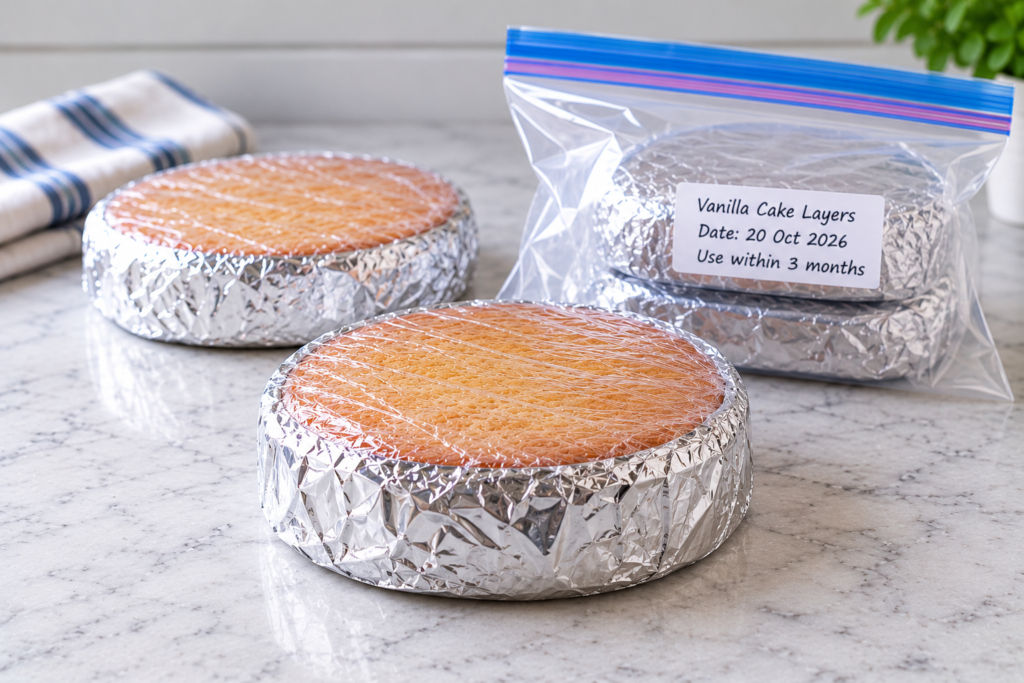
How to freeze cake layers
- Let the cake cool completely.
- Wrap each layer securely in food-safe wrap.
- Add an outer layer of protection, such as foil or a freezer-safe container.
- Label the package with the date.
- Freeze at approximately −18°C.
Good wrapping limits exposure to air and helps protect the cake from freezer burn.
How long can cake stay in the freezer?
For unfrosted cake layers or loaf cakes, aim to use them within 3–4 months for the best quality. King Arthur Baking notes that they can remain fresh-tasting for longer, but quality is usually best within this period.
Fully assembled, frosted cakes are different. The same source recommends freezing these for up to one month.
These are quality recommendations, not precise expiry dates. The type of cake, wrapping and stability of the freezer temperature all make a difference. Not every frosting, filling or decoration freezes well, so check the recipe before freezing an assembled cake.
How should you thaw frozen cake?
For gradual thawing, leave the cake wrapped and place it in the refrigerator. Keeping it wrapped helps limit moisture loss and reduces direct exposure to condensation.
Once thawed, follow the storage requirements for the frosting and filling. Avoid repeatedly thawing and refreezing the cake, as this can affect quality and complicate temperature control.
Frequently Asked Questions
Should I store cake in the refrigerator or at room temperature?
It depends on the ingredients. A plain cake may be stored at room temperature in suitable conditions, while cakes with fresh cream, custard or other perishable components need refrigeration. Follow the recipe’s storage instructions.
Should I cover a cake while it is cooling?
Let the cake cool properly before wrapping it for storage. Covering a warm cake tightly can trap steam and lead to condensation.
Can I freeze cake before frosting it?
Yes. Completely cooled cake layers can be wrapped securely and frozen. For best quality, aim to use them within three to four months. Thaw them carefully before frosting, and follow the recipe’s guidance for any filling or decoration.
Can I leave a fresh-cream cake out overnight?
No. A cake containing fresh cream should be refrigerated and handled according to food-safety guidance. Do not leave it out overnight to improve its texture.
How do I keep a cut cake from drying out?
Protect the exposed cut surface directly, then place the cake in an airtight container. This reduces moisture loss from the area most exposed to air.
For more practical baking advice, explore my Eggless Baking Guide, where I explain common baking problems, why they happen, and how to fix them for better results in your kitchen.
Final Thoughts
When a cake changes during storage, look at what has actually happened before changing your method.
If the cut edge is dry but the centre remains soft, protect the exposed surface. If the whole cake is dry, review the baking process. If droplets appear under the cover, check cooling and temperature changes. And if the cake contains perishable ingredients, prioritise safe storage.
The aim is not simply to cover the cake. It is to understand what the cake needs and store it accordingly.