
Letting Go of the Life You Thought You’d Have
The Grief No One Talks About
Many people spend years grieving the life they thought they’d have without fully realizing it.
When we think about grief, most of us think about losing someone.
A relationship ends. A loved one dies. Someone important leaves our life.
Those losses are real, visible, and widely understood.
But some of life’s deepest grief has nothing to do with losing another person.
Many people spend years grieving the life they thought they’d have without fully realizing it.
The future they imagined never arrived.
Or perhaps it arrived looking nothing like they expected.
And yet the loss is real.
Perhaps you’ve noticed this in your own life.
You find yourself looking back more often than forward.
You wonder why certain memories still carry so much weight.
You feel a quiet sadness when you think about the life you once imagined for yourself.
The strange part is that nothing obvious has happened.
There has been no dramatic ending.
No clear loss that others can see.
Yet something inside you knows that, somewhere along the way, a chapter ended.
I’ve spoken with people who still think about a career they left twenty years ago.
Not because they want it back.
But because some part of them still wonders who they might have become.
Perhaps you’ve met this grief in your own life.
In the relationship you thought would last.
The business you were certain would work.
The version of yourself you expected to become by now.
The future that once felt inevitable.
And then, little by little, life became something else.
Life moved forward.
You adapted.
You kept going.
But the goodbye never fully happened.
Perhaps that’s why grieving the life you thought you’d have can feel so confusing.
There is no funeral.
No public acknowledgment.
No clear moment when others recognize your loss.
Instead, the grief often hides beneath other emotions.
It appears as disappointment.
Regret.
Comparison.
Overthinking.
Emotional exhaustion.
Sometimes it shows up as self-doubt or the feeling that everyone else has somehow figured life out while you are still trying to make peace with what didn’t happen.
But beneath all of those feelings is often something much simpler:
A goodbye that was never fully acknowledged.
Why Grieving the Life You Thought You’d Have Hurts So Much
Sometimes the hardest losses aren’t the ones we can point to.
They’re the futures we quietly carried in our hearts.
Most of us imagine how life will unfold. We picture certain milestones, relationships, achievements, or experiences. We assume that if we work hard enough, wait long enough, or make the right choices, life will eventually look the way we hoped it would.
Then life takes a different path.
You may have imagined being in a different relationship, a different career, a different city, or a different season of life by now. Instead, you find yourself facing a reality you never planned for and wondering how you ended up here.
You may be grieving lost dreams, mourning opportunities that never arrived, or struggling to accept that life didn’t go as planned. The pain can feel confusing because nothing tangible was taken away.
Yet something meaningful has still been lost:
The future you thought was waiting for you.
Perhaps you’ve even found yourself wondering:
“Why am I grieving something that never actually happened?”
One thing I’ve learned is that grieving lost dreams can feel just as real as grieving something tangible.
The future may have existed only in our imagination, but the hope, meaning, and identity attached to it were very real.
I’ve come to see that this kind of grief is rarely about a single goal or outcome. It’s about the meaning we attached to it. We don’t just grieve a different future; we grieve the version of ourselves we expected to become within that future.
When those expectations remain unmet, it’s easy to believe something has gone wrong. We compare our present reality to an imagined future and find ourselves coming up short.
Many of us carry this invisible comparison for years without realizing it.
The turning point often comes when we stop asking reality to be different from what it is.
At least for me, that was the beginning of making peace with things.
Not because I approved of everything that happened.
Not because I stopped wishing certain things had turned out differently.
But because I realized I was spending so much energy comparing my life to the future I imagined that I wasn’t fully living the life that was actually here.
Letting go of expectations isn’t about lowering our hopes.
It’s about releasing our attachment to a specific outcome so we can fully engage with the life that exists now.
If you’re grieving the life you thought you’d have, you’re in good company.
More people carry this kind of invisible grief than we realize.
Most of us simply don’t talk about it.
Sometimes peace arrives when we stop measuring our lives against the future we imagined and start building a relationship with the life we have.
The story may not look the way you planned.
But it isn’t finished yet.
And sometimes the life we learn to accept becomes more meaningful than the one we once imagined.
Why Letting Go Feels So Difficult
For a long time, I thought letting go meant giving up.
Perhaps you’ve felt that too.
We tell ourselves:
If I accept this, it means the dream didn’t matter.
If I stop fighting for the future I imagined, it means I failed.
If I let go, it means I’m settling.
But over time, I’ve come to see acceptance differently.
Acceptance isn’t agreeing that everything happened the way we wanted.
Acceptance isn’t pretending we aren’t disappointed.
Acceptance is simply stopping the argument with reality.
And that can be surprisingly hard.
Part of the reason is that our dreams often become woven into our identity.
A future isn’t just a future.
It becomes part of who we believe we are.
The person building a business.
The person raising a family.
The person living in a particular place.
The person who achieves a specific goal.
When those plans change, we aren’t only losing an outcome.
We may also feel as though we’re losing a version of ourselves.
For me, this was one of the most important insights about personal growth after disappointment.
Sometimes we’re not only grieving what didn’t happen.
We’re grieving who we thought we would become.
That is why life transitions can feel so emotional.
A career change.
A divorce.
An empty nest.
A health challenge.
A retirement that feels different than expected.
These experiences often involve identity loss as much as practical change.
And identity loss can be difficult to name.
The Comparison Trap
Social media doesn’t always help.
Many of us scroll through carefully edited snapshots of other people’s lives.
We see milestones.
Achievements.
Celebrations.
And without meaning to, we compare those moments to our own disappointments.
I’ve noticed that comparison rarely creates peace.
More often, it deepens the feeling that everyone else received the future they wanted while we somehow missed ours.
But the older I get, the more I realize something important:
Nearly everyone is grieving something.
A dream that didn’t happen.
A relationship that didn’t last.
A path not taken.
A future that unfolded differently than expected.
Most people simply don’t talk about it.
Which is why we often assume we’re the only ones struggling to accept a life we didn’t expect.
We’re not.
Many of us are learning, day by day, how to let go of the future we imagined and make peace with the life that is here.
And perhaps that is one of the quietest forms of courage there is.
Before we move on, there is something worth remembering.
Even when life unfolds differently than expected, not everything is lost.
Some things remain.
What Lasts
- Grieving the life you thought you’d have is a real form of loss.
- Unmet expectations often hurt because they are tied to identity, not just outcomes.
- Acceptance and peace can exist alongside disappointment.
- A meaningful life is still possible, even when life doesn’t go as planned.
- Peace often begins when you stop chasing what could have been and start noticing what still can be.
Examples of Life Changes That Trigger This Grief
The phrase “grieving the life you thought you’d have” resonates with so many people because it can emerge from countless life experiences.
1. A Career That Didn’t Unfold As Expected
Perhaps you imagined yourself in a different role.
Maybe you thought your business would grow faster.
Maybe you expected greater financial security.
Or perhaps you simply imagined feeling more fulfilled by now.
The grief isn’t always about the career itself.
Often it’s about the identity and meaning attached to it.
I’ve spoken with people who still think about a career they left twenty years ago.
Not because they want it back.
Not because they regret every decision.
But because some small part of them still wonders who they might have become if they had stayed.
Sometimes we aren’t grieving the job.
We’re grieving a version of ourselves that never had the chance to fully exist.
2. A Relationship That Ended
When relationships end, we don’t only lose the person.
We also lose the future we imagined alongside them.
The conversations.
The plans.
The milestones.
The life story we expected to share.
Sometimes that future is what we’re grieving most.
3. Not Becoming a Parent
For some people, one of life’s deepest disappointments is the family they hoped to have.
This grief often remains invisible because society doesn’t always know how to acknowledge it.
Yet it can shape a person’s sense of identity, belonging, and purpose.
4. Health Challenges
A diagnosis, injury, or chronic condition can change more than daily routines.
It can change the future we imagined.
Many people find themselves grieving opportunities, experiences, and possibilities that suddenly feel uncertain.
5. Midlife, Aging, and Unexpected Transitions
There often comes a point when we look back and realize some dreams may never happen.
That realization can be painful.
But it can also become an invitation.
An invitation to redefine success.
An invitation to discover new meaning.
An invitation to create a future that reflects who we are now rather than who we once expected to be.
6. Children Leaving Home
Many parents are surprised by the emotions that arrive when children grow up.
The house becomes quieter.
The routines change.
And sometimes there is grief for a role that shaped daily life for many years.
7. Dreams Delayed by Circumstances
Sometimes the dream isn’t gone.
Life simply unfolded differently than expected.
Responsibilities.
Financial pressures.
Caregiving.
Unexpected setbacks.
These experiences can leave us feeling disappointed, even when the dream remains possible.
And perhaps that is what makes this kind of grief so universal.
Sooner or later, most of us discover that life does not unfold exactly as planned.
The question is not whether disappointment will visit us.
The question is how we will respond when it does.
What You’re Really Grieving
One thing I’ve noticed is that the longer we carry a disappointment, the easier it becomes to focus on the surface of it.
We tell ourselves we’re grieving a career that didn’t work out.
A relationship that ended.
A dream that never happened.
A future that unfolded differently than expected.
And while all of those losses are real, I’ve come to believe that many of us are grieving something deeper.
The dream is often only the visible part of the loss.
Beneath it, there is usually something else.
1. You’re Grieving Certainty
When we imagine the future, we aren’t only imagining events.
We’re imagining security.
We’re imagining a version of life that feels predictable.
A version where the important questions seem answered.
Who will I become?
Where will I live?
Who will share my life?
What will my future look like?
Then life changes.
The answers become less clear.
And suddenly we find ourselves standing in uncertainty.
Perhaps you’ve experienced that feeling.
Not knowing exactly what comes next.
Not knowing whether the life ahead will resemble the life you once imagined.
That uncertainty can feel surprisingly painful because what we’re grieving isn’t only the dream.
We’re grieving the certainty that came with it.
2. You’re Grieving Identity
Many of us spend years building an image of who we expect to become.
Without realizing it, we begin introducing ourselves to ourselves through those future identities.
The successful entrepreneur.
The devoted parent.
The happily married partner.
The respected professional.
The person living a particular kind of life.
When those identities shift, something inside us often feels unsettled.
We begin asking questions we never expected to ask:
Who am I now?
What matters to me now?
What does success mean now?
I’ve learned that these questions are uncomfortable, but they are also important.
They often mark the beginning of self-discovery.
3. You’re Grieving Belonging
Sometimes the sadness has less to do with the dream itself and more to do with feeling left behind.
Perhaps you’ve watched friends reach milestones you once expected for yourself.
Relationships.
Careers.
Families.
Achievements.
The comparison isn’t always intentional.
It simply happens.
And when it does, it’s easy to feel as though everyone else moved forward while you remained standing still.
But one thing I’ve learned is that every life contains hidden disappointments.
Every person carries a story that didn’t unfold the way they expected.
We simply don’t see most of those stories.
I’ve often noticed that we compare our private disappointments to other people’s public milestones.
And that’s an unfair comparison.
Because while we can see their celebrations, we rarely see their grief.
We see the chapter they share.
Not the chapters they quietly carry.
4. You’re Grieving the Story You Told Yourself
Perhaps the deepest loss of all is the story.
The story that said:
“This is how my life will unfold.”
For years, that story may have felt certain.
It may have guided decisions, inspired hope, and provided direction.
Then reality took a different path.
And now there is grief not only for the dream itself but for the narrative that once made everything feel understandable.
Recognizing this can be surprisingly freeing.
Because when we stop trying to force reality back into the old story, we create space for a new one.
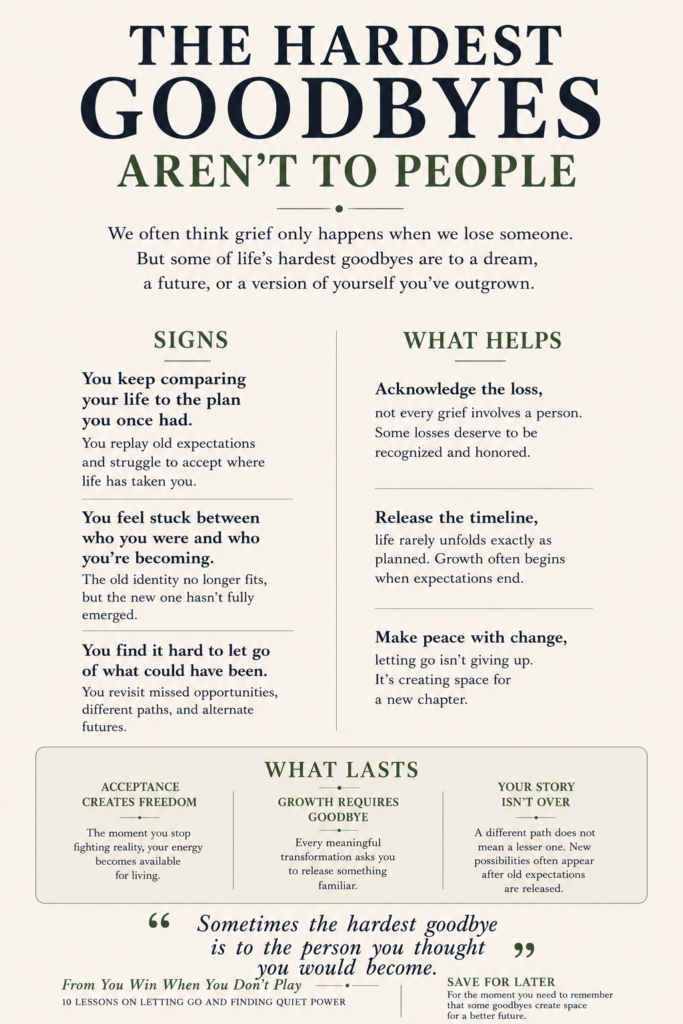
Signs You’re Grieving an Old Version of Yourself
The challenge with this kind of grief is that it rarely announces itself clearly.
Most of us don’t wake up one morning and think:
“I’m grieving the life I thought I’d have.”
Instead, the grief appears in quieter ways.
1. You Find Yourself Looking Back More Than Forward
Perhaps you’ve noticed how often your mind returns to old plans.
Old dreams.
Old expectations.
You revisit the life you imagined and compare it to the life you have now.
The comparison becomes so familiar that it feels normal.
Yet each comparison quietly reinforces the feeling that something important is missing.
2. You Replay Alternative Versions of Your Life
Many people who are coping with disappointment in life spend a great deal of time in “what if.”
What if I had chosen differently?
What if that relationship had worked?
What if I had taken that opportunity?
What if circumstances had been different?
I’ve certainly noticed how tempting it can be to revisit alternate versions of our lives.
The mind searches for explanations because it hopes explanation will bring peace.
Yet endless overthinking rarely provides the comfort we’re looking for.
3. You Feel Stuck Between Who You Were and Who You’re Becoming
This may be one of the most difficult parts of any life transition.
The old identity no longer fits.
The new identity hasn’t fully arrived.
You feel caught between chapters.
Caught between certainty and possibility.
Caught between the person you expected to become and the person you’re still discovering.
Many people interpret this as failure.
I’ve come to see it as a natural part of growth.
4. You Struggle to Celebrate Your Progress
When life doesn’t match the original vision, it becomes easy to overlook everything that has gone right.
You focus on what is missing.
You focus on what didn’t happen.
You focus on the distance between expectation and reality.
And without realizing it, you ignore your resilience.
Your growth.
Your courage.
The life you’ve built despite disappointments.
5. New Possibilities Feel Difficult to Embrace
Sometimes we remain so emotionally attached to the future we lost that we cannot fully see the future that still exists.
We tell ourselves we’re stuck.
But often we’re standing in front of a new door while still looking at the one that closed.
The Hidden Cost of Holding On
One thing I’ve learned is that holding on doesn’t always feel like holding on.
Often it feels like remembering.
Reflecting.
Trying to understand.
Trying to make sense of what happened.
But over time, attachment to an old future can quietly shape how we experience the present.
1. It Fuels Overthinking
Many of us believe that if we think about the past long enough, we’ll eventually find the answer that brings peace.
So we replay conversations.
Decisions.
Mistakes.
Missed opportunities.
We analyze what happened and imagine how things could have unfolded differently.
But overthinking rarely changes the past.
It simply keeps us emotionally connected to it.
And eventually that mental effort becomes exhausting.
2. It Creates Self-Doubt
When life doesn’t go as planned, it’s easy to assume we did something wrong.
We begin questioning our decisions.
Our abilities.
Our worth.
The disappointment becomes personal.
Instead of saying:
“My plans changed.”
We begin saying:
“I failed.”
Those are not the same thing.
Yet many people spend years carrying that burden.
3. It Strengthens Comparison
I’ve noticed that comparison tends to grow wherever disappointment exists.
The more attached we remain to a lost future, the more likely we are to compare our lives to others.
Social media often amplifies this.
We see carefully edited snapshots of success and assume everyone else received the life we wanted.
Comparison steals attention from our own journey.
And it almost always leaves us feeling worse.
Perhaps you’ve noticed how comparison becomes louder after a disappointment.
A friend’s promotion.
Someone else’s wedding photo.
A retirement announcement.
A family celebration.
On ordinary days, these moments might not affect us at all.
But when we’re quietly grieving something in our own lives, they can feel like reminders of a road we never got to travel.
Not because we’re jealous.
Because we’re hurting.
4. It Encourages People-Pleasing
Sometimes the future we’re grieving wasn’t entirely ours.
Perhaps part of the dream came from family expectations.
Cultural expectations.
The desire for validation.
The hope of proving our worth.
Many people discover that they spent years pursuing approval rather than fulfillment.
And when that dream falls apart, they are left asking an important question:
What do I actually want?
5. It Damages Self-Worth
This may be the deepest cost of all.
When we remain attached to an old version of our life, we often begin measuring our worth against outcomes.
We wonder whether we failed.
Whether we made the wrong choices.
Whether we somehow fell behind.
This can fuel emotional exhaustion, self-doubt, comparison, and a lingering feeling that we are not enough.
Yet our worth was never meant to depend on a particular outcome.
A dream changing does not diminish our value.
A disappointment does not define who we are.
6. It Prevents New Possibilities
Perhaps the greatest tragedy of holding on is that it keeps our attention fixed on a future that no longer exists.
As long as we remain emotionally invested in what might have been, we struggle to fully engage with what still could be.
And yet life continues to offer possibilities.
Different possibilities.
Unexpected possibilities.
Possibilities we often cannot see until we loosen our grip on the story we thought we needed.
Which is why letting go of expectations is not really about losing something.
It is about creating room for something new.
What Helps
I wish I could tell you there is a simple moment when acceptance arrives.
A day when you wake up and suddenly feel at peace with everything that didn’t happen.
In my experience, it rarely works that way.
Acceptance tends to arrive quietly.
A little at a time.
Through small moments of honesty.
Through gentle acts of letting go.
Through a growing willingness to stop arguing with reality.
Many of us spend years trying to change the past in our minds.
We replay conversations.
We revisit decisions.
We imagine different outcomes.
But eventually there comes a moment when we begin asking a different question.
Not:
“How do I get back to the life I planned?”
But:
“How do I make peace with the life I have?”
That question changes everything.
1. Acknowledge the Loss
One thing I’ve learned is that healing often begins when we stop minimizing our disappointment.
Many of us tell ourselves:
- It shouldn’t bother me this much.
- I should be over this by now.
- Other people have bigger problems.
But grief doesn’t disappear because we judge it.
Sometimes the kindest thing we can do is simply admit:
“This mattered to me.”
“I really wanted this.”
“I’m sad it didn’t happen.”
There is something deeply freeing about telling the truth.
2. Stop Measuring Life Against an Old Blueprint
Perhaps you’ve noticed how easy it is to compare today’s reality with yesterday’s expectations.
We carry an invisible blueprint for how life was supposed to unfold.
Then we judge our present against it.
But what if the blueprint was never meant to be permanent?
What if it was simply a starting point?
Looking back, some of the most meaningful parts of life often arrive through detours we never planned.
3. Let New Possibilities Be Small
Many people feel pressure to immediately replace one dream with another.
I’ve never found that particularly helpful.
Sometimes healing begins with something much smaller.
A new interest.
A new friendship.
A new routine.
A quiet curiosity about what else might be possible.
The future doesn’t need to arrive all at once.
Sometimes it returns one small step at a time.
4. Practice Acceptance Without Demanding Certainty
One thing I’ve come to believe is that acceptance and certainty are not the same thing.
We often think we need answers before we can move forward.
But life rarely offers complete certainty.
Acceptance simply asks us to take the next step without knowing the entire path.
And perhaps that is enough.
What No One Tells You About Letting Go
Many of us think letting go is a decision.
We imagine a moment when we finally accept what happened and move on.
But I’ve rarely seen it work that way.
Letting go often happens in layers.
We accept something, and then a memory brings the grief back.
We make peace with a disappointment, and then an anniversary arrives.
We think we’ve moved forward, and then we meet someone living the life we once imagined.
Healing is rarely a straight line.
It is usually a conversation we return to again and again.
Not because we’re failing.
Because we’re human.
And perhaps that’s what makes healing so difficult.
And so beautiful.
We do not move forward by forgetting.
We move forward by carrying the story differently.
A Practical Reflection
If you’re currently grieving the life you thought you’d have, I invite you to spend a few quiet moments with these questions.
Not as an exercise to complete.
But as a conversation with yourself.
What future am I still holding onto?
Not the practical details.
The emotional attachment.
The version of life that still lives in your mind.
What did I hope that future would give me?
Security?
Belonging?
Love?
Recognition?
Purpose?
Sometimes we discover that the deeper need still exists even if the original dream does not.
What strengths has this disappointment revealed?
Most of us underestimate how much resilience we’ve developed.
The setbacks.
The losses.
The unexpected turns.
They often teach us things success never could.
What possibilities am I overlooking because I’m still looking backward?
This may be the most powerful question of all.
Not because it erases the past.
But because it gently turns our attention toward the future.
What Lasts
When the plans change.
When the expectations fall away.
When the future looks different than imagined.
Certain truths remain.
Acceptance Creates Freedom
I’ve noticed that peace rarely arrives when life finally becomes perfect.
It often arrives when we stop demanding perfection from life.
The moment we stop fighting reality, we free up energy that was trapped in resistance.
Growth Requires Goodbye
Every meaningful season of growth asks us to release something.
Sometimes it’s a belief.
Sometimes it’s an identity.
Sometimes it’s a future we spent years imagining.
The goodbye is painful.
But it also creates space.
Your Story Isn’t Over
This may be the truth I return to most often.
A different path does not mean a lesser path.
A delayed dream does not mean a meaningless life.
A closed door does not mean the end of possibility.
Life continues unfolding.
And often the chapters we never planned become the ones that shape us most deeply.
What I Have Learned About Letting Go of Expectations
Looking back, I can see how much energy I once spent trying to make life match my expectations.
I thought peace would arrive when circumstances finally aligned with the picture I carried in my mind.
When the right things happened.
At the right time.
In the right way.
But life rarely follows our schedules.
What surprised me was realizing that peace did not arrive through control.
It arrived through release.
Not releasing dreams.
Not releasing hope.
But releasing the belief that life had to unfold in one specific way.
I’ve learned that some of the most meaningful experiences arrive through unexpected doors.
Doors I would never have chosen.
Doors I once resisted.
And yet those experiences taught me lessons I could not have learned any other way.
One thing I’ve come to believe is that disappointment changes us.
But it doesn’t have to diminish us.
Sometimes it softens us.
Sometimes it deepens us.
Sometimes it teaches us how to find meaning beyond achievement.
And sometimes it introduces us to parts of ourselves we might never have discovered otherwise.
Key Takeaways
- Grieving the life you thought you’d have is a real and often unrecognized form of grief.
- Many life transitions can trigger this experience, including career changes, divorce, health challenges, aging, and empty nest seasons.
- Often we are grieving certainty, identity, belonging, or an imagined future.
- Overthinking, comparison, people-pleasing, and self-worth struggles can make it harder to let go.
- Acceptance is not giving up. It is learning to stop fighting reality.
- Letting go of expectations creates space for emotional healing, personal growth, and self-discovery.
- A different future can still be a meaningful one.
Final Reflection
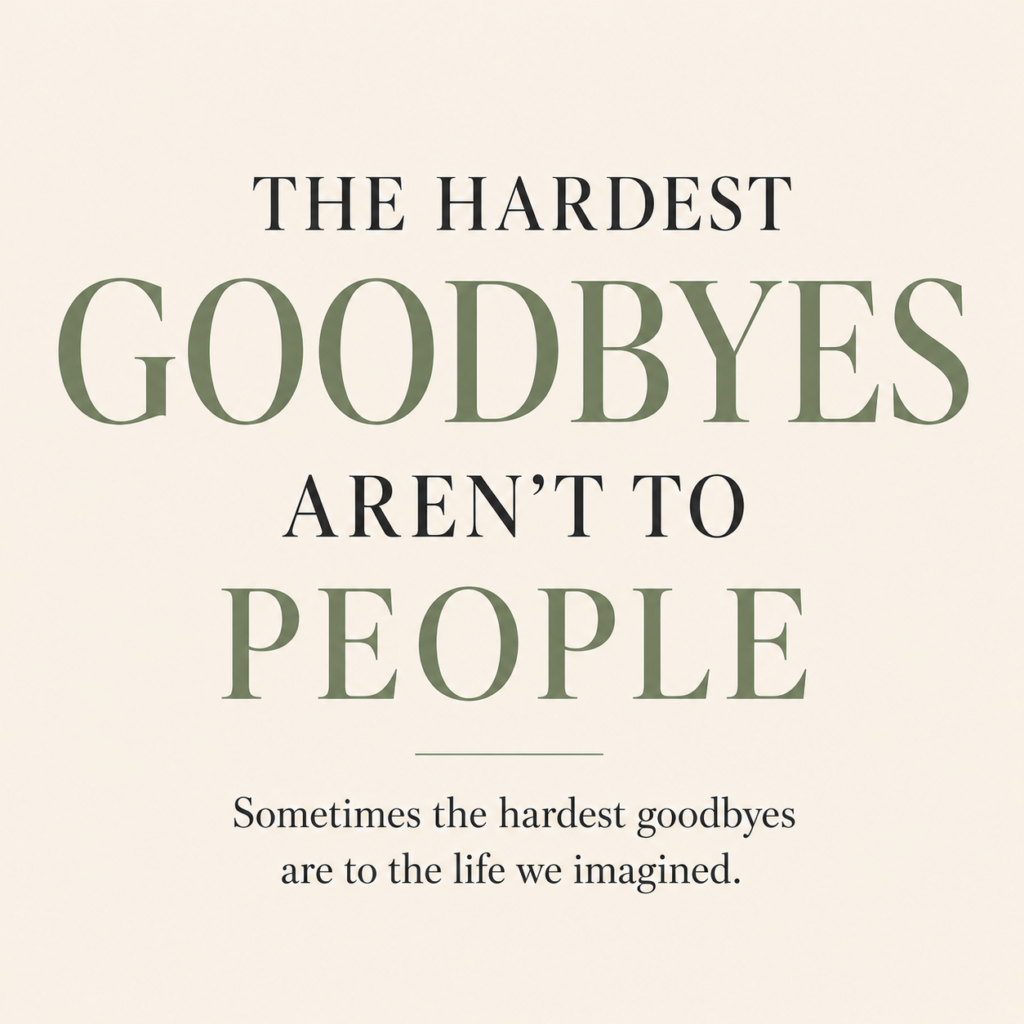
Perhaps the hardest goodbyes are not to people.
Perhaps they are to the futures we carried for years.
The dreams that shaped us.
The plans that comforted us.
The stories that helped us make sense of where we were going.
And yet life asks all of us, at some point, to release something we thought would stay.
Not because life is cruel.
But because life is constantly changing.
I’ve come to believe that almost everyone carries a goodbye that nobody else can see.
A dream.
A relationship.
A version of themselves.
A future that never arrived.
The details may be different.
But the experience is surprisingly universal.
Which is why you’re probably less alone than you think.
If you’re standing in that place right now, grieving a future that never arrived, I hope you remember this:
You are not behind.
You are not broken.
You are not the only one learning how to let go.
Many of us are walking this road too.
And while the path may not look the way you expected, it can still lead somewhere meaningful.
Sometimes the hardest goodbyes become the beginning of a different kind of peace.
A Lesson From You Win When You Don’t Play
One of the central lessons in You Win When You Don’t Play: 10 Lessons in Letting Go and Finding Quiet Power is that not every struggle deserves a lifetime of attachment.
Many of us spend years fighting reality.
Trying to recover what was lost.
Trying to force life back into an old shape.
Trying to reclaim a future that no longer exists.
But quiet power often begins with release.
The willingness to stop chasing what cannot be changed.
The courage to trust what is still unfolding.
And the wisdom to understand that letting go is not weakness.
Sometimes it is the most powerful thing we can do.
If these ideas resonate with you, you’ll find them explored more deeply in You Win When You Don’t Play: 10 Lessons in Letting Go and Finding Quiet Power.
Learn More About the Book
If something in this article felt familiar, you’re not alone.
Many of us spend years carrying things we were never taught how to release.
We carry overthinking long after the situation has ended.
We carry the weight of other people’s expectations.
We carry disappointment when life doesn’t go as planned.
We carry old stories about who we should be and struggle to understand why they still have so much power over us.
These are the questions that eventually led me to write You Win When You Don’t Play: 10 Lessons in Letting Go and Finding Quiet Power.
The book explores many of the themes woven throughout this article, including:
- How to stop overthinking and find greater mental clarity
- Letting go of validation-seeking and the need for approval
- People-pleasing, self-abandonment, and learning to set healthy boundaries
- Emotional exhaustion, burnout, and carrying too much for too long
- Rebuilding self-worth after disappointment and difficult life experiences
- Finding peace when life doesn’t go as planned
- Grieving lost dreams and letting go of expectations
- Emotional resilience during difficult life transitions
- Self-discovery, inner peace, and emotional freedom
- Learning how to trust yourself again
But more than anything, it explores a simple idea I’ve returned to again and again:
Not every struggle deserves your energy.
Not every battle needs to be won.
And not every burden needs to be carried.
Along the way, the book explores the invisible competitions, emotional pressures, and exhausting patterns that many of us carry without realizing how much they cost us.
Not to offer perfect answers.
But to help us see ourselves more clearly.
To understand ourselves more honestly.
And to recognize what may finally be ready to be released.
Because peace is rarely found by becoming more.
It is often found by needing less.
Less approval.
Less proving.
Less carrying what was never ours to hold.
Perhaps that’s why letting go often feels less like losing something and more like coming home to yourself.
Buy the Book on Amazon
Whether you’re struggling with overthinking, emotional exhaustion, people-pleasing, difficult relationships, self-worth, chronic stress, or the feeling that you’ve lost yourself beneath other people’s expectations, I hope the book offers the same thing I try to offer through my writing:
A different perspective.
A little more clarity.
And a gentler way forward.
You can learn more about the book or get your copy here:
Ask Sharmila – Personal Guidance for Overthinking, Emotional Exhaustion, Self-Worth, and Life’s Difficult Questions
Sometimes the hardest part isn’t finding advice.
It’s making sense of what you’re carrying.
Perhaps you’ve been overthinking the same situation for weeks. Perhaps you’re emotionally exhausted from trying to keep everyone happy. Or maybe you’re struggling to let go of a difficult relationship, rebuild your self-worth after disappointment, or find peace when life doesn’t go as planned.
Many of us carry questions that don’t have simple answers.
Questions about boundaries.
Questions about people-pleasing.
Questions about validation.
Questions about emotional healing, difficult life transitions, and how to stop carrying responsibilities that were never ours to hold.
You don’t have to figure it all out alone.
Through Ask Sharmila, you’re invited to share a question that’s been weighing on you.
Together, we’ll look beneath the surface of the situation—not to find perfect answers, but to uncover a clearer perspective and a gentler way forward.
Over Time, I’ve Noticed That Many Questions Tend to Circle Around the Same Themes
- How to stop overthinking and replaying conversations
- Emotional exhaustion and feeling drained by life
- People-pleasing recovery and setting healthy boundaries
- Seeking validation from others
- Rebuilding self-worth after disappointment
- Difficult relationships and emotional resilience
- Letting go of expectations that no longer fit your life
- Grieving the life you thought you’d have
- Learning how to let go when life doesn’t unfold as expected
- Finding inner peace during challenging life transitions
- Living more intentionally and trusting yourself again
One thing I’ve learned is that a new perspective doesn’t always change the situation.
I’ve seen people spend months stuck in the same thought loop, only to discover that what they needed wasn’t another solution.
It was a different way of seeing the situation.
And sometimes that’s where healing begins.
Personal Reflection and Written Guidance – ₹499
Every question is read personally by me, and every response is written thoughtfully and individually.
You Will Receive
- A personal written response tailored to your situation
- Thoughtful reflection grounded in emotional healing, self-discovery, and personal growth
- Practical perspective and gentle guidance
- Support for overthinking, emotional exhaustion, people-pleasing, self-worth struggles, boundaries, validation, difficult relationships, and major life transitions
- A response within 5 days

Personal Written Guidance for Overthinking, Emotional Exhaustion, Self-Worth, and Life’s Difficult Questions
The goal is not to have all the answers.
The goal is to understand yourself more clearly, carry less emotional weight, and discover a calmer, more compassionate way forward.
Sometimes clarity begins when we stop asking,
“How do I fix this?”
and start asking,
“What is this situation trying to teach me?”
Often, that’s where a gentler way forward begins.
Frequently Asked Questions
Is grieving the life you thought you’d have normal?
Yes. Grieving the life you thought you’d have is a common response when dreams, expectations, relationships, careers, or major life plans change. Many people experience this type of grief during life transitions such as divorce, career changes, retirement, health challenges, or becoming an empty nester. While it may feel isolating, it is a natural part of adapting to a future that looks different than expected.
How do I accept that life didn’t go as planned?
Learning how to accept that life didn’t go as planned often begins with acknowledging your disappointment rather than pushing it away. Many of us spend years resisting reality because we believe acceptance means giving up. Over time, acceptance becomes easier when we focus less on the future we lost and more on the possibilities that still exist. Acceptance is not surrender. It is making peace with what is while remaining open to what comes next.
Why do I keep thinking about what could have been?
If you constantly think about what could have been, you are not alone. Overthinking after disappointment is often the mind’s attempt to make sense of loss. Many people replay old decisions, missed opportunities, or alternative life paths when they are grieving lost dreams or unmet expectations. While reflection can be helpful, repeatedly revisiting the past can make it harder to embrace the present.
How do I stop grieving a future that never happened?
Many people struggle with grieving a future that never happened because there is no clear ending to mourn. The process often involves acknowledging the loss, allowing yourself to feel disappointed, and gradually releasing the belief that your life needed to follow a specific path. Letting go of expectations does not erase the dream. It simply creates room for a different future to emerge.
Why am I grieving a version of myself that no longer exists?
Life transitions often involve identity loss. You may not only be grieving a dream, relationship, or career. You may also be grieving the person you expected to become. This is especially common during career changes, divorce, retirement, aging, health challenges, and major personal growth periods. Grieving an old version of yourself is often part of discovering who you are becoming.
Can letting go of expectations improve emotional well-being?
Yes. Many people find that letting go of expectations reduces emotional exhaustion, self-doubt, comparison, and frustration. When we stop measuring life against an old blueprint, we often experience greater emotional healing, resilience, self-acceptance, and inner peace.
What is the difference between acceptance and giving up?
Giving up means abandoning yourself or your values. Acceptance means acknowledging reality without allowing it to define your worth. Acceptance allows you to stop fighting what cannot be changed so you can invest your energy in what is still possible.
Why do I compare my life to other people’s success?
Comparison often becomes stronger when we are coping with disappointment in life. When we feel disconnected from our own path, we naturally focus on the paths of others. Social media can intensify this by showing carefully edited highlights rather than the full reality of people’s lives. Returning your attention to your own growth, values, and journey can help reduce the need for comparison.
Can grieving lost dreams affect self-worth?
Yes. Many people begin questioning their value when important dreams do not unfold as expected. They wonder whether they failed, made the wrong choices, or somehow fell behind. Over time, this can affect self-worth and confidence. One of the most important parts of emotional healing is learning that your worth is not determined by a particular outcome or life path.
What helps with emotional healing after disappointment?
Emotional healing after disappointment often begins with self-compassion. Allowing yourself to acknowledge grief, process regret, release unrealistic expectations, and focus on personal growth can gradually create more peace. Healing is rarely about forgetting what happened. It is about carrying the experience differently and allowing it to become part of your story rather than the whole story.
About Sharmila Sengupta
I’m Sharmila Sengupta, author of You Win When You Don’t Play: 10 Lessons in Letting Go and Finding Quiet Power.
Over the years, I’ve become fascinated by the quiet struggles many of us carry but rarely talk about openly—the exhaustion of overthinking, the weight of people-pleasing, the search for validation, the challenge of setting healthy boundaries, and the grief that comes when life doesn’t go as planned.
Much of my writing begins with things I’ve noticed—in my own life, in conversations with others, and in the quiet struggles many of us carry without talking about them.
I’ve noticed how often we replay old conversations, question our self-worth, compare our lives to others, or carry emotional burdens that were never ours to hold. I’ve also noticed that many of us are quietly grieving lost dreams, coping with disappointment in life, navigating difficult life transitions, or learning how to let go of expectations about the future.
Perhaps you’ve found yourself asking some of those same questions.
How do I stop overthinking?
How do I let go of expectations that no longer fit my life?
Why do I feel emotionally exhausted even when everything seems fine on the surface?
How do I find peace when life doesn’t go as planned?
How do I stop seeking validation from other people?
How do I rebuild self-worth after disappointment or difficult relationships?
These are the questions that often inspire my writing.
Again and again, they seem to lead back to the same lesson: peace often begins when we stop carrying what was never ours to hold.
Through my articles and books, I reflect on emotional healing, personal growth, self-discovery, emotional resilience, and the quiet work of learning how to let go of what no longer serves us. Not as someone with all the answers, but as a fellow traveller who continues to learn what it means to let go, trust life a little more, and find strength in quieter ways.
My hope is that readers leave feeling less alone, more understood, and a little gentler with themselves than they were before they arrived.
Related Reading
- Why You Feel Drained by Other People’s Problems
- Why You Feel Emotionally Exhausted All the Time
- How to Stop Overthinking Without Feeling Mentally Exhausted
- When Other People’s Expectations Become Your Burden
- Why You Feel Responsible for Other People’s Emotions
- Why It’s So Hard to Let People Learn Their Own Lessons
- Why Familiar Pain Feels Safer Than Change