
Why It’s So Hard to Enjoy Your Life Right Now
The Feeling That Life Hasn’t Started Yet
Have you ever noticed how often happiness gets pushed into the future?
I’ll be happy when I get the promotion.
I’ll be happy when I lose the weight.
I’ll be happy when I find the right relationship.
I’ll be happy when life feels less stressful.
I’ll be happy when things finally settle down.
Many of us live as though our real lives are waiting somewhere ahead.
We move through our days carrying the quiet belief that happiness exists on the other side of achievement, certainty, healing, success, or approval.
Meanwhile, the present moment becomes a waiting room.
A temporary place.
A place we tolerate while we wait for life to begin.
The problem is that tomorrow never arrives in the way we imagine.
When one milestone is reached, another appears.
When one problem is solved, another takes its place.
When one goal is achieved, the mind immediately searches for the next thing.
This creates a cycle of emotional dissatisfaction that quietly steals joy from ordinary life.
Many people assume they are searching for happiness.
What they are often searching for is permission to enjoy the life they already have.
If you’ve ever felt stuck, disconnected, emotionally exhausted, or unable to appreciate your life despite everything you’ve accomplished, this pattern may be part of the reason.
Why This Happens
Human beings are naturally future-oriented.
Planning helps us survive.
Goals help us grow.
Dreams help us move forward.
The problem begins when the future becomes more important than the present.
Instead of using goals to guide our lives, we begin using them to postpone our lives.
We tell ourselves:
“Life will be better when…”
And without realizing it, we condition ourselves to believe that today is not enough.
This mindset creates a constant state of emotional striving.
A feeling that we should always be somewhere else.
Someone else.
Further ahead.
Over time, the present moment starts feeling incomplete.
Not because it is.
Because we have trained ourselves to see it that way.
The Hidden Relationship Between Self-Worth and the Future
Many people don’t realize that future-focused living is often connected to self-worth.
If your self-worth depends on achievement, you will always feel like you need one more accomplishment.
If your self-worth depends on approval, you will always feel like you need one more person’s validation.
If your self-worth depends on perfection, you will always feel like you need one more improvement.
The future becomes attractive because it promises relief.
You imagine a future version of yourself who finally feels enough.
Finally feels successful.
Finally feels worthy.
Finally feels at peace.
But peace built on conditions is fragile.
Because every condition creates another condition.
This is one reason so many high-achieving people feel emotionally exhausted.
They aren’t chasing goals.
They’re chasing permission to feel okay.
Why Modern Life Keeps Us Waiting
The modern world profits from dissatisfaction.
Everywhere you look, there is a message suggesting that your life would be better if you had something more.
More success.
More money.
More followers.
More productivity.
More confidence.
More certainty.
The result is a culture that constantly trains attention toward what is missing.
And what we focus on grows.
If your attention is always focused on what you lack, your life will feel lacking.
Even when it isn’t.
Social Media and the Illusion of Better Lives
Social media has intensified this pattern.
Every day we are exposed to carefully edited versions of other people’s lives.
Their achievements.
Their vacations.
Their relationships.
Their transformations.
Their highlights.
What we rarely see are their doubts.
Their struggles.
Their ordinary days.
The comparison is unfair from the beginning.
Yet many people compare their entire lives to someone else’s best moments.
The result is a chronic feeling of being behind.
A feeling that life hasn’t started yet.
A feeling that happiness belongs to other people.
This creates emotional fatigue, anxiety, and dissatisfaction that have little to do with reality and everything to do with perception.
The Validation Trap
Many people postpone happiness because they are waiting for validation.
Validation from family.
Validation from society.
Validation from a partner.
Validation from an audience.
Validation feels powerful because it temporarily relieves self-doubt.
But validation is not the same thing as self-worth.
Validation comes from outside.
Self-worth comes from within.
When happiness depends on approval, the finish line keeps moving.
Someone approves.
Then someone doesn’t.
Someone praises you.
Then someone criticizes you.
Someone understands you.
Then someone misunderstands you.
Your emotional state rises and falls with circumstances you cannot control.
This creates a life that feels permanently unfinished.
Signs You May Be Treating Today Like a Waiting Room for Tomorrow
This pattern often hides in plain sight.
You may recognize yourself in some of these signs.
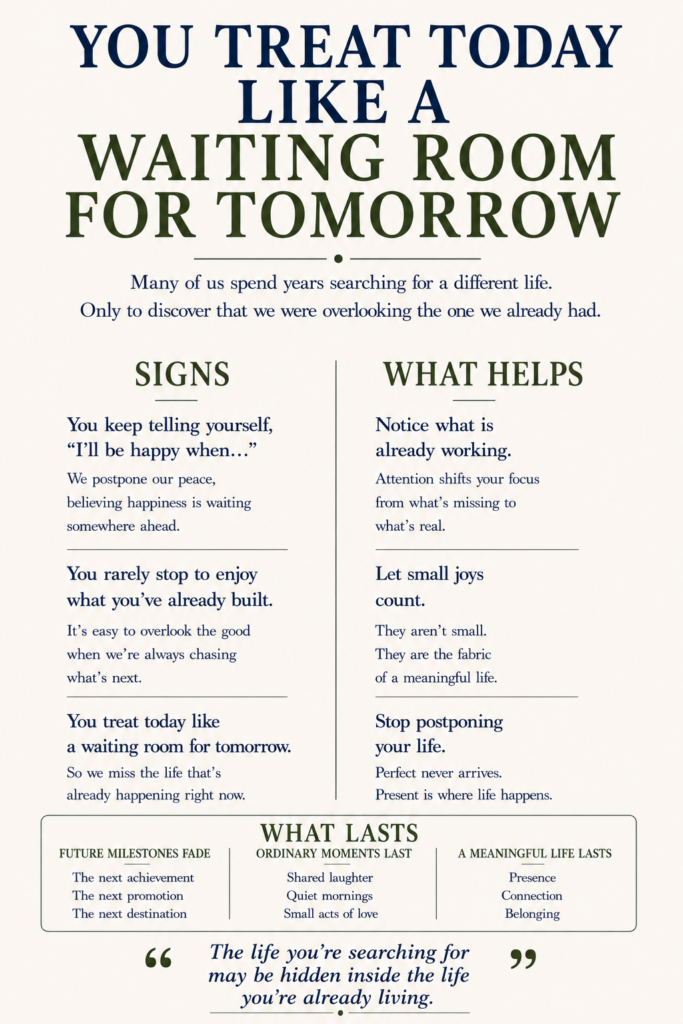
1. You frequently tell yourself, “I’ll be happy when…”
Your happiness is attached to future conditions.
2. You struggle to enjoy achievements after reaching them.
Success provides relief, but not satisfaction.
3. You feel emotionally exhausted despite making progress.
Because your mind immediately moves the goalpost.
4. You rarely celebrate how far you’ve come.
Your attention stays fixed on what remains undone.
5. You compare your timeline to everyone else’s.
And feel behind, even when you’re not.
6. You postpone joy until everything is perfect.
A day that never arrives.
7. You struggle to be present.
Your attention lives in the future.
8. You feel guilty resting.
Because rest doesn’t look productive.
9. You constantly chase the next milestone.
Without fully experiencing the current one.
10. You feel like life is happening somewhere else.
As though your real life hasn’t started yet.
A Question Worth Sitting With
What if the life you’re waiting for isn’t in the future?
What if it is already here?
Not perfect.
Not complete.
Not exactly as you imagined.
But here.
And what if the greatest thing standing between you and peace isn’t your circumstances?
What if it’s the belief that peace belongs to a future version of your life?
That possibility changes everything.
The Hidden Cost of Living in Tomorrow
At first, future-focused living can feel productive.
You set goals.
You make plans.
You stay motivated.
You work toward something meaningful.
There is nothing wrong with that.
The problem begins when the future becomes your primary source of hope.
When you start believing that peace exists somewhere ahead.
That happiness belongs to a future version of yourself.
That life will finally begin once you arrive somewhere else.
This mindset creates a hidden emotional cost.
Because while your body lives in the present, your attention lives somewhere else.
And attention is where life is experienced.
Why the Present Starts Feeling Empty
Many people assume they are unhappy because something is missing.
Sometimes that’s true.
But often the issue is not absence.
It’s attention.
When your mind is constantly focused on what comes next, it becomes difficult to appreciate what already exists.
You stop noticing ordinary joys.
You stop recognizing progress.
You stop celebrating milestones.
You stop feeling connected to your own life.
The present begins to feel like an obstacle instead of a destination.
A temporary inconvenience before happiness finally arrives.
The irony is that the future never becomes the present in the way we imagine.
Because when tomorrow arrives, the mind creates another tomorrow.
And another.
And another.
This is why so many successful people still feel dissatisfied.
Achievement solves practical problems.
It does not automatically create contentment.
How Overthinking Keeps You Stuck in Tomorrow
Overthinking is one of the biggest reasons people struggle to enjoy the present moment.
The overthinking mind is constantly searching.
Searching for certainty.
Searching for answers.
Searching for reassurance.
Searching for control.
Unfortunately, life offers very little certainty.
Which means the search never ends.
Instead of experiencing life, the overthinking mind tries to solve life.
It replays conversations.
Anticipates future problems.
Imagines worst-case scenarios.
Creates endless mental checklists.
This creates emotional exhaustion because your mind is working even when no action is required.
The future becomes a problem to manage.
The present becomes something you overlook.
The Mental Habit of “When Then”
Many people unknowingly live by a pattern called “when then.”
When I lose weight, then I’ll feel confident.
When I find the right relationship, then I’ll feel complete.
When I make more money, then I’ll feel secure.
When I heal, then I’ll start living.
This habit creates a dangerous illusion.
It teaches the mind that fulfillment is always conditional.
Always postponed.
Always waiting somewhere ahead.
But life rarely works this way.
Confidence often comes before success.
Peace often comes before certainty.
Joy often appears during the journey, not at the destination.
The more we postpone happiness, the harder it becomes to recognize when it arrives.
How People-Pleasing Disconnects You From Today
People-pleasing creates another form of future-focused living.
People-pleasers spend enormous amounts of energy trying to predict reactions.
Avoid conflict.
Prevent disappointment.
Maintain approval.
They are constantly scanning ahead.
Trying to manage outcomes before they happen.
This keeps attention trapped in the future.
You stop asking:
“What do I need?”
And start asking:
“What will everyone else think?”
Over time, this weakens self-trust.
It disconnects you from your own needs.
It creates emotional fatigue.
And it reinforces the belief that your peace depends on circumstances you cannot control.
The more you seek approval, the harder it becomes to feel present.
Because your attention is always focused on someone else’s response.
Why Validation Never Feels Like Enough
External validation creates temporary relief.
Someone compliments you.
You feel better.
Someone approves of your choice.
You feel reassured.
Someone praises your work.
You feel confident.
For a while.
The problem is that validation fades quickly.
Because validation does not solve insecurity.
It only quiets it temporarily.
Soon the mind wants more reassurance.
More approval.
More confirmation.
The cycle continues.
This is one reason validation-seeking is so emotionally exhausting.
It turns peace into something that must constantly be earned.
And what must constantly be earned rarely feels secure.
What Helps
The goal is not to stop planning for the future.
The goal is to stop postponing your life until the future arrives.
Inner peace comes from learning how to hold both.
Hope for tomorrow.
Presence for today.
1. Bring Your Attention Back to What Is Already Here
Most people believe gratitude is the solution.
But gratitude begins with attention.
You cannot appreciate what you do not notice.
Start paying attention to:
- What is working
- What is growing
- What is already meaningful
- What you would miss if it disappeared tomorrow
Attention changes experience.
Not because life changes.
Because your relationship with life changes.
2. Stop Moving the Goalposts
Notice how often your mind says:
“Yes, but…”
Yes, but I should be further ahead.
Yes, but I haven’t done enough.
Yes, but I’m not there yet.
This habit prevents satisfaction.
Every achievement becomes immediately diminished by the next expectation.
Practice allowing accomplishments to exist without immediately replacing them with another demand.
3. Build Self-Worth That Doesn’t Depend on Achievement
Many people postpone happiness because achievement has become their primary source of self-worth.
But self-worth built on achievement is unstable.
Because achievement is never finished.
There is always another goal.
Another improvement.
Another benchmark.
The more self-worth comes from within, the less pressure there is to constantly prove yourself.
And the less pressure there is, the easier it becomes to enjoy the life you’re living.
4. Practice Presence Instead of Perfection
Perfection keeps attention trapped in the future.
Presence returns attention to now.
Perfection asks:
“What still needs fixing?”
Presence asks:
“What is here right now?”
One creates pressure.
The other creates peace.
5. Let Ordinary Moments Matter
Many people overlook the moments that actually make up a meaningful life.
A conversation.
A quiet morning.
Shared laughter.
A walk.
A meal.
A moment of connection.
We often treat these experiences as insignificant because they don’t look extraordinary.
Yet these moments become the memories we carry.
Life is rarely transformed by dramatic milestones.
It is shaped by ordinary days.
Practical Exercise: The Waiting Room Audit
Take a piece of paper and answer the following questions.
What am I waiting for?
List everything you believe needs to happen before you can fully enjoy your life.
Examples:
- More money
- A relationship
- A career change
- Better health
- More confidence
- Less anxiety
What do I believe this will give me?
For each item ask:
Will this give me peace?
Security?
Acceptance?
Freedom?
Confidence?
Love?
Now look closely.
Often the thing we are seeking is not the goal itself.
It is the feeling we expect the goal to create.
Can I begin practicing that feeling today?
This question changes everything.
Because it shifts attention from waiting to living.
From future conditions to present possibilities.
From someday to now.
What Lasts
Many of the things we spend our lives chasing are temporary.
Achievements fade.
Recognition fades.
Status fades.
Approval fades.
What lasts tends to be quieter.
MILESTONES FADE
Promotions
Titles
Achievements
External success
SELF-WORTH LASTS
Self-respect
Self-trust
Self-acceptance
Inner confidence
A MEANINGFUL LIFE LASTS
Presence
Connection
Belonging
The things that matter most are often the things we spend the least time chasing.
And perhaps that’s because they were never waiting somewhere ahead.
Perhaps they were here all along.
What I Have Learned About Living in Tomorrow
One of the most surprising things I have learned is that the future never arrives in the way we expect.
For years, I believed peace lived somewhere ahead.
Ahead of a goal.
Ahead of a milestone.
Ahead of some future version of life.
But every time I arrived somewhere new, the mind created another destination.
Another condition.
Another reason to wait.
Eventually I realized that the problem wasn’t my circumstances.
It was my relationship with the present.
I was treating life as preparation for life.
Waiting for the moment when everything would finally come together.
Waiting for permission to enjoy what was already here.
What changed everything was a simple realization:
The life I was searching for wasn’t hiding in the future.
It was hiding beneath my constant search for it.
That realization didn’t solve every problem.
But it changed how I experienced ordinary days.
And ordinary days are what life is mostly made of.
Key Takeaways
If you take only a few things from this article, let them be these:
- Many people postpone happiness by attaching it to future conditions.
- Overthinking keeps attention trapped in tomorrow instead of rooted in today.
- Validation-seeking often creates the feeling that life is never quite enough.
- Self-worth built on achievement creates a moving finish line.
- People-pleasing disconnects you from your own needs and priorities.
- Emotional exhaustion often develops when attention is constantly focused on what is missing.
- Inner peace grows when we stop treating life as a waiting room.
- Presence is not the absence of goals; it is the ability to live while pursuing them.
- A meaningful life is built from ordinary moments, not extraordinary milestones.
- The future matters, but life is experienced in the present.
Final Reflection
Many of us spend years waiting.
Waiting for certainty.
Waiting for confidence.
Waiting for success.
Waiting for healing.
Waiting for permission.
We convince ourselves that happiness belongs to a future version of life.
A version where everything is finally organized.
Resolved.
Complete.
But life rarely unfolds that way.
There will always be another challenge.
Another goal.
Another uncertainty.
Another chapter.
If peace depends on reaching a destination, peace will always remain just out of reach.
Perhaps the deeper invitation is not to stop dreaming about tomorrow.
It is to stop sacrificing today.
To stop treating this moment as a temporary stop on the way to somewhere better.
To stop overlooking the life that is already happening.
The most meaningful parts of life often arrive quietly.
A conversation.
A connection.
A moment of laughter.
A sunrise.
A deep breath.
A sense of belonging.
These moments rarely announce themselves as important.
Yet they are often the moments we remember most.
The future deserves your attention.
But not at the cost of your life.
Because the life you’re waiting for may already be here.
A Lesson From You Win When You Don’t Play
One of the central ideas in You Win When You Don’t Play is that many of the games we spend our lives trying to win have no finish line.
The game of proving your worth.
The game of gaining everyone’s approval.
The game of keeping everyone happy.
The game of becoming “enough.”
These games create a future-focused life because they constantly promise satisfaction just beyond the next achievement.
Just beyond the next compliment.
Just beyond the next milestone.
But the reward never lasts.
The finish line keeps moving.
The rules keep changing.
And the pursuit becomes exhausting.
The book explores a different possibility:
What if you stopped playing games that can never truly be won?
What if peace comes not from winning the game, but from stepping out of it?
What if your worth was never something you needed to earn?
What if your life was never meant to begin in the future?
Many of us spend years trying to arrive somewhere.
The deeper lesson is learning how to arrive here.
If these ideas resonate with you, you’ll find them explored more deeply in You Win When You Don’t Play: 10 Lessons in Letting Go and Finding Quiet Power.
Learn More About the Book
If something in this article felt familiar, you’re not alone.
Many of us spend years carrying things we were never taught how to release.
We carry overthinking long after the situation has ended.
We carry the weight of other people’s expectations.
We carry disappointment when life doesn’t go as planned.
We carry old stories about who we should be and struggle to understand why they still have so much power over us.
These are the questions that eventually led me to write You Win When You Don’t Play: 10 Lessons in Letting Go and Finding Quiet Power.
The book explores many of the themes woven throughout this article, including:
- How to stop overthinking and find greater mental clarity
- Letting go of validation-seeking and the need for approval
- People-pleasing, self-abandonment, and learning to set healthy boundaries
- Emotional exhaustion, burnout, and carrying too much for too long
- Rebuilding self-worth after disappointment and difficult life experiences
- Finding peace when life doesn’t go as planned
- Grieving lost dreams and letting go of expectations
- Emotional resilience during difficult life transitions
- Self-discovery, inner peace, and emotional freedom
- Learning how to trust yourself again
But more than anything, it explores a simple idea I’ve returned to again and again:
Not every struggle deserves your energy.
Not every battle needs to be won.
And not every burden needs to be carried.
Along the way, the book explores the invisible competitions, emotional pressures, and exhausting patterns that many of us carry without realizing how much they cost us.
Not to offer perfect answers.
But to help us see ourselves more clearly.
To understand ourselves more honestly.
And to recognize what may finally be ready to be released.
Because peace is rarely found by becoming more.
It is often found by needing less.
Less approval.
Less proving.
Less carrying what was never ours to hold.
Perhaps that’s why letting go often feels less like losing something and more like coming home to yourself.
Buy the Book on Amazon
Whether you’re struggling with overthinking, emotional exhaustion, people-pleasing, difficult relationships, self-worth, chronic stress, or the feeling that you’ve lost yourself beneath other people’s expectations, I hope the book offers the same thing I try to offer through my writing:
A different perspective.
A little more clarity.
And a gentler way forward.
You can learn more about the book or get your copy here:
Ask Sharmila – Personal Guidance for Overthinking, Emotional Exhaustion, Self-Worth, and Life’s Difficult Questions
Sometimes the hardest part isn’t finding advice.
It’s making sense of what you’re carrying.
Perhaps you’ve been overthinking the same situation for weeks. Perhaps you’re emotionally exhausted from trying to keep everyone happy. Or maybe you’re struggling to let go of a difficult relationship, rebuild your self-worth after disappointment, or find peace when life doesn’t go as planned.
Many of us carry questions that don’t have simple answers.
Questions about boundaries.
Questions about people-pleasing.
Questions about validation.
Questions about emotional healing, difficult life transitions, and how to stop carrying responsibilities that were never ours to hold.
You don’t have to figure it all out alone.
Through Ask Sharmila, you’re invited to share a question that’s been weighing on you.
Together, we’ll look beneath the surface of the situation—not to find perfect answers, but to uncover a clearer perspective and a gentler way forward.
Over Time, I’ve Noticed That Many Questions Tend to Circle Around the Same Themes
- How to stop overthinking and replaying conversations
- Emotional exhaustion and feeling drained by life
- People-pleasing recovery and setting healthy boundaries
- Seeking validation from others
- Rebuilding self-worth after disappointment
- Difficult relationships and emotional resilience
- Letting go of expectations that no longer fit your life
- Grieving the life you thought you’d have
- Learning how to let go when life doesn’t unfold as expected
- Finding inner peace during challenging life transitions
- Living more intentionally and trusting yourself again
One thing I’ve learned is that a new perspective doesn’t always change the situation.
I’ve seen people spend months stuck in the same thought loop, only to discover that what they needed wasn’t another solution.
It was a different way of seeing the situation.
And sometimes that’s where healing begins.
Personal Reflection and Written Guidance – ₹499
Every question is read personally by me, and every response is written thoughtfully and individually.
You Will Receive
- A personal written response tailored to your situation
- Thoughtful reflection grounded in emotional healing, self-discovery, and personal growth
- Practical perspective and gentle guidance
- Support for overthinking, emotional exhaustion, people-pleasing, self-worth struggles, boundaries, validation, difficult relationships, and major life transitions
- A response within 5 days

Personal Written Guidance for Overthinking, Emotional Exhaustion, Self-Worth, and Life’s Difficult Questions
The goal is not to have all the answers.
The goal is to understand yourself more clearly, carry less emotional weight, and discover a calmer, more compassionate way forward.
Sometimes clarity begins when we stop asking,
“How do I fix this?”
and start asking,
“What is this situation trying to teach me?”
Often, that’s where a gentler way forward begins.
Frequently Asked Questions
Why do I feel like life hasn’t started yet?
Many people feel like life hasn’t started yet because they attach happiness and fulfillment to future milestones. They believe life will begin once they achieve a goal, find the right relationship, earn more money, heal emotionally, or become more confident. This future-focused mindset can make it difficult to enjoy the present moment and often leads to chronic dissatisfaction.
What does it mean to treat today like a waiting room for tomorrow?
Treating today like a waiting room for tomorrow means living as though your real life exists in the future. Instead of fully engaging with the present, you constantly wait for circumstances to improve before allowing yourself to feel happy, successful, peaceful, or fulfilled. This pattern is common among people who struggle with perfectionism, overthinking, and validation-seeking.
Why do I keep waiting to be happy?
Many people wait to be happy because they believe happiness must be earned through achievement, approval, productivity, or external success. This often stems from low self-worth, perfectionism, people-pleasing, or the belief that fulfillment exists somewhere in the future rather than in the present.
Can overthinking make it harder to enjoy life?
Yes. Overthinking keeps your attention focused on future worries, imagined problems, and past mistakes. This mental habit can create emotional exhaustion, decision fatigue, anxiety, and difficulty experiencing joy in the present moment. Learning how to stop overthinking is often an important step toward greater peace and life satisfaction.
How does social media affect life satisfaction and happiness?
Social media often encourages unhealthy comparison by exposing people to carefully curated highlights of other people’s lives. Constant comparison can create feelings of inadequacy, self-doubt, and the belief that everyone else is happier, more successful, or further ahead. Over time, this can negatively affect self-esteem, emotional well-being, and overall life satisfaction.
Why do successful people still feel unhappy?
Many successful people feel unhappy because achievement alone does not create inner peace. When self-worth depends on success, accomplishments provide only temporary satisfaction before the mind moves on to the next goal. This cycle can lead to emotional exhaustion, chronic striving, and the feeling that nothing is ever enough.
Is people-pleasing connected to future-focused living?
Yes. People-pleasing often keeps people focused on future outcomes, approval, and other people’s reactions. Instead of being present, they spend energy trying to avoid conflict, prevent disappointment, and gain acceptance. This can create anxiety, emotional fatigue, and a persistent feeling of living for others rather than themselves.
What is the difference between validation and self-worth?
Validation comes from external approval, praise, or recognition from other people. Self-worth comes from your relationship with yourself. While validation is temporary and dependent on outside factors, healthy self-worth is more stable because it is built on self-acceptance, self-respect, and internal confidence.
How can I stop comparing my life to others?
To stop comparing yourself to others, focus on your own values, goals, and personal growth rather than someone else’s timeline. Limiting comparison triggers, reducing social media consumption, practicing gratitude, and developing self-awareness can help you build a healthier sense of self-worth and contentment.
What helps create lasting inner peace?
Lasting inner peace comes from self-awareness, emotional boundaries, self-trust, self-acceptance, and learning to live in the present moment. It also involves letting go of constant validation-seeking, reducing overthinking, and recognizing that happiness does not need to be postponed until everything is perfect.
How do I become more present and enjoy life now?
Becoming more present begins with attention. Instead of constantly focusing on what is missing or what comes next, practice noticing what is already here. Mindfulness, gratitude, meaningful relationships, and intentional living can help you reconnect with the present moment and experience greater fulfillment.
Can emotional exhaustion come from always chasing the next goal?
Absolutely. Constantly chasing the next achievement, milestone, or version of yourself can create emotional exhaustion and burnout. When happiness is always tied to future success, it becomes difficult to appreciate current progress. A meaningful life requires both growth and the ability to be present with where you are today.
About Sharmila Sengupta
I’m Sharmila Sengupta, author of You Win When You Don’t Play: 10 Lessons in Letting Go and Finding Quiet Power.
Over the years, I’ve become fascinated by the quiet struggles many of us carry but rarely talk about openly—the exhaustion of overthinking, the weight of people-pleasing, the search for validation, the challenge of setting healthy boundaries, and the grief that comes when life doesn’t go as planned.
Much of my writing begins with things I’ve noticed—in my own life, in conversations with others, and in the quiet struggles many of us carry without talking about them.
I’ve noticed how often we replay old conversations, question our self-worth, compare our lives to others, or carry emotional burdens that were never ours to hold. I’ve also noticed that many of us are quietly grieving lost dreams, coping with disappointment in life, navigating difficult life transitions, or learning how to let go of expectations about the future.
Perhaps you’ve found yourself asking some of those same questions.
How do I stop overthinking?
How do I let go of expectations that no longer fit my life?
Why do I feel emotionally exhausted even when everything seems fine on the surface?
How do I find peace when life doesn’t go as planned?
How do I stop seeking validation from other people?
How do I rebuild self-worth after disappointment or difficult relationships?
These are the questions that often inspire my writing.
Again and again, they seem to lead back to the same lesson: peace often begins when we stop carrying what was never ours to hold.
Through my articles and books, I reflect on emotional healing, personal growth, self-discovery, emotional resilience, and the quiet work of learning how to let go of what no longer serves us. Not as someone with all the answers, but as a fellow traveller who continues to learn what it means to let go, trust life a little more, and find strength in quieter ways.
My hope is that readers leave feeling less alone, more understood, and a little gentler with themselves than they were before they arrived.
Related Reading
- Why You Feel Drained by Other People’s Problems
- Why You Feel Emotionally Exhausted All the Time
- How to Stop Overthinking Without Feeling Mentally Exhausted
- When Other People’s Expectations Become Your Burden
- Why You Feel Responsible for Other People’s Emotions
- Why It’s So Hard to Let People Learn Their Own Lessons
- Why Familiar Pain Feels Safer Than Change