
Many of life’s most important lessons emerge through experience, self-discovery, emotional maturity, and personal insight.
Few things are more frustrating than watching someone you care about ignore advice you know could help them.
You see the warning signs.
You see the consequences coming.
You can almost predict how the situation will unfold.
Yet no matter how much you explain, persuade, encourage, or warn them, they continue down the same path.
You watch.
You worry.
You replay conversations in your mind.
You wonder if you should say something again.
Maybe this time they will listen.
Maybe this time they will understand.
But beneath that frustration is often something deeper.
Watching someone struggle can force us into a difficult process of self-reflection.
Why is their situation affecting us so strongly?
Why do we feel responsible for helping them avoid pain?
Why is it so difficult to step back and allow another person to make their own choices?
These questions invite a level of self-awareness that many of us rarely explore.
Sometimes our discomfort is not only about their potential mistake.
It is about our own fear of seeing someone we love suffer.
Sometimes it reflects our desire to protect, rescue, or control an outcome we cannot control.
Sometimes it reveals how deeply we have tied our peace of mind to another person’s decisions.
And that is when many people discover a difficult truth:
Some lessons cannot be taught.
They must be lived.
This is one of the most challenging realities of human growth and personal development.
We want to believe that wisdom can be transferred through advice.
That if we care enough, explain clearly enough, or share enough of our own life experience, we can help people avoid mistakes.
But personal growth rarely works that way.
Many of life’s most meaningful lessons emerge through learning through experience, self-discovery, emotional resilience, and personal insight.
The relationship that teaches discernment.
The disappointment that teaches resilience.
The mistake that teaches personal responsibility.
The setback that develops adaptability.
The challenge that strengthens self-trust.
The experience that deepens emotional maturity.
When we understand why it is so hard to let people learn their own lessons, we begin to uncover a deeper truth about ourselves.
Growth is not something we can give another person.
It is something they must discover for themselves.
And sometimes our greatest lesson is learning to let go of the belief that someone else’s journey is ours to manage.
Why It’s So Hard…..
If you’ve ever watched someone repeat the same mistake despite your advice, you know how frustrating it can feel.
The challenge is not simply that we want them to make better choices.
The challenge is that their struggle often becomes our struggle.
We worry about the consequences.
We imagine the pain they may experience.
We carry the emotional weight of outcomes that ultimately belong to them.
For many people, this goes beyond concern.
It becomes emotional responsibility—the belief that we should be able to protect others from disappointment, failure, or regret.
The more we care, the harder it becomes to separate support from responsibility.
Yet personal growth rarely develops when someone else removes every obstacle.
Many of life’s most meaningful lessons emerge through direct experience, self-discovery, and personal insight.
What feels like struggle from the outside may be the very experience that helps someone build self-awareness, emotional resilience, wisdom, and self-trust.
Understanding this does not make letting go easy.
But it reminds us that growth is often an inside job.
No matter how much we care, some lessons can only be learned by living them.
Why This Happens
Most people struggle to let others learn their own lessons because they care deeply.
Not because they are controlling.
Not because they want to interfere.
But because watching someone struggle is painful.
Especially when the lesson seems obvious from the outside.
There is a helplessness that comes from watching someone move toward an experience you know may hurt them.
You want to spare them the disappointment.
You want to save them time.
You want to protect them from regret.
And yet many of the lessons that shape our lives arrive through exactly those experiences.
This creates an emotional conflict.
Part of us wants growth for the people we love.
Another part wants to protect them from the very experiences that create growth.
The irony is that these goals often compete with each other.
Personal development rarely happens in comfort.
Emotional resilience rarely develops without challenge.
Self-awareness rarely emerges without reflection.
And emotional maturity rarely develops without difficult experiences.
Many of the qualities we admire most in others were not created by avoiding struggle.
They were created by moving through it.
Why We Feel the Need to Save People From Their Mistakes
One reason this topic resonates so deeply is that many people carry an unspoken belief:
If I can help someone avoid pain, I should.
On the surface, this belief appears compassionate.
But beneath it is often a misunderstanding about how people learn.
We assume that pain is always the problem.
Sometimes pain is the teacher.
This does not mean suffering should be glorified.
It means some forms of discomfort create awareness.
Some disappointments create wisdom.
Some mistakes create growth.
Some failures create resilience.
The wrong career path may lead someone to meaningful work.
The wrong relationship may teach self-respect.
The wrong decision may strengthen personal responsibility.
The setback may develop a growth mindset.
The experience may become the lesson.
When we view every mistake as something that must be prevented, we miss an important truth:
Many life lessons arrive disguised as experiences we would never willingly choose.
The Psychology of Advice
Most people believe advice changes lives.
If that were true, personal growth would be much easier.
The reality is that advice often creates awareness.
Experience creates transformation.
Think about the lessons that changed your own life.
Many were probably explained to you long before you truly understood them.
Someone may have warned you.
Someone may have encouraged you.
Someone may have tried to save you from making a mistake.
Yet the lesson only became real when you experienced it yourself.
This is because information and wisdom are not the same thing.
Information can be shared.
Wisdom must be earned.
Advice can point toward a lesson.
Life experience creates understanding.
That is why two people can receive the same guidance and respond completely differently.
One person is ready to learn.
The other still needs the experience.
Growth is influenced by timing, emotional readiness, self-awareness, personal insight, and life experience.
Not information alone.
And that realization can be both frustrating and freeing.
Frustrating because we cannot force growth.
Freeing because we no longer have to.
Why We Learn More From Experience Than Advice
There is a reason people often say:
Experience is the best teacher.
Experience engages us in a way advice never can.
Advice speaks to the mind.
Experience speaks to the whole person.
When we live through something, we feel it.
We reflect on it.
We adapt because of it.
We remember it.
This is why learning through experience often creates deeper and more lasting change than simply receiving information.
A person can be told not to ignore red flags.
A person can be told to trust themselves.
A person can be told to stop seeking validation.
But until those lessons become part of lived experience, they often remain ideas rather than wisdom.
Experience transforms knowledge into understanding.
And understanding is what creates lasting change.
Why Failure Is Often a Better Teacher Than Success
Most people spend their lives trying to avoid failure.
Yet when we look back honestly, many of the experiences that shaped us most were not our successes.
They were our disappointments.
Our wrong turns.
Our regrets.
Our mistakes.
Our failures.
Success is rewarding because it confirms what already works.
Failure is uncomfortable because it forces us to see what we could not see before.
Success rarely demands change.
Failure often does.
This is why some of life’s deepest lessons emerge from experiences we initially wish had never happened.
The relationship that broke our heart may have taught us self-respect.
The opportunity we lost may have redirected us toward something better.
The mistake we regret may have become the beginning of greater self-awareness.
The setback we feared may have developed emotional resilience we didn’t know we needed.
Looking back, we often discover that the experiences we wanted to avoid became the experiences that transformed us.
This is what makes it so difficult to watch someone else’s journey unfold.
We know growth often comes through struggle.
Yet we still want to protect people from the very experiences that may help them grow.
Why We Remember Lessons We Learn Ourselves
Think about the most important lesson you have ever learned.
Chances are, you do not remember it because someone explained it to you.
You remember it because you lived it.
The lessons that stay with us are often the lessons connected to experience.
They carry emotional weight.
They become part of our story.
They shape the way we see ourselves and the world around us.
Advice can be forgotten.
Information can be ignored.
But experiences leave emotional fingerprints.
They create perspective.
They create personal insight.
They create self-discovery.
And they often become the foundation for future wisdom.
This is one reason learning through experience is so powerful.
A lesson discovered personally is often remembered far longer than a lesson received from someone else.
When people arrive at an insight on their own, it becomes theirs.
It is no longer borrowed knowledge.
It becomes lived understanding.
That understanding is what creates lasting change.
The Emotional Discomfort of Watching Someone Struggle
One reason it is so hard to let people learn their own lessons is that their struggle often becomes our struggle.
We imagine what they will feel.
We imagine what might happen.
We anticipate their disappointment before it arrives.
And because we care, we experience some of that discomfort ourselves.
This is why stepping back can feel so difficult.
Not because we do not trust the other person.
But because we struggle with feeling helpless.
When we see someone heading toward a mistake, we want to do something.
Anything.
Advice feels active.
Intervention feels useful.
Stepping back feels passive.
But growth often requires us to tolerate the discomfort of not being able to control another person’s experience.
This is one of the quieter forms of emotional maturity.
Accepting that love does not always mean intervention.
Accepting that support does not always mean prevention.
Accepting that some experiences belong to the person living them.
The Growth Mindset We Rarely Apply to Other People
Many people embrace a growth mindset for themselves.
They believe challenges help them grow.
They believe mistakes create learning.
They believe setbacks build resilience.
They believe failure can become feedback.
Yet when it comes to people they love, they often forget this perspective.
Suddenly every mistake feels dangerous.
Every setback feels unnecessary.
Every disappointment feels avoidable.
We want growth for others.
We just do not want them to experience the process that creates it.
But a growth mindset is not simply believing that improvement is possible.
It is trusting that growth can emerge from difficulty.
It is believing that challenges are not always obstacles.
Sometimes they are teachers.
The same principle that applies to our own personal development applies to the people we care about.
Their mistakes may teach them something we never could.
Their life experience may create understanding that advice never could.
Their setbacks may become the foundation of future wisdom.
Their failures may become the source of future strength.
Self-Awareness Cannot Be Borrowed
This is one of the most overlooked truths about personal growth.
Self-awareness cannot be borrowed.
No one can hand it to us.
No one can explain it into existence.
No one can create it for us.
It develops when we encounter ourselves honestly.
It develops when our expectations collide with reality.
It develops when our choices produce results we did not anticipate.
It develops when we pause long enough to reflect on our experiences.
Why did I make that decision?
What was I hoping would happen?
What pattern am I repeating?
What can I learn from this?
These questions often emerge after an experience—not before it.
That is why people sometimes need to live through a situation before they are ready to understand it.
From the outside, this can be frustrating.
We see the lesson clearly.
We want them to see it too.
But personal insight that arrives through self-discovery is often more powerful than understanding that arrives through explanation.
Emotional Resilience Is Built, Not Given
Many people want to protect loved ones from pain because they assume pain will weaken them.
Sometimes the opposite is true.
Some of the strongest people you know are strong because of what they survived.
Not because life spared them difficulty.
But because life required them to develop resilience.
Emotional resilience is not the absence of struggle.
It is the ability to move through struggle and continue growing.
It is the ability to recover from disappointment.
To adapt when circumstances change.
To learn from setbacks.
To trust yourself after making mistakes.
To keep moving forward even when things do not go according to plan.
These qualities cannot be taught in theory.
They must be developed through life experience.
This is why trying to remove every obstacle from another person’s path can sometimes prevent the development of the very strengths they will need later in life.
The Difference Between Protecting and Preparing
Many of us think we are protecting people.
But perhaps a better goal is preparing them.
Protection says:
“I will keep you from experiencing difficulty.”
Preparation says:
“I trust that you can handle difficulty when it comes.”
Protection focuses on avoiding struggle.
Preparation focuses on building strength.
Protection seeks certainty.
Preparation develops resilience.
Protection often comes from fear.
Preparation comes from trust.
This shift changes everything.
Because the goal is not to make life easy for the people we love.
The goal is to help them become capable of handling life when it is not easy.
And sometimes the lessons that prepare them are lessons only experience can teach.
What Helps
Learning to let people learn their own lessons is not about becoming detached.
It is not about caring less.
It is not about withdrawing support.
It is about understanding the difference between influencing growth and trying to control it.
Many of us carry the belief that love means protecting people from every mistake.
But the truth is that some of the experiences that shape us most are experiences nobody could have prevented.
The lesson is not to stop caring.
The lesson is to trust the process of growth.
1. Shift From Correction to Curiosity
When someone is making a choice you disagree with, the instinct is often to correct them.
To explain.
To persuade.
To convince.
But curiosity can sometimes be more powerful than correction.
Instead of asking:
“How do I stop them from making this mistake?”
Ask:
“What might they learn from this experience?”
This question changes the conversation.
It reminds us that growth is not always found in avoiding difficulty.
Sometimes it is found in moving through it.
2. Trust Their Capacity to Grow
Many people underestimate the resilience of the people they love.
They focus on the mistake rather than the strength that may emerge from it.
They focus on the setback rather than the growth that may follow.
Yet much of personal development comes from discovering that we can survive things we once feared.
Confidence grows through experience.
Self-trust grows through experience.
Emotional resilience grows through experience.
People often become stronger not because life protected them, but because life required them to adapt.
3. Focus on Presence Instead of Prevention
One of the most meaningful shifts we can make is moving from prevention to presence.
Prevention says:
“I need to stop this from happening.”
Presence says:
“I will be here while you move through it.”
Presence offers support without taking ownership.
It creates connection without creating dependency.
And it allows people to have their own experiences while still knowing they are not alone.
Practical Reflection: The Lesson You Couldn’t Borrow
Think about one lesson that changed your life.
Perhaps it taught you:
- self-worth
- resilience
- trust
- confidence
- personal responsibility
- emotional maturity
Now ask yourself:
Could someone have explained that lesson deeply enough for me to fully understand it before I experienced it?
Most people answer no.
The lesson became meaningful because it became personal.
It moved from information to understanding.
From advice to experience.
From knowledge to wisdom.
Remembering this can help us become more patient with people who are still learning lessons we learned years ago.
Their path is different.
Their timing is different.
Their experience belongs to them.
What Lasts
Not every experience leaves us with the outcome we hoped for.
Not every lesson arrives gently.
But when we allow ourselves to learn from life’s experiences rather than resist them, certain qualities remain long after the situation has passed.
Self-Awareness
Growth often begins with seeing ourselves more clearly.
Through experience, we discover our patterns, assumptions, strengths, fears, and blind spots. Self-awareness creates the foundation for meaningful personal growth and lasting change.
Personal Responsibility
As we mature, we begin to recognize that our choices shape our lives.
Rather than blaming circumstances or waiting for others to change, we learn to take ownership of our actions, decisions, and responses. Personal responsibility is one of the most valuable lessons experience can teach.
Emotional Resilience
Challenges do not simply test us; they strengthen us.
Each setback, disappointment, and obstacle teaches us that we can recover, adapt, and move forward. Emotional resilience grows when we learn that difficult experiences are survivable.
Personal Insight
With time and reflection, experiences begin to reveal deeper truths.
We gain personal insight about what matters, what does not, and who we want to become. These moments of self-discovery often become turning points in our growth journey.
Wisdom
Wisdom rarely comes from information alone.
It emerges from lived experience, reflection, mistakes, successes, and lessons learned over time. Wisdom helps us navigate future challenges with greater perspective, patience, and understanding.
Inner Peace
Perhaps the greatest gift of all is peace.
Not because life becomes easier, but because we develop greater trust in ourselves and in the growth process itself. We stop fighting every lesson, stop resisting every challenge, and begin to accept that growth unfolds through experience. From that acceptance comes a deeper sense of inner peace.
What I Have Learned About Letting People Learn Their Own Lessons
One of the most humbling things I have learned is that understanding and experience are not the same thing.
There have been times when I could clearly see what someone else could not.
I could see the warning signs.
I could see the likely outcome.
I could see the lesson waiting for them on the other side.
Naturally, I wanted to help.
I wanted to save them time.
I wanted to spare them disappointment.
I wanted to help them avoid the mistakes I had already made.
But over time I realized something important.
Many of the lessons that shaped my own life were lessons I was not ready to learn until I lived them myself.
No amount of advice could have created the same understanding.
No amount of explanation could have produced the same personal insight.
The experiences that strengthened my self-awareness, emotional resilience, and self-trust were often experiences I would never have chosen.
Yet they became some of my greatest teachers.
Today, when I feel the urge to save someone from a lesson, I try to remember that growth is deeply personal.
We can offer wisdom.
We can offer support.
We can offer compassion.
But some lessons belong to the person living them.
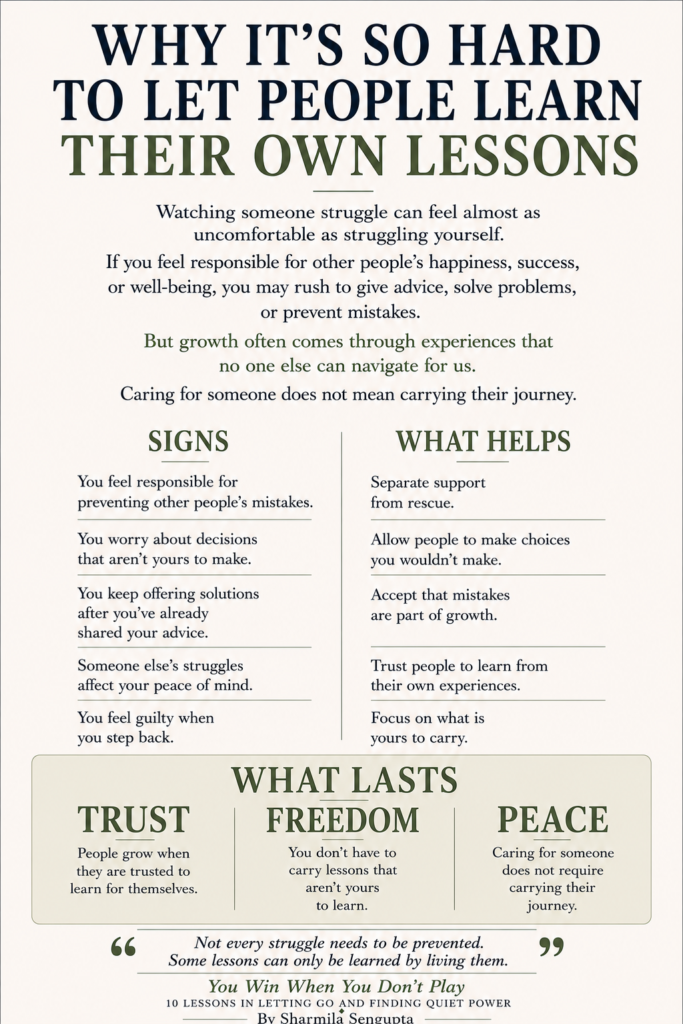
Key Takeaways
- Some life lessons can only be learned through direct experience.
- Learning through experience often creates deeper understanding than advice alone.
- Emotional resilience develops through challenges, setbacks, and recovery.
- Self-awareness grows through reflection and lived experience.
- Personal responsibility strengthens when people learn from the consequences of their choices.
- A growth mindset allows people to see mistakes as opportunities for learning.
- Personal insight often emerges through self-discovery rather than instruction.
- Caring for someone does not require preventing every difficult experience.
Final Reflection
Understanding why it’s so hard to let people learn their own lessons requires recognizing that growth cannot be handed to someone else. It must be discovered through experience.
Every person has life lessons that belong uniquely to their own journey.
Perhaps one of the hardest truths about love, personal growth, and emotional maturity is accepting that we cannot grow for other people.
We cannot learn for them.
We cannot develop wisdom for them.
We cannot experience life on their behalf.
Every individual must walk their own path of self-discovery and gain their own personal insight through lived experience.
Some people learn through success.
Some learn through failure.
Most learn through a combination of both.
That is how growth often happens—not through advice alone, but through learning through experience.
As difficult as it can be to watch someone struggle, there is also something deeply hopeful about trusting their capacity to grow.
Not because the journey will be easy.
But because human beings are remarkably resilient.
We learn.
We adapt.
We recover.
We develop emotional resilience.
And over time, we gain wisdom that cannot be taught in any other way.
Often, the life experiences we once wished had never happened become the experiences that shape our character, strengthen our growth mindset, and deepen our self-awareness.
Many of life’s most valuable lessons emerge from challenges, setbacks, mistakes, and unexpected turns.
These experiences become the foundation of personal growth, self-discovery, personal responsibility, and lasting wisdom.
When we understand why it’s so hard to let people learn their own lessons, we begin to see that every growth journey belongs to the person walking it.
Sometimes the greatest act of love is not protecting someone from every lesson.
It is trusting their ability to learn it.
Trusting their strength to navigate their own journey.
And trusting that the lessons they discover for themselves will become part of the person they are meant to become.
In the end, growth is not something we can give another person.
It is something they must discover for themselves.
A Lesson From You Win When You Don’t Play
One of the themes woven throughout You Win When You Don’t Play is that peace often comes from releasing responsibilities that were never ours to carry.
Many of us spend years trying to manage outcomes, direct journeys, and prevent experiences that feel uncomfortable.
Eventually we discover that wisdom does not come from controlling life.
It comes from participating in it.
The same is true for the people we love.
When we stop trying to orchestrate every lesson, we create space for something more powerful:
Self-trust.
Emotional resilience.
Personal responsibility.
Wisdom.
And the quiet confidence that comes from lived experience.
If these ideas resonate with you, you’ll find them explored more deeply in You Win When You Don’t Play: 10 Lessons in Letting Go and Finding Quiet Power.
Learn More About the Book
If something in this article felt familiar, you’re not alone.
Many of us spend years carrying things we were never taught how to release.
We carry overthinking long after the situation has ended.
We carry the weight of other people’s expectations.
We carry disappointment when life doesn’t go as planned.
We carry old stories about who we should be and struggle to understand why they still have so much power over us.
These are the questions that eventually led me to write You Win When You Don’t Play: 10 Lessons in Letting Go and Finding Quiet Power.
The book explores many of the themes woven throughout this article, including:
- How to stop overthinking and find greater mental clarity
- Letting go of validation-seeking and the need for approval
- People-pleasing, self-abandonment, and learning to set healthy boundaries
- Emotional exhaustion, burnout, and carrying too much for too long
- Rebuilding self-worth after disappointment and difficult life experiences
- Finding peace when life doesn’t go as planned
- Grieving lost dreams and letting go of expectations
- Emotional resilience during difficult life transitions
- Self-discovery, inner peace, and emotional freedom
- Learning how to trust yourself again
But more than anything, it explores a simple idea I’ve returned to again and again:
Not every struggle deserves your energy.
Not every battle needs to be won.
And not every burden needs to be carried.
Along the way, the book explores the invisible competitions, emotional pressures, and exhausting patterns that many of us carry without realizing how much they cost us.
Not to offer perfect answers.
But to help us see ourselves more clearly.
To understand ourselves more honestly.
And to recognize what may finally be ready to be released.
Because peace is rarely found by becoming more.
It is often found by needing less.
Less approval.
Less proving.
Less carrying what was never ours to hold.
Perhaps that’s why letting go often feels less like losing something and more like coming home to yourself.
Buy the Book on Amazon
Whether you’re struggling with overthinking, emotional exhaustion, people-pleasing, difficult relationships, self-worth, chronic stress, or the feeling that you’ve lost yourself beneath other people’s expectations, I hope the book offers the same thing I try to offer through my writing:
A different perspective.
A little more clarity.
And a gentler way forward.
You can learn more about the book or get your copy here:
Ask Sharmila – Personal Guidance for Overthinking, Emotional Exhaustion, Self-Worth, and Life’s Difficult Questions
Sometimes the hardest part isn’t finding advice.
It’s making sense of what you’re carrying.
Perhaps you’ve been overthinking the same situation for weeks. Perhaps you’re emotionally exhausted from trying to keep everyone happy. Or maybe you’re struggling to let go of a difficult relationship, rebuild your self-worth after disappointment, or find peace when life doesn’t go as planned.
Many of us carry questions that don’t have simple answers.
Questions about boundaries.
Questions about people-pleasing.
Questions about validation.
Questions about emotional healing, difficult life transitions, and how to stop carrying responsibilities that were never ours to hold.
You don’t have to figure it all out alone.
Through Ask Sharmila, you’re invited to share a question that’s been weighing on you.
Together, we’ll look beneath the surface of the situation—not to find perfect answers, but to uncover a clearer perspective and a gentler way forward.
Over Time, I’ve Noticed That Many Questions Tend to Circle Around the Same Themes
- How to stop overthinking and replaying conversations
- Emotional exhaustion and feeling drained by life
- People-pleasing recovery and setting healthy boundaries
- Seeking validation from others
- Rebuilding self-worth after disappointment
- Difficult relationships and emotional resilience
- Letting go of expectations that no longer fit your life
- Grieving the life you thought you’d have
- Learning how to let go when life doesn’t unfold as expected
- Finding inner peace during challenging life transitions
- Living more intentionally and trusting yourself again
One thing I’ve learned is that a new perspective doesn’t always change the situation.
I’ve seen people spend months stuck in the same thought loop, only to discover that what they needed wasn’t another solution.
It was a different way of seeing the situation.
And sometimes that’s where healing begins.
Personal Reflection and Written Guidance – ₹499
Every question is read personally by me, and every response is written thoughtfully and individually.
You Will Receive
- A personal written response tailored to your situation
- Thoughtful reflection grounded in emotional healing, self-discovery, and personal growth
- Practical perspective and gentle guidance
- Support for overthinking, emotional exhaustion, people-pleasing, self-worth struggles, boundaries, validation, difficult relationships, and major life transitions
- A response within 5 days

Personal Written Guidance for Overthinking, Emotional Exhaustion, Self-Worth, and Life’s Difficult Questions
The goal is not to have all the answers.
The goal is to understand yourself more clearly, carry less emotional weight, and discover a calmer, more compassionate way forward.
Sometimes clarity begins when we stop asking,
“How do I fix this?”
and start asking,
“What is this situation trying to teach me?”
Often, that’s where a gentler way forward begins.
Frequently Asked Questions
Why is it so hard to let people learn their own lessons?
It is difficult to let people learn their own lessons because caring about someone naturally creates a desire to protect them from pain, disappointment, mistakes, or failure. Many people also struggle with emotional responsibility and feel responsible for preventing others from suffering. However, some of life’s most important lessons can only be learned through personal experience, self-discovery, and individual growth.
Why do people learn more from experience than advice?
People often learn more from experience than advice because experience creates emotional understanding, while advice primarily creates awareness. Learning through experience allows individuals to develop self-awareness, personal insight, emotional maturity, and wisdom in ways that information alone cannot provide.
Why are life lessons learned through experience so powerful?
Life lessons learned through experience tend to create lasting change because they involve real emotions, consequences, decisions, and outcomes. Personal experiences often lead to deeper self-reflection, stronger personal growth, and a greater understanding of ourselves and the world around us.
Is experience really the best teacher for personal growth?
In many situations, experience is one of the most effective teachers for personal growth and self-development. While guidance and advice can be valuable, lived experience often transforms knowledge into wisdom and helps people build confidence, resilience, adaptability, and self-trust.
What is emotional resilience and why is it important?
Emotional resilience is the ability to recover, adapt, and continue moving forward after setbacks, challenges, disappointments, or difficult life experiences. Developing emotional resilience helps people navigate uncertainty, manage stress more effectively, and continue growing through adversity.
What is self-discovery and how does it happen?
Self-discovery is the process of gaining a deeper understanding of your values, beliefs, strengths, patterns, and purpose. It often develops through life experience, self-reflection, personal challenges, and the lessons we learn as we grow and evolve.
What is a growth mindset and how can it help you learn from mistakes?
A growth mindset is the belief that abilities, confidence, emotional intelligence, wisdom, and personal strengths can be developed through effort, learning, reflection, and experience. People with a growth mindset view mistakes and setbacks as opportunities for learning and personal development rather than evidence of failure.
How do mistakes contribute to personal growth and self-awareness?
Mistakes often create valuable opportunities for learning and self-reflection. They can reveal blind spots, challenge assumptions, strengthen problem-solving skills, and increase self-awareness. Many of life’s most meaningful lessons emerge from mistakes that ultimately lead to personal growth and greater wisdom.
How can I stop trying to fix other people’s problems?
Learning how to stop fixing other people’s problems begins with recognizing the difference between support and control. Offer guidance when appropriate, listen with empathy, and provide encouragement, but trust that others are capable of learning their own life lessons. Healthy relationships allow people the space to develop resilience, self-trust, and personal responsibility through their own experiences.
Can you help someone without rescuing them?
Yes. Supporting someone without rescuing them means being present, listening, encouraging, and offering guidance when requested, while still allowing them to make their own decisions. This approach promotes independence, emotional growth, personal responsibility, and long-term confidence.
About Sharmila Sengupta
I’m Sharmila Sengupta, author of You Win When You Don’t Play: 10 Lessons in Letting Go and Finding Quiet Power.
Over the years, I’ve become fascinated by the quiet struggles many of us carry but rarely talk about openly—the exhaustion of overthinking, the weight of people-pleasing, the search for validation, the challenge of setting healthy boundaries, and the grief that comes when life doesn’t go as planned.
Much of my writing begins with things I’ve noticed—in my own life, in conversations with others, and in the quiet struggles many of us carry without talking about them.
I’ve noticed how often we replay old conversations, question our self-worth, compare our lives to others, or carry emotional burdens that were never ours to hold. I’ve also noticed that many of us are quietly grieving lost dreams, coping with disappointment in life, navigating difficult life transitions, or learning how to let go of expectations about the future.
Perhaps you’ve found yourself asking some of those same questions.
How do I stop overthinking?
How do I let go of expectations that no longer fit my life?
Why do I feel emotionally exhausted even when everything seems fine on the surface?
How do I find peace when life doesn’t go as planned?
How do I stop seeking validation from other people?
How do I rebuild self-worth after disappointment or difficult relationships?
These are the questions that often inspire my writing.
Again and again, they seem to lead back to the same lesson: peace often begins when we stop carrying what was never ours to hold.
Through my articles and books, I reflect on emotional healing, personal growth, self-discovery, emotional resilience, and the quiet work of learning how to let go of what no longer serves us. Not as someone with all the answers, but as a fellow traveller who continues to learn what it means to let go, trust life a little more, and find strength in quieter ways.
My hope is that readers leave feeling less alone, more understood, and a little gentler with themselves than they were before they arrived.