
The Emotional Weight You Were Never Meant to Carry
If someone’s mood changes, do you immediately wonder whether you did something wrong?
Do you feel guilty when someone is upset, anxious when someone is disappointed, or responsible for fixing problems that are not yours to solve?
Do you find yourself trying to keep everyone happy, avoid conflict, and manage other people’s feelings—even when it comes at the expense of your own emotional well-being?
If so, you are not alone.
Many people spend years carrying emotional responsibilities that do not belong to them. They feel responsible for other people’s emotions, moods, reactions, and feelings without realizing how deeply this pattern affects their mental health, self-worth, and relationships.
They monitor other people’s feelings.
They worry about disappointing others.
They absorb stress, tension, and negativity from the people around them.
They take responsibility for emotions that are outside their control.
And over time, this emotional burden becomes exhausting.
The result is often emotional exhaustion, emotional burnout, people-pleasing, chronic overthinking, approval-seeking, anxiety, and a growing sense of emotional overwhelm.
Many people who struggle with emotional responsibility believe they are simply being caring, supportive, or empathetic. In reality, they may be carrying emotional weight that was never theirs to carry.
This is one of the most common consequences of weak emotional boundaries.
When you constantly absorb other people’s emotions and prioritize other people’s needs above your own, it becomes difficult to protect your peace, trust yourself, or maintain healthy relationships.
What many people do not realize is that caring about someone and feeling responsible for their emotions are two very different things.
Compassion is healthy.
Empathy is healthy.
Emotional caretaking and emotional over-responsibility are not.
Learning the difference can help you strengthen emotional boundaries, reduce people-pleasing, stop seeking constant approval, and create greater emotional freedom, self-trust, and inner peace.
The moment you stop taking responsibility for other people’s feelings, you create space for your own emotional healing.
Why This Happens
If you have ever wondered why you feel responsible for other people’s emotions, the answer often lies in patterns that were learned long before you recognized them.
Many people begin believing they are responsible for other people’s feelings without consciously realizing it. They feel guilty when someone is upset, anxious when someone is disappointed, and responsible for fixing emotions that are outside their control.
Nobody is born carrying this level of emotional responsibility.
It is usually learned through childhood experiences, family dynamics, social conditioning, and relationship patterns.
Many people grow up receiving subtle messages such as:
- Keep everyone happy.
- Avoid conflict.
- Be nice.
- Do not upset people.
- Put other people’s needs first.
- Keep the peace.
- Be responsible for how others feel.
Over time, these messages can create an unhealthy sense of emotional responsibility and emotional over-responsibility.
Instead of recognizing that every person is responsible for managing their own emotions, thoughts, and reactions, we begin taking ownership of feelings that do not belong to us.
We become highly aware of other people’s moods.
We scan for signs of tension.
We anticipate emotional reactions.
We worry about disappointing people.
We avoid conflict whenever possible.
We prioritize keeping others comfortable over protecting our own emotional well-being.
This pattern is especially common among people pleasers, peacekeepers, and those who struggle with approval-seeking behavior.
Many people learn to associate their self-worth with being helpful, accommodating, and emotionally available. As a result, they begin measuring their value by how other people feel.
If someone is happy, they feel successful.
If someone is upset, they feel responsible.
If someone is disappointed, they feel guilty.
Over time, this creates emotional vigilance—a constant state of monitoring, managing, and worrying about other people’s feelings.
Because this pattern develops gradually, it often feels normal.
But emotional vigilance comes at a cost.
It can contribute to emotional exhaustion, emotional burnout, chronic stress, overthinking, anxiety, and emotional overwhelm.
It can weaken emotional boundaries, increase dependence on external validation, and make it difficult to separate your emotions from someone else’s emotions.
Perhaps most importantly, it can leave you carrying emotional burdens that were never yours to carry.
Understanding how this pattern develops is the first step toward creating healthier emotional boundaries, strengthening self-trust, and letting go of responsibilities that do not belong to you.
The Hidden Link Between Emotional Responsibility and People-Pleasing
Many people who feel responsible for other people’s emotions are also struggling with people-pleasing.
The two patterns are deeply connected.
In fact, one of the most common reasons people feel responsible for other people’s feelings is that they have learned to associate their worth with keeping other people happy.
Many people pleasers become highly sensitive to other people’s emotions, moods, and reactions. They monitor emotional cues closely and often adjust their behavior to avoid upsetting anyone.
They become experts at reading the room.
They notice tension immediately.
They anticipate conflict before it happens.
They worry about disappointing others.
And they often put other people’s emotional needs ahead of their own.
At first, this behavior may appear thoughtful, supportive, or compassionate.
But beneath the surface, it is often driven by a deeper fear of rejection, criticism, conflict, or disapproval.
Many people pleasers believe their value comes from being helpful, understanding, accommodating, and emotionally available.
As a result, they begin taking responsibility for emotions that are not theirs to manage.
When someone is upset, they try to fix it.
When someone is angry, they assume they caused it.
When someone is disappointed, they feel guilty.
When someone is stressed, they absorb the stress themselves.
When someone withdraws emotionally, they immediately wonder what they did wrong.
Over time, this creates a cycle of emotional responsibility and approval-seeking.
Instead of asking, “What do I need?” many people begin asking, “How can I make everyone else feel okay?”
This is where self-abandonment often begins.
The more focused you become on managing other people’s feelings, the easier it becomes to ignore your own emotional well-being.
Your needs become secondary.
Your boundaries become weaker.
Your self-worth becomes dependent on other people’s reactions.
And your emotional energy becomes increasingly depleted.
This is one reason people-pleasing often leads to emotional exhaustion, emotional fatigue, and emotional burnout.
The emotional labor required to constantly monitor moods, avoid conflict, manage expectations, and seek approval is enormous.
Eventually, carrying this emotional burden becomes unsustainable.
The goal is not to become less caring.
The goal is to recognize that caring about someone is very different from taking responsibility for their emotions.
Healthy relationships require compassion.
They do not require emotional caretaking, emotional over-responsibility, or sacrificing your own peace to keep everyone else comfortable.
Learning this distinction is one of the most important steps toward stronger emotional boundaries, healthier relationships, greater self-trust, and lasting emotional freedom.
Validation, Conditioning, and Self-Worth
Many people who feel responsible for other people’s emotions also struggle with approval-seeking and external validation.
Their sense of self-worth becomes tied to how others feel about them.
If someone is happy, they feel successful.
If someone is upset, they feel like they have failed.
This creates a fragile emotional foundation because your peace depends on circumstances you cannot control.
You begin measuring your worth through:
- Other people’s approval
- Other people’s reactions
- Other people’s moods
- Other people’s expectations
The problem is that no matter how hard you try, you cannot control how another person feels.
When self-worth depends on managing other people’s emotions, emotional exhaustion becomes a constant companion.
True emotional freedom begins when your sense of worth comes from within rather than from external validation.
Signs and Symptoms
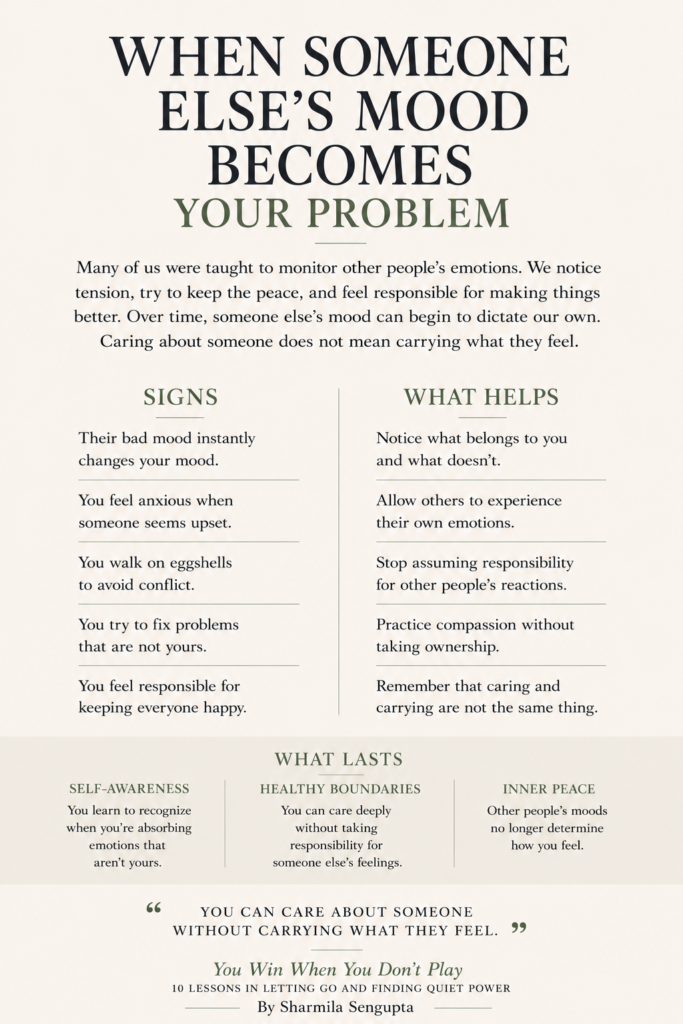
You may be taking responsibility for other people’s emotions if:
- Someone’s bad mood instantly affects your mood
- You feel guilty when someone is upset
- You constantly worry about disappointing people
- You struggle to say no
- You avoid conflict whenever possible
- You replay conversations repeatedly
- You seek reassurance before making decisions
- You feel emotionally drained after social interactions
- You absorb other people’s stress and anxiety
- You believe it is your job to keep everyone happy
Additional signs include:
- Overthinking relationship problems
- Feeling responsible for fixing difficult situations
- Walking on eggshells around certain people
- Prioritizing other people’s needs over your own
- Difficulty setting healthy boundaries
- Feeling emotionally exhausted despite getting enough rest
Many people experiencing these symptoms assume they simply care deeply.
In reality, they may be carrying emotional burdens that do not belong to them.
The Hidden Cost of Taking Responsibility for Other People’s Emotions
Feeling responsible for other people’s emotions may seem like a sign of compassion, but it often comes with hidden costs.
At first, the costs are subtle.
You feel emotionally drained after certain conversations.
You spend hours replaying interactions in your mind.
You worry about how people feel.
You struggle to relax because your mind is constantly monitoring emotional situations around you.
Over time, these patterns can lead to emotional exhaustion, emotional burnout, chronic stress, and emotional overwhelm.
1. The Cost to Your Mental Health
When you constantly absorb other people’s emotions, your nervous system rarely gets a chance to rest.
You become emotionally hypervigilant.
You monitor moods.
You anticipate problems.
You prepare for conflict.
You try to prevent disappointment.
This ongoing emotional labor can create:
- Anxiety
- Emotional fatigue
- Mental exhaustion
- Chronic stress
- Emotional overload
- Difficulty concentrating
Many people who feel emotionally exhausted all the time are not overwhelmed by their own problems.
They are overwhelmed by the emotional weight they carry for everyone else.
2. The Cost to Your Relationships
Ironically, emotional over-responsibility often damages relationships.
When you become responsible for everyone’s emotional well-being, resentment often follows.
You may begin to feel:
- Unappreciated
- Overburdened
- Emotionally depleted
- Taken for granted
Healthy relationships require shared responsibility.
They do not require emotional caretaking.
When one person becomes responsible for everyone else’s emotional state, the relationship often becomes unbalanced.
3. The Cost to Your Self-Worth
Many people confuse being needed with being valued.
As a result, their self-worth becomes tied to how useful they are to others.
They feel valuable when they are helping.
They feel guilty when they are not.
This creates a cycle of approval-seeking and external validation.
Instead of trusting themselves, they depend on other people’s reactions to determine whether they are doing enough.
Over time, this weakens self-trust and creates emotional dependence on approval.
How Weak Emotional Boundaries Create Emotional Burnout
Without healthy emotional boundaries, other people’s emotions can easily become your burden. You begin carrying emotional weight that was never yours to carry, often without realizing it.
One of the biggest causes of emotional burnout is weak emotional boundaries.
Emotional boundaries help you distinguish between:
- Your feelings and someone else’s feelings
- Your responsibilities and someone else’s responsibilities
- Your emotional needs and someone else’s emotional needs
Without strong emotional boundaries, it becomes difficult to separate what belongs to you from what belongs to others.
When someone is angry, you feel responsible.
When someone is disappointed, you feel guilty.
When someone is stressed, you absorb their stress.
When someone is unhappy, you feel compelled to fix the situation.
Over time, this pattern of emotional absorption creates emotional fatigue, emotional overload, and eventually emotional burnout.
Many people with weak emotional boundaries become highly sensitive to the moods, reactions, and expectations of others. They spend so much energy managing other people’s emotions that they neglect their own emotional well-being.
Many people believe boundaries are selfish.
In reality, healthy emotional boundaries are one of the most compassionate things you can develop.
Boundaries do not reduce compassion.
They make compassion sustainable.
They allow you to care about people without taking responsibility for their feelings, carrying their emotional burdens, or sacrificing your own peace of mind.
Healthy emotional boundaries protect:
- Your energy
- Your peace of mind
- Your emotional health
- Your self-respect
- Your relationships
Without emotional boundaries, even healthy relationships can become emotionally exhausting.
The goal is not to care less about others.
The goal is to care without carrying what was never yours to carry.
Why Overthinking Makes Emotional Responsibility Worse
People who feel responsible for other people’s feelings often spend hours replaying conversations, analyzing interactions, and searching for signs that someone might be upset with them.
Overthinking and emotional responsibility often reinforce each other.
When you believe you are responsible for how others feel, your mind rarely rests.
You replay conversations.
You analyze facial expressions and tone of voice.
You search for hidden meanings in messages.
You wonder if someone is upset with you.
You question whether you said the wrong thing.
You imagine worst-case scenarios.
Over time, simple interactions become sources of anxiety and emotional stress.
Questions begin to dominate your thinking:
- Did I hurt their feelings?
- Are they angry with me?
- Did I disappoint them?
- Should I have handled that differently?
- Is there something I need to fix?
This pattern of overthinking creates emotional anxiety, self-doubt, and mental exhaustion.
The more you overthink, the more emotionally overwhelmed you become.
The more emotionally overwhelmed you become, the harder it becomes to stop overthinking.
What often begins as concern for others can slowly turn into emotional hypervigilance—a constant state of monitoring, analyzing, and managing other people’s reactions.
Many people spend years trapped in this cycle.
They mistake overthinking for caring.
They mistake worry for responsibility.
And they mistake emotional monitoring for emotional support.
In reality, overthinking rarely solves the problem.
It simply convinces you that every emotion, reaction, or disappointment is yours to manage.
The solution is not finding the perfect answer.
The solution is recognizing that not every emotion requires your intervention.
Not every reaction requires your management.
Not every silence has a hidden meaning.
And not every problem requires your solution.
The moment you stop taking responsibility for other people’s feelings is often the moment your mind begins to find peace.
Why You Cannot Control Other People’s Feelings
One of the most liberating truths about emotional health is this:
You are not responsible for controlling how other people feel.
You can be kind.
You can be respectful.
You can be thoughtful.
You can communicate clearly.
But you cannot control:
- How someone interprets your words
- How someone processes disappointment
- How someone reacts to boundaries
- How someone manages their emotions
Every person is responsible for their own emotional experience.
Trying to manage someone else’s feelings is like trying to control the weather.
It creates frustration because the task is impossible.
The moment you accept that other people’s emotions belong to them, you create space for emotional freedom.
What Helps
If you struggle with emotional responsibility, remind yourself regularly that understanding someone’s feelings is not the same as being responsible for those feelings.
Empathy is healthy.
Emotional responsibility is not.
The goal is not to become less caring.
The goal is to stop confusing caring with carrying.
1. Separate Compassion from Responsibility
Compassion means caring about someone’s experience.
Responsibility means taking ownership of that experience.
They are not the same.
You can support someone, listen to them, and care deeply about them without becoming responsible for their emotions, reactions, or choices.
Healthy relationships require compassion.
They do not require emotional self-sacrifice.
2. Strengthen Emotional Boundaries
Strong emotional boundaries help you recognize where your responsibilities end and another person’s begin.
When someone is upset, pause and ask yourself:
“Is this emotion mine to manage?”
This simple question creates emotional clarity and helps prevent emotional overload, emotional exhaustion, and burnout.
Emotional boundaries allow you to care without absorbing.
Support without rescuing.
And love without losing yourself.
3. Stop Seeking Constant Approval
Many people who struggle with emotional responsibility also struggle with approval-seeking.
They believe that if everyone is happy, they must be doing something right.
But emotional well-being cannot depend on keeping everyone pleased.
Not everyone will approve of your decisions.
Not everyone will understand your boundaries.
Not everyone will agree with your choices.
That is okay.
Your self-worth cannot depend on universal approval.
4. Develop Greater Self-Awareness
Pay attention to the moments when you begin absorbing emotions that do not belong to you.
Notice when you feel responsible for fixing, rescuing, comforting, or managing everyone around you.
These patterns often operate automatically.
Awareness is the first step toward change.
The more self-aware you become, the easier it becomes to recognize emotional overinvolvement before it leads to emotional fatigue.
5. Allow Others to Manage Their Own Feelings
One of the greatest gifts you can give someone is the opportunity to develop emotional resilience.
People grow when they learn how to navigate disappointment, frustration, conflict, and uncertainty on their own.
When you constantly rescue others from uncomfortable emotions, you may unintentionally prevent that growth.
You do not need to solve every problem.
You do not need to fix every feeling.
And you do not need to rescue everyone.
Sometimes the healthiest response is to care, support, and then allow others to carry what is theirs to carry.
Practical Exercise: What Belongs to Me?
The next time you feel emotionally overwhelmed, pause and ask yourself:
- What emotion am I experiencing?
- Did this emotion originate with me?
- Am I taking responsibility for someone else’s reaction?
- What part of this situation actually belongs to me?
- What part belongs to someone else?
Write your answers down.
This simple exercise helps strengthen emotional boundaries, reduce overthinking, improve self-awareness, and prevent emotional burnout.
Over time, it becomes easier to distinguish between caring about someone and carrying their emotional burdens.
What Lasts
The goal is not simply to stop feeling overwhelmed.
The goal is to create lasting emotional health, stronger boundaries, greater self-trust, and a more peaceful relationship with yourself.
Self-Awareness Lasts
When you become aware of your tendency to take responsibility for other people’s emotions, you gain the ability to make different choices.
You begin noticing when you are:
- Absorbing other people’s stress
- Carrying emotional burdens that are not yours
- Seeking approval instead of trusting yourself
- Prioritizing other people’s needs at the expense of your own
Self-awareness is the foundation of emotional healing.
Healthy Emotional Boundaries Last
Strong emotional boundaries help you distinguish between compassion and responsibility.
You stop taking ownership of emotions that belong to other people.
You stop feeling obligated to rescue everyone.
You stop carrying emotional weight that was never yours to carry.
Instead, you learn how to support people without sacrificing yourself.
Self-Trust Lasts
Many people who struggle with emotional responsibility also struggle with self-trust.
They look to other people for reassurance.
They seek external validation before making decisions.
They question themselves constantly.
As emotional boundaries strengthen, self-trust grows.
You become less dependent on approval and more confident in your own judgment.
Inner Peace Lasts
One of the greatest rewards of letting go of emotional over-responsibility is inner peace.
You no longer feel responsible for managing everyone’s reactions.
You stop carrying emotional stress that does not belong to you.
You stop trying to control outcomes you cannot control.
Life becomes lighter.
Relationships become healthier.
Your emotional energy becomes available for your own growth and well-being.
What I Have Learned About Emotional Responsibility
One of the most important lessons I have learned is that emotional freedom begins when we stop taking responsibility for other people’s emotions, expectations, reactions, and outcomes.
Compassion does not require emotional ownership.
Over the years, I have noticed that many people who feel emotionally exhausted are not overwhelmed by their own problems.
They are overwhelmed by the emotional weight they carry for everyone else.
Many people struggling with emotional responsibility spend their days managing other people’s moods, anticipating other people’s reactions, and worrying about how their decisions might affect those around them. They become so focused on keeping the peace, avoiding conflict, and preventing disappointment that they gradually lose sight of their own needs, feelings, and well-being.
What often looks like kindness is actually emotional over-responsibility.
What often looks like compassion is sometimes approval-seeking.
What often looks like strength can quietly become emotional burnout.
I have seen how weak emotional boundaries, people-pleasing, conflict avoidance, and the fear of disappointing others can slowly drain a person’s mental and emotional energy.
The pattern is rarely dramatic.
It develops gradually.
A habit of saying yes when you want to say no.
A tendency to absorb other people’s emotions.
A reluctance to set healthy boundaries.
A need for external validation.
A habit of overthinking conversations, relationships, and other people’s opinions.
Over time, these patterns create emotional overload, emotional fatigue, and chronic stress.
What makes emotional responsibility so difficult to recognize is that it is often praised by others.
The person who is always available.
The person who never causes problems.
The person who keeps everyone happy.
The person who carries more than their share.
These behaviors are often rewarded, even when they come at the cost of self-respect, emotional health, and inner peace.
One of the most important lessons I have learned is that caring about people and carrying people are not the same thing.
Healthy relationships require empathy.
They require compassion.
But they also require emotional boundaries.
Without boundaries, caring can become self-abandonment.
Without boundaries, empathy can become emotional exhaustion.
Without boundaries, compassion can become emotional burnout.
The healthiest form of compassion includes yourself.
The healthiest form of kindness does not require sacrificing your own well-being.
And the healthiest form of emotional responsibility is recognizing what belongs to you and what does not.
The moment you stop carrying what was never yours to carry, you create space for emotional healing, self-respect, self-trust, emotional resilience, and lasting peace of mind.
That is where emotional freedom begins.
Emotional Responsibility Checklist
You May Be Taking Responsibility for Other People’s Emotions If…
✓ Other people’s moods affect your mood
✓ You feel guilty when someone is upset
✓ You constantly worry about disappointing people
✓ You replay conversations repeatedly
✓ You struggle with people-pleasing
✓ You feel responsible for keeping everyone happy
✓ You avoid conflict whenever possible
✓ You absorb other people’s stress and anxiety
✓ You struggle to say no without guilt
✓ You seek reassurance before making decisions
✓ You feel emotionally drained after social interactions
✓ You put other people’s needs ahead of your own
✓ You worry excessively about how others perceive you
✓ You feel responsible for fixing problems that are not yours
✓ You rarely prioritize your own emotional well-being
What Your Results Might Mean
If several of these statements feel familiar, emotional responsibility may be contributing to your emotional exhaustion.
This does not mean you care too much.
It means you may be carrying emotional burdens that were never yours to carry.
Learning to strengthen emotional boundaries, reduce approval-seeking, and let go of emotional over-responsibility can help you recover from emotional burnout and create greater emotional balance.
Key Takeaways
- You are not responsible for managing other people’s emotions.
- Emotional responsibility often develops through conditioning, people-pleasing, and approval-seeking.
- Weak emotional boundaries contribute to emotional exhaustion and burnout.
- Overthinking often reinforces emotional over-responsibility.
- Healthy relationships require compassion, not emotional caretaking.
- Self-worth should not depend on other people’s moods or reactions.
- Emotional healing begins when you stop carrying emotional burdens that are not yours.
- Strong boundaries support both emotional well-being and healthier relationships.
Final Reflection
Many of us were taught that caring means fixing.
That kindness means keeping everyone happy.
That love means taking responsibility for how other people feel.
But emotional maturity teaches a different lesson.
You can support someone without rescuing them.
You can care about someone without absorbing their emotions.
You can love people deeply without making their happiness your responsibility.
Not every burden belongs on your shoulders.
Not every problem is yours to solve.
Not every emotion is yours to manage.
Sometimes protecting your peace is not selfish.
It is necessary.
And sometimes the most important question you can ask yourself is:
“Am I carrying something that was never mine to carry?”
A Lesson From You Win When You Don’t Play
One of the central lessons in You Win When You Don’t Play: 10 Lessons in Letting Go and Finding Quiet Power is that peace often begins when we stop participating in struggles that do not belong to us.
Many people spend years carrying:
- Other people’s expectations
- Other people’s emotions
- Other people’s opinions
- Other people’s disappointments
The result is emotional exhaustion, self-doubt, and a constant feeling of being emotionally overwhelmed.
The solution is not to care less.
The solution is to let go of responsibilities that were never yours.
When you stop carrying what does not belong to you, you create space for self-trust, emotional freedom, stronger boundaries, and genuine inner peace.
That is where quiet power begins.
If these ideas resonate with you, you’ll find them explored more deeply in You Win When You Don’t Play: 10 Lessons in Letting Go and Finding Quiet Power.
Learn More About the Book
If something in this article felt familiar, you’re not alone.
Many of us spend years carrying things we were never taught how to release.
We carry overthinking long after the situation has ended.
We carry the weight of other people’s expectations.
We carry disappointment when life doesn’t go as planned.
We carry old stories about who we should be and struggle to understand why they still have so much power over us.
These are the questions that eventually led me to write You Win When You Don’t Play: 10 Lessons in Letting Go and Finding Quiet Power.
The book explores many of the themes woven throughout this article, including:
- How to stop overthinking and find greater mental clarity
- Letting go of validation-seeking and the need for approval
- People-pleasing, self-abandonment, and learning to set healthy boundaries
- Emotional exhaustion, burnout, and carrying too much for too long
- Rebuilding self-worth after disappointment and difficult life experiences
- Finding peace when life doesn’t go as planned
- Grieving lost dreams and letting go of expectations
- Emotional resilience during difficult life transitions
- Self-discovery, inner peace, and emotional freedom
- Learning how to trust yourself again
But more than anything, it explores a simple idea I’ve returned to again and again:
Not every struggle deserves your energy.
Not every battle needs to be won.
And not every burden needs to be carried.
Along the way, the book explores the invisible competitions, emotional pressures, and exhausting patterns that many of us carry without realizing how much they cost us.
Not to offer perfect answers.
But to help us see ourselves more clearly.
To understand ourselves more honestly.
And to recognize what may finally be ready to be released.
Because peace is rarely found by becoming more.
It is often found by needing less.
Less approval.
Less proving.
Less carrying what was never ours to hold.
Perhaps that’s why letting go often feels less like losing something and more like coming home to yourself.
Buy the Book on Amazon
Whether you’re struggling with overthinking, emotional exhaustion, people-pleasing, difficult relationships, self-worth, chronic stress, or the feeling that you’ve lost yourself beneath other people’s expectations, I hope the book offers the same thing I try to offer through my writing:
A different perspective.
A little more clarity.
And a gentler way forward.
You can learn more about the book or get your copy here:
Ask Sharmila – Personal Guidance for Overthinking, Emotional Exhaustion, Self-Worth, and Life’s Difficult Questions
Sometimes the hardest part isn’t finding advice.
It’s making sense of what you’re carrying.
Perhaps you’ve been overthinking the same situation for weeks. Perhaps you’re emotionally exhausted from trying to keep everyone happy. Or maybe you’re struggling to let go of a difficult relationship, rebuild your self-worth after disappointment, or find peace when life doesn’t go as planned.
Many of us carry questions that don’t have simple answers.
Questions about boundaries.
Questions about people-pleasing.
Questions about validation.
Questions about emotional healing, difficult life transitions, and how to stop carrying responsibilities that were never ours to hold.
You don’t have to figure it all out alone.
Through Ask Sharmila, you’re invited to share a question that’s been weighing on you.
Together, we’ll look beneath the surface of the situation—not to find perfect answers, but to uncover a clearer perspective and a gentler way forward.
Over Time, I’ve Noticed That Many Questions Tend to Circle Around the Same Themes
- How to stop overthinking and replaying conversations
- Emotional exhaustion and feeling drained by life
- People-pleasing recovery and setting healthy boundaries
- Seeking validation from others
- Rebuilding self-worth after disappointment
- Difficult relationships and emotional resilience
- Letting go of expectations that no longer fit your life
- Grieving the life you thought you’d have
- Learning how to let go when life doesn’t unfold as expected
- Finding inner peace during challenging life transitions
- Living more intentionally and trusting yourself again
One thing I’ve learned is that a new perspective doesn’t always change the situation.
I’ve seen people spend months stuck in the same thought loop, only to discover that what they needed wasn’t another solution.
It was a different way of seeing the situation.
And sometimes that’s where healing begins.
Personal Reflection and Written Guidance – ₹499
Every question is read personally by me, and every response is written thoughtfully and individually.
You Will Receive
- A personal written response tailored to your situation
- Thoughtful reflection grounded in emotional healing, self-discovery, and personal growth
- Practical perspective and gentle guidance
- Support for overthinking, emotional exhaustion, people-pleasing, self-worth struggles, boundaries, validation, difficult relationships, and major life transitions
- A response within 5 days

Personal Written Guidance for Overthinking, Emotional Exhaustion, Self-Worth, and Life’s Difficult Questions
The goal is not to have all the answers.
The goal is to understand yourself more clearly, carry less emotional weight, and discover a calmer, more compassionate way forward.
Sometimes clarity begins when we stop asking,
“How do I fix this?”
and start asking,
“What is this situation trying to teach me?”
Often, that’s where a gentler way forward begins.
Frequently Asked Questions About Emotional Responsibility
Why do I feel responsible for other people’s emotions?
Many people develop emotional responsibility through childhood conditioning, people-pleasing behaviors, conflict avoidance, or a strong desire for approval and acceptance. Over time, they begin believing that it is their job to keep other people happy, prevent disappointment, or manage emotional reactions that are not theirs to control.
Is feeling responsible for other people’s feelings a sign of empathy?
Not necessarily.
Empathy allows you to understand, care about, and respond compassionately to other people’s emotions.
Emotional responsibility occurs when you believe it is your job to fix, manage, or change those emotions.
Healthy empathy includes emotional boundaries. You can care about someone’s feelings without taking ownership of them.
Can emotional responsibility cause emotional exhaustion?
Yes.
Constantly monitoring moods, absorbing stress, managing conflict, and worrying about how other people feel can create emotional fatigue, emotional overwhelm, and chronic emotional exhaustion.
Over time, this pattern can contribute to emotional burnout, anxiety, and a loss of emotional well-being.
How do emotional boundaries help?
Healthy emotional boundaries help you distinguish between your feelings and someone else’s feelings.
They create emotional clarity by helping you recognize what is your responsibility and what is not.
Strong emotional boundaries allow you to be compassionate, supportive, and caring without becoming emotionally overwhelmed or sacrificing your own peace of mind.
Is people-pleasing connected to emotional responsibility?
Very often.
Many people pleasers feel responsible for keeping everyone happy, avoiding conflict, preventing disappointment, and maintaining harmony in relationships.
This creates emotional pressure and can lead to emotional overload, self-abandonment, and weakened self-trust.
People-pleasing and emotional responsibility often reinforce each other.
What is the difference between emotional responsibility and emotional support?
Emotional support means listening, caring, encouraging, and showing compassion.
Emotional responsibility means believing that someone else’s emotions are yours to fix, manage, or carry.
Healthy relationships require emotional support.
They do not require emotional ownership.
Can weak emotional boundaries affect relationships?
Yes.
Weak emotional boundaries can create resentment, emotional exhaustion, codependent relationship patterns, and unhealthy emotional dependence.
Healthy boundaries strengthen relationships because they allow both people to take responsibility for their own emotions while remaining connected and supportive.
How do I stop carrying other people’s emotions?
Start by increasing self-awareness and noticing when you feel responsible for someone else’s mood, reaction, or emotional experience.
Strengthen your emotional boundaries.
Reduce approval-seeking behaviors.
Practice letting others solve their own problems.
And regularly ask yourself:
“Is this mine to carry?”
That simple question can help you separate compassion from emotional responsibility and protect your emotional well-being.
Can emotional responsibility affect self-worth?
Yes.
Many people tie their self-worth to being helpful, needed, understood, or appreciated by others.
When self-worth depends on keeping everyone happy, emotional responsibility often becomes stronger.
Building self-trust and healthy boundaries helps create a more stable sense of self-worth that is not dependent on other people’s emotions or approval.
About Sharmila Sengupta
I’m Sharmila Sengupta, author of You Win When You Don’t Play: 10 Lessons in Letting Go and Finding Quiet Power.
Over the years, I’ve become fascinated by the quiet struggles many of us carry but rarely talk about openly—the exhaustion of overthinking, the weight of people-pleasing, the search for validation, the challenge of setting healthy boundaries, and the grief that comes when life doesn’t go as planned.
Much of my writing begins with things I’ve noticed—in my own life, in conversations with others, and in the quiet struggles many of us carry without talking about them.
I’ve noticed how often we replay old conversations, question our self-worth, compare our lives to others, or carry emotional burdens that were never ours to hold. I’ve also noticed that many of us are quietly grieving lost dreams, coping with disappointment in life, navigating difficult life transitions, or learning how to let go of expectations about the future.
Perhaps you’ve found yourself asking some of those same questions.
How do I stop overthinking?
How do I let go of expectations that no longer fit my life?
Why do I feel emotionally exhausted even when everything seems fine on the surface?
How do I find peace when life doesn’t go as planned?
How do I stop seeking validation from other people?
How do I rebuild self-worth after disappointment or difficult relationships?
These are the questions that often inspire my writing.
Again and again, they seem to lead back to the same lesson: peace often begins when we stop carrying what was never ours to hold.
Through my articles and books, I reflect on emotional healing, personal growth, self-discovery, emotional resilience, and the quiet work of learning how to let go of what no longer serves us. Not as someone with all the answers, but as a fellow traveller who continues to learn what it means to let go, trust life a little more, and find strength in quieter ways.
My hope is that readers leave feeling less alone, more understood, and a little gentler with themselves than they were before they arrived.