
Learn how people-pleasing, emotional responsibility, and weak boundaries lead to over-apologizing.
Many people find themselves saying “sorry” even when they have not made a mistake.
Perhaps a friend seemed disappointed, a colleague appeared irritated, or a family member reacted negatively to a decision you made. Even though you had done nothing wrong, you apologized anyway.
For many people, apologizing becomes automatic. It slips into conversations without conscious thought:
- “Sorry for bothering you.”
- “Sorry for asking.”
- “Sorry, but I think…”
- “Sorry if you’re upset.”
At first glance, this habit may seem harmless. It can even appear polite and considerate.
But excessive apologizing often points to something deeper.
Sometimes the apology is not about guilt. Sometimes it is about fear.
Fear of conflict.
Fear of disappointing someone.
Fear of rejection.
Fear of being misunderstood.
And perhaps most importantly, fear of being responsible for someone else’s emotional discomfort.
If you frequently apologize even when you have done nothing wrong, you may be carrying emotional responsibilities that were never yours to carry.
Understanding why this happens is the first step toward building healthier boundaries, stronger self-respect, and greater inner peace.
Why You Apologize Even When You Did Nothing Wrong
Most people are not born believing they are responsible for everyone else’s emotions.
This belief is usually learned.
Over time, many of us absorb subtle messages such as:
- Keep everyone happy.
- Avoid upsetting people.
- Be easy to get along with.
- Don’t make things difficult.
- Put other people’s needs first.
These messages often come from family dynamics, cultural expectations, social conditioning, workplaces, friendships, or relationships.
Eventually, a simple equation forms in the mind:
Someone is upset = I must have done something wrong.
When that happens, apologizing becomes a strategy for restoring emotional safety.
The apology may not be about guilt at all.
It may be an attempt to:
- Reduce tension.
- Avoid conflict.
- Reassure someone else.
- Prevent rejection.
- Restore harmony.
Over time, the habit becomes automatic.
You stop asking:
“Did I actually do something wrong?”
And start asking:
“How can I make this discomfort go away?”
The result is a pattern of apologizing for emotions, reactions, and expectations that do not belong to you.
Why Emotional Responsibility Feels So Heavy
One of the central themes I explore throughout life and relationships is emotional responsibility.
Many people confuse compassion with responsibility.
Compassion says:
“I care about how you feel.”
Emotional responsibility says:
“I am responsible for how you feel.”
These are not the same thing.
Healthy relationships require empathy.
Unhealthy emotional patterns often involve taking ownership of emotions that belong to someone else.
When you begin carrying other people’s disappointment, frustration, sadness, or anger, life becomes exhausting.
You become hypervigilant.
You monitor reactions.
You overthink conversations.
You second-guess decisions.
And frequently, you apologize simply because someone else is uncomfortable.
The apology becomes an emotional burden rather than an expression of genuine accountability.
The Connection Between Chronic Apologizing and Conflict Avoidance
Many people who struggle with excessive apologizing are not actually apologizing because they have done something wrong.
They are apologizing because they are trying to avoid conflict.
Conflict avoidance often develops when disagreements feel emotionally unsafe. Instead of expressing a need, setting a boundary, or accepting that someone may disagree, the automatic response becomes:
“I’m sorry.”
The apology acts as a way to reduce tension and restore emotional comfort.
Over time, this creates a cycle:
- Someone becomes upset.
- You feel uncomfortable.
- You apologize.
- The tension decreases temporarily.
The problem is that the apology does not address the underlying issue. It simply teaches your brain that managing conflict is your responsibility.
Many people who over-apologize are actually trying to avoid:
- Rejection
- Criticism
- Disapproval
- Confrontation
- Difficult conversations
This is why chronic apologizing is often linked to people-pleasing, approval-seeking, and emotional exhaustion.
Learning to tolerate disagreement without immediately apologizing is an important step toward healthier boundaries and stronger self-respect.
Validation, Conditioning, and the Desire to Be Liked
Many chronic apologizers are also people-pleasers.
People-pleasing is rarely about kindness alone.
More often, it is connected to validation.
When approval becomes tied to self-worth, upsetting someone can feel dangerous.
You may unconsciously believe:
- If someone is upset with me, I am a bad person.
- If someone is disappointed in me, I have failed.
- If someone disagrees with me, I must defend myself.
- If someone is unhappy, I need to fix it.
Social media can reinforce these tendencies.
We live in a culture that encourages constant visibility, feedback, and validation.
As a result, many people become increasingly uncomfortable with disapproval.
But personal growth requires accepting a difficult truth:
You can be kind, respectful, thoughtful, and loving—and someone may still be disappointed.
Their disappointment does not automatically mean you are wrong.
Learning this distinction can be life-changing.
How Childhood Conditioning Can Create Over-Apologizing
Many habits around apologizing begin long before adulthood.
In some families, children learn that maintaining harmony is more important than expressing their own needs.
They may receive messages such as:
- Don’t upset people.
- Be the good child.
- Keep everyone happy.
- Avoid making problems.
Over time, these messages can create a pattern of emotional caretaking.
As adults, these individuals often become highly sensitive to other people’s moods and reactions.
They may feel responsible for:
- Keeping everyone comfortable
- Preventing disappointment
- Avoiding conflict
- Managing emotional tension
This can lead to excessive apologizing, even when no mistake has been made.
The apology becomes a learned coping mechanism rather than an appropriate response to wrongdoing.
Understanding where the habit came from can help reduce shame and create space for healthier patterns.
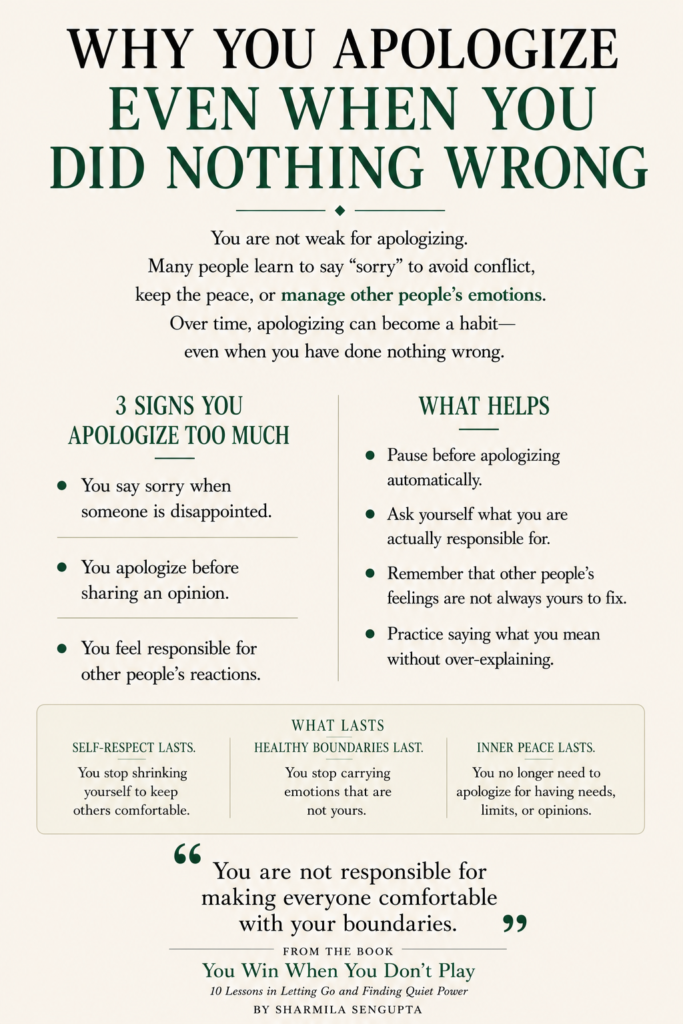
Signs You Apologize Even When You Did Nothing Wrong
1. You Apologize When Someone Is Disappointed
Someone does not get what they want.
Someone disagrees with your decision.
Someone feels unhappy about a boundary.
Your immediate response is:
“I’m sorry.”
Even when no wrongdoing occurred.
2. You Apologize Before Sharing an Opinion
Many people begin sentences with:
“Sorry, but…”
This habit suggests discomfort with taking up space.
It implies that your thoughts require permission before they can be expressed.
3. You Feel Responsible for Other People’s Reactions
This is often the most important sign.
You believe:
- Their anger is your responsibility.
- Their disappointment is your responsibility.
- Their frustration is your responsibility.
As a result, apologizing becomes an attempt to manage reactions rather than acknowledge mistakes.
4. You Apologize for Having Needs
You feel guilty asking for help.
You feel guilty setting limits.
You feel guilty saying no.
The apology becomes a way of minimizing your own needs.
5. You Apologize to Keep the Peace
Sometimes apologizing feels easier than having an honest conversation.
Unfortunately, temporary peace often comes at the expense of long-term self-respect.
Is Over-Apologizing a Trauma Response?
For some people, yes.
Over-apologizing can sometimes develop as a survival strategy.
When someone grows up in an environment where conflict feels unpredictable, criticism feels intense, or emotional safety feels uncertain, they may become hyperaware of other people’s reactions.
This is sometimes called hypervigilance.
Hypervigilance causes people to constantly scan for signs that someone is upset, disappointed, or unhappy.
The goal is simple:
Stay safe.
Apologizing becomes a tool for reducing perceived threats and restoring emotional stability.
This does not mean everyone who apologizes too much has experienced trauma.
However, many people discover that their excessive apologizing is connected to old patterns of self-protection rather than genuine accountability.
Recognizing this distinction can be incredibly freeing.
The Hidden Cost of Apologizing Too Much
At first, apologizing may seem like a harmless habit.
In reality, excessive apologizing often carries hidden costs that accumulate over time.
1. It Weakens Self-Trust
Every unnecessary apology sends a subtle message to yourself:
“My judgment cannot be trusted.”
Over time, you begin relying more on other people’s reactions than your own inner compass.
2. It Creates Emotional Exhaustion
When you constantly monitor how everyone feels, you are never truly at rest.
You become responsible for:
- Their disappointment
- Their frustration
- Their mood
- Their expectations
Eventually, emotional responsibility becomes emotional exhaustion.
3. It Encourages Self-Abandonment
Many people apologize not because they are wrong, but because they are afraid of losing connection.
The problem is that repeatedly sacrificing yourself to maintain harmony often damages the most important relationship of all:
The relationship you have with yourself.
4. It Makes Boundaries Feel Wrong
If every boundary is followed by an apology, boundaries begin to feel selfish.
You start believing:
- Saying no is rude.
- Disagreeing is unkind.
- Prioritizing yourself is wrong.
But healthy boundaries are not acts of selfishness.
They are acts of self-respect.
Why Boundary Setting Often Triggers Guilt
One of the most common reasons people apologize unnecessarily is because they feel guilty when setting boundaries.
Boundary guilt occurs when protecting yourself feels selfish.
For example:
- Saying no to a request
- Declining an invitation
- Asking for space
- Expressing a different opinion
- Protecting your time
Even healthy boundaries can trigger discomfort.
Many people immediately apologize because they assume someone else’s disappointment means they have done something wrong.
But disappointment and wrongdoing are not the same thing.
Someone can be disappointed by your boundary while your boundary remains completely healthy.
Learning to tolerate that discomfort is an essential part of building self-trust.
The goal is not to eliminate guilt immediately.
The goal is to stop treating guilt as proof that you are wrong.
What Helps
Breaking the habit of unnecessary apologizing requires awareness before it requires change.
1. Pause Before Saying Sorry
The next time you feel the urge to apologize, ask yourself:
What exactly am I apologizing for?
If you cannot identify a genuine mistake, the apology may not be necessary.
2. Replace Apologies with Gratitude
Instead of:
“Sorry for taking your time.”
Try:
“Thank you for your time.”
Instead of:
“Sorry for asking.”
Try:
“Thank you for helping.”
This small shift changes your energy from guilt to appreciation.
3. Separate Feelings from Responsibility
Someone can be upset without you being responsible for their feelings.
Someone can disagree with you without you being wrong.
Someone can be disappointed without you needing to fix it.
This distinction is essential.
4. Accept Temporary Discomfort
Many people apologize because they are trying to eliminate discomfort.
But discomfort is part of healthy relationships.
Not every disagreement needs an apology.
Not every unhappy reaction requires a solution.
5. Practice Boundary Language
Instead of:
“Sorry, but I can’t.”
Try:
“I won’t be able to do that.”
Instead of:
“Sorry for saying no.”
Try:
“No, thank you.”
Simple, respectful, and clear.
Practical Exercise: The Apology Audit
For the next seven days, pay attention to every apology you make.
Create two columns.
Necessary Apologies
Examples:
- I made a mistake.
- I broke a commitment.
- I hurt someone.
- I acted unfairly.
Unnecessary Apologies
Examples:
- Someone disagreed with me.
- Someone was disappointed.
- I expressed a need.
- I set a boundary.
- I asked a question.
At the end of the week, review the list.
Most people are surprised by how often they apologize for existing, speaking, asking, or protecting their peace.
Awareness is often the beginning of change.
What Lasts
Self-Respect Lasts
When you stop apologizing for who you are, you begin treating yourself with greater dignity.
You stop shrinking to make others comfortable.
Healthy Boundaries Last
You stop carrying emotions that are not yours.
You learn where your responsibility ends and someone else’s begins.
Inner Peace Lasts
You no longer need everyone to approve of you in order to feel okay.
You become less reactive to disappointment, disagreement, and disapproval.
That peace is worth protecting.
What I Have Learned About Apologizing
Over the years, I have noticed that many people who seek guidance about boundaries, emotional exhaustion, people-pleasing, and difficult relationships share one common habit:
They apologize for things that are not their responsibility.
They apologize for:
- Someone else’s disappointment
- Someone else’s reaction
- Having needs
- Taking up space
- Setting boundaries
- Choosing themselves
What I have learned is that most of these apologies are not about guilt.
They are about fear.
Fear of conflict.
Fear of rejection.
Fear of disappointing someone.
Fear of being misunderstood.
Many people spend years carrying emotional burdens that were never theirs to carry.
They believe they are responsible for keeping everyone comfortable.
But real peace begins when you understand a simple truth:
You can care about how someone feels without becoming responsible for how they feel.
That distinction has the power to change relationships, boundaries, self-respect, and inner peace.
And in many ways, it sits at the heart of everything I write about in You Win When You Don’t Play.
When an Apology Is Actually Necessary
Not every apology is unhealthy.
In fact, a sincere apology is an important part of healthy communication, accountability, and relationship repair.
The goal is not to stop apologizing altogether.
The goal is to stop over-apologizing for things that are not your responsibility.
A healthy apology is appropriate when:
- You hurt someone through your words or actions.
- You break a commitment or fail to follow through.
- You act unfairly or disrespectfully.
- You make a genuine mistake.
- You take responsibility for behavior that caused harm.
In these situations, an apology reflects self-awareness, accountability, and emotional maturity.
The problem arises when apologizing becomes a people-pleasing habit rather than a response to wrongdoing.
Many people who struggle with excessive apologizing say sorry for:
- Someone else’s disappointment.
- Someone else’s emotions.
- Setting a healthy boundary.
- Expressing a need.
- Having a different opinion.
- Protecting their time and energy.
These situations do not necessarily require an apology.
Learning the difference between personal responsibility and emotional responsibility can be life-changing.
You are responsible for your actions.
You are not responsible for managing everyone else’s reactions.
A healthy apology builds trust.
Over-apologizing often weakens self-trust.
The goal is not to apologize less.
The goal is to apologize appropriately—while respecting your own boundaries, needs, and emotional well-being.
Key Takeaways
- Excessive apologizing is often connected to people-pleasing and emotional responsibility.
- Many unnecessary apologies are attempts to avoid conflict or disappointment.
- Someone else’s feelings are not automatically your responsibility.
- Healthy boundaries do not require constant apologies.
- Self-respect grows when you stop apologizing for having needs, opinions, and limits.
- Inner peace comes from carrying only what belongs to you.
Final Reflection
Not every apology is a sign that you were wrong.
Sometimes it is a sign that you have spent too much time trying to manage emotions, expectations, and reactions that were never yours to manage.
You can be thoughtful without becoming responsible.
You can be compassionate without becoming accountable for everyone’s happiness.
And you can be kind without apologizing for your existence.
The goal is not to stop caring.
The goal is to stop carrying.
That is where freedom begins.
A Lesson From You Win When You Don’t Play
One of the most important lessons in You Win When You Don’t Play: 10 Lessons in Letting Go and Finding Quiet Power is this:
Not every problem is yours to solve.
Not every emotion is yours to carry.
Not every reaction requires a response.
Many people spend years trying to keep everyone comfortable.
They smooth over tension.
They absorb disappointment.
They apologize for things that are not their fault.
They carry responsibilities that belong to other people.
Eventually, this becomes exhausting.
The truth is that peace does not come from managing everyone else’s emotions.
Peace comes from understanding where your responsibility ends.
You are responsible for:
- Your words
- Your actions
- Your choices
- Your integrity
You are not responsible for:
- Other people’s expectations
- Other people’s moods
- Other people’s approval
- Other people’s reactions
The more clearly you understand that distinction, the lighter life becomes.
That is the quiet power of letting go.
If these ideas resonate with you, you’ll find them explored more deeply in You Win When You Don’t Play: 10 Lessons in Letting Go and Finding Quiet Power.
Learn More About the Book
If something in this article felt familiar, you’re not alone.
Many of us spend years carrying things we were never taught how to release.
We carry overthinking long after the situation has ended.
We carry the weight of other people’s expectations.
We carry disappointment when life doesn’t go as planned.
We carry old stories about who we should be and struggle to understand why they still have so much power over us.
These are the questions that eventually led me to write You Win When You Don’t Play: 10 Lessons in Letting Go and Finding Quiet Power.
The book explores many of the themes woven throughout this article, including:
- How to stop overthinking and find greater mental clarity
- Letting go of validation-seeking and the need for approval
- People-pleasing, self-abandonment, and learning to set healthy boundaries
- Emotional exhaustion, burnout, and carrying too much for too long
- Rebuilding self-worth after disappointment and difficult life experiences
- Finding peace when life doesn’t go as planned
- Grieving lost dreams and letting go of expectations
- Emotional resilience during difficult life transitions
- Self-discovery, inner peace, and emotional freedom
- Learning how to trust yourself again
But more than anything, it explores a simple idea I’ve returned to again and again:
Not every struggle deserves your energy.
Not every battle needs to be won.
And not every burden needs to be carried.
Along the way, the book explores the invisible competitions, emotional pressures, and exhausting patterns that many of us carry without realizing how much they cost us.
Not to offer perfect answers.
But to help us see ourselves more clearly.
To understand ourselves more honestly.
And to recognize what may finally be ready to be released.
Because peace is rarely found by becoming more.
It is often found by needing less.
Less approval.
Less proving.
Less carrying what was never ours to hold.
Perhaps that’s why letting go often feels less like losing something and more like coming home to yourself.
Buy the Book on Amazon
Whether you’re struggling with overthinking, emotional exhaustion, people-pleasing, difficult relationships, self-worth, chronic stress, or the feeling that you’ve lost yourself beneath other people’s expectations, I hope the book offers the same thing I try to offer through my writing:
A different perspective.
A little more clarity.
And a gentler way forward.
You can learn more about the book or get your copy here:
Ask Sharmila – Personal Guidance for Overthinking, Emotional Exhaustion, Self-Worth, and Life’s Difficult Questions
Sometimes the hardest part isn’t finding advice.
It’s making sense of what you’re carrying.
Perhaps you’ve been overthinking the same situation for weeks. Perhaps you’re emotionally exhausted from trying to keep everyone happy. Or maybe you’re struggling to let go of a difficult relationship, rebuild your self-worth after disappointment, or find peace when life doesn’t go as planned.
Many of us carry questions that don’t have simple answers.
Questions about boundaries.
Questions about people-pleasing.
Questions about validation.
Questions about emotional healing, difficult life transitions, and how to stop carrying responsibilities that were never ours to hold.
You don’t have to figure it all out alone.
Through Ask Sharmila, you’re invited to share a question that’s been weighing on you.
Together, we’ll look beneath the surface of the situation—not to find perfect answers, but to uncover a clearer perspective and a gentler way forward.
Over Time, I’ve Noticed That Many Questions Tend to Circle Around the Same Themes
- How to stop overthinking and replaying conversations
- Emotional exhaustion and feeling drained by life
- People-pleasing recovery and setting healthy boundaries
- Seeking validation from others
- Rebuilding self-worth after disappointment
- Difficult relationships and emotional resilience
- Letting go of expectations that no longer fit your life
- Grieving the life you thought you’d have
- Learning how to let go when life doesn’t unfold as expected
- Finding inner peace during challenging life transitions
- Living more intentionally and trusting yourself again
One thing I’ve learned is that a new perspective doesn’t always change the situation.
I’ve seen people spend months stuck in the same thought loop, only to discover that what they needed wasn’t another solution.
It was a different way of seeing the situation.
And sometimes that’s where healing begins.
Personal Reflection and Written Guidance – ₹499
Every question is read personally by me, and every response is written thoughtfully and individually.
You Will Receive
- A personal written response tailored to your situation
- Thoughtful reflection grounded in emotional healing, self-discovery, and personal growth
- Practical perspective and gentle guidance
- Support for overthinking, emotional exhaustion, people-pleasing, self-worth struggles, boundaries, validation, difficult relationships, and major life transitions
- A response within 5 days

Personal Written Guidance for Overthinking, Emotional Exhaustion, Self-Worth, and Life’s Difficult Questions
The goal is not to have all the answers.
The goal is to understand yourself more clearly, carry less emotional weight, and discover a calmer, more compassionate way forward.
Sometimes clarity begins when we stop asking,
“How do I fix this?”
and start asking,
“What is this situation trying to teach me?”
Often, that’s where a gentler way forward begins.
Frequently Asked Questions
Why do I apologize even when I did nothing wrong?
Many people apologize automatically to avoid conflict, keep the peace, or manage other people’s emotions. Over time, apologizing can become a learned habit rather than a genuine response to wrongdoing.
Is apologizing too much a sign of people-pleasing?
Often, yes.
People-pleasers frequently apologize to maintain harmony, gain approval, or avoid disappointing others. The apology becomes a way to manage relationships rather than acknowledge mistakes.
How do I stop apologizing for everything?
Start by pausing before saying sorry.
Ask yourself:
Did I actually do something wrong?
If the answer is no, consider expressing gratitude, setting a boundary, or simply stating your needs without apologizing.
Why do I feel guilty when other people are upset?
Many people develop a sense of emotional responsibility for other people’s feelings.
While empathy is healthy, believing that you are responsible for everyone’s emotions can lead to guilt, anxiety, and emotional exhaustion.
Are healthy boundaries selfish?
No.
Healthy boundaries help protect your time, energy, and emotional well-being.
Boundaries are not about controlling others. They are about taking responsibility for yourself.
Can apologizing too much affect self-esteem?
Yes.
Constantly apologizing can reinforce the belief that your needs, opinions, and boundaries are less important than everyone else’s.
Reducing unnecessary apologies often helps strengthen self-respect and self-trust.
About Sharmila Sengupta
I’m Sharmila Sengupta, author of You Win When You Don’t Play: 10 Lessons in Letting Go and Finding Quiet Power.
Over the years, I’ve become fascinated by the quiet struggles many of us carry but rarely talk about openly—the exhaustion of overthinking, the weight of people-pleasing, the search for validation, the challenge of setting healthy boundaries, and the grief that comes when life doesn’t go as planned.
Much of my writing begins with things I’ve noticed—in my own life, in conversations with others, and in the quiet struggles many of us carry without talking about them.
I’ve noticed how often we replay old conversations, question our self-worth, compare our lives to others, or carry emotional burdens that were never ours to hold. I’ve also noticed that many of us are quietly grieving lost dreams, coping with disappointment in life, navigating difficult life transitions, or learning how to let go of expectations about the future.
Perhaps you’ve found yourself asking some of those same questions.
How do I stop overthinking?
How do I let go of expectations that no longer fit my life?
Why do I feel emotionally exhausted even when everything seems fine on the surface?
How do I find peace when life doesn’t go as planned?
How do I stop seeking validation from other people?
How do I rebuild self-worth after disappointment or difficult relationships?
These are the questions that often inspire my writing.
Again and again, they seem to lead back to the same lesson: peace often begins when we stop carrying what was never ours to hold.
Through my articles and books, I reflect on emotional healing, personal growth, self-discovery, emotional resilience, and the quiet work of learning how to let go of what no longer serves us. Not as someone with all the answers, but as a fellow traveller who continues to learn what it means to let go, trust life a little more, and find strength in quieter ways.
My hope is that readers leave feeling less alone, more understood, and a little gentler with themselves than they were before they arrived.