People pleasing and emotional exhaustion often go hand in hand. Many people who constantly put others first eventually find themselves emotionally drained, overwhelmed, and struggling to protect their own wellbeing.
Caring about other people is a beautiful quality. It helps us build meaningful relationships, support loved ones through difficult times, and create a sense of connection and belonging.
But there is a difference between caring and carrying.
Many people who struggle with emotional exhaustion are not uncaring. In fact, they often care deeply. They are compassionate, empathetic, and generous. Yet somewhere along the way, their caring becomes carrying.
They begin carrying other people’s emotions, expectations, disappointments, responsibilities, and problems.
Over time, this emotional burden creates stress, anxiety, resentment, overthinking, and burnout.
If you often feel responsible for everyone else’s happiness, struggle to say no, or find yourself emotionally drained by the people around you, you may not simply be caring.
You may be carrying.
Learning the difference can help you reclaim your energy, strengthen your boundaries, and find greater inner peace.
Many people who struggle with people pleasing and emotional exhaustion also spend a great deal of time worrying about how they are perceived by others. They fear disappointing people, being criticized, or not meeting expectations. This often leads to overthinking, approval seeking, and a constant need for reassurance.
If this sounds familiar, you may also relate to my article on Why You Care So Much What People Think, which explores how validation seeking can quietly shape our decisions, relationships, confidence, and emotional wellbeing.
The more your self-worth depends on other people’s opinions, the harder it becomes to set healthy boundaries and protect your peace. Learning to trust yourself instead of constantly seeking approval is one of the most important steps toward emotional freedom.
People Pleasing and Emotional Exhaustion: Why They Are Connected
People pleasing and emotional exhaustion often go hand in hand.
At first, people-pleasing may seem like a positive trait. You are helpful, considerate, and willing to support others. You avoid conflict, try to keep everyone happy, and often put other people’s needs ahead of your own.
The problem begins when your sense of self-worth becomes tied to approval.
Instead of helping because you genuinely want to, you start helping because you feel responsible. You feel responsible for other people’s happiness, emotions, comfort, and expectations.
This creates a form of emotional labor that many people carry every day without realizing it.
You monitor moods.
You replay conversations.
You worry about disappointing people.
You seek reassurance that everything is okay.
Over time, this constant emotional responsibility creates a heavy mental load.
The nervous system remains on high alert, scanning for signs of conflict, rejection, criticism, or disapproval. This state of hypervigilance can contribute to chronic stress, anxiety, emotional overwhelm, and eventually emotional burnout.
Many people who struggle with people pleasing and emotional exhaustion are not physically tired.
They are emotionally tired.
They are exhausted from managing relationships, carrying expectations, and trying to control outcomes that are not theirs to control.
The more you seek external validation, the more vulnerable you become to emotional exhaustion.
A positive response provides temporary relief.
A negative response creates anxiety and self-doubt.
As a result, your emotional wellbeing becomes dependent on factors outside your control.
This is why healthy boundaries are so important.
Boundaries help separate compassion from responsibility.
They allow you to care without carrying.
They help you support others without sacrificing your own wellbeing.
Most importantly, boundaries strengthen self-trust.
When you trust yourself, you no longer need constant approval to feel worthy.
You stop measuring your value by how happy everyone else is.
You stop taking ownership of emotions that do not belong to you.
And that is often where emotional healing begins.
The goal is not to become less caring.
The goal is to become emotionally resilient enough to care without becoming emotionally exhausted.
That is the difference between healthy compassion and chronic people-pleasing.
One leads to connection.
The other often leads to burnout.
How People Pleasing and Emotional Exhaustion Create a Cycle
One reason people pleasing and emotional exhaustion are so closely connected is that they often create a self-reinforcing cycle.
The cycle usually begins with a desire to help, avoid conflict, gain approval, or keep relationships running smoothly. You say yes when you want to say no. You put other people’s needs ahead of your own. You take responsibility for problems that are not yours to solve.
Initially, this behavior may seem harmless.
You receive appreciation.
You avoid uncomfortable conversations.
You feel needed and valued.
But over time, the emotional cost begins to grow.
The more emotional labor you perform, the more emotionally depleted you become. You start experiencing emotional exhaustion, mental fatigue, stress, and overwhelm. Yet instead of stepping back, many people respond by trying even harder.
They seek more approval.
They overexplain their decisions.
They become increasingly sensitive to criticism or disappointment.
They worry constantly about letting people down.
As emotional exhaustion increases, self-worth often becomes even more dependent on external validation.
One of the most overlooked causes of emotional exhaustion is emotional labor.
Emotional labor is the invisible work of managing emotions—both your own and everyone else’s.
It includes:
Comforting people when they are upset
Anticipating emotional needs
Managing conflict
Providing reassurance
Remembering everyone’s problems
Carrying the mental load of relationships
Many people who struggle with people-pleasing become the emotional caretakers of their families, friendships, or workplaces.
They are the listeners.
The fixers.
The supporters.
The ones everyone depends on.
While emotional labor can come from a place of compassion, constantly carrying the emotional needs of others creates emotional overload.
Even when you are physically resting, your mind remains busy.
You replay conversations.
You worry about people’s problems.
You wonder whether someone is upset.
You carry stress that does not belong to you.
This invisible burden often leads to chronic stress, emotional fatigue, anxiety, emotional overwhelm, and emotional burnout.
Why Validation and Approval Seeking Make This Worse
Many people-pleasing behaviors are rooted in a deeper need for approval.
When your self-worth depends on external validation, boundaries become difficult.
You may find yourself:
Overexplaining your decisions
Seeking reassurance
Worrying about what people think
Feeling guilty when saying no
Avoiding conflict
Constantly checking whether others are happy with you
The more you depend on approval, the more emotional weight you carry.
The problem is that approval is temporary.
No amount of validation can create lasting self-worth.
When your emotional wellbeing depends on how others feel about you, you become trapped in a cycle of anxiety, overthinking, and emotional dependency.
True peace comes from replacing approval seeking with self-trust.
The more you trust yourself, the less you need everyone else’s permission to feel worthy.
Why Validation and Approval Seeking Make This Worse
Self-trust is closely connected to emotional regulation. When your sense of worth depends on external approval, your emotions rise and fall with other people’s reactions. A compliment can lift your mood. Criticism can ruin your day.
Healthy emotional regulation allows you to respond thoughtfully rather than react automatically. The more you trust yourself, the less power other people’s opinions have over your emotional wellbeing.
When Caring Becomes Self-Abandonment
This is where self-compassion becomes essential. Many people find it easy to offer patience, understanding, and kindness to others while being harsh and demanding toward themselves.
Self-compassion means treating yourself with the same care you freely offer other people. It means recognizing that your needs, feelings, and wellbeing matter too. Without self-compassion, people-pleasing often becomes a cycle of self-neglect that eventually leads to emotional burnout.
Why Empathetic People Are Especially Vulnerable
This constant awareness of other people’s emotional states can keep the nervous system in a state of hypervigilance. Instead of feeling safe and grounded, you become highly alert to shifts in mood, tone, and behavior. You may find yourself scanning conversations for signs of disappointment, conflict, or disapproval.
Over time, this heightened stress response can contribute to chronic anxiety, emotional fatigue, and emotional exhaustion. Your mind remains focused on managing other people’s emotional experiences, leaving little energy for your own wellbeing.
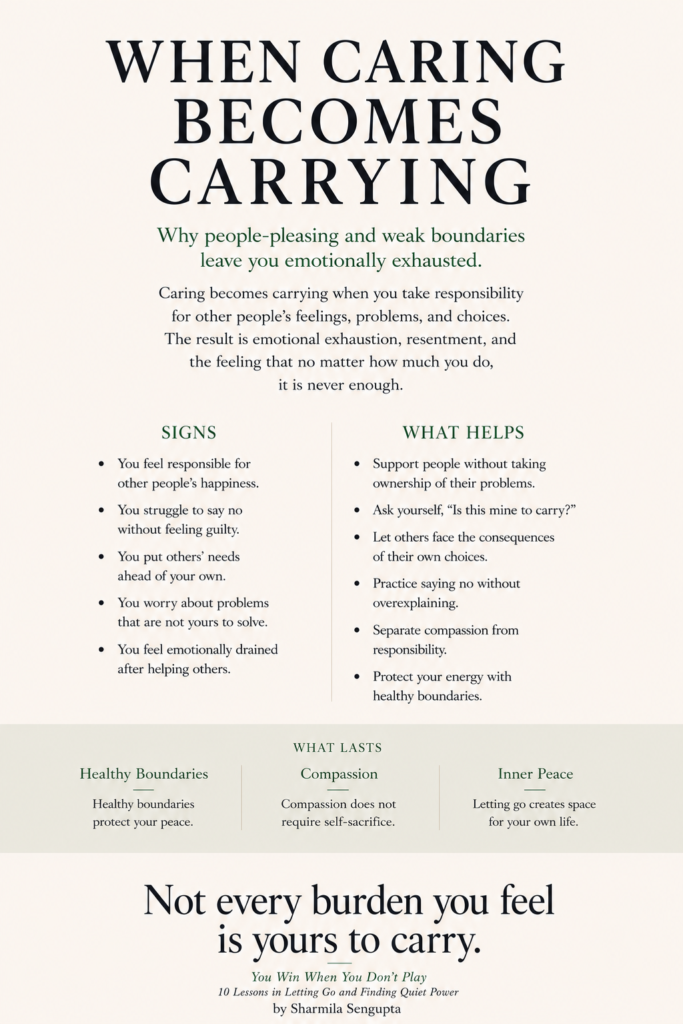
Signs That Caring Has Become Carrying
Many people do not realize they are carrying too much until emotional exhaustion appears.
What begins as kindness can gradually become emotional over-responsibility.
The following signs may indicate that caring has become carrying.
1. You Feel Responsible for Other People’s Happiness
You believe it is your job to keep everyone emotionally comfortable, satisfied, and supported.
When someone is upset, you immediately feel responsible for fixing it.
2. You Struggle to Say No
Even healthy boundaries trigger guilt.
You agree to things you do not want to do because disappointing people feels uncomfortable.
3. You Put Other People’s Needs Ahead of Your Own
Your needs consistently move to the bottom of the list.
You take care of everyone else first and hope there is enough energy left for yourself.
4. You Worry About Problems That Are Not Yours to Solve
You spend significant mental energy trying to manage situations that are outside your control.
5. You Feel Emotionally Drained After Helping Others
Supporting people leaves you exhausted instead of fulfilled.
6. You Constantly Overthink Interactions
You replay conversations and worry about whether someone is upset, disappointed, or judging you.
The Hidden Cost of Carrying Too Much
People-pleasing often appears helpful on the surface.
But beneath the surface are significant emotional costs.
1. Emotional Burnout
When you continually carry responsibilities that do not belong to you, emotional burnout becomes likely.
Your emotional reserves become depleted.
You feel tired even when you are not physically exhausted.
2. Chronic Anxiety
Constantly monitoring other people’s emotions creates ongoing stress and worry.
You become hyperaware of potential conflict, criticism, or disappointment.
3. Resentment
Giving without boundaries often creates hidden resentment.
You may feel unappreciated, taken for granted, or overwhelmed by expectations.
4. Loss of Identity
You become so focused on what everyone else needs that you lose touch with your own desires, goals, and values.
5. Reduced Self-Worth
Every time you abandon yourself for approval, you reinforce the belief that your needs matter less.
Over time, this weakens self-trust and self-respect.
6. Relationship Burnout
Many people assume carrying others strengthens relationships.
Often, the opposite happens.
Relationships become unbalanced when one person consistently assumes emotional responsibility for everyone involved.
The Hidden Cost of Carrying Too Much
Reduced Emotional Availability
One of the most overlooked consequences of emotional exhaustion is reduced emotional availability.
When you spend so much time carrying other people’s burdens, you often have very little emotional energy left for the people who matter most. You may become distracted, withdrawn, irritable, or emotionally numb.
Ironically, trying to be available to everyone can leave you less available to the relationships you genuinely value. Protecting your emotional energy through healthy boundaries allows you to be more present, connected, and emotionally engaged.
How Emotional Burnout Develops
Emotional burnout rarely happens overnight.
It develops through repeated emotional overextension.
You keep helping.
You keep rescuing.
You keep carrying.
You keep saying yes.
Eventually, your emotional resources become depleted.
Common symptoms of emotional burnout include:
Constant fatigue
Feeling overwhelmed
Emotional numbness
Irritability
Increased anxiety
Difficulty concentrating
Loss of motivation
Feeling disconnected from yourself
Many people assume they simply need more rest.
Rest helps.
But emotional burnout often requires something deeper.
It requires releasing emotional responsibilities that were never yours to carry.
Recovery begins when you stop taking ownership of other people’s emotions, choices, and expectations.
The Difference Between Support and Rescue
One of the most important lessons in healthy boundaries is understanding the difference between support and rescue.
Many people who struggle with people-pleasing believe they are helping when they are actually rescuing.
Support empowers people.
Rescue creates dependence.
Support respects another person’s ability to handle challenges.
Rescue assumes responsibility for challenges that belong to someone else.
Support
Rescue
Listen
Fix
Encourage
Take over
Respect choices
Control outcomes
Offer guidance
Assume responsibility
Care
Carry
Support says:
“I believe you can handle this.”
Rescue says:
“Let me take care of this for you.”
Support helps people grow.
Rescue often prevents growth.
When caring becomes carrying, rescue replaces support.
Learning the difference allows you to remain compassionate without becoming emotionally exhausted.
Real-Life Examples of Caring vs Carrying
Understanding the concept intellectually is helpful.
Seeing it in everyday situations makes it easier to recognize.
1. In Friendships
A friend is struggling with a difficult decision.
Caring: Listening, offering perspective, and being supportive.
Carrying: Losing sleep over their decision and feeling responsible for the outcome.
2. In Families
A family member is dealing with financial problems.
Caring: Offering encouragement and practical support when appropriate.
Carrying: Taking responsibility for solving their problems while neglecting your own wellbeing.
3. In Romantic Relationships
Your partner is stressed about work.
Caring: Listening and being emotionally present.
Carrying: Believing it is your job to make their stress disappear.
4. At Work
A colleague is overwhelmed by deadlines.
Caring: Helping when you genuinely have capacity.
Carrying: Consistently taking on extra work at the expense of your own mental health.
In each situation, the difference comes down to emotional responsibility.
You are responsible for your actions and choices.
You are not responsible for managing everyone else’s life.
What Helps
The goal is not to stop caring.
The goal is to stop carrying.
1. Separate Compassion from Responsibility
You can care about someone’s struggle without becoming responsible for solving it.
2. Ask Yourself One Powerful Question
Whenever you feel overwhelmed, ask:
“Is this mine to carry?”
The answer is often revealing.
3. Allow Others to Own Their Choices
Growth requires responsibility.
People learn through facing the consequences of their own decisions.
4. Stop Overexplaining
A simple boundary does not require a lengthy justification.
5. Strengthen Self-Trust
The less validation you seek, the easier it becomes to protect your energy.
6. Focus on What You Can Control
Your energy is better spent managing:
Your actions
Your choices
Your responses
Your boundaries
Your wellbeing
rather than trying to manage everyone else’s emotions.
Why Healthy Boundaries Protect Your Mental Health
Healthy boundaries are one of the most effective tools for preventing emotional exhaustion.
Boundaries are not barriers that keep people away.
They are guidelines that protect your emotional wellbeing, mental health, and personal energy.
Without boundaries, it becomes easy to absorb other people’s stress, emotional burdens, expectations, and responsibilities.
With boundaries, you can remain caring without becoming overwhelmed.
Healthy boundaries help you:
Reduce emotional overload
Prevent emotional burnout
Strengthen self-respect
Improve self-worth
Reduce anxiety
Protect your peace
Build healthier relationships
Increase emotional resilience
Many people fear that setting boundaries will make them selfish.
In reality, boundaries are an act of emotional responsibility.
They allow you to care for others without sacrificing yourself.
They create relationships built on respect rather than resentment.
The strongest boundaries are often simple.
“I am not available right now.”
“That doesn’t work for me.”
“I care about you, but I can’t solve this for you.”
These statements protect your mental health while preserving your compassion.
How to Set Boundaries Without Feeling Guilty
One reason people struggle with boundaries is guilt.
Many of us were taught that saying no is selfish, disappointing people is wrong, or putting ourselves first is inconsiderate.
As a result, boundary setting can feel uncomfortable.
But guilt is not always a sign that you are doing something wrong.
Sometimes guilt is simply a sign that you are doing something differently.
When you begin setting healthy boundaries, people may react.
Some may be surprised.
Some may resist.
Some may prefer the version of you that never said no.
That does not mean your boundary is wrong.
Healthy boundaries protect your emotional wellbeing.
They prevent emotional burnout.
They reduce resentment.
They create healthier relationships built on respect rather than obligation.
Instead of asking:
“Will everyone approve of this boundary?”
Ask:
“Is this boundary necessary for my wellbeing?”
That question often provides a clearer answer.
The goal is not to eliminate guilt completely.
The goal is to stop allowing guilt to make your decisions for you.
5 Small Boundary Scripts That Protect Your Peace
Many people know they need boundaries but struggle to find the words.
Simple language is often the most effective.
1. When Someone Wants You to Fix Their Problem
“I care about you, but I can’t solve this for you.”
2. When You Need Time to Think
“I need some time to think about that before I answer.”
3. When You Do Not Have Capacity
“I would like to help, but I don’t have the capacity right now.”
4. When Something Doesn’t Work for You
“That doesn’t work for me.”
5. When You Need to Protect Your Energy
“I understand your situation, but I need to take care of my own wellbeing right now.”
These statements may feel uncomfortable at first.
But every healthy boundary strengthens self-respect, emotional resilience, and self-trust.
The more you practice them, the easier they become.
Eventually, protecting your peace feels natural rather than selfish.
Building Emotional Resilience Instead of Emotional Responsibility
Many people spend years carrying emotional responsibility for everyone around them.
They believe it is their job to keep the peace, solve problems, prevent disappointment, and manage relationships.
This responsibility becomes exhausting because much of it is impossible.
You cannot control other people’s emotions.
You cannot control their reactions.
You cannot control their choices.
What you can develop instead is emotional resilience.
Emotional resilience is the ability to remain compassionate without becoming overwhelmed.
It allows you to care deeply while maintaining healthy boundaries.
It helps you respond thoughtfully rather than react emotionally.
Most importantly, emotional resilience allows you to support others without sacrificing your own mental health.
The goal is not to become less caring.
The goal is to become emotionally strong enough to care without carrying.
Building Emotional Resilience Instead of Emotional Responsibility
Emotional resilience grows when you learn to regulate your emotions without taking responsibility for everyone else’s. Instead of absorbing stress, you learn to acknowledge it without carrying it. Instead of reacting to every emotional demand, you learn to pause, reflect, and choose your response.
This ability to practice emotional regulation while maintaining healthy boundaries creates a stronger foundation for long-term emotional wellbeing.
That is where freedom begins.
Practical Exercise: The Responsibility Audit
Take a sheet of paper and draw two columns.
Mine
My choices
My actions
My emotions
My boundaries
My wellbeing
My responses
My personal growth
Not Mine
Other people’s feelings
Other people’s expectations
Other people’s reactions
Other people’s choices
Other people’s happiness
Other people’s opinions of me
Other people’s life decisions
Whenever you feel emotionally overwhelmed, review the list.
This simple exercise can help you separate compassion from responsibility and support from rescue.
What Lasts
Healthy Boundaries
Healthy boundaries protect your peace.
Compassion
Compassion does not require self-sacrifice.
Inner Peace
Letting go creates space for your own life.
What I Have Learned About Caring and Carrying
For many years, I confused caring with responsibility.
If someone I loved was struggling, I felt compelled to fix it.
If someone was disappointed, I assumed I had failed them.
If someone was unhappy, I felt responsible.
What I did not realize was that I was slowly carrying emotional burdens that were never mine.
The result was not deeper connection.
The result was emotional exhaustion.
Over time, I learned that supporting people and carrying people are not the same thing.
I learned that healthy relationships require boundaries.
I learned that self-worth cannot depend on approval.
Most importantly, I learned that compassion becomes sustainable only when it is balanced with self-respect.
People did not need me to carry their burdens.
They needed me to respect their ability to carry their own.
That realization changed the way I think about relationships, boundaries, and inner peace.
When caring becomes carrying, emotional exhaustion often follows. Healthy boundaries help you protect your peace, reduce emotional burnout, and care for others without losing yourself.
Key Takeaways
Caring and carrying are not the same thing.
Emotional labor can become emotional overload.
People-pleasing often leads to emotional exhaustion and burnout.
Approval seeking weakens self-trust.
Self-abandonment damages self-worth.
Healthy boundaries protect your mental health.
Compassion does not require self-sacrifice.
Emotional resilience is more sustainable than emotional responsibility.
You are not responsible for everyone else’s happiness.
Inner peace grows when you let go of what is not yours to carry.
Final Reflection
Many people spend years carrying emotional burdens that were never theirs.
They carry expectations.
They carry guilt.
They carry responsibility for emotions they cannot control.
They carry the mental load of relationships, trying to keep everyone comfortable while neglecting themselves.
But freedom begins with a simple realization:
Not every burden you feel is yours to carry.
The moment you stop carrying what belongs to others, you create space for your own life.
You create space for self-care.
You create space for healthier relationships.
You create space for self-respect.
And perhaps most importantly, you create space for peace.
Understanding the connection between people pleasing and emotional exhaustion is often the first step toward building healthier boundaries and finding greater inner peace.
A Lesson From You Win When You Don’t Play
One of the central lessons in You Win When You Don’t Play: 10 Lessons in Letting Go and Finding Quiet Power is that peace often comes from stepping out of roles we were never meant to play.
Many people become trapped in cycles of people-pleasing, approval seeking, overthinking, emotional dependency, and emotional over-responsibility.
The book explores how letting go of these patterns can help you build stronger boundaries, trust yourself more deeply, and discover a quieter form of strength.
Sometimes winning is not about doing more.
Sometimes winning is about carrying less.
If these ideas resonate with you, you’ll find them explored more deeply in You Win When You Don’t Play: 10 Lessons in Letting Go and Finding Quiet Power.
If something in this article felt familiar, you’re not alone.
Many of us spend years carrying things we were never taught how to release.
We carry overthinking long after the situation has ended.
We carry the weight of other people’s expectations.
We carry disappointment when life doesn’t go as planned.
We carry old stories about who we should be and struggle to understand why they still have so much power over us.
These are the questions that eventually led me to write You Win When You Don’t Play: 10 Lessons in Letting Go and Finding Quiet Power.
The book explores many of the themes woven throughout this article, including:
How to stop overthinking and find greater mental clarity
Letting go of validation-seeking and the need for approval
People-pleasing, self-abandonment, and learning to set healthy boundaries
Emotional exhaustion, burnout, and carrying too much for too long
Rebuilding self-worth after disappointment and difficult life experiences
Finding peace when life doesn’t go as planned
Grieving lost dreams and letting go of expectations
Emotional resilience during difficult life transitions
Self-discovery, inner peace, and emotional freedom
Learning how to trust yourself again
But more than anything, it explores a simple idea I’ve returned to again and again:
Not every struggle deserves your energy.
Not every battle needs to be won.
And not every burden needs to be carried.
Along the way, the book explores the invisible competitions, emotional pressures, and exhausting patterns that many of us carry without realizing how much they cost us.
Not to offer perfect answers.
But to help us see ourselves more clearly.
To understand ourselves more honestly.
And to recognize what may finally be ready to be released.
Because peace is rarely found by becoming more.
It is often found by needing less.
Less approval.
Less proving.
Less carrying what was never ours to hold.
Perhaps that’s why letting go often feels less like losing something and more like coming home to yourself.
Buy the Book on Amazon
Whether you’re struggling with overthinking, emotional exhaustion, people-pleasing, difficult relationships, self-worth, chronic stress, or the feeling that you’ve lost yourself beneath other people’s expectations, I hope the book offers the same thing I try to offer through my writing:
A different perspective.
A little more clarity.
And a gentler way forward.
You can learn more about the book or get your copy here:
Ask Sharmila – Personal Guidance for Overthinking, Emotional Exhaustion, Self-Worth, and Life’s Difficult Questions
Sometimes the hardest part isn’t finding advice.
It’s making sense of what you’re carrying.
Perhaps you’ve been overthinking the same situation for weeks. Perhaps you’re emotionally exhausted from trying to keep everyone happy. Or maybe you’re struggling to let go of a difficult relationship, rebuild your self-worth after disappointment, or find peace when life doesn’t go as planned.
Many of us carry questions that don’t have simple answers.
Questions about boundaries.
Questions about people-pleasing.
Questions about validation.
Questions about emotional healing, difficult life transitions, and how to stop carrying responsibilities that were never ours to hold.
You don’t have to figure it all out alone.
Through Ask Sharmila, you’re invited to share a question that’s been weighing on you.
Together, we’ll look beneath the surface of the situation—not to find perfect answers, but to uncover a clearer perspective and a gentler way forward.
Over Time, I’ve Noticed That Many Questions Tend to Circle Around the Same Themes
How to stop overthinking and replaying conversations
Emotional exhaustion and feeling drained by life
People-pleasing recovery and setting healthy boundaries
Seeking validation from others
Rebuilding self-worth after disappointment
Difficult relationships and emotional resilience
Letting go of expectations that no longer fit your life
Grieving the life you thought you’d have
Learning how to let go when life doesn’t unfold as expected
Finding inner peace during challenging life transitions
Living more intentionally and trusting yourself again
One thing I’ve learned is that a new perspective doesn’t always change the situation.
I’ve seen people spend months stuck in the same thought loop, only to discover that what they needed wasn’t another solution.
It was a different way of seeing the situation.
And sometimes that’s where healing begins.
Personal Reflection and Written Guidance – ₹499
Every question is read personally by me, and every response is written thoughtfully and individually.
You Will Receive
A personal written response tailored to your situation
Thoughtful reflection grounded in emotional healing, self-discovery, and personal growth
Practical perspective and gentle guidance
Support for overthinking, emotional exhaustion, people-pleasing, self-worth struggles, boundaries, validation, difficult relationships, and major life transitions
Personal Written Guidance for Overthinking, Emotional Exhaustion, Self-Worth, and Life’s Difficult Questions
The goal is not to have all the answers.
The goal is to understand yourself more clearly, carry less emotional weight, and discover a calmer, more compassionate way forward.
Sometimes clarity begins when we stop asking,
“How do I fix this?”
and start asking,
“What is this situation trying to teach me?”
Often, that’s where a gentler way forward begins.
Frequently Asked Questions
What is the difference between caring and carrying?
Caring means offering support, compassion, and understanding while respecting another person’s responsibility for their own choices and emotions. Carrying happens when you take ownership of problems, feelings, or outcomes that do not belong to you. Caring is healthy. Carrying often leads to emotional exhaustion, anxiety, and burnout because you are attempting to manage things outside your control.
Why does people-pleasing cause emotional exhaustion?
People-pleasing often requires you to ignore your own needs while focusing excessively on the needs and expectations of others. Over time, this creates emotional overload, chronic stress, and resentment. Constantly seeking approval and avoiding conflict can leave you emotionally drained because your wellbeing becomes dependent on other people’s reactions.
What is emotional labor?
Emotional labor is the invisible work involved in managing emotions, providing reassurance, resolving conflicts, and carrying the mental load of relationships. While emotional labor is a natural part of healthy relationships, excessive emotional labor can contribute to emotional exhaustion, compassion fatigue, and burnout.
What are signs of emotional burnout?
Common signs of emotional burnout include constant fatigue, irritability, anxiety, emotional numbness, difficulty concentrating, loss of motivation, and feeling overwhelmed by everyday responsibilities. Emotional burnout often develops gradually when you consistently carry emotional burdens that do not belong to you.
Why do I feel responsible for everyone?
Many people develop this pattern in childhood or early relationships. They may have learned that being helpful, agreeable, or responsible earned approval and acceptance. Over time, this belief can evolve into emotional over-responsibility, where you feel responsible for other people’s happiness, comfort, or emotional wellbeing.
How do healthy boundaries reduce stress?
Healthy boundaries reduce stress by helping you separate what is within your control from what is not. They protect your emotional energy, reduce resentment, improve self-respect, and prevent emotional burnout. Boundaries allow you to care for others without sacrificing your own wellbeing.
Is setting boundaries selfish?
No. Healthy boundaries are not selfish. They are an important form of self-care and emotional responsibility. Boundaries help create healthier, more balanced relationships because they prevent resentment and emotional exhaustion while encouraging mutual respect.
Can people-pleasing damage relationships?
Yes. While people-pleasing may seem helpful, it often creates unhealthy dynamics. When one person consistently prioritizes everyone else’s needs, resentment can build. Relationships thrive when both people take responsibility for their own emotions, needs, and choices.
Why do I feel guilty when I say no?
Many people associate saying no with disappointing others or being selfish. If your self-worth has become connected to approval, setting boundaries may trigger guilt. However, guilt is not always a sign that you are doing something wrong. Sometimes it simply means you are learning a healthier way of relating to others.
How can I stop carrying other people’s problems?
Start by asking yourself: “Is this mine to carry?” Focus on what you can control—your actions, choices, boundaries, and responses—and let go of responsibility for other people’s emotions, expectations, and decisions. Supporting people is healthy. Carrying their lives is not.
About Sharmila Sengupta
I’m Sharmila Sengupta, author of You Win When You Don’t Play: 10 Lessons in Letting Go and Finding Quiet Power.
Over the years, I’ve become fascinated by the quiet struggles many of us carry but rarely talk about openly—the exhaustion of overthinking, the weight of people-pleasing, the search for validation, the challenge of setting healthy boundaries, and the grief that comes when life doesn’t go as planned.
Much of my writing begins with things I’ve noticed—in my own life, in conversations with others, and in the quiet struggles many of us carry without talking about them.
I’ve noticed how often we replay old conversations, question our self-worth, compare our lives to others, or carry emotional burdens that were never ours to hold. I’ve also noticed that many of us are quietly grieving lost dreams, coping with disappointment in life, navigating difficult life transitions, or learning how to let go of expectations about the future.
Perhaps you’ve found yourself asking some of those same questions.
How do I stop overthinking?
How do I let go of expectations that no longer fit my life?
Why do I feel emotionally exhausted even when everything seems fine on the surface?
How do I find peace when life doesn’t go as planned?
How do I stop seeking validation from other people?
How do I rebuild self-worth after disappointment or difficult relationships?
These are the questions that often inspire my writing.
Again and again, they seem to lead back to the same lesson: peace often begins when we stop carrying what was never ours to hold.
Through my articles and books, I reflect on emotional healing, personal growth, self-discovery, emotional resilience, and the quiet work of learning how to let go of what no longer serves us. Not as someone with all the answers, but as a fellow traveller who continues to learn what it means to let go, trust life a little more, and find strength in quieter ways.
My hope is that readers leave feeling less alone, more understood, and a little gentler with themselves than they were before they arrived.