
How people-pleasing, approval seeking, weak boundaries, emotional labor, and the need for validation can lead to emotional exhaustion and emotional burnout.
Why Do Other People’s Expectations Feel So Heavy?
Do you constantly worry about disappointing others? Do you find yourself saying yes when you want to say no? If other people’s expectations often feel heavier than your own needs, you may be experiencing emotional exhaustion, people-pleasing, and chronic stress. Many people carry emotional responsibilities that do not belong to them, leaving them feeling overwhelmed, mentally drained, and disconnected from themselves.
Ask yourself:
- Do you feel emotionally exhausted trying to meet everyone’s expectations?
- Do you seek approval before making important decisions?
- Do you feel guilty when you prioritize your own needs?
If these questions feel familiar, you may be carrying emotional burdens that were never yours to carry.
Why Do Other People’s Expectations Become a Burden?
Other people’s expectations become a burden when your self-worth becomes tied to approval, validation, and avoiding disappointment. Over time, people-pleasing, weak boundaries, emotional labor, and chronic stress can lead to emotional exhaustion, mental fatigue, emotional overwhelm, and emotional burnout.
Many people believe they are simply being caring, supportive, or responsible. In reality, they may be carrying emotional responsibilities that do not belong to them. When your sense of worth depends on keeping everyone happy, meeting expectations can start to feel like an obligation rather than a choice.
The more you seek approval and fear disappointing others, the heavier these expectations become. Learning to separate empathy from responsibility is essential for building healthy boundaries, protecting your emotional energy, and creating lasting inner peace.
When Other People’s Expectations Become Your Burden
Have you ever felt responsible for making everyone around you happy?
Do you find yourself worrying about how other people will react to your decisions?
Do you spend more time managing expectations than listening to your own needs?
Many people experience emotional exhaustion because they unconsciously carry expectations that were never theirs to carry.
At first, it feels like kindness.
You help.
You support.
You accommodate.
You sacrifice.
Over time, however, caring becomes carrying.
The emotional weight grows heavier.
The pressure to avoid disappointing others becomes exhausting.
You begin making decisions based on fear rather than values.
You stop asking what you want.
You start asking what everyone else expects.
This is often where emotional labor, people-pleasing, chronic stress, and emotional burnout begin.
Why People-Pleasing and Approval Seeking Make Other People’s Expectations Feel Like Your Responsibility
Most people are not born believing they must meet everyone’s expectations.
This belief is often learned through childhood experiences, family dynamics, social conditioning, and a deep desire for approval.
Many of us receive praise when we are:
- Helpful
- Responsible
- Accommodating
- Successful
- Self-sacrificing
These experiences teach us that approval feels safe.
We learn that being liked feels rewarding.
We learn that disappointing others feels uncomfortable.
Over time, this conditioning creates a powerful connection between self-worth and approval.
Instead of asking:
“What feels right for me?”
we begin asking:
“What will make everyone else happy?”
This shift can slowly disconnect us from our own needs, values, and emotional well-being.
The more we focus on meeting expectations, the less attention we give to ourselves.
How Validation, Social Conditioning, and Fear of Disappointing Others Create Emotional Exhaustion
Modern life often reinforces these patterns.
Social media encourages comparison.
Workplaces reward constant availability.
Families sometimes celebrate self-sacrifice.
Society often praises people who put everyone else first.
As a result, many people develop a strong need for external validation.
They begin measuring their worth through:
- Approval
- Praise
- Recognition
- Acceptance
- Achievement
The problem is that validation is temporary.
No amount of approval can create lasting self-worth.
There will always be another expectation.
Another standard.
Another person to please.
Another demand on your time and emotional energy.
Research in psychology suggests that relying heavily on external validation can increase anxiety, emotional distress, and chronic stress. When our self-worth depends on how others respond to us, we lose a sense of control over our emotional well-being.
This is why many people feel emotionally drained even when they are doing everything “right.”
The pursuit of approval never truly ends.
Why Seeking Approval Creates Emotional Exhaustion
Seeking approval may feel harmless at first, but over time it can become one of the biggest causes of emotional exhaustion, people-pleasing, and chronic stress.
When your self-worth depends on other people’s opinions, you begin making decisions based on external validation rather than your own values. Instead of asking what feels right for you, you start focusing on what will gain approval, avoid criticism, or prevent disappointment.
This creates a constant cycle of emotional labor.
You worry about how people perceive you.
You overthink conversations.
You replay interactions in your mind.
You try to avoid conflict.
You take responsibility for other people’s reactions.
Over time, this approval-seeking behavior can lead to emotional overwhelm, mental fatigue, anxiety, and emotional burnout.
Many people who struggle with people-pleasing believe they are simply being considerate. In reality, they are often carrying the emotional weight of maintaining relationships, managing expectations, and protecting themselves from rejection.
The problem is that approval is temporary.
No matter how hard you try, there will always be another expectation to meet, another opinion to consider, and another person to please.
This is why external validation rarely creates lasting confidence.
True self-worth comes from self-trust, self-respect, and the ability to make decisions that align with your values rather than your fear of judgment.
The less dependent you become on approval, the more emotional freedom you gain.
And the more emotional freedom you gain, the less emotionally exhausted, overwhelmed, and mentally drained you become.
Common Causes of Carrying Other People’s Expectations
1. People-Pleasing
People-pleasers often prioritize other people’s needs above their own.
They fear conflict.
They fear rejection.
They fear disappointing others.
As a result, they take on emotional burdens that were never theirs to carry.
2. Weak Boundaries
Without healthy boundaries, it becomes difficult to distinguish between your responsibilities and someone else’s expectations.
Everything begins to feel like your responsibility.
3. Fear of Rejection
Many people meet expectations because they worry that saying no will damage relationships.
This fear can become a powerful driver of emotional exhaustion.
4. Low Self-Worth
When self-worth depends on approval, meeting expectations feels necessary for emotional safety.
5. Emotional Responsibility
Some people believe they are responsible for managing everyone else’s emotions.
They feel guilty when someone is upset.
They feel responsible when someone is disappointed.
This creates enormous emotional pressure.
6. Overthinking
Overthinking often magnifies expectations.
A simple request becomes a source of anxiety.
A minor disagreement becomes a major concern.
The mind constantly tries to predict, prevent, and control negative outcomes.
This mental fatigue contributes significantly to emotional exhaustion.
Signs You Are Carrying Other People’s Expectations and Neglecting Your Own Needs
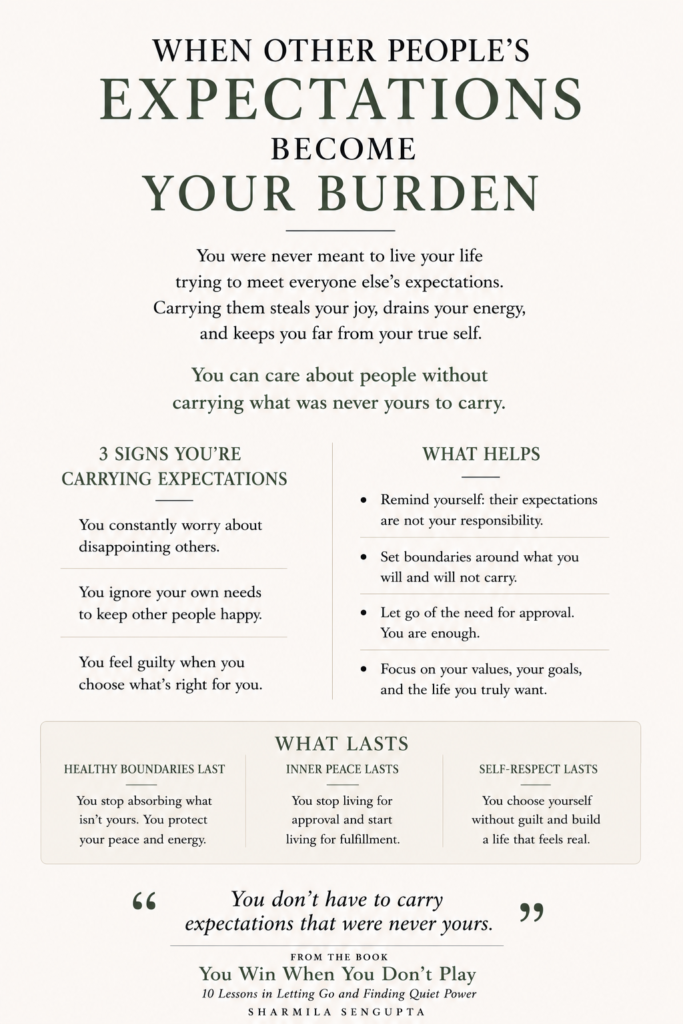
1. You Constantly Worry About Disappointing Others
Even small decisions create anxiety because you fear how people will react.
2. You Feel Guilty When You Set Boundaries
Saying no feels selfish, even when you are emotionally exhausted.
3. You Seek Approval Before Making Decisions
You struggle to trust yourself without reassurance from others.
4. You Ignore Your Own Needs
Your needs consistently come last.
You prioritize everyone else’s comfort, happiness, and expectations.
5. You Feel Responsible for Other People’s Emotions
You believe it is your job to prevent disappointment, conflict, sadness, or frustration.
6. You Feel Emotionally Exhausted
You spend so much energy managing expectations that there is very little left for yourself.
7. You Struggle to Relax
Even when nothing is wrong, your mind remains focused on responsibilities, expectations, and obligations.
The Hidden Cost of People-Pleasing, Weak Boundaries, and Emotional Labor
The consequences of carrying other people’s expectations often extend far beyond stress.
Many people experience:
- Emotional exhaustion
- Emotional overwhelm
- Mental fatigue
- Anxiety
- Chronic stress
- Decision fatigue
- Emotional burnout
- Resentment
- Loss of self-confidence
- Reduced emotional resilience
Perhaps the greatest cost is losing touch with yourself.
You become so focused on meeting expectations that you forget what you actually want.
You become an expert at managing other people’s needs while neglecting your own.
Over time, this creates a growing sense of frustration, emptiness, and emotional depletion.
Emotional Exhaustion vs Emotional Burnout
Although the terms are often used interchangeably, emotional exhaustion and emotional burnout are not exactly the same.
| Emotional Exhaustion | Emotional Burnout |
|---|---|
| Emotional depletion | Emotional and physical depletion |
| Often linked to relationships and emotional labor | Often linked to prolonged work stress |
| Can develop from people-pleasing | Often develops from chronic overload |
| Feeling emotionally drained | Feeling completely depleted |
| May improve with stronger boundaries | Often requires significant recovery |
| Common among caregivers and helpers | Common among overworked professionals |
Many people who carry other people’s expectations experience emotional exhaustion long before they reach full burnout.
Recognizing the signs early can help you protect your emotional well-being before the problem becomes more serious.
What Research Says About Emotional Exhaustion and Chronic Stress
Research consistently shows that chronic stress affects both mental and physical health.
Studies have linked prolonged stress to:
- Increased anxiety
- Sleep difficulties
- Reduced concentration
- Emotional fatigue
- Depression symptoms
- Lower resilience
- Increased risk of burnout
Researchers studying emotional labor have also found that constantly managing emotions—both your own and other people’s—can contribute significantly to emotional exhaustion.
This is particularly relevant for people who:
- Care for family members
- Work in helping professions
- Struggle with people-pleasing
- Feel responsible for other people’s emotions
- Constantly seek approval
The lesson is simple but powerful:
Your emotional energy is a limited resource.
The more you spend trying to manage other people’s expectations, the less you have available for your own well-being.
Emotional Exhaustion in Relationships
Relationships are one of the most common places where other people’s expectations become a burden.
Healthy relationships are built on mutual respect, communication, personal responsibility, and healthy boundaries. However, many people find themselves trapped in patterns of people-pleasing, conflict avoidance, emotional labor, and approval-seeking that slowly drain their emotional energy.
You may find yourself:
- Constantly trying to avoid conflict
- Managing another person’s moods
- Walking on eggshells
- Feeling responsible for someone else’s happiness
- Ignoring your own needs to keep the peace
- Seeking approval to avoid rejection
- Taking responsibility for problems you did not create
Over time, these patterns create relationship stress and emotional exhaustion.
The relationship may begin to feel less like a source of support and more like a source of pressure.
Many people mistake this emotional burden for love.
In reality, it is often emotional labor.
The Role of Codependent Relationships
In codependent relationships, one person often becomes overly responsible for the emotions, needs, or problems of another.
They may feel responsible for:
- Fixing problems
- Preventing disappointment
- Managing emotions
- Keeping the relationship stable
- Making sure everyone is happy
This can create chronic stress, emotional overwhelm, and emotional burnout.
The more responsibility you take for another person’s emotional well-being, the less energy you have for your own.
Over time, codependent relationships can weaken self-worth, increase anxiety, and contribute to emotional exhaustion.
Emotionally Draining Relationships
Not every relationship is emotionally draining, but some relationships require so much emotional labor that they leave you feeling mentally exhausted.
Signs of emotionally draining relationships include:
- Feeling depleted after conversations
- Constantly giving emotional support without receiving it
- Feeling responsible for solving someone else’s problems
- Repeated conflict and unresolved tension
- Frequent guilt, obligation, or resentment
- Lack of respect for your boundaries
If you regularly feel emotionally drained after interacting with someone, it may be a sign that the relationship is demanding more emotional energy than it is giving back.
Conflict Avoidance and Emotional Exhaustion
Many people carry other people’s expectations because they fear conflict.
They believe that saying no, expressing a different opinion, or setting boundaries will damage the relationship.
As a result, they avoid difficult conversations and suppress their own needs.
This pattern of conflict avoidance often creates more stress rather than less.
Unspoken frustrations build over time.
Resentment grows.
Emotional exhaustion increases.
Healthy relationships allow room for disagreement, honesty, and boundaries.
You do not need to sacrifice your emotional well-being to maintain connection.
Healthy Relationships Do Not Require Self-Abandonment
One of the most important lessons in emotional well-being is understanding that healthy relationships do not require you to abandon yourself.
You can be supportive without becoming responsible.
You can be compassionate without carrying another person’s emotional burden.
You can care deeply without sacrificing your peace.
The strongest relationships are not built on self-sacrifice.
They are built on mutual respect, healthy boundaries, emotional responsibility, and the freedom for both people to be themselves.
When Family Expectations Become a Burden
Family expectations can be especially difficult to navigate.
Many people grow up believing they must:
- Meet family standards
- Follow a predetermined path
- Avoid disappointing parents
- Prioritize family approval
- Suppress their own desires
Family expectations often feel more powerful because they are connected to identity, belonging, and emotional safety.
As a result, many adults continue carrying expectations that no longer align with their values.
The challenge is learning that gratitude and obedience are not the same thing.
You can love your family without living your entire life according to their expectations.
The Link Between Overthinking and Expectations
Overthinking often amplifies expectations.
The mind constantly asks:
- What if they are disappointed?
- What if they are upset?
- What if they judge me?
- What if I make the wrong decision?
- What if I let someone down?
These thoughts create anxiety and mental fatigue.
The more you overthink, the heavier expectations begin to feel.
Many people believe overthinking helps them avoid mistakes.
In reality, it often increases emotional exhaustion.
The mind becomes trapped in a cycle of worry, approval-seeking, and self-doubt.
One of the most important steps toward inner peace is learning to tolerate uncertainty.
Not everyone will approve of your decisions.
That is okay.
How to Stop Carrying Other People’s Expectations and Protect Your Emotional Energy
1. Remember That Expectations Are Not Obligations
People are allowed to have expectations.
You are allowed to decide whether those expectations align with your values.
Someone else’s expectation does not automatically become your responsibility.
2. Separate Caring From Carrying
This distinction changes everything.
You can care deeply about people without carrying their emotional burdens.
You can support someone without sacrificing your own well-being.
You can be compassionate without becoming responsible for someone else’s life.
3. Learn to Tolerate Disappointment
Many people carry expectations because they fear disappointing others.
The truth is:
People can be disappointed without you being wrong.
Disappointment is a normal part of life.
You are not responsible for protecting everyone from uncomfortable emotions.
4. Strengthen Healthy Boundaries
Boundaries are not walls.
Boundaries are guidelines that protect your:
- Time
- Energy
- Emotional well-being
- Self-respect
- Mental health
Healthy boundaries reduce emotional exhaustion because they help you distinguish between your responsibilities and someone else’s expectations.
5. Build Internal Validation
The more you trust yourself, the less dependent you become on approval from others.
Internal validation means recognizing your worth without constantly seeking reassurance.
This is one of the most powerful forms of emotional resilience.
Practical Exercise: The Expectation Audit
Take a sheet of paper and divide it into two columns.
Column One: Expectations I Carry
Write down every expectation you feel pressured to meet.
Examples:
- Always being available
- Never disappointing anyone
- Solving everyone’s problems
- Keeping everyone happy
- Being perfect
- Avoiding conflict
Column Two: Expectations I Choose
Review each item and ask:
- Does this align with my values?
- Is this helping or harming my well-being?
- Am I choosing this freely?
- Am I acting from fear or authenticity?
Many people discover that they are carrying expectations they never consciously agreed to.
Awareness is often the first step toward freedom.
What Happens When You Stop Living for Other People’s Approval
The goal is not to stop caring.
The goal is to stop carrying.
When you release unnecessary emotional burdens, something remarkable happens.
Healthy Boundaries Last
You stop feeling responsible for everyone’s emotions.
You protect your energy without guilt.
Inner Peace Lasts
You spend less time seeking approval and more time trusting yourself.
Self-Respect Lasts
Your decisions become guided by values rather than fear.
Emotional Resilience Lasts
You become more capable of handling criticism, disappointment, and uncertainty.
Authentic Relationships Last
The people who truly care about you learn to respect your boundaries rather than depend on your self-sacrifice.
What I Have Learned About Other People’s Expectations
One lesson I continue to learn is that many people confuse kindness with self-sacrifice.
For years, I believed that being a good person meant carrying more than my share.
I believed that saying yes was generous.
I believed that avoiding disappointment was responsible.
I believed that if people were upset with me, I had done something wrong.
Without realizing it, I had tied my self-worth to approval.
The more approval I received, the better I felt.
The more criticism I encountered, the more I questioned myself.
Looking back, I can see how exhausting that way of living was.
It created emotional exhaustion because I was constantly monitoring how other people felt.
It created anxiety because I was always trying to prevent disappointment.
It created emotional overwhelm because I believed every expectation required my attention.
The turning point came when I began asking a different question.
Instead of asking:
“What do they want from me?”
I started asking:
“What is true for me?”
That simple shift changed everything.
I realized that other people’s expectations are often reflections of their own needs, preferences, fears, and beliefs.
They are not always instructions for how I should live my life.
I learned that boundaries are not acts of rejection.
They are acts of self-respect.
I learned that saying no does not make me selfish.
I learned that disappointing someone does not automatically mean I have done something wrong.
Most importantly, I learned that self-worth cannot be built on approval.
Approval is unpredictable.
Self-respect is not.
Today, I still care deeply about people.
But I no longer believe it is my responsibility to carry expectations that do not belong to me.
That distinction has brought more peace, clarity, and emotional resilience into my life than almost anything else.
Key Takeaways
- Other people’s expectations are not automatically your responsibility.
- People-pleasing often develops from a need for approval and validation.
- Emotional labor can contribute significantly to emotional exhaustion and burnout.
- Healthy boundaries protect your emotional energy and mental well-being.
- Self-worth grows when it comes from within rather than from external approval.
- Overthinking often makes expectations feel heavier than they actually are.
- Emotional resilience increases when you stop trying to control how everyone feels about you.
- You can care about people without carrying their emotional burdens.
- Inner peace begins when you stop living for approval and start living according to your values.
Final Reflection
When other people’s expectations become your burden, life begins to feel heavier than it needs to be.
You spend your energy managing reactions, avoiding disappointment, and chasing approval.
You become so focused on meeting expectations that you forget to ask what you actually want.
Over time, this can lead to emotional exhaustion, mental fatigue, emotional overwhelm, and a growing sense of disconnection from yourself.
Many people who carry other people’s expectations believe they are simply being caring, supportive, or responsible.
In reality, they may be carrying emotional responsibilities that were never theirs to carry.
People-pleasing often convinces us that our self-worth depends on keeping everyone happy. The truth is that lasting self-respect and emotional well-being are built by honoring your own values, not by meeting every expectation placed upon you.
You do not have to meet every expectation.
The more you stop seeking approval and start building healthy boundaries, the less emotionally drained and overwhelmed you will feel.
You do not have to keep everyone happy.
You do not have to sacrifice your well-being to gain approval.
You can care deeply without carrying the emotional weight of other people’s lives.
That is where healthier boundaries begin.
And often, that is where inner peace begins too.
A Lesson From You Win When You Don’t Play
One of the central lessons in You Win When You Don’t Play: 10 Lessons in Letting Go and Finding Quiet Power is that peace often comes from refusing to participate in battles that were never yours to fight.
Many of us spend years trying to earn approval, manage expectations, avoid criticism, and keep everyone happy.
We believe that if we try hard enough, we can finally reach a point where everyone approves of us.
But that moment never arrives.
There will always be another expectation.
Another opinion.
Another demand.
Another standard.
Real freedom begins when you stop measuring your worth through other people’s approval.
The moment you stop carrying expectations that do not belong to you, you reclaim your energy, your confidence, and your peace.
Sometimes the most powerful thing you can do is stop playing a game you were never meant to win.
If these ideas resonate with you, you’ll find them explored more deeply in You Win When You Don’t Play: 10 Lessons in Letting Go and Finding Quiet Power.
Learn More About the Book
If something in this article felt familiar, you’re not alone.
Many of us spend years carrying things we were never taught how to release.
We carry overthinking long after the situation has ended.
We carry the weight of other people’s expectations.
We carry disappointment when life doesn’t go as planned.
We carry old stories about who we should be and struggle to understand why they still have so much power over us.
These are the questions that eventually led me to write You Win When You Don’t Play: 10 Lessons in Letting Go and Finding Quiet Power.
The book explores many of the themes woven throughout this article, including:
- How to stop overthinking and find greater mental clarity
- Letting go of validation-seeking and the need for approval
- People-pleasing, self-abandonment, and learning to set healthy boundaries
- Emotional exhaustion, burnout, and carrying too much for too long
- Rebuilding self-worth after disappointment and difficult life experiences
- Finding peace when life doesn’t go as planned
- Grieving lost dreams and letting go of expectations
- Emotional resilience during difficult life transitions
- Self-discovery, inner peace, and emotional freedom
- Learning how to trust yourself again
But more than anything, it explores a simple idea I’ve returned to again and again:
Not every struggle deserves your energy.
Not every battle needs to be won.
And not every burden needs to be carried.
Along the way, the book explores the invisible competitions, emotional pressures, and exhausting patterns that many of us carry without realizing how much they cost us.
Not to offer perfect answers.
But to help us see ourselves more clearly.
To understand ourselves more honestly.
And to recognize what may finally be ready to be released.
Because peace is rarely found by becoming more.
It is often found by needing less.
Less approval.
Less proving.
Less carrying what was never ours to hold.
Perhaps that’s why letting go often feels less like losing something and more like coming home to yourself.
Buy the Book on Amazon
Whether you’re struggling with overthinking, emotional exhaustion, people-pleasing, difficult relationships, self-worth, chronic stress, or the feeling that you’ve lost yourself beneath other people’s expectations, I hope the book offers the same thing I try to offer through my writing:
A different perspective.
A little more clarity.
And a gentler way forward.
You can learn more about the book or get your copy here:
Ask Sharmila – Personal Guidance for Overthinking, Emotional Exhaustion, Self-Worth, and Life’s Difficult Questions
Sometimes the hardest part isn’t finding advice.
It’s making sense of what you’re carrying.
Perhaps you’ve been overthinking the same situation for weeks. Perhaps you’re emotionally exhausted from trying to keep everyone happy. Or maybe you’re struggling to let go of a difficult relationship, rebuild your self-worth after disappointment, or find peace when life doesn’t go as planned.
Many of us carry questions that don’t have simple answers.
Questions about boundaries.
Questions about people-pleasing.
Questions about validation.
Questions about emotional healing, difficult life transitions, and how to stop carrying responsibilities that were never ours to hold.
You don’t have to figure it all out alone.
Through Ask Sharmila, you’re invited to share a question that’s been weighing on you.
Together, we’ll look beneath the surface of the situation—not to find perfect answers, but to uncover a clearer perspective and a gentler way forward.
Over Time, I’ve Noticed That Many Questions Tend to Circle Around the Same Themes
- How to stop overthinking and replaying conversations
- Emotional exhaustion and feeling drained by life
- People-pleasing recovery and setting healthy boundaries
- Seeking validation from others
- Rebuilding self-worth after disappointment
- Difficult relationships and emotional resilience
- Letting go of expectations that no longer fit your life
- Grieving the life you thought you’d have
- Learning how to let go when life doesn’t unfold as expected
- Finding inner peace during challenging life transitions
- Living more intentionally and trusting yourself again
One thing I’ve learned is that a new perspective doesn’t always change the situation.
I’ve seen people spend months stuck in the same thought loop, only to discover that what they needed wasn’t another solution.
It was a different way of seeing the situation.
And sometimes that’s where healing begins.
Personal Reflection and Written Guidance – ₹499
Every question is read personally by me, and every response is written thoughtfully and individually.
You Will Receive
- A personal written response tailored to your situation
- Thoughtful reflection grounded in emotional healing, self-discovery, and personal growth
- Practical perspective and gentle guidance
- Support for overthinking, emotional exhaustion, people-pleasing, self-worth struggles, boundaries, validation, difficult relationships, and major life transitions
- A response within 5 days

Personal Written Guidance for Overthinking, Emotional Exhaustion, Self-Worth, and Life’s Difficult Questions
The goal is not to have all the answers.
The goal is to understand yourself more clearly, carry less emotional weight, and discover a calmer, more compassionate way forward.
Sometimes clarity begins when we stop asking,
“How do I fix this?”
and start asking,
“What is this situation trying to teach me?”
Often, that’s where a gentler way forward begins.
Frequently Asked Questions
Why do other people’s expectations affect me so much?
Many people learn from an early age to seek approval and avoid disappointment. Over time, this can create a strong emotional connection between self-worth and meeting other people’s expectations.
Is people-pleasing connected to emotional exhaustion?
Yes. Constantly trying to meet everyone’s expectations can drain emotional energy and contribute to emotional exhaustion, chronic stress, emotional overwhelm, and burnout.
Can other people’s expectations cause anxiety?
Yes. When your sense of worth becomes tied to approval, you may constantly worry about criticism, rejection, or disappointing others, which can increase anxiety and stress.
How do healthy boundaries reduce emotional exhaustion?
Healthy boundaries help you separate your responsibilities from the expectations and emotions of others. This protects your emotional energy and supports better mental well-being.
Why do I feel guilty when I set boundaries?
Many people associate boundaries with selfishness because they have been conditioned to prioritize other people’s needs. In reality, healthy boundaries are an important form of self-respect.
Why do I feel responsible for keeping everyone happy?
People who struggle with people-pleasing often develop a sense of emotional responsibility for other people’s feelings. This can lead to emotional labor, stress, and exhaustion.
Can emotional exhaustion affect relationships?
Yes. Emotional exhaustion can reduce patience, increase resentment, create communication difficulties, and make relationships feel overwhelming rather than supportive.
How do I stop carrying other people’s expectations?
Start by identifying which expectations genuinely align with your values and which are driven by guilt, fear, or the need for approval. Healthy boundaries and self-trust can help you release unnecessary emotional burdens.
What Are the Signs of Emotional Exhaustion?
Common signs of emotional exhaustion include feeling emotionally drained, mentally exhausted, overwhelmed, irritable, unmotivated, and unable to cope with everyday stress. Many people also experience anxiety, difficulty concentrating, sleep problems, emotional fatigue, and a constant feeling of being overwhelmed. Emotional exhaustion often develops gradually when chronic stress, emotional labor, people-pleasing, or weak boundaries drain your emotional energy over time.
Can People-Pleasing Cause Anxiety?
Yes. People-pleasing is often closely connected to anxiety. When you constantly seek approval, fear disappointing others, or worry about how people perceive you, your mind remains in a state of stress and hypervigilance. Over time, approval-seeking behavior can contribute to chronic stress, emotional exhaustion, self-doubt, overthinking, and anxiety. Learning to set healthy boundaries and build self-worth can help reduce people-pleasing tendencies and improve emotional well-being.
Is Emotional Exhaustion the Same as Burnout?
Not exactly. Emotional exhaustion is often considered one of the earliest signs of burnout. Emotional exhaustion primarily involves feeling emotionally drained, overwhelmed, and mentally fatigued. Burnout is usually more severe and may include emotional exhaustion, physical fatigue, loss of motivation, cynicism, reduced productivity, and a feeling of complete depletion. Addressing emotional exhaustion early can help prevent full burnout.
Can Weak Boundaries Affect Mental Health?
Yes. Weak boundaries can have a significant impact on mental health and emotional well-being. When you struggle to set limits, you may take on other people’s problems, emotions, and expectations, leading to emotional overwhelm, chronic stress, anxiety, resentment, and emotional exhaustion. Healthy boundaries protect your emotional energy, support self-respect, improve relationships, and reduce the risk of burnout.
About Sharmila Sengupta
I’m Sharmila Sengupta, author of You Win When You Don’t Play: 10 Lessons in Letting Go and Finding Quiet Power.
Over the years, I’ve become fascinated by the quiet struggles many of us carry but rarely talk about openly—the exhaustion of overthinking, the weight of people-pleasing, the search for validation, the challenge of setting healthy boundaries, and the grief that comes when life doesn’t go as planned.
Much of my writing begins with things I’ve noticed—in my own life, in conversations with others, and in the quiet struggles many of us carry without talking about them.
I’ve noticed how often we replay old conversations, question our self-worth, compare our lives to others, or carry emotional burdens that were never ours to hold. I’ve also noticed that many of us are quietly grieving lost dreams, coping with disappointment in life, navigating difficult life transitions, or learning how to let go of expectations about the future.
Perhaps you’ve found yourself asking some of those same questions.
How do I stop overthinking?
How do I let go of expectations that no longer fit my life?
Why do I feel emotionally exhausted even when everything seems fine on the surface?
How do I find peace when life doesn’t go as planned?
How do I stop seeking validation from other people?
How do I rebuild self-worth after disappointment or difficult relationships?
These are the questions that often inspire my writing.
Again and again, they seem to lead back to the same lesson: peace often begins when we stop carrying what was never ours to hold.
Through my articles and books, I reflect on emotional healing, personal growth, self-discovery, emotional resilience, and the quiet work of learning how to let go of what no longer serves us. Not as someone with all the answers, but as a fellow traveller who continues to learn what it means to let go, trust life a little more, and find strength in quieter ways.
My hope is that readers leave feeling less alone, more understood, and a little gentler with themselves than they were before they arrived.