
You may feel emotionally exhausted because of chronic stress, overthinking, people-pleasing, emotional labor, weak boundaries, or constantly seeking validation. Emotional exhaustion occurs when your mental and emotional energy is depleted faster than it can be restored.
If you feel emotionally drained even after resting, your exhaustion may not be physical. It may be the result of carrying too much mental and emotional weight for too long.
When Rest Doesn’t Feel Like Enough
Have you ever woken up after a full night’s sleep and still felt exhausted?
Not physically tired.
Emotionally tired.
The kind of tired that follows you through the day. The kind that makes simple decisions feel overwhelming. The kind that leaves you wondering why you feel drained when nothing particularly bad has happened.
Many people assume emotional exhaustion is caused by doing too much.
But often, emotional exhaustion comes from carrying too much.
Too many worries.
Too many expectations.
Too many responsibilities.
Too much pressure to keep everyone happy.
Too much concern about what other people think.
Over time, these invisible burdens create emotional overwhelm, mental fatigue, and chronic stress that slowly drain your energy.
Why This Happens
Emotional exhaustion rarely arrives overnight.
Instead, it develops gradually through countless moments of emotional effort.
You overthink a conversation.
You worry about disappointing someone.
You replay a mistake.
You try to manage another person’s emotions.
You seek reassurance before trusting yourself.
Individually, these habits may seem harmless.
Together, they create emotional burnout.
The human mind was never designed to carry every possible outcome, solve every problem, or absorb everyone else’s emotions.
Yet many people spend years doing exactly that.
Eventually, the weight becomes too heavy.
Common Causes of Emotional Exhaustion
1. Chronic Overthinking
Overthinking is one of the most common causes of emotional exhaustion.
When you constantly analyze conversations, anticipate future problems, or second-guess your decisions, your brain remains active even when your body is resting.
The result is mental fatigue.
You may appear calm on the outside while your mind works around the clock.
The more you overthink, the more emotionally drained you become.
2. People-Pleasing
People-pleasing often looks kind from the outside.
But beneath the surface, it can be exhausting.
People-pleasers frequently sacrifice their own needs to avoid conflict, rejection, or disappointment.
They spend enormous emotional energy trying to manage how others feel.
Eventually, this creates resentment, anxiety, and emotional depletion.
3. Emotional Labor
Emotional labor is the invisible work of managing emotions—your own and often other people’s.
You become the listener.
The fixer.
The peacemaker.
The person everyone turns to.
While helping others can be meaningful, constantly carrying emotional responsibility for everyone around you often leads to compassion fatigue and emotional exhaustion.
4. Relationship Stress
Relationships can be one of life’s greatest sources of joy—and one of its greatest sources of emotional stress.
Conflict, uncertainty, poor communication, emotional dependence, or unhealthy dynamics can create ongoing emotional strain.
Even relationships that appear stable can become exhausting when boundaries are weak.
5. Constant Validation-Seeking
If your sense of worth depends on approval from others, emotional exhaustion becomes almost inevitable.
Validation-seeking creates a cycle of anxiety and exhaustion.
You become hyperaware of how others perceive you.
You constantly monitor reactions.
You seek reassurance before trusting your own judgment.
This emotional vigilance consumes enormous energy.
6. Lack of Boundaries
Weak boundaries make emotional exhaustion worse.
Without clear boundaries, other people’s problems become your problems.
Their stress becomes your stress.
Their expectations become your responsibility.
Healthy boundaries are not selfish.
They are essential for emotional resilience.
What Research Says About Emotional Exhaustion
Emotional exhaustion is not simply a personal struggle. Research shows it has become a widespread challenge affecting mental well-being, productivity, relationships, and overall quality of life.
According to the American Psychological Association, large numbers of adults report symptoms associated with emotional exhaustion, including emotional fatigue, cognitive weariness, and chronic stress. In one survey, 32% of respondents reported emotional exhaustion, while 44% reported physical fatigue linked to prolonged stress.
Research on emotional labor—the effort required to manage emotions and meet the emotional expectations of others—has consistently found a strong connection between emotional labor, fatigue, and emotional exhaustion. A 2024 study involving more than 1,600 nurses found that emotional labor was significantly associated with fatigue and reduced well-being, highlighting how constantly managing emotions can become mentally draining over time.
Burnout research also identifies emotional exhaustion as one of the core dimensions of burnout. Researchers describe burnout as a condition characterized by emotional exhaustion, cynicism, and reduced effectiveness that develops in response to chronic stress over time.
What makes these findings important is that emotional exhaustion is not always caused by dramatic life events. More often, it develops gradually through ongoing stress, emotional overwhelm, people-pleasing, excessive responsibility, weak boundaries, and the constant pressure to manage both your own emotions and the emotions of others.
The research supports what many people experience personally: emotional exhaustion occurs when emotional demands consistently exceed the mind’s ability to recover. Over time, this imbalance can contribute to anxiety, mental fatigue, emotional burnout, and difficulty maintaining emotional resilience.
Why Overthinking Creates Exhaustion
Many people underestimate how exhausting overthinking can be.
Every thought requires mental energy.
When your mind continuously revisits the same concerns, it consumes energy without producing solutions.
Overthinking creates:
- Mental fatigue
- Anxiety and exhaustion
- Difficulty sleeping
- Decision paralysis
- Emotional overwhelm
The mind becomes trapped in a cycle of analyzing rather than living.
The irony is that overthinking is often an attempt to create certainty.
Yet it usually creates more uncertainty.
Emotional Exhaustion in Relationships
One of the most overlooked causes of emotional exhaustion is relationship stress.
You may feel responsible for someone else’s happiness.
You may constantly monitor their mood.
You may walk on eggshells to avoid conflict.
You may repeatedly sacrifice your own needs to maintain harmony.
Over time, this creates emotional depletion.
Healthy relationships support emotional well-being.
Unhealthy relationship patterns often create emotional burnout.
Emotional Exhaustion and Social Media
Social media has made comparison easier than ever.
Every day, we are exposed to carefully curated versions of other people’s lives.
This can create subtle but powerful pressure.
Pressure to achieve more.
Pressure to look better.
Pressure to be happier.
Pressure to keep up.
For many people, social media quietly fuels validation-seeking and emotional overwhelm.
The more we compare ourselves to others, the harder it becomes to appreciate our own lives.
Emotional Exhaustion vs Burnout
Although they are related, emotional exhaustion and burnout are not identical.
Burnout is often associated with prolonged work-related stress.
Emotional exhaustion can come from any area of life.
Relationships.
Family responsibilities.
People-pleasing.
Caregiving.
Overthinking.
Validation-seeking.
Many people experience emotional exhaustion long before they recognize signs of burnout.
Emotional Exhaustion vs Burnout: What’s the Difference?
Although emotional exhaustion and burnout are closely related, they are not exactly the same.
Emotional exhaustion can develop from many areas of life, including relationships, people-pleasing, caregiving, emotional labor, chronic stress, and overthinking. Burnout is often associated with prolonged workplace stress and ongoing pressure without adequate recovery.
| Emotional Exhaustion | Burnout |
|---|---|
| Can come from relationships, caregiving, people-pleasing, or chronic stress | Most commonly associated with prolonged workplace stress |
| Primarily emotional and mental depletion | Emotional, mental, and physical depletion |
| Often linked to overthinking and emotional overwhelm | Often linked to excessive workload and job pressure |
| May occur even when work is manageable | Usually develops after long-term work-related stress |
| Can affect personal relationships and emotional well-being | Often affects job performance, motivation, and productivity |
| Frequently connected to weak boundaries and validation-seeking | Frequently connected to chronic workplace demands |
| Recovery focuses on emotional healing, self-trust, and boundaries | Recovery often requires workload changes, rest, and stress reduction |
Many people experience emotional exhaustion before they experience full burnout. Recognizing the signs early can help prevent deeper mental fatigue and emotional burnout later.
Signs and Symptoms of Emotional Exhaustion
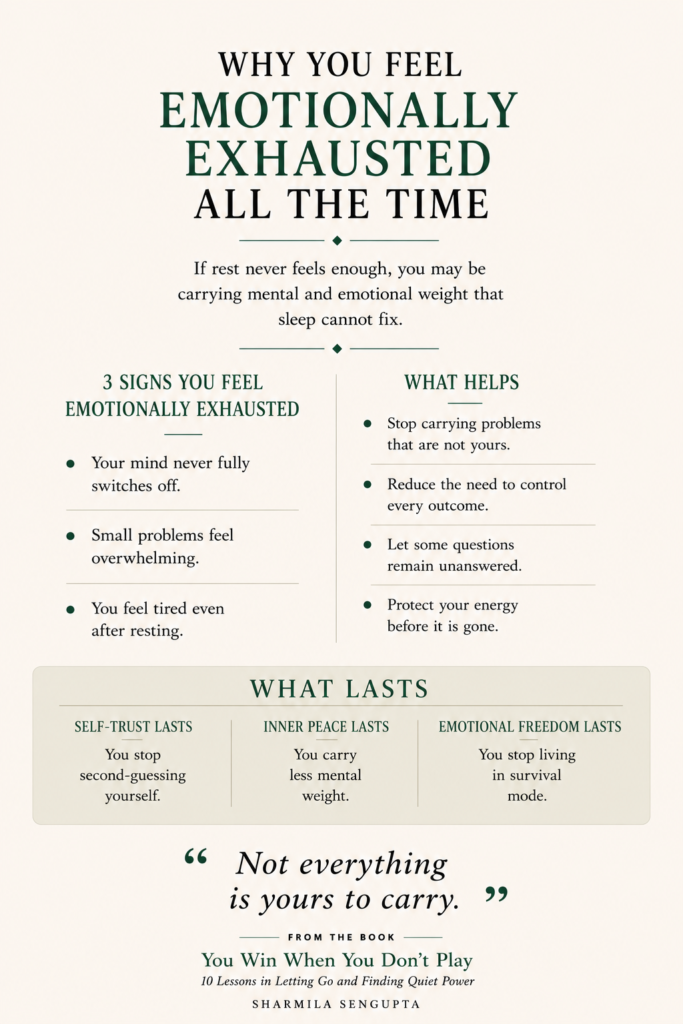
You may be emotionally exhausted if:
- Your mind never fully switches off.
- Small problems feel overwhelming.
- You feel tired even after resting.
- You struggle to enjoy peaceful moments.
- You constantly feel responsible for others.
- You become easily irritated.
- You feel emotionally numb.
- You experience chronic stress.
- You feel emotionally drained most days.
- You struggle to make decisions.
The Hidden Cost
Emotional exhaustion affects more than your energy.
It impacts:
- Self-confidence
- Relationships
- Productivity
- Creativity
- Physical health
- Mental clarity
- Decision-making
Perhaps the greatest cost is that emotional exhaustion disconnects you from yourself.
You become so focused on managing life that you forget how to enjoy it.
What Helps
1. Stop Carrying Problems That Are Not Yours
You can care about people without carrying their emotional responsibilities.
2. Reduce the Need to Control Every Outcome
Uncertainty is uncomfortable.
But trying to control everything is exhausting.
3. Let Some Questions Remain Unanswered
Not every thought deserves attention.
Not every situation requires analysis.
4. Build Stronger Boundaries
Boundaries protect your time, energy, and emotional well-being.
5. Practice Self-Trust
The more you trust yourself, the less energy you spend seeking reassurance.
Practical Exercise: The Emotional Weight Audit
Draw two columns.
Column One:
What Am I Carrying?
Column Two:
Is This Actually Mine?
Write down every worry occupying your mind.
Then ask:
- Can I control this?
- Am I responsible for this?
- Does this belong to someone else?
This simple exercise often reveals how much emotional weight we carry unnecessarily.
What Lasts
Self-Trust Lasts
You stop second-guessing yourself.
Inner Peace Lasts
You carry less mental weight.
Emotional Freedom Lasts
You stop living in survival mode.
What I Have Learned About Emotional Exhaustion
For a long time, I believed emotional exhaustion meant I needed to become stronger.
More disciplined.
More productive.
More resilient.
What I eventually learned was something very different.
I wasn’t exhausted because I lacked strength.
I was exhausted because I was carrying too much.
I spent years seeking approval.
I worried about disappointing people.
I replayed conversations.
I tried to manage situations that were never fully within my control.
I believed caring deeply meant carrying deeply.
But there is a difference.
You can care without carrying.
You can support without rescuing.
You can love without sacrificing yourself.
One of the most important shifts in my life came when I stopped measuring my worth through other people’s approval.
The less I sought validation, the more energy I regained.
The stronger my boundaries became, the lighter life felt.
Not because life became easier.
But because I stopped making it heavier than it needed to be.
Key Takeaways
- Emotional exhaustion often results from chronic stress and emotional overload.
- Overthinking can create significant mental fatigue.
- People-pleasing and validation-seeking drain emotional energy.
- Boundaries protect emotional well-being.
- Social media can amplify emotional overwhelm.
- Self-trust reduces anxiety and exhaustion.
- Not everything is yours to carry.
Final Reflection
Sometimes emotional exhaustion is not a sign that you need to do more.
It is a sign that you need to carry less.
Less guilt.
Less responsibility.
Less pressure.
Less need for approval.
Less concern about things beyond your control.
The path back to peace often begins with a simple realization:
Not everything is yours to carry.
A Lesson From You Win When You Don’t Play
Many emotional struggles continue because we keep participating in them.
We participate in approval-seeking.
We participate in overthinking.
We participate in emotional battles that never belonged to us.
The moment we stop playing those exhausting games, we begin reclaiming our energy, clarity, and peace.
If these ideas resonate with you, you’ll find them explored more deeply in You Win When You Don’t Play: 10 Lessons in Letting Go and Finding Quiet Power.
Learn More About the Book
If something in this article felt familiar, you’re not alone.
Many of us spend years carrying things we were never taught how to release.
We carry overthinking long after the situation has ended.
We carry the weight of other people’s expectations.
We carry disappointment when life doesn’t go as planned.
We carry old stories about who we should be and struggle to understand why they still have so much power over us.
These are the questions that eventually led me to write You Win When You Don’t Play: 10 Lessons in Letting Go and Finding Quiet Power.
The book explores many of the themes woven throughout this article, including:
- How to stop overthinking and find greater mental clarity
- Letting go of validation-seeking and the need for approval
- People-pleasing, self-abandonment, and learning to set healthy boundaries
- Emotional exhaustion, burnout, and carrying too much for too long
- Rebuilding self-worth after disappointment and difficult life experiences
- Finding peace when life doesn’t go as planned
- Grieving lost dreams and letting go of expectations
- Emotional resilience during difficult life transitions
- Self-discovery, inner peace, and emotional freedom
- Learning how to trust yourself again
But more than anything, it explores a simple idea I’ve returned to again and again:
Not every struggle deserves your energy.
Not every battle needs to be won.
And not every burden needs to be carried.
Along the way, the book explores the invisible competitions, emotional pressures, and exhausting patterns that many of us carry without realizing how much they cost us.
Not to offer perfect answers.
But to help us see ourselves more clearly.
To understand ourselves more honestly.
And to recognize what may finally be ready to be released.
Because peace is rarely found by becoming more.
It is often found by needing less.
Less approval.
Less proving.
Less carrying what was never ours to hold.
Perhaps that’s why letting go often feels less like losing something and more like coming home to yourself.
Buy the Book on Amazon
Whether you’re struggling with overthinking, emotional exhaustion, people-pleasing, difficult relationships, self-worth, chronic stress, or the feeling that you’ve lost yourself beneath other people’s expectations, I hope the book offers the same thing I try to offer through my writing:
A different perspective.
A little more clarity.
And a gentler way forward.
You can learn more about the book or get your copy here:
Ask Sharmila – Personal Guidance for Overthinking, Emotional Exhaustion, Self-Worth, and Life’s Difficult Questions
Sometimes the hardest part isn’t finding advice.
It’s making sense of what you’re carrying.
Perhaps you’ve been overthinking the same situation for weeks. Perhaps you’re emotionally exhausted from trying to keep everyone happy. Or maybe you’re struggling to let go of a difficult relationship, rebuild your self-worth after disappointment, or find peace when life doesn’t go as planned.
Many of us carry questions that don’t have simple answers.
Questions about boundaries.
Questions about people-pleasing.
Questions about validation.
Questions about emotional healing, difficult life transitions, and how to stop carrying responsibilities that were never ours to hold.
You don’t have to figure it all out alone.
Through Ask Sharmila, you’re invited to share a question that’s been weighing on you.
Together, we’ll look beneath the surface of the situation—not to find perfect answers, but to uncover a clearer perspective and a gentler way forward.
Over Time, I’ve Noticed That Many Questions Tend to Circle Around the Same Themes
- How to stop overthinking and replaying conversations
- Emotional exhaustion and feeling drained by life
- People-pleasing recovery and setting healthy boundaries
- Seeking validation from others
- Rebuilding self-worth after disappointment
- Difficult relationships and emotional resilience
- Letting go of expectations that no longer fit your life
- Grieving the life you thought you’d have
- Learning how to let go when life doesn’t unfold as expected
- Finding inner peace during challenging life transitions
- Living more intentionally and trusting yourself again
One thing I’ve learned is that a new perspective doesn’t always change the situation.
I’ve seen people spend months stuck in the same thought loop, only to discover that what they needed wasn’t another solution.
It was a different way of seeing the situation.
And sometimes that’s where healing begins.
Personal Reflection and Written Guidance – ₹499
Every question is read personally by me, and every response is written thoughtfully and individually.
You Will Receive
- A personal written response tailored to your situation
- Thoughtful reflection grounded in emotional healing, self-discovery, and personal growth
- Practical perspective and gentle guidance
- Support for overthinking, emotional exhaustion, people-pleasing, self-worth struggles, boundaries, validation, difficult relationships, and major life transitions
- A response within 5 days

Personal Written Guidance for Overthinking, Emotional Exhaustion, Self-Worth, and Life’s Difficult Questions
The goal is not to have all the answers.
The goal is to understand yourself more clearly, carry less emotional weight, and discover a calmer, more compassionate way forward.
Sometimes clarity begins when we stop asking,
“How do I fix this?”
and start asking,
“What is this situation trying to teach me?”
Often, that’s where a gentler way forward begins.
Frequently Asked Questions
Why do I feel emotionally exhausted all the time?
Emotional exhaustion is often caused by chronic stress, overthinking, emotional labor, people-pleasing, weak boundaries, and validation-seeking.
What are the symptoms of emotional exhaustion?
Common symptoms include feeling emotionally drained, mental fatigue, irritability, difficulty concentrating, chronic stress, emotional numbness, and feeling tired even after resting.
Can emotional exhaustion cause physical symptoms?
Yes. Emotional exhaustion can contribute to headaches, muscle tension, digestive issues, sleep disturbances, low energy, and increased susceptibility to illness.
How long does emotional exhaustion last?
Recovery time varies. Some people recover within weeks after reducing stress and improving boundaries, while others may need months of intentional emotional recovery.
Can emotional exhaustion affect relationships?
Absolutely. Emotional exhaustion can reduce patience, increase irritability, create emotional withdrawal, and make healthy communication more difficult.
Is emotional exhaustion the same as burnout?
No. Burnout is typically linked to prolonged workplace stress, while emotional exhaustion can arise from relationships, caregiving, people-pleasing, overthinking, or chronic emotional strain.
Why does overthinking make me feel tired?
Overthinking keeps your brain engaged even when no action is required. This constant mental activity creates mental fatigue and prevents true emotional rest.
About Sharmila Sengupta
I’m Sharmila Sengupta, author of You Win When You Don’t Play: 10 Lessons in Letting Go and Finding Quiet Power.
Over the years, I’ve become fascinated by the quiet struggles many of us carry but rarely talk about openly—the exhaustion of overthinking, the weight of people-pleasing, the search for validation, the challenge of setting healthy boundaries, and the grief that comes when life doesn’t go as planned.
Much of my writing begins with things I’ve noticed—in my own life, in conversations with others, and in the quiet struggles many of us carry without talking about them.
I’ve noticed how often we replay old conversations, question our self-worth, compare our lives to others, or carry emotional burdens that were never ours to hold. I’ve also noticed that many of us are quietly grieving lost dreams, coping with disappointment in life, navigating difficult life transitions, or learning how to let go of expectations about the future.
Perhaps you’ve found yourself asking some of those same questions.
How do I stop overthinking?
How do I let go of expectations that no longer fit my life?
Why do I feel emotionally exhausted even when everything seems fine on the surface?
How do I find peace when life doesn’t go as planned?
How do I stop seeking validation from other people?
How do I rebuild self-worth after disappointment or difficult relationships?
These are the questions that often inspire my writing.
Again and again, they seem to lead back to the same lesson: peace often begins when we stop carrying what was never ours to hold.
Through my articles and books, I reflect on emotional healing, personal growth, self-discovery, emotional resilience, and the quiet work of learning how to let go of what no longer serves us. Not as someone with all the answers, but as a fellow traveller who continues to learn what it means to let go, trust life a little more, and find strength in quieter ways.
My hope is that readers leave feeling less alone, more understood, and a little gentler with themselves than they were before they arrived.